Specific Heats of Ideal Gases Assume that a pure, ideal gas is made - - PowerPoint PPT Presentation

specific heats of ideal gases
SMART_READER_LITE
LIVE PREVIEW

Specific Heats of Ideal Gases Assume that a pure, ideal gas is made - - PowerPoint PPT Presentation

Specific Heats of Ideal Gases Assume that a pure, ideal gas is made of tiny particles that bounce into each other and the walls of their cubic container of side . Show the average pressure P exerted by this gas is P = 1 N 35 (J/K-mole) V mv


slide-1
SLIDE 1

Specific Heats of Ideal Gases

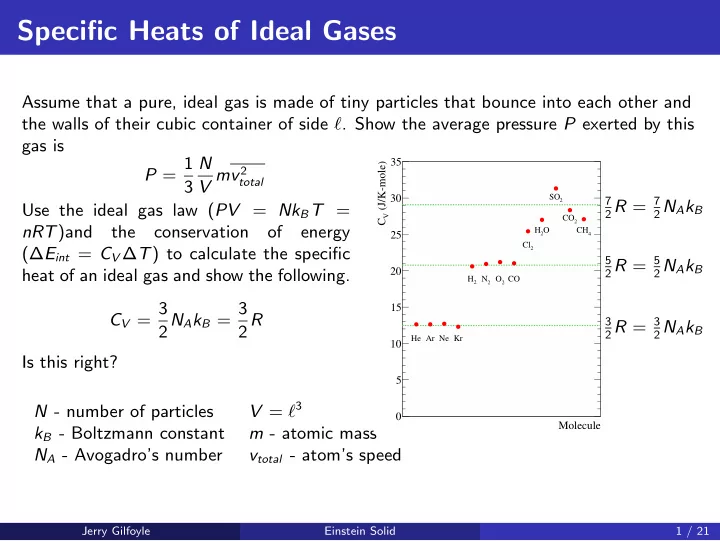
Assume that a pure, ideal gas is made of tiny particles that bounce into each other and the walls of their cubic container of side ℓ. Show the average pressure P exerted by this gas is P = 1 3 N V mv 2

total

Use the ideal gas law (PV = NkBT = nRT)and the conservation

  • f

energy (∆Eint = CV ∆T) to calculate the specific heat of an ideal gas and show the following. CV = 3 2NAkB = 3 2R Is this right? N - number of particles V = ℓ3 kB - Boltzmann constant m - atomic mass NA - Avogadro’s number vtotal - atom’s speed

Molecule (J/K-mole)

V

C 5 10 15 20 25 30 35

He Ar Ne Kr

2

H

2

N

2

O CO

2

Cl O

2

H

2

SO

2

CO

4

CH

3 2R = 3 2NAkB 5 2R = 5 2NAkB 7 2R = 7 2NAkB Jerry Gilfoyle Einstein Solid 1 / 21

slide-2
SLIDE 2

A Hint of Quantum Mechanics

H2 gas

Jerry Gilfoyle Einstein Solid 2 / 21

slide-3
SLIDE 3

Rotational Kinetic Energy

Classically Erot = L2 2I where I =

  • mr2

i =

  • r2dm

Jerry Gilfoyle Einstein Solid 3 / 21

slide-4
SLIDE 4

Rotational Kinetic Energy

Classically Erot = L2 2I where I =

  • mr2

i =

  • r2dm

Quantum mechanically E qm

rot = ℓ(ℓ + 1) 2

2I where l is the angular momen- tum quantum number.

Jerry Gilfoyle Einstein Solid 3 / 21

slide-5
SLIDE 5

The Specific Heat of Elemental Solids - 1

R = 8.31 J/mol K

Jerry Gilfoyle Einstein Solid 4 / 21

slide-6
SLIDE 6

The Specific Heat of Elemental Solids - 2

Solid Molar Specific Heat Our Results (J/K-mole) (J/K-mole) Lead 26.4 22 ± 6 Zinc 25.4 36 ± 14 Aluminum 26.4 24 ± 5 Copper 24.5 23 ± 5 Tin 27.0 52 ± 15 Gold 25.4 Silver 25.4 Iron 25.0

Jerry Gilfoyle Einstein Solid 5 / 21

slide-7
SLIDE 7

The Einstein Solid

atoms Cell boundaries

Jerry Gilfoyle Einstein Solid 6 / 21

slide-8
SLIDE 8

Molar Specific Heat of Elemental Solids

An Einstein solid is made of N, three-dimensional harmonic oscillators containing q quanta of energy.

1 What is the multiplicity of

a single Einstein solid?

2 What is the multiplicity of

two Einstein solids in ther- mal contact?

3 How would you determine

the most likely microstate

  • f the system?

4 How is entropy related to

temperature?

5 How is the energy related to temperature? 6 What is the molar specific heat of an elemental solid?

Molar Specific Solid Heat Our Results (J/K-mole) (J/K-mole) Lead 26.4 ± 0.7 22 ± 6 Zinc 25.4 ± 0.6 36 ± 14 Aluminum 26.4 ± 0.2 24 ± 3 Copper 24.5 ± 0.6 23 ± 5 Tin 27.0 ± 0.6 52 ± 15 Gold 25.4 ± 0.6 Silver 25.4 ± 0.6 Iron 25.0 ± 0.6

Jerry Gilfoyle Einstein Solid 7 / 21

slide-9
SLIDE 9

Rolling Dice

Jerry Gilfoyle Einstein Solid 8 / 21

slide-10
SLIDE 10

A Probability Distribution

2014-12-30 19:21:22

Sum 2 4 6 8 10 12 14 16 Number of Events 1 2 3 4 5 6

Throwing Dice

Jerry Gilfoyle Einstein Solid 9 / 21

slide-11
SLIDE 11

The Entropy of the Einstein Solid

An Einstein solid is made of N, three-dimensional harmonic oscillators containing q quanta of energy as shown below.

1 What is the energy of a single oscillator? of N oscillators? 2 How many microstates Ω

exist for a ‘system’ with N = 1 and q = 3? for N = 2, q = 2?

3 What is Ω for any N and q? Jerry Gilfoyle Einstein Solid 10 / 21

slide-12
SLIDE 12

Microstates for NA = 2, qA = 2

n1 n2 n3 n4 n5 n6 n1 n2 n3 n4 n5 n6

Jerry Gilfoyle Einstein Solid 11 / 21

slide-13
SLIDE 13

Microstates for NA = 2, qA = 2

Jerry Gilfoyle Einstein Solid 12 / 21

slide-14
SLIDE 14

Summary So Far

Eint = (nx + ny + nz)ω =

3N

  • i=1

niω for N atoms multiplicity (Ω) number of microstates macrostate configuration of a solid defined by bulk proper- ties like N and E/U. microstate

  • ne of the configurations of quanta consistent

with the macrostate. Ω(NA, qA) = (qA + 3NA − 1)! qA!(3NA − 1)! ΩAB = ΩAΩB where ΩAB - multiplicity of combined state ΩA,B - individual multiplicities.

Jerry Gilfoyle Einstein Solid 13 / 21

slide-15
SLIDE 15

Multiplicity and Number of Quanta

x1032 x1037 x1054 redB blackAB blueA NA30 NB25 qAB200 50 100 150 200 0.0 0.5 1.0 1.5 2.0 qa

  • Einstein Solid

Jerry Gilfoyle Einstein Solid 14 / 21

slide-16
SLIDE 16

Some Math - Logarithms

Jerry Gilfoyle Einstein Solid 15 / 21

slide-17
SLIDE 17

Entropy of Two Einstein Solids

SAB SB SA Equilibrium Point qa Entropy

Jerry Gilfoyle Einstein Solid 16 / 21

slide-18
SLIDE 18

Entropy of Two Einstein Solids in Energy Terms

SAB SB SA Equilibrium Point E a Entropy

Jerry Gilfoyle Einstein Solid 17 / 21

slide-19
SLIDE 19

The Specific Heat of Elemental Solids

Measured Our Solid Molar Specific Heat Our Results Calculation (J/K-mole) (J/K-mole) (J/K-mole) Lead 26.4 ± 0.7 22 ± 8 24.9 Zinc 25.4 ± 0.6 36 ± 14 24.9 Aluminum 26.4 ± 0.2 24 ± 3 24.9 Copper 24.5 ± 0.6 23 ± 5 24.9 Tin 27.0 ± 0.6 52 ± 15 24.9 Gold 25.4 ± 0.6 24.9 Silver 25.4 ± 0.6 24.9 Iron 25.0 ± 0.6 24.9

Jerry Gilfoyle Einstein Solid 18 / 21

slide-20
SLIDE 20

The Harmonic Oscillator Approximation

Harmonic Oscillator Potential red True Potential green Displacement From Equilibrium Potential Energy

Jerry Gilfoyle Einstein Solid 19 / 21

slide-21
SLIDE 21

Quantum Oscillator

Jerry Gilfoyle Einstein Solid 20 / 21

slide-22
SLIDE 22

Updating equilib.exe

1

Go to: http://www.physics.pomona.edu/sixideas/sicpr.html

2

Scroll down to the section entitled “For Use With Unit T:”.

3

Scroll down to the paragraph that starts with “Equilib 2.1”.

4

Scroll down to “Download for:” and right click on “Windows” and save it to your Desktop.

5

Double click on the folder entitled “Equil.exe.zip”. You should see a list of the contents of the folder.

6

Double click on “Equilib.exe”. You should get a GUI telling you the application may depend on other compressed files in the folder. Click the “Extract All” button and then choose the Desktop to place the files.

7

Double click on “Equilib.exe” and you will now see the contents of the folder with the application.

8

Double click on “Equilib.exe”. You will get a GUI worrying about the publisher.

9

Click “Run” and you’re off.

Jerry Gilfoyle Einstein Solid 21 / 21