SPACE AGENCY UNITED SPACE IN EUROPE February 2018 ESA facts and - - PowerPoint PPT Presentation

space agency
SMART_READER_LITE
LIVE PREVIEW

SPACE AGENCY UNITED SPACE IN EUROPE February 2018 ESA facts and - - PowerPoint PPT Presentation

THE EUROPEAN SPACE AGENCY UNITED SPACE IN EUROPE February 2018 ESA facts and figures Over 50 years of experience 22 Member States Eight sites/facilities in Europe, about 2300 staff 5.6 billion Euro budget (2018) Over 80


slide-1
SLIDE 1

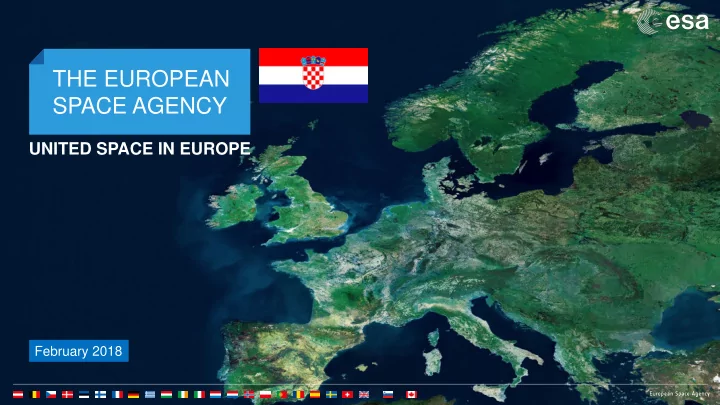
THE EUROPEAN SPACE AGENCY

February 2018

UNITED SPACE IN EUROPE

slide-2
SLIDE 2

Slide 2

  • Over 50 years of experience
  • 22 Member States
  • Eight sites/facilities in Europe, about 2300

staff

  • 5.6 billion Euro budget (2018)
  • Over 80 satellites designed, tested and
  • perated in flight

ESA facts and figures

slide-3
SLIDE 3

Slide 3

Member States

ESA has 22 Member States: 20 states of the EU (AT, BE, CZ, DE, DK, EE, ES, FI, FR, IT, GR, HU, IE, LU, NL, PT, PL, RO, SE, UK) plus Norway and Switzerland. Six other EU states have Cooperation Agreements with ESA: Bulgaria, Cyprus, Latvia, Lithuania, Malta and Slovakia and Croatia. Slovenia is an Associate Member. Canada takes part in some programmes under a long-standing Cooperation Agreement.

slide-4
SLIDE 4

Slide 4

space science telecommunications human spaceflight earth observation space transportation navigation

  • perations

technology exploration

Activities

* Space science is a Mandatory programme, all Member States contribute to it according to GNP. All other programmes are Optional, funded ‘a la carte’ by Participating States.

ESA is one of the few space agencies in the world to combine responsibility in nearly all areas of space activity.

slide-5
SLIDE 5

Slide 5 Washington Houston Kourou Maspalomas Santa Maria New Norcia Moscow ESRIN (Rome) Oberpfaffenhofen ESOC (Darmstadt) EAC (Cologne) Salmijaervi (Kiruna) ESTEC (Noordwijk) ECSAT (Harwell) Toulouse Brussels Cebreros ESA HQ (Paris) ESEC (Redu) Malargüe ESAC (Madrid)

ESA sites Offices ESA Ground Station ESA Ground Station + Offices ESA sites + ESA Ground Station

ESA’s locations

slide-6
SLIDE 6

Slide 6

slide-7
SLIDE 7

Slide 7

slide-8
SLIDE 8

Slide 8

ESA and the European space sector

  • The European space industry sustains around 35 000 jobs;
  • Europe is successful in the commercial arena, with a market

share of telecom and launch services higher than the fraction of Europe’s public spending worldwide;

  • European scientific communities are world-class and attract

international cooperation;

  • Research and innovation centres are recognised worldwide;
  • European space operators (Arianespace, Eumetsat, Eutelsat,

SES Global, etc.) are the most successful in the world.

slide-9
SLIDE 9

Slide 9

ESA’s industrial policy

  • Ensures that Member States get a fair return on

their investment;

  • Improves competitiveness of European industry;
  • Maintains and develops space technology;
  • Exploits the advantages of free competitive

bidding, except where incompatible with objectives

  • f the industrial policy.

About 85% of ESA’s budget is spent on contracts with European industry. ESA’s industrial policy:

slide-10
SLIDE 10

Slide 10

Birth of commercial operators

ESA’s ‘catalyst’ role ESA is responsible for R&D of space

  • projects. On completion of qualification,

they are handed to outside entities for production and exploitation. Most of these entities emanated from ESA. Meteorology: Eumetsat Launch services: Arianespace Telecoms: Eutelsat and Inmarsat

slide-11
SLIDE 11

Slide 11

ESA Council

The Council is the governing body of ESA. It provides the basic policy guidelines for ESA’s activities. Each Member State is represented on the Council and has one vote. Every two to three years, Council meets at ministerial level (‘Ministerial Council’) to take key decisions on new and continuing programmes and financial commitment. The ESA Council at ministerial level also meets together with the EU Council to form the European ‘Space Council’.

slide-12
SLIDE 12

Slide 12

Ministerial Council 2016, Lucerne

Ministers declared support for the ESA Director General’s vision for Europe in space and the role and development of ESA: now the Space 4.0i era can start with ESA committing to inform, innovate, interact and inspire. The next Council at ministerial level is scheduled for the end of 2019 in Spain. Four Resolutions were adopted:

  • Towards Space 4.0 for a ‘United Space in Europe’;
  • Level of Resources for the Agency’s Mandatory Activities

2017–21;

  • Guiana Space Centre, 2017–21;
  • ESA Programmes.
slide-13
SLIDE 13

SCIENCE

slide-14
SLIDE 14

Slide 14

On 14 January 2005, ESA’s Huygens probe made the most distant landing ever,

  • n Titan, the largest moon of Saturn

(about 1427 million km from the Sun).

First landing on a world in the outer Solar System

Huygens

slide-15
SLIDE 15

Slide 15

On 6 August 2014, ESA’s Rosetta became the first spacecraft to rendezvous with a comet and, on 12 November, its Philae probe made the first soft-landing on a comet and returned data from the surface.

Rosetta

First rendezvous, orbit and soft-landing on a comet

slide-16
SLIDE 16

Slide 16

  • Mars Express (2003– ) studying Mars, its moons and atmosphere from orbit
  • Gaia (2013– ) mapping a thousand million stars in our galaxy
  • LISA Pathfinder (2015– ) testing technologies to detect gravitational waves

Gaia LISA Pathfinder Mars Express

Today’s Science missions

slide-17
SLIDE 17

Slide 17

Upcoming missions (1)

  • BepiColombo (2018) a satellite duo exploring Mercury (with JAXA)
  • Cheops (2018) studying exoplanets around nearby bright stars
  • Solar Orbiter (2018) studying the Sun from close range
  • James Webb Space Telescope (2019) studying the very distant Universe (with NASA/CSA)

BepiColombo Cheops Solar Orbiter James Webb Space Telescope

Solar Orbiter BepiColombo Cheops James Webb Space Telescope

slide-18
SLIDE 18

Slide 18

  • Euclid (2020) probing ‘dark matter’, ‘dark energy’ and the expanding Universe
  • JUICE (2022) studying the ocean-bearing moons around Jupiter
  • Plato (2024) searching for planets around nearby stars
  • Athena (2028) space telescope for studying the energetic Universe
  • Gravitational wave observatory (2034) studying ripples in spacetime caused by massive objects in the Universe

Upcoming missions (2)

Plato JUICE Euclid Athena

slide-19
SLIDE 19

EARTH OBSERVATION

slide-20
SLIDE 20

Slide 20

Earth Explorers

These missions address critical and specific issues raised by the science community, while demonstrating the latest observing techniques.

  • GOCE (2009–13) studying Earth’s gravity field
  • SMOS (2009– ) studying Earth’s water cycle
  • CryoSat-2 (2010– ) studying Earth’s ice cover
  • Swarm (2013– ) three satellites studying Earth’s magnetic field
  • ADM-Aeolus (2018) studying global winds
  • EarthCARE (2019) studying Earth’s clouds, aerosols and

radiation (ESA/JAXA)

  • Biomass (2021) studying Earth’s carbon cycle
  • FLEX (2022) studying photosynthesis
  • Earth Explorers 9 & 10 to be selected
slide-21
SLIDE 21

Slide 21

MTG MetOp-SG

Meteorological missions

Developed in cooperation with ESA’s partner, Eumetsat, as Europe’s contribution to the World Meteorological Organization’s space-based Global Observing System: Meteosat Second Generation (2002, 2005, 2012, 2015–) series of four satellites providing images of Earth from geostationary orbit. Meteosat Third Generation (2021– ) series of six geostationary satellites providing images (four satellites) and atmospheric sounding (two satellites). MetOp (2006, 2012, 2018) – series of three satellites providing

  • perational meteorological observations from polar orbit.

MetOp Second Generation (2021– ) two series of polar-orbiters, three satellites in each series, continuing and enhancing meteorological, oceanographic and climate monitoring

  • bservations from the first MetOp series.
slide-22
SLIDE 22

Slide 22

Global monitoring for a safer world

Copernicus: an Earth observation programme for global monitoring for environment and security. Led by the European Commission in partnership with ESA and the European Environment Agency, and responding to Europe’s need for geo-spatial information services, it will provide autonomous and independent access to information for policy-makers, particularly for environment and security issues. ESA is implementing the space component: developing the Sentinel satellite series, its ground segment and coordinating data access. ESA has started a Climate Change Initiative, for storage, production and assessment of essential climate data.

slide-23
SLIDE 23

Slide 23

  • Sentinel-1 – land and ocean services. Sentinel-1A launched in

2014/Sentinel-1B in 2016.

  • Sentinel-2 – land monitoring. Sentinel-2A launched in 2015/Sentinel-

2B launched in 2017.

  • Sentinel-3 – ocean forecasting, environmental and climate
  • monitoring. Sentinel-3A launched in 2016. Sentinel-3B (2018).
  • Sentinel-4 – atmospheric monitoring payload (2019)
  • Sentinel-5 – atmospheric monitoring payload (2021)
  • Sentinel-5 Precursor – atmospheric monitoring launched in 2017.
  • Sentinel-6 – oceanography and climate studies (2020)

Copernicus space component: the Sentinels

slide-24
SLIDE 24

TECHNOLOGY

slide-25
SLIDE 25

Slide 25

Space technology

The development of technology, along with access to space, is one

  • f the enabling activities of ESA. ESA’s technical heart is ESTEC

(NL).

  • Supporting competitiveness of European industry.
  • Transferring technology from space to non-space applications

(‘spin-off’), and bringing innovations from outside the space sector to use in design of new space systems (‘spin-in’).

  • Fostering innovation and enhancing European technological

independence and the availability of European resources for critical technologies.

  • Creating Space Incubators across Europe.
slide-26
SLIDE 26

MISSION OPERATIONS

slide-27
SLIDE 27

Slide 27

ESOC, the European Space Operations Centre, is ESA’s centre for mission operations and ground systems engineering, where we:

  • Study and develop mission concepts and technologies;
  • Specify required ground facilities and functionality;
  • Simulate mission scenarios and train

multi-disciplinary mission teams;

  • Perform end-to-end mission readiness testing;
  • Plan and execute spacecraft and ground facilities operations

during all mission phases.

Mission operations

slide-28
SLIDE 28

Slide 28

ESOC’s ground systems engineering teams:

  • Develop multi-mission infrastructure for mission control

systems, ground stations, high-fidelity simulators, operational communication and computer systems and tailor them for specific missions;

  • Perform studies, mission analysis, flight dynamics, high-

precision navigation, space-debris monitoring and avoidance and CleanSpace studies;

  • Develop new technologies and standards to support future

missions.

Ground segment engineering

slide-29
SLIDE 29

Slide 29

ESOC is home to the Space Situational Awareness Programme (SSA) an initiative aiming to provide European autonomy in civil systems and services needed to protect satellites and Earth. Entering its third development period, it will consolidate European facilities and services for:

  • Monitoring, cataloguing and tracking space debris;
  • Monitoring space weather, and preparing for a future Lagrange mission;
  • Identifying and tracking near Earth objects.

Supported by 19 Member States, SSA is coordinated with the institutions of the European Union and international partners.

Space Situational Awareness

slide-30
SLIDE 30

TELECOMMUNICATIONS & INTEGRATED APPLICATIONS

slide-31
SLIDE 31

Slide 31

  • Helping European industry to stay at the leading edge of the highly competitive global market for satellite communications

and applications;

  • Supporting R&D and pioneering technical, commercial and operational approaches to bring new systems and solutions close

to the point of market readiness;

  • Building partnerships capable of creating wealth, jobs and new services for the citizens of Europe;
  • Improving our daily lives across almost every market sector, from health to transport and from civil protection to energy and

environmental services.

Ensuring competitive and innovative industry

ESA’s Advanced Research in Telecommunications Systems (ARTES) programme stimulates innovation and promotes the development of products, services and applications in partnership with industry.

slide-32
SLIDE 32

Slide 32

  • SmallGEO – for the 3-tonne market, with OHB (first launch on Hispasat’s H36W-1, 2017)
  • Spacebus Neo and Eurostar Neo – for the 3- to 6-tonne market, with Thales Alenia Space/Airbus D&S (first launches in 2019)
  • Electra – first fully electric propulsion OHB satellite, with SES (2021)

ARTES satellite platforms

Eurostar Neo Electra SmallGEO Spacebus Neo

slide-33
SLIDE 33

Slide 33

GlobeNet Quantum

ARTES innovation and new technology

  • EDRS – the European Data Relay System, or

‘SpaceDataHighway’, that with its GlobeNet extension will make data gathered anywhere on Earth available in quasi-real time, with Airbus D&S (first launch, 2016; second launch, 2018)

  • ScyLight – optical communications capable of exchanging

unprecedented amounts of data between satellites, aircraft and the ground (starting 2017)

  • Quantum – in-orbit reprogrammable ‘chameleon’ satellite, with

Eutelsat/Airbus D&S (2018)

  • ICE – next-generation mobile satellite services, with Inmarsat

(starting 2017)

slide-34
SLIDE 34

Slide 34

ARTES for new markets

  • SAT-AIS – microsatellites will track seafaring vessels anywhere
  • n Earth, with the European Maritime Safety Agency (first

launch, 2017)

  • Iris – a new satellite-based data communication system as part
  • f the Single European Skies Air Traffic Management Research

project, with Inmarsat (precursor service, 2018–28)

  • ESA’s Govsatcom Precursor – secure and resilient European

government communications, in coordination with the EC and EDA (service demonstration, 2017–20)

  • Pioneer – helping new technologies and services obtain fast,

low-cost in-orbit demonstration (starting 2017)

SAT-AIS Iris

slide-35
SLIDE 35

NAVIGATION

slide-36
SLIDE 36

Slide 36

Putting Europe at the forefront of this strategically and economically important sector, Galileo will provide a highly accurate, guaranteed global positioning service under civilian control. Full Operational Capability – 22 satellites now in orbit. Deployment

  • f remaining ground/space infrastructure ongoing (full system – 24

satellites, plus orbital spares to prevent interruption in service). ESA is the system architect for Galileo, managing its design, development, procurement, deployment and validation on behalf of the EU. ESA will maintain this role, providing technical support to the European GNSS Agency, designated by the EC to run the system and provide Galileo services. Dec 2016 – start of Galileo Initial Services, the first step towards full operational capability.

Galileo: ‘made in Europe’

slide-37
SLIDE 37

Slide 37

  • Since 2010, EGNOS has been improving accuracy and

augmenting GPS, offering safety-critical applications for aviation users.

  • Galileo is expected to spawn a wide range
  • f applications, based on positioning

and timing for transport by road, rail, air and sea, infrastructure and public works management, agricultural and livestock management and tracking, e-banking and e-commerce.

  • It will be a key asset for public services, such as rescue
  • perations and crisis management.
  • With the new ESA Navigation Innovation and Support

Programme (NAVISP), research will focus on integration of space and terrestrial navigation and new ways to improve GNSS.

EGNOS, Galileo applications and NAVISP

slide-38
SLIDE 38

HUMAN SPACEFLIGHT

slide-39
SLIDE 39

Slide 39

In response to the Resolution on Europe’s Space Exploration Strategy adopted in Luxembourg in December 2014, exploration activities are being consolidated in a single European Exploration Envelope Programme (E3P) integrating the three ESA exploration destinations ‘as part of a single exploration process’. Its main activities will cover:

  • International Space Station – Operations until 2024
  • ExoMars – Trace Gas Orbiter and 2020 rover mission
  • Luna-Resource Lander – Contributions to Russian-led Luna-Resource Lander, Luna 27 (2021)
  • European Service Module – First Orion flight (June 2020) and second flight model (TBC)
  • Future Human Exploration
  • SciSpacE – Science in Space Environment
  • ExPeRT – Exploration Preparation, Research and Technology

European Exploration Envelope (E3P)

slide-40
SLIDE 40

Slide 40

The ISS unites USA, Russia, Japan, Canada and Europe in one of the largest partnerships in the history of science. Crews of up to six astronauts conduct research into life and physical sciences and applications, and prepare for future human exploration missions. Europe’s two key contributions are the Columbus laboratory and the Automated Transfer Vehicle (ATV). Columbus provides a substantial part of the ISS’s research capability, specialising in fluid physics, materials science and life sciences. Europe has also provided almost 50% of the pressurised part of the ISS, including Cupola, Node-2 and Node-3.

International Space Station (ISS)

slide-41
SLIDE 41

Slide 41

The European Service Module (ESM) is ESA’s contribution to NASA’s Orion spacecraft that will send astronauts to the Moon and beyond. The spacecraft comprises the ESM and the US Crew Module. The ESM resembles ESA’s Automated Transfer Vehicle, from which it evolved. Between 2009 and 2014, five Automated Transfer Vehicles delivered supplies to the International Space Station and helped to keep the outpost in orbit. The first mission for the complete Orion spacecraft will be an unmanned flight to the Moon and back (first launch, June 2020)

European Service Module

slide-42
SLIDE 42

Slide 42

Paolo Nespoli – Expedition 52/53, Soyuz MS-05, May 2017 Alexander Gerst – Expedition 56/57, Soyuz MS-09, May 2018 Luca Parmitano – May 2019

Recent and future flights

Alexander Gerst (DE) Luca Parmitano (IT) Paolo Nespoli (IT)

slide-43
SLIDE 43

Slide 43

Robotic exploration

In cooperation with Roscosmos (Russia), two ExoMars missions (2016 and 2020) will investigate the martian environment, particularly astro-biological issues, and develop and demonstrate new technologies for planetary exploration with the long-term view of a future Mars sample return mission.

slide-44
SLIDE 44

Slide 44

The ESA-provided Trace Gas Orbiter is now in orbit around Mars (2016). ESA’s ExoMars rover will be launched in 2020. Roscosmos will be responsible for the 2020 descent module and surface platform, and provides Proton launchers for both

  • missions. Both partners will supply scientific instruments and

will cooperate closely in the scientific exploitation of the

  • missions. The Entry, Descent & Landing Demonstrator Module

was deployed on 19 October 2016, but made a ‘hard landing’

  • n Mars after returning a large volume of useful data.

ExoMars

slide-45
SLIDE 45

SPACE TRANSPORTATION

slide-46
SLIDE 46

Slide 46

The Ariane and Vega launchers developed by ESA guarantee European autonomous access to space. Their development and successful exploitation is an example of how space challenges European industry and provides precious expertise. Ariane is one of the most successful launcher series in the world. Complemented since 2011 by Vega and Soyuz, they are all launched from Europe’s Spaceport in French Guiana.

The European launcher family

slide-47
SLIDE 47

Slide 47

European Ministers agreed at the Ministerial Council 2014 to develop Ariane 6 and Vega C. These launchers will provide guaranteed access to space for Europe at a competitive price without requiring public sector support for commercial exploitation.

  • Ariane 6 – modular three-stage launcher with two

configurations, using two (A62) or four boosters (A64);

  • Vega C – evolution of Vega with increased performance and

same launch service cost;

  • Common solid rocket motor for Ariane 6 boosters and Vega C

first stage;

  • New governance for Ariane 6 development and exploitation

allocating increased roles and responsibilities to industry;

  • Vega C and Ariane 6 first flights – 2019 and 2020.

Launchers and technologies of the future: Ariane 6 and Vega C

slide-48
SLIDE 48

Slide 48

Space Rider

  • An affordable, reusable, end-to-end integrated

transport system offering Europe independent access to and from low Earth orbit.

  • European opportunities for in-orbit validation of

technologies.

  • First launch on Vega C in 2020.

Future Launchers Preparatory Programme (FLPP) New Economic Opportunities (NEO)…

  • 1. Develop competitive technologies for future launchers that

will:

  • include low development and production costs, and lower risks;
  • shorten the launcher development phase to less than 5 years.
  • 2. Invest in a more diversified launcher development

portfolio focusing on:

  • key technologies and new manufacturing processes;
  • integrated demonstration before transfer into orbit;
  • validating ultra-low cost engine demonstrator (Prometheus).

Launchers and technologies of the future

slide-49
SLIDE 49

ESA AND THE EUROPEAN UNION

slide-50
SLIDE 50

Slide 50

United space in Europe

  • To maximise the integration of space into European

society and economy;

  • To foster a globally competitive European space

sector;

  • To ensure European autonomy in accessing and

using space in a safe and secure environment. As confirmed in the ‘Joint Statement on Shared Vision and Goals for the Future of European Space’, signed by the ESA Director General and the European Commission in October 2016, ESA and the EU share three core goals for the future:

slide-51
SLIDE 51

Partnership

slide-52
SLIDE 52

Slide 52

From Cooperation Agreement to Accession Agreement for European Union Member States not ESA Member States Cooperation Agreement European Cooperating State

(open only to EU MS)

Integration Period X years Dedicated Task Force

In principle 5 years renewable 5 years renewable

  • min. 6 years

non-renewable No exchange of funds 1 M€ /year e.c. 2001

Participation in mandatory and

  • ptional programmes
  • Participation in the “Plan for

European Cooperating States” (PECS)

  • Predominantly scientific activities
  • No direct access to ESA tenders
  • Participation in the PECS

Commitee

  • Observer at ESA Council and

relevant ESA subordinate bodies

  • Predominantly industrial

activities

  • Optimisation of juste retour
  • Exchange of information
  • Training
  • Implementing arrangements for

specific projects

  • Observer at ESA Council and

relevant ESA subordinate bodies

Unanimous Council decision Technical visit to evaluate space capabilities by ESA experts

Associate Member

5 years renewable

  • Direct participation in
  • ptional programmes
  • Dedicated access to the

Agency facilities and services

  • Delegates in ESA Council and

relevant ESA subordinate bodies

≈70% of the contribution to yearly Agency’s General Budget Entrance fee + contribution to the mandatory activities’ budget

ESA Member State

slide-53
SLIDE 53

Would you like to know more? Visit www.esa.int