Social influence Conformity Informational influence Influence that - - PDF document

social influence
SMART_READER_LITE
LIVE PREVIEW

Social influence Conformity Informational influence Influence that - - PDF document

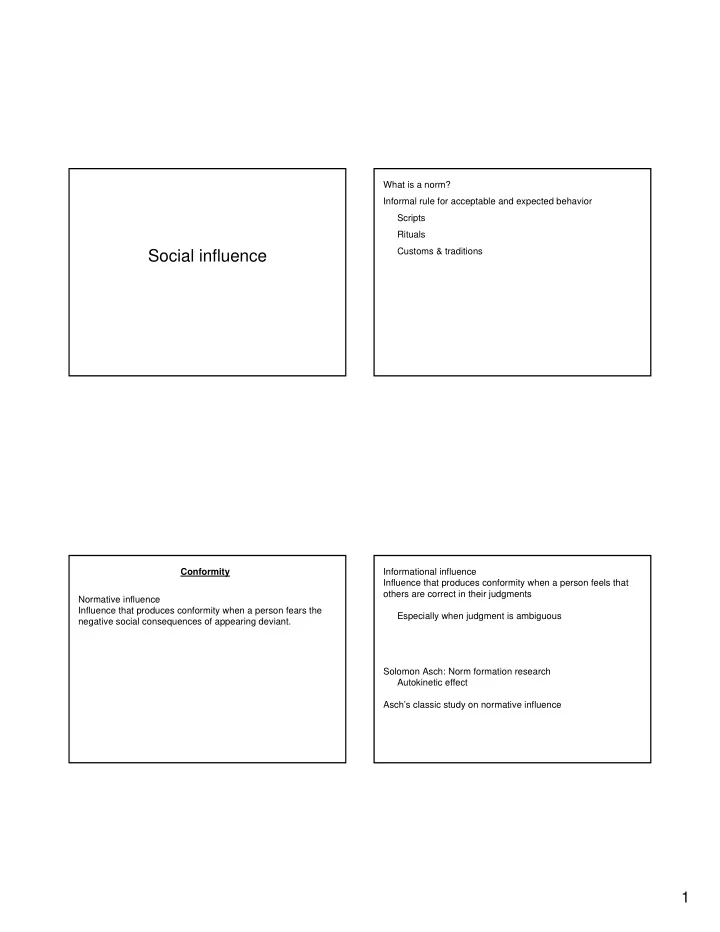
What is a norm? Informal rule for acceptable and expected behavior Scripts Rituals Customs & traditions Social influence Conformity Informational influence Influence that produces conformity when a person feels that others are correct


slide-1
SLIDE 1

1

Social influence

What is a norm? Informal rule for acceptable and expected behavior Scripts Rituals Customs & traditions Conformity Normative influence Influence that produces conformity when a person fears the negative social consequences of appearing deviant. Informational influence Influence that produces conformity when a person feels that

  • thers are correct in their judgments

Especially when judgment is ambiguous Solomon Asch: Norm formation research Autokinetic effect Asch’s classic study on normative influence

slide-2
SLIDE 2

2

Who is most likely to conform? Age (adolescents) Berndt (1979) Students in grades 3, 6, 9, and 12 Conformity rises steadily from 3rd to 6th grade Peaks at 9th grade Gender Sistrunk & McDavid (1971) Quasi-IV: Male vs. female participants IV: Questions about stereotypically masculine, feminine, or neutral topics DV: Percent agreeing with “majority” response Results: Females conformed more on masculine items, males conformed more on feminine items, and no sex differences

  • n neutral items.

Face-to-face social pressure Compliance Agreeing to go along with a direct explicit appeal. You want me not to give a comprehensive final exam. How could you get me to comply?

slide-3
SLIDE 3

3

Cialdini Basic principles of compliance Liking/Friendship Commitment/Consistency Reciprocity Scarcity Authority Compliance tactics (selected examples) Ingratiation Foot-in-the-Door Lowball Door-in-the-Face That's-Not-All Principle Playing Hard to Get Fast-Approaching Deadline Langer & colleagues (1978) IV: How phrased request: (1) Excuse me. I have five pages. May I use the Xerox machine? (No reason) (60%) (2) ....because I’m in a rush. (real reason) (94%) (3) ...because I have to make some copies (illusion of a reason) (93%) DV: Percent agreeing to request Regan (1971) IV: Confederate acts likable or dislikable IV: Confederate buys participant a Coke without being asked OR does not buy participant a Coke OR experimenter buys participant a Coke DV: Whether or not participants buy raffle tickets and amount spent on them Results: Participants bought more raffle tickets when confederate did them a favor, regardless of whether confederate was likable or dislikable Summary of Milgram studies Teacher does not deliver shock, but helped out 93% Victim pounds on wall then becomes silent 65% Victim heard protesting (movie version) 50% Victim in same room 40% Teacher has to put victim's hand on shock plate 30% Study done in Bridgeport, CT 48% Victim says at outset that he will do study

  • nly if he is let out when he wants to be

40% Experimenter in remote location 19% Teacher told to select the level of shock (experimenter legitimizes all levels) 3%

slide-4
SLIDE 4

4

Replications of Milgram Study Hofling et al. (1966) Unknown doctor called nurses and asked them to administer 20 milligrams of the drug "Astroten" to a patient on the ward 21/22 (95%) of the nurses were about to administer the drug, before being stopped and debriefed by one of the researchers. Sheridan & King (1972) Replicated Milgram exactly, except that (a) participants were male & female college students, (b) victim was a "cute, fluffy, puppy," and (c) the shocks were real. Participants instructed to deliver a shock each time the puppy failed to learn a discrimination task, which was actually insoluble Percent delivering the maximum amount of shock similar to percent in Milgram’s studies. Would Milgram find less obedience if he conducted his experiments today?