
SLIDE 1
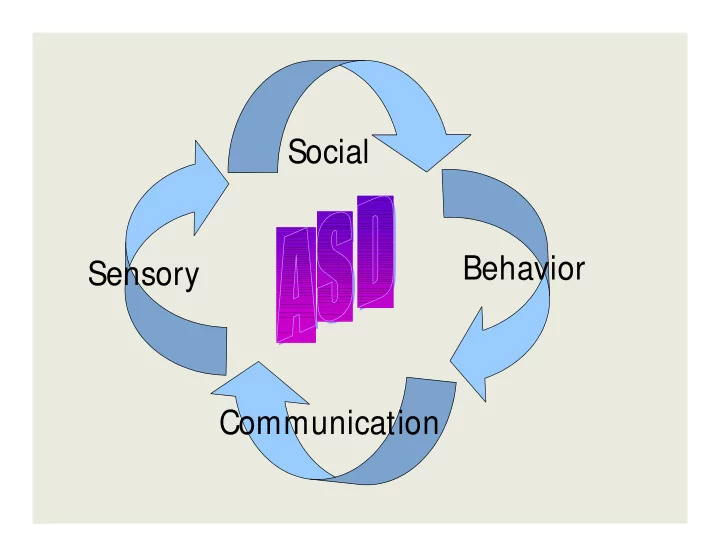
Social Behavior Sensory Communication Autism Spectrum Disorder is - - PowerPoint PPT Presentation
Social Behavior Sensory Communication Autism Spectrum Disorder is . A neurobiological disorder of development that causes discrepancies or differences in the way information is processed. The information-processing differences affects
Communication Social Sensory Behavior
2000 4000 6000 8000 10000 12000 14000 16000
1989 1990 1991 1992 1993 1994 1995 1996 1997 1998 1999 2000 2001 2002 2003 2004 2005 2006 2007 2008 2009 2010
Number of students
1,208 15,403
2012 The Child and Adolescent Health Measurement Initiative strophy or Down syndrome, combined
Please decode the following:
Left voice mail to tell you miss you so much. Now I’m laughing my a** off at you. My life is awesome!
The more traditional approaches to teaching social
Efforts to successfully teach social skills to students
The National Research Council report (2001)
Increases socialization Improves responsibility Facilitates respect Develops awareness and insight into individuals with Autism Spectrum
Disorder.
Builds friendships Teaches patience, tolerance and acceptance. Recognizes common interests Develops leadership qualities Provides another meaningful elective to choose from Changes the culture of the school setting Reduces bullying Increases experiences with those with differences Increases attendance
Improves socialization skills
Develops skills to interact with others Indentifies social cues in a natural setting Develops friendships Increases independence Enhances communication skills Increases academic output Recognizes common interest Integration into school culture Improved attendance Increased involvement in extracurricular activities Improved organizational skills Decreases student anxiety
53 GLCE’s related to social skills K-12 Multiple curricular areas Example: Grade 5 L.CN.05.02 - Listen to or view
Classroom teachers
Provides feedback to the teacher of record Responsible for the learning of the ASD student Provides all instruction, direction, and discipline
Teacher of record- Special Education Teacher
Attendance Monitors progress and online curriculum of LINKS students Problem solving Case Conferences Monitors communication blogs Solicits feedback from classroom teachers
P2P Support overview: http:/ / www.gvsu.edu/ autismcenter/ peer-to-peer-supports-388.htm Paul’s Personal Blog on LINKS: http:/ / helpingeducators.edublogs.org/ Link to LINKS curriculum: http:/ / gvsu.edu/ autismcenter/ comprehensive-curriculum-for-link-program-392.htm Another way to access the curriculum: 1.Go to: helpingeducators.edublogs.org 1.Right-hand column 2.Click on “Internet Training M odules” 3.Click on “M aster Planning Document 2.4 Autism M odules for curriculum through website: http:/ / www.autisminternetmodules.org/ index.php Link to Pupil Accounting rules for LINKS program: http:/ / gvsu.edu/ autismcenter/ pupil-accounting-rules-390.htm Link to videos from LINKS programs: http:/ / gvsu.edu/ autismcenter/ peer-to-peer-videos-401.htm Paul M iller’s Edublog regarding LINKS: http:/ / millep.edublogs.org/ Application to request support establishing a LINKS program at your school: http:/ / www.gvsu.edu/ autismcenter/ applications-273.htm
Rosenberg RE, Law JK, Yenokyan G, McGready J, Kaufmann WE, Law PA. Characterisitics and concordance of autism spectrum disorders among 277 twin pairs. Arch Pediatr Adolesc Med. 2009; 163(10): 907-914. Hallmayer J, Cleveland S, Torres A, Phillips J, Cohen B, Torigoe T, Miller J, Fedele A, Collins J, Smith K, Lotspeich L, Croen LA, Ozonoff S, Lajonchere C, Grether JK, Risch N. Genetic heritability and shared environmental factors among twin pairs with autism. Arch Gen Psychiatry. 2011; 68(11): 1095-1102. Ronald A, HappeF, Bolton P, Butcher LM, Price TS, Wheelwright S, Baron-Cohen S, Plomin R. Genetic heterogeneity between the three components of the autism spectrum: A twin study. J. Am. Acad. Child Adolesc. Psychiatry. 2006; 45(6): 691-699. Taniai H, NishiyamaT, Miyahci T, Imaeda M, Sumi S. Genetic influences on the board spectrum of autism: Study of proband-ascertained twins. Am J Med Genet B Neuropsychiatr Genet. 2008; 147B(6): 844-849. Ozonoff S, Young GS, Carter A, Messinger D, Yirmiya N, Zwaigenbaum L, Bryson S, Carver LJ, Constantino JN, DobkinsK, Hutman T, Iverson JM, Landa R, Rogers SJ, Sigman M, Stone WL. Recurrence risk for autism spectrum disorders: A Baby Siblings Research Consortium study. Pediatrics. 2011; 128: e488-e495. Sumi S, Taniai H, Miyachi T, Tanemura M. Sibling risk of pervasive developmental disorder estimated by means of an epidemiologic survey in Nagoya, Japan. J Hum Genet. 2006; 51: 518-522. DiGuiseppi C, Hepburn S, Davis JM, Fidler DJ, Hartway S, Lee NR, Miller L, Ruttenber M, Robinson C. Screening for autism spectrum disorders in children with Down syndrome. J Dev Behav Pediatr. 2010; 31:181-191. Cohen D, Pichard N, Tordjman S, Baumann C, Burglen L, Excoffier E, Lazar G, Mazet P, Pinquier C, Verloes A, Heron
2005; 35(1): 103-116. Hall SS, Lightbody AA, Reiss AL. Compulsive, self-injurious, and autistic behavior in children and adolescents with fragile X syndrome. Am J Ment Retard. 2008; 113(1): 44-53. Zecavati N, Spence SJ. Neurometabolic disorders and dysfunction in autism spectrum disorders. Curr Neurol Neurosci
Amendah, D., Grosse, S.D., Peacock, G., & Mandell, D.S. (2011). The economic costs of autism: A review. In D. Amaral,