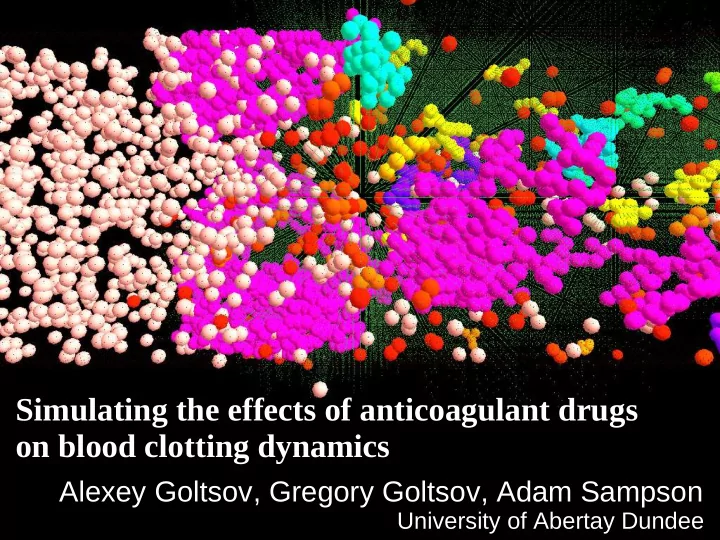
SLIDE 1 Simulating the effects of anticoagulant drugs Simulating the effects of anticoagulant drugs
- n blood clotting dynamics
- n blood clotting dynamics
Alexey Goltsov, Gregory Goltsov, Adam Sampson
University of Abertay Dundee
SLIDE 2
Blood clotting
platelets in bloodstream
SLIDE 3
Blood clotting
platelets in bloodstream damaged tissue
SLIDE 4
Blood clotting
platelets in bloodstream damaged tissue emits clotting factors
SLIDE 5 Blood clotting
platelets in bloodstream platelets become sticky
chemical signalling
damaged tissue emits clotting factors
SLIDE 6 Blood clotting
platelets in bloodstream platelets become sticky clots form
chemical signalling mechanical interaction
damaged tissue emits clotting factors
SLIDE 7
- This process doesn't always work properly
– Excessive clotting – e.g. thromboembolisms – Insufficient clotting
- To treat these problems, we use drugs to change
the behaviour of platelets' signalling networks
– … such as aspirin – … or specialised anticoagulants – … or – more interestingly – combinations of the
above
SLIDE 8
built a large-scale simulator of artificial platelets for the TUNA project; simple physics, but no real behaviour
simulator using CoSMoS tech; same behaviour, but supports interactive use
SLIDE 9
modelling platelet signalling under the effects of various drugs; good behaviour, but no physics
and the physics matter!
SLIDE 10
So GG applied for – So GG applied for – and was awarded – and was awarded – a 2011 a 2011 Nuffield Nuffield bursary bursary
SLIDE 11
- Identify signalling metamodel: hybrid Petri nets
– … hybrid because they have continuous quantities
rather than discrete tokens
– … but the graphical language is convenient!
- Identify an appropriate (subset) signalling model
based on AG's existing one
- Define a domain-specific language for hybrid
Petri nets so we can automatically generate the code AG wrote by hand...
- Give each cell in the simulator its own Petri net
SLIDE 12
SLIDE 13
SLIDE 14
SLIDE 15
SLIDE 16
- Success!
- … that is, the technology works; we haven't yet
calibrated the combined model
- Platelets can now amplify the damage signalling:
you don't need to emit (unrealistically) large signals into the bloodstream any more
- Can adjust signalling model parameters in real
time and see the physical effects
SLIDE 17
- Where next? Better metamodel tool support?
- We actually want to use this for cancer, rather
than blood clotting – same modelling technologies, but more complex problems
- … for example, helping to design drugs that affect
tumour morphology when growing into tissue – less invasive, easier to remove
- For this, we need a more sophisticated physical
model too...
SLIDE 18
MSc projects
Jiujiang Zhu, Ye Li, Ni Guo Ellipsoid cell model
SLIDE 19
Tim Newman, Dundee Tim Newman, Dundee ScEM finite-element cell model ScEM finite-element cell model
SLIDE 20
… … achieving large scales through distribution achieving large scales through distribution
SLIDE 21
… … and experimenting with new interaction techniques and experimenting with new interaction techniques
SLIDE 22
- Thanks to EPSRC, Nuffield, and our
collaborators at York, Kent, Dundee, Edinburgh and St. Andrews