Significance of Alignments COMP 571 Luay Nakhleh, Rice University - - PowerPoint PPT Presentation

significance of alignments
SMART_READER_LITE
LIVE PREVIEW

Significance of Alignments COMP 571 Luay Nakhleh, Rice University - - PowerPoint PPT Presentation

1 Significance of Alignments COMP 571 Luay Nakhleh, Rice University 2 Hypothesis Testing for Sequence Homology When a best local alignment is found, the next task is to assess its biological relevance This is most often done based on


slide-1
SLIDE 1

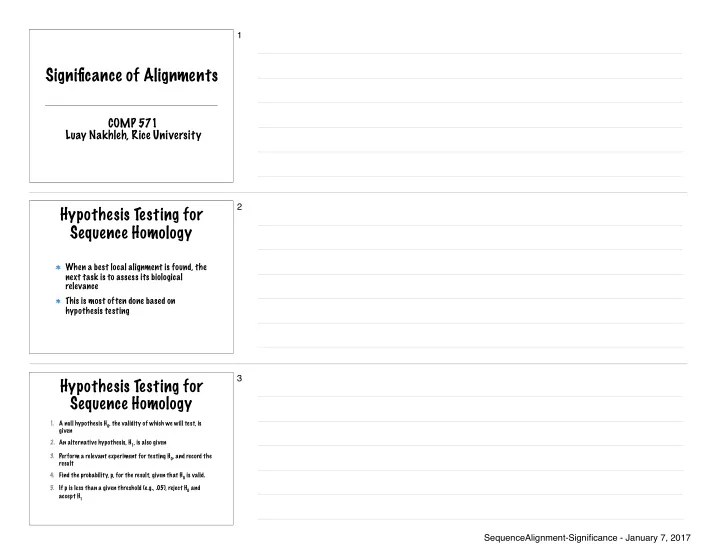
Significance of Alignments

COMP 571 Luay Nakhleh, Rice University

1

Hypothesis Testing for Sequence Homology

When a best local alignment is found, the next task is to assess its biological relevance This is most often done based on hypothesis testing

2

Hypothesis Testing for Sequence Homology

1. A null hypothesis H0, the validity of which we will test, is given

  • 2. An alternative hypothesis, H1, is also given

3. Perform a relevant experiment for testing H0, and record the result

  • 4. Find the probability, p, for the result, given that H0 is valid.

5. If p is less than a given threshold (e.g., .05), reject H0 and accept H1

3 SequenceAlignment-Significance - January 7, 2017

slide-2
SLIDE 2

Hypothesis Testing for Sequence Homology

1. H0: the two sequences are not homologous 2. H1: the two sequences are homologous

  • 2. Determine the experiment: find the segment pair from the two sequences with the

highest score 3. Determine the probability of the result, given H0 (details: next slide) 4. Determine the rejection threshold for H0 (e.g., 0.5x10⁻⁵) 5. Perform the experiment chosen in (2): find the segment pair with the highest score and record the result 6. Determine the probability of achieving the result or higher, given H0 (use the probability distribution found above), and compare with the rejection level for H0

4

Probability of the Result, Given H0

This is often done by finding the probability distribution for the highest-scoring segment pairs in randomly generated sequences (details: next slide) A large number of such sequences are generated, and compared with one of the two sequences being aligned, and the scores of these comparisons are the basis for the probability distribution of the scores

5

Random Generation of Sequences

A frequency distribution of the

  • ccurrences of the amino acids has to be

used The amino acid of the random sequence is drawn using this distribution, often independent of the position and which amino acids are in the other positions

6 SequenceAlignment-Significance - January 7, 2017

slide-3
SLIDE 3

Example

7

Example

0.0181 The probability of finding a local alignment with score at least 6, when q is aligned with a random sequence with the same amino acid distribution and length as d

8

Deriving the Amino Acid Frequency Distribution

Universal Over all known sequences Global Super-family Local From the sequences (q,d) themselves

9 SequenceAlignment-Significance - January 7, 2017

slide-4
SLIDE 4

What Frequency Distribution to Use

The distribution of the amino acids in d should be used to assess the score obtained by comparing q with d

10

Using Z Scores to Estimate Statistical Significance

11

Using Z Values to Estimate Statistical Significance: Example

12 SequenceAlignment-Significance - January 7, 2017

slide-5
SLIDE 5

Questions?

13 SequenceAlignment-Significance - January 7, 2017