Short homework due Wednesday On the web site Worth five - - PDF document

short homework due wednesday on the web site worth five
SMART_READER_LITE
LIVE PREVIEW

Short homework due Wednesday On the web site Worth five - - PDF document

Administrative Notes Homework Short homework due Wednesday On the web site Worth five points Exams Graded and returned Friday Statistics in slides for last class ( at the end ) COMP 210, Spring 2002 1 Files and


slide-1
SLIDE 1

COMP 210, Spring 2002 1

Administrative Notes

Homework

  • Short homework due Wednesday
  • On the web site
  • Worth five points

Exams

  • Graded and returned Friday
  • Statistics in slides for last class

(at the end )

COMP 210, Spring 2002 2

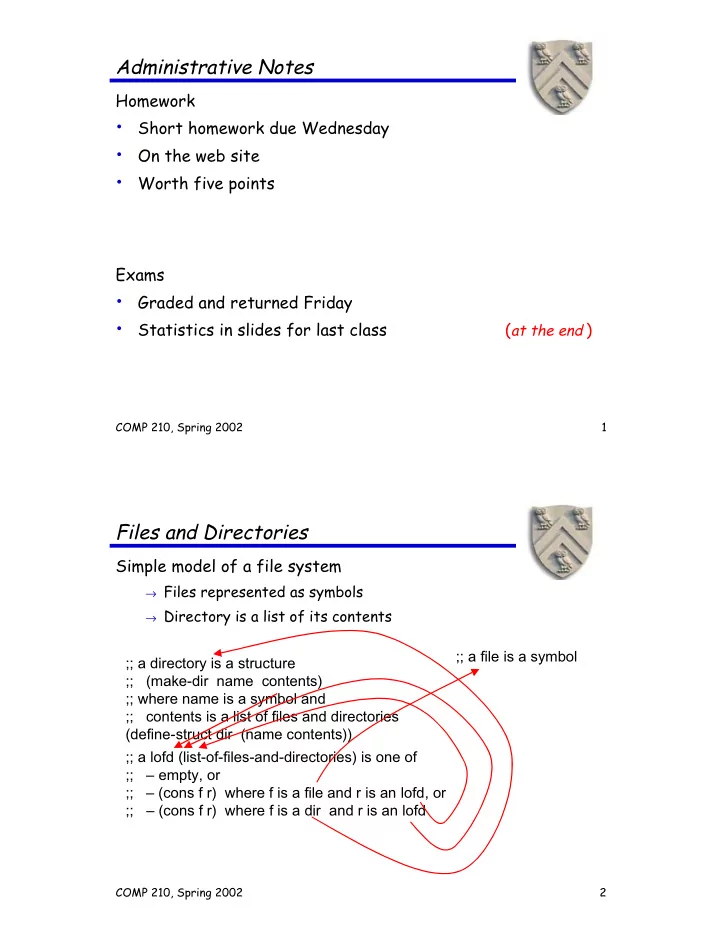
Simple model of a file system

→ Files represented as symbols → Directory is a list of its contents

Files and Directories

;; a directory is a structure ;; (make-dir name contents) ;; where name is a symbol and ;; contents is a list of files and directories (define-struct dir (name contents)) ;; a lofd (list-of-files-and-directories) is one of ;; – empty, or ;; – (cons f r) where f is a file and r is an lofd, or ;; – (cons f r) where f is a dir and r is an lofd ;; a file is a symbol

slide-2
SLIDE 2

COMP 210, Spring 2002 3

Files and Directories

Template for File System

(define (f a-file …) …) ;; simple template for file (define (g a-dir …) ;; structure template for dir ( … (dir-name a-dir) … … (h (dir-contents a-dir) …) … ) (define (h a-lofd …) ;; list of several types for lofd (cond [(empty? a-lofd) … ] [(symbol? (first a-lofd)) … (f (first a-lofd) … ) … … (h (rest a-lofd) … ) … ] [(dir? (first a-lofd)) … (g (first a-lofd) … ) … … (h (rest a-lofd) … ) … ] )) Write the program ;; Depth-dir : dir -> number ;; Purpose: return nesting depth of ;; most deeply nested directory (define (count-files a-dir) … )

COMP 210, Spring 2002 4

Files and Directories

Depth-dir

→ Write a program that consumes a dir and produces a number

indicating how many levels of nested directories are in the tree ;; depth-dir: dir -> number (define (depth-dir a-dir) (add1 (depth-lofd (dir-contents a-dir)) ) ) ;; depth-lofd: lofd -> number (define (depth-lofd a-lofd) (cond [(empty? a-lofd) 0] [(symbol? (first a-lofd)) (depth-lofd (rest a-lofd)) ] [(dir? (first a-lofd)) (max (depth-dir (first a-lofd)) (depth-lofd (rest a-lofd)) ) ] ))

slide-3
SLIDE 3

COMP 210, Spring 2002 5

Programs with Multiple Complex Arguments

So far,

  • Programs have consumed, at most, one complicated argument
  • In flatten, you needed a helper that consumed two lists

→ This lead to append

;; append: list list -> list ;; Purpose: consumes two lists and produces a single list ;; that contains all the elements of the first argument ;; followed by all the elements of the second argument (define (append list1 list2 ) (cond [(empty? list1) list2 ] [(cons? list1) (cons (first list1) (append (rest list1) list2 ))] ) )

Notice how append uses list2

COMP 210, Spring 2002 6

;; append: list list -> list ;; Purpose: consumes two lists and produces a single list ;; that contains all the elements of the first argument ;; followed by all the elements of the second argument (define (append list1 list2 ) (cond [(empty? list1) list2 ] [(cons? list1) (cons (first list1) (append (rest list1) list2 ))] ) )

Programs with Multiple Complex Arguments

  • In append, the second argument is never treated as a list

→ Passed along as second argument in recursive call

  • Append follows the standard list template
slide-4
SLIDE 4

COMP 210, Spring 2002 7

Programs with Multiple Complex Arguments

Another example What template should we use?

  • Make-points manipulates both x-list and y-list
  • Make-points only works if (= (length x-list) (length y-list))

;; a point is ;; (make-point x y) ;; where x and y are numbers (define-struct point (x y)) ;; make-points : list-of-numbers list-of-numbers -> list-of-points ;; Purpose: consumes two lists of numbers, interprets the first as ;; a list of x coordinates, the second as a list of y coordinates, ;; and produces the corresponding list of points (define (make-points x-list y-list … )

COMP 210, Spring 2002 8

Programs with Multiple Complex Arguments

Another example

  • This simplifies the template
  • We can complete the program from the template

→ Fill in the blanks → Ellide unneeded stuff

(define (f x-list y-list … ) (cond [(empty? x-list) …] [(cons? x-list) … (first x-list) … (first y-list) … … (f (rest x-list) (rest y-list) … ) … ] ) )

Only need to test one argument

slide-5
SLIDE 5

COMP 210, Spring 2002 9

Programs with Multiple Complex Arguments

But, …

  • Template contained problem specific-knowledge

→ This violates our (previous) assumption that templates follow

(just) the data structure

→ Here, template depended on set of arguments to the program

  • This is a leap from what we’ve done in the past

(define (make-points x-list y-list ) (cond [(empty? x-list) empty] [(cons? x-list) (cons (make-point (first x-list) (first y-list)) (make-points (rest x-list) (rest y-list)) ) ] ) )

COMP 210, Spring 2002 10

Programs with Multiple Complex Arguments

Another example

  • Clearly, merge must look inside both lists
  • Clearly, the lists can have different length

→ (merge empty (cons 1 empty)) should be (cons 1 empty)

  • How do we write a template for this problem?

→ Study the possibilities

;; merge : list-of-numbers list-of-numbers -> list-of-numbers ;; Purpose: consumes two lists of numbers, assumed to be in ;; ascending order by value, and produces a single list of ;; numbers that contains all the elements of the input lists ;; (including duplicates) in ascending order by value (define (merge a-lon1 a-lon2) …)

slide-6
SLIDE 6

COMP 210, Spring 2002 11

Programs with Multiple Complex Arguments

Merge

  • Consider the possibilities
  • 2 inputs, 2 cases in the definition ⇒ 4 cases & 4 examples
  • Merge must handle all of these possibilities

→ Cond construct with four clauses → Must work out tests that distinguish them

(merge empty empty) ⇒ empty (merge empty (list 1 5)) ⇒ (list 1 5) (merge (list 1 5) empty) ⇒ (list 1 5) (merge (list 1 5) (list 3)) ⇒ (list 1 3 5)

COMP 210, Spring 2002 12

Programs with Multiple Complex Arguments

Merge

  • Questions for list X list

(and (cons? a-lon1) (cons? a-lon2)) (and (cons? a-lon1) (empty? a-lon2)) (cons? a-lon1) (and (empty? a-lon1) (cons? a-lon2)) (and (empty? a-lon1) (empty? a-lon2)) (empty? a-lon1) (cons? a-lon2) (empty? a-lon2) The template must include (and handle) all these cases

slide-7
SLIDE 7

COMP 210, Spring 2002 13

Programs with Multiple Complex Arguments

Merge – the template

(define (f a-lon1 a-lon2) (cond [(and (empty? a-lon1) (empty? a-lon2)) …] [(and (empty? a-lon1) (cons? a-lon2)) … (first a-lon2) … (rest a-lon2) …] [(and (cons? a-lon1) (empty? a-lon2)) … (first a-lon1) … (rest a-lon1) …] [(and (cons? a-lon1) (cons? a-lon2)) … (first a-lon1) … (first a-lon2) … … (rest a-lon1) … (rest a-lon2) …] ) ) Structure is clear, but where are the recursion relationships?

COMP 210, Spring 2002 14

Recur on both several cases (f a-lon1 (rest a-lon2)) (f (rest a-lon1) a-lon2)) (f (rest a-lon1) (rest a-lon2)) Same case on a-lon1 Recur on a-lon2 and empty. Empty lists implies no recursion

Programs with Multiple Complex Arguments

Merge – the template

(define (f a-lon1 a-lon2) (cond [(and (empty? a-lon1) (empty? a-lon2)) …] [(and (empty? a-lon1) (cons? a-lon2)) … (first a-lon2) … (rest a-lon2) …] [(and (cons? a-lon1) (empty? a-lon2)) … (first a-lon1) … (rest a-lon1) …] [(and (cons? a-lon1) (cons? a-lon2)) … (first a-lon1) … (first a-lon2) … … (rest a-lon1) … (rest a-lon2) …] ) )

slide-8
SLIDE 8

COMP 210, Spring 2002 15

Programs with Multiple Complex Arguments

Merge – the template

(define (f a-lon1 a-lon2) (cond [(and (empty? a-lon1) (empty? a-lon2)) …] [(and (empty? a-lon1) (cons? a-lon2)) … (first a-lon2) … (f a-lon1 (rest a-lon2)) …] [(and (cons? a-lon1) (empty? a-lon2)) … (first a-lon1) … (f (rest a-lon1) a-lon2)…] [(and (cons? a-lon1) (cons? a-lon2)) … (first a-lon1) … (first a-lon2) … … (f a-lon1 (rest a-lon2)) … … (f (rest a-lon1) a-lon2) … … (f (rest a-lon1) (rest a-lon2)) …] ) ) You fill in the rest to make merge work