Set 2: DOM Review DHTML Basics Find the HTML object we want to - - PDF document

set 2 dom
SMART_READER_LITE
LIVE PREVIEW

Set 2: DOM Review DHTML Basics Find the HTML object we want to - - PDF document

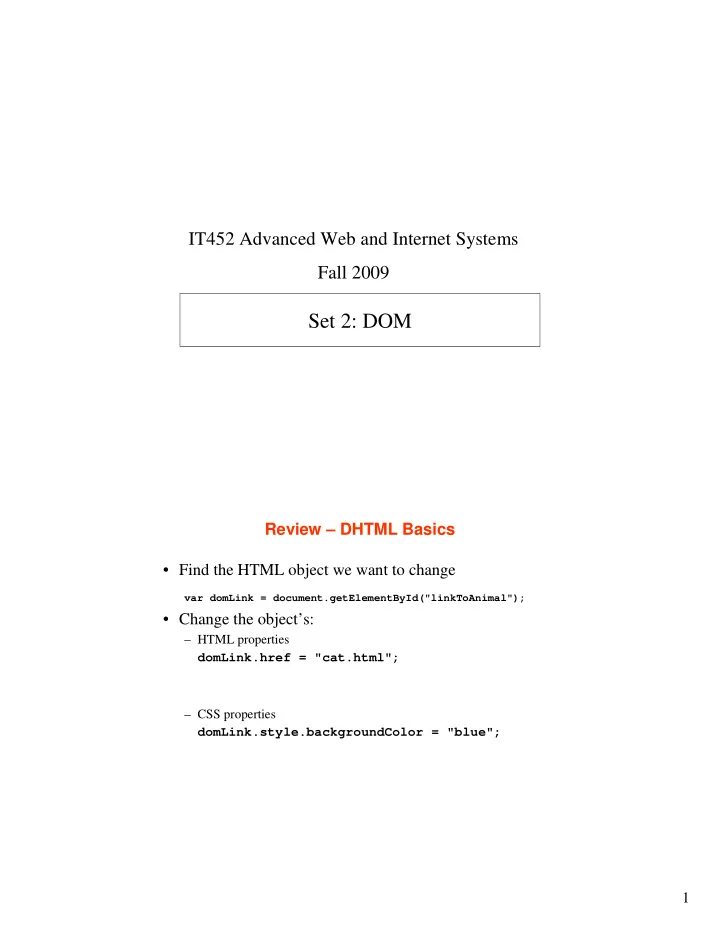
IT452 Advanced Web and Internet Systems Fall 2009 Set 2: DOM Review DHTML Basics Find the HTML object we want to change var domLink = document.getElementById("linkToAnimal"); Change the objects: HTML properties


slide-1
SLIDE 1

1

Set 2: DOM

IT452 Advanced Web and Internet Systems Fall 2009

Review – DHTML Basics

  • Find the HTML object we want to change

var domLink = document.getElementById("linkToAnimal");

  • Change the object’s:

– HTML properties domLink.href = "cat.html"; – CSS properties domLink.style.backgroundColor = "blue";

slide-2
SLIDE 2

2

Simple Paint (ex1.html) – Part 1

?xml version = "1.0" encoding="utf-8" ?> <!DOCTYPE html PUBLIC "-//W3C//DTD XHTML 1.1//EN" "http://www.w3.org/TR/xhtml11//DTD/xhtml11.dtd"> <html xmlns = "http://www.w3.org/1999/xhtml"> <head> <title>IT 452 DOM demo</title> <script type="text/javascript" > <!-- var currentAction = "red"; function doupdate(curNode ) { curNode.style.backgroundColor = currentAction; } // --> </script> </head>

Simple Paint (ex1.html) – Part 2

<body> <h1> IT 452 DOM demo </h1> <p>Tools:</p> <ul> <li onclick="currentAction='red' "> Set red </li> <li onclick="currentAction='blue' "> Set blue </li> <li onclick="currentAction='insert'"> Insert </li> <li onclick="currentAction='delete'"> Delete </li> <li onclick="currentAction='edit' "> Edit </li> </ul> <table border="1"> <tr> <td onclick="doupdate(this)"> thing 1 </td> <td onclick="doupdate(this)"> thing 2 </td> </tr> <tr> <td onclick="doupdate(this)"> thing 3 </td> <td onclick="doupdate(this)"> thing 4 </td> </tr> </table> </body></html>

slide-3
SLIDE 3

3

What does the DOM tree look like? ex2.html – add insert/delete/edit

function doupdate(curNode ) { var parent = curNode.parentNode; if (currentAction == "insert") { newThing = document.createElement("td"); parent.insertBefore(newThing, curNode); newThing.innerHTML = "hello"; } else if (currentAction == "delete") { parent.removeChild(curNode); } else if (currentAction == "edit") { curNode.innerHTML = window.prompt("Enter new text", ""); } else { curNode.style.backgroundColor = currentAction; } }

slide-4
SLIDE 4

4

ex3.html – fully functional

function doupdateDyn() { doupdate(this); } function doupdate(curNode ) { var parent = curNode.parentNode; if (currentAction == "insert") { newThing = document.createElement("td"); parent.insertBefore(newThing, curNode); newThing.innerHTML = "hello"; newThing.onclick = doupdateDyn; } else if (currentAction == "delete") { parent.removeChild(curNode); } else if (currentAction == "edit") { curNode.innerHTML = window.prompt("Enter new text", curNode.innerHTML); } else { curNode.style.backgroundColor = currentAction; } }

Some tempting ideas (too bad they don’t work) newThing.onclick = "doupdate(this) " newThing.onclick = doupdateDyn()

slide-5
SLIDE 5

5

ex4.html – more elegant / alternatives

function doupdate(curNode ) { var parent = curNode.parentNode; if (currentAction == "insert") { newThing = document.createElement("td"); parent.insertBefore(newThing, curNode); newThing.innerHTML = "hello"; newThing.onclick = function() {doupdate(this)}; } else if (currentAction == "delete") { parent.removeChild(curNode); } else if (currentAction == "edit") { curNode.firstChild.nodeValue = window.prompt("Enter new text", curNode.innerHTML); } else { curNode.style.backgroundColor = currentAction; } }

Tips

  • Remember JavaScript console
  • How many children?

– Use DOM Inspector to see – From ex5.html:

else if (currentAction == "parent") { var kids = parent.childNodes; window.alert("Number children: "+kids.length); window.alert("Type of first: "+kids[0].nodeType); }

  • See DOM reference links under IT452 page

– Use the API!
slide-6
SLIDE 6

6

Ex6.html: iterating over children

else if (currentAction == "rowInfo") { var kids = parent.childNodes; for (var i=0; i < kids.length; i++) { var theKid = kids[i]; window.alert("Kid #"+i+" has type“ +theKid.nodeType); } }