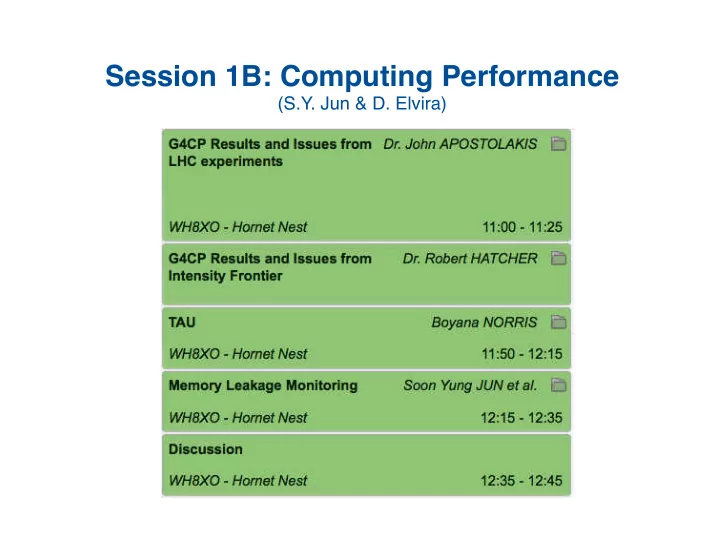
Session 1B: Computing Performance (S.Y. Jun & D. Elvira) CPU - - PowerPoint PPT Presentation

session 1b computing performance
SMART_READER_LITE
LIVE PREVIEW

Session 1B: Computing Performance (S.Y. Jun & D. Elvira) CPU - - PowerPoint PPT Presentation

Session 1B: Computing Performance (S.Y. Jun & D. Elvira) CPU Performance: ATLAS&CMS (John Apostolakis) Geant4 Status in CMS 2015 production: 10.0.p02 (sequential), QGSP_FTFP_BERT_EML, ~ 5 billion events (2015) (+ ) CPU


slide-1
SLIDE 1

Session 1B: Computing Performance


(S.Y. Jun & D. Elvira)

slide-2
SLIDE 2

CPU Performance: ATLAS&CMS
 (John Apostolakis)

slide-3
SLIDE 3

Geant4 Status in CMS

  • 2015 production: 10.0.p02 (sequential),

QGSP_FTFP_BERT_EML, ~ 5 billion events (2015) (+ )

– CPU

  • Technical performance Improvements for Run 2

– Upgrade to 10.0 (~5%) – Russian Roulette (~30%) – CMSSW optimization (~15%) – Library repackaging (~10%)

3

slide-4
SLIDE 4

Geant4 Status in CMS

  • Multi-threaded Geant4 (10.0p03) is fully integrated with CMS

multi-threaded framework – plan to use it in production 2016

  • Performance of CMS MT GEN- SIM (CHEP2015)

– Excellent scaling performance in Time/Event – ~2 GB RSS for 12 single threaded jobs (+200 MB per thread)

4

slide-5
SLIDE 5

Geant4 Status in ATLAS

  • Integrated Sim. Framework (ISF) use almost all production.

– 9.6 full simulation used in 80% of production (ratio will drop) – Expect move to 10.1 for next campaign (end 2015)

  • Stability and production

– Crash rate: ~1.5% failure for jobs of 1,000 events (unacceptable) – The Multi Level Locator has proven to be a weakness

  • Hot spots and remedies

– Neutrons take a lot of CPU time. – Might seek to use available biasing features

  • Memory – use and churn

– Memory consumption is significant, but not enormous concerns – Memory churn was issue, but Geant4 no longer dominates churn

  • Seen potential of static builds vs DLLs (difficult for ATLAS)
  • Reasonably advanced prototype of MT app for Cori

5

slide-6
SLIDE 6

6

slide-7
SLIDE 7

7

slide-8
SLIDE 8

8

slide-9
SLIDE 9

IF Summary

  • A variety of programs – hard to generalize CPU/memory uses
  • Still use relatively old versions of Geant4 (9.2, 9.4, 9.6)
  • Generally, open to new technology (MT, track parallelism,

multi- cores, etc) if no extra efforts are necessary

  • Effort underway to centralize MC production needs and

estimate required resources

  • G4CPT will seek for representative applications to evaluate

computing performance of IF-experiments (profiling and benchmarking)

9

slide-10
SLIDE 10

10

slide-11
SLIDE 11

11

slide-12
SLIDE 12

12

slide-13
SLIDE 13

TAU

  • Low overhead
  • Comprehensive
  • Hardware counters and

derivative metrics

  • Inclusive vs. exclusive
  • Variety of meta-tools for

sophisticated analysis

13

slide-14
SLIDE 14

Ex: TAU for Geant4

  • Interactive canvas

– Application – Trial – Metric (PAPI HWC) – Thread (multi/many)

  • DB-based analysis
  • Working in progress

– Add more analysis – Add display options

14

slide-15
SLIDE 15

Memory Leakage Monitoring

  • S. Y. Jun (Fermilab), G. Cosmo (CERN), A. Dotti (SLAC)

20th Geant4 Collaboration Meeting at Fermilab

  • Sept. 28 - Oct. 2, 2015
slide-16
SLIDE 16

Memory leak

  • Leaks from Geant4? - relatively clean. Two distinct types:

– Memory allocated at initialization, but not explicitly released at the end of program (the majority of the cases, less critical) – Memory allocated within the event loop, but not freed (the most critical and relevant for production runs in the experiments)

  • Problem Statement:

– Indication of a poor design for ownership or lifetime of objects – Reduce existing memory leaks – Monitor newly introduced leaks

  • Tools

– Igprof (a low-overhead memory profiler - memory footprints) – Valgrind (a great tool for memcheck, but too slow - complete) – Coverity (a static code analysis) – a custom monitoring tool (under developing - efficient)

16

slide-17
SLIDE 17

Valgrind Tests: (ex: Geant4 10.2.beta)

  • Output: /afs/cern.ch/sw/geant4/dev/QA_tools/Valgrind/logs/
  • Definitely Lost: no pointer to the block can be found (i.e, lost

the pointer at the earlier point) – 19 test for major releases

  • Geant4 code being released is relatively clean

17

~1M bytes

slide-18
SLIDE 18

Summary of Coverity Analysis

  • Static analysis: http://coverity.cern.ch/ (289 issues under G4)
  • Two types of resource leaks (39) under the Geant4 project

– new on a data-member and does not free it – a new of an object in a method and no clear ownership

  • Use std::unique_ptr and move – make ownership explicitly

18

class ¡G4Something; ¡ class ¡G4Class ¡{ ¡ ¡ ¡G4Something* ¡pointer; ¡ ¡~G4Class() ¡{ ¡/*?? ¡should ¡I ¡delete ¡pointer??*/ ¡} ¡ ¡void ¡set( ¡G4Something* ¡p) ¡{ ¡pointer ¡= ¡p;} ¡ ¡ ¡G4Something* ¡get() ¡const ¡{ ¡return ¡pointer; ¡} ¡ }; ¡ //Usage ¡ ¡ ¡G4Something* ¡smt ¡= ¡new ¡G4Something; ¡ ¡ ¡G4Class* ¡cls ¡= ¡new ¡G4Class(); ¡ ¡ ¡cls-­‑>set( ¡smt ¡); ¡ //Who ¡owns ¡smt? ¡Who ¡should ¡delete ¡it? ¡

slide-19
SLIDE 19

A Custom Memory Leak Monitor

  • Check unreleased memory at the exit of an application

– A very light leak monitoring tool (efficient) and complimentary to Valgrind (correctness)

  • Push/pop memory alloc/dealloc during an application is

running and dump undeleted pointers at the end program

– Override new and delete (new[] and delete[]) with custom

  • perators by adding/removing the address of the caller

– builtin_return_address(0) : return address of the current function – addr2line(pointer) : convert the address of pointer to the file name and line number

19

void* ¡operator ¡new(size_t ¡size, ¡const ¡std::nothrow_t&) ¡_NOEXCEPT ¡ { ¡ ¡ ¡ ¡ ¡return ¡new(size, ¡(char*)__builtin_return_address(0),0); ¡ } ¡

slide-20
SLIDE 20

A Custom Monitoring Tool (exampleB2b)

20

  • Summary
  • List of file names and line numbers for undeleted objects
  • Run the memory leak monitor for each reference release

– Select representative examples/tests – Post the list of potential leak (file names and line numbers) – Report a summary (and changes by the release version)

slide-21
SLIDE 21

Thank You to All Contributors

21