
Edsger’ s perspective
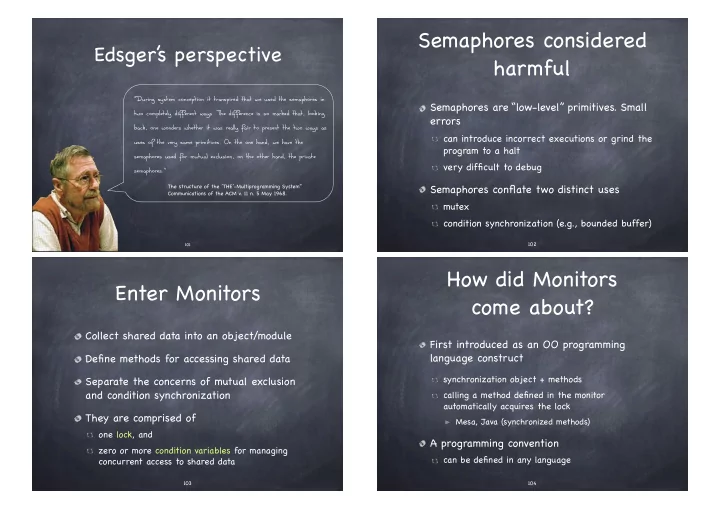
“During system conception it transpired that we used the semaphores in two completely different ways. The difference is so marked that, looking back, one wonders whether it was really fair to present the two ways as uses of the very same primitives. On the one hand, we have the semaphores used for mutual exclusion, on the other hand, the private semaphores.”
The structure of the ’THE’-Multiprogramming System” Communications of the ACM v. 11 n. 5 May 1968.
101
Semaphores considered harmful
Semaphores are “low-level” primitives. Small errors
can introduce incorrect executions or grind the program to a halt very difficult to debug
Semaphores conflate two distinct uses
mutex condition synchronization (e.g., bounded buffer)
102
Enter Monitors
Collect shared data into an object/module Define methods for accessing shared data Separate the concerns of mutual exclusion and condition synchronization They are comprised of
- ne lock, and
zero or more condition variables for managing concurrent access to shared data
103
How did Monitors come about?
First introduced as an OO programming language construct
synchronization object + methods calling a method defined in the monitor automatically acquires the lock
Mesa, Java (synchronized methods)
A programming convention
can be defined in any language
104