Semantic Roles How the arguments of a predicate map to functional - - PowerPoint PPT Presentation

semantic roles
SMART_READER_LITE
LIVE PREVIEW

Semantic Roles How the arguments of a predicate map to functional - - PowerPoint PPT Presentation

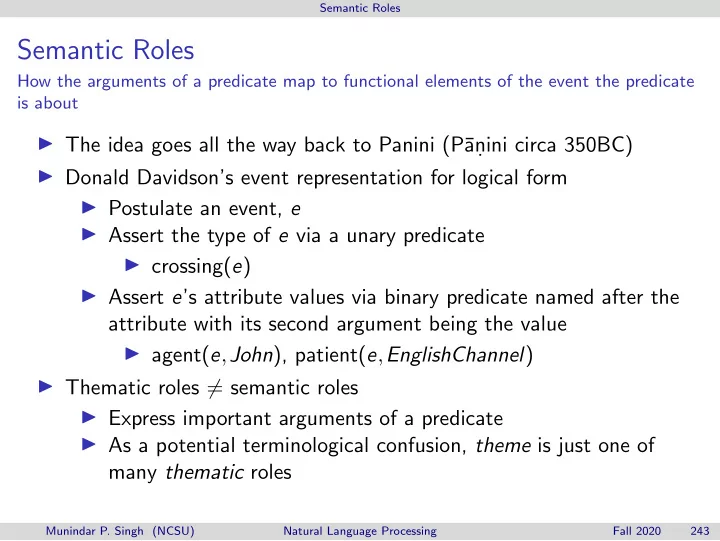
Semantic Roles Semantic Roles How the arguments of a predicate map to functional elements of the event the predicate is about The idea goes all the way back to Panini (P an .ini circa 350BC) Donald Davidsons event representation


slide-1
SLIDE 1

Semantic Roles

Semantic Roles

How the arguments of a predicate map to functional elements of the event the predicate is about

◮ The idea goes all the way back to Panini (P¯ an .ini circa 350BC) ◮ Donald Davidson’s event representation for logical form ◮ Postulate an event, e ◮ Assert the type of e via a unary predicate ◮ crossing(e) ◮ Assert e’s attribute values via binary predicate named after the attribute with its second argument being the value ◮ agent(e,John), patient(e,EnglishChannel) ◮ Thematic roles = semantic roles ◮ Express important arguments of a predicate ◮ As a potential terminological confusion, theme is just one of many thematic roles

Munindar P. Singh (NCSU) Natural Language Processing Fall 2020 243

slide-2
SLIDE 2

Semantic Roles

Major Thematic Roles in the Literature

Not a fixed set

  • Th. Role

Definition Sample Words Agent Volitional causer (includes acci- dents) Kick Experiencer One who experiences it Has (a feeling) Force Nonvolitional causer Tsunami Theme One (most) directly affected Shut (the door) Result Outcome Wrote (a book) Content Proposition

  • f

a propositional event Asked Instrument With a screwdriver Beneficiary For his son Source Origin of the object in a transfer event Shipped Goal Destination of the object in a transfer event Delivered

Munindar P. Singh (NCSU) Natural Language Processing Fall 2020 244

slide-3
SLIDE 3

Semantic Roles

Thematic Roles Exercise

For each thematic role, state an example sentence that illustrates it

Munindar P. Singh (NCSU) Natural Language Processing Fall 2020 245

slide-4
SLIDE 4

Semantic Roles

Thematic Grid or Case Frame or θ-Grid of a Verb

The set of thematic roles that the verb takes on

◮ Constraints on how a verb’s thematic roles are presented and ordered John broke the window agent theme John broke the window with a rock agent theme instrument The rock broke the window instrument theme The window broke theme The window was broken by John theme agent

Munindar P. Singh (NCSU) Natural Language Processing Fall 2020 246

slide-5
SLIDE 5

Semantic Roles

Diathesis Alternation or Verb Alternation

Multiple alternative mappings from arguments to syntactic positions

◮ For break (previous page) Subject Object Preposition (With) Phrase agent theme agent theme instrument instrument theme theme ◮ For give, dative alternation Doris gave the book to Edward agent theme goal Doris gave Edward the book agent goal theme

Munindar P. Singh (NCSU) Natural Language Processing Fall 2020 247

slide-6
SLIDE 6

Semantic Roles

VerbNet

Gathers knowledge about verbs

◮ Class hierarchy of verbs that maps out what alternations each verb participates in ◮ Verbs that support the dative alternation ◮ Verbs of future having: advance, allocate, offer, owe ◮ Verbs of sending: forward, hand, mail ◮ Verbs of throwing: kick, pass, throw ◮ Levin’s classification ◮ 47 high-level classes ◮ 193 low-level classes ◮ 3,100 verbs

Munindar P. Singh (NCSU) Natural Language Processing Fall 2020 248

slide-7
SLIDE 7

Semantic Roles

Problems with Thematic Roles

Despite their intuitive appeal, . . .

◮ Difficult to standardize on set of thematic roles ◮ Difficult to formally specify ◮ Frequent need to refine (fragment) the roles ◮ Example: instrument seems to be two subroles ◮ This alternation works for intermediate instrument The cook opened the jar with the new gadget The new gadget opened the jar ◮ But not for enabling instrument The cook ate noodles with a fork *A fork ate the noodles ◮ How about this? The cook whisked the eggs with a fork A fork whisked the eggs

Munindar P. Singh (NCSU) Natural Language Processing Fall 2020 249

slide-8
SLIDE 8

Semantic Roles

PropBank: Proposition Bank

Labels of (English and Chinese) sentences in Penn Treebank with semantic roles

◮ Semantic roles are defined specific to verb senses, not universally ◮ Not given meaningful names (helps avoid unnecessary controversy, I assume) ◮ Some generalizations ◮ Arg0: proto-agent ◮ Arg1: proto-patient ◮ Arg2: often benefactive, instrument, attribute, or end state ◮ Arg3: often benefactive, instrument, attribute, or starting point ◮ Arg4: often end point ◮ Helps recover shallow semantic information from arguments of verbs

Munindar P. Singh (NCSU) Natural Language Processing Fall 2020 250

slide-9
SLIDE 9

Semantic Roles

PropBank Frame File Example: Agree.01

◮ Arg0: Agreer ≈ Agent ◮ Arg1: Proposition being agreed to ≈ Content ◮ Arg2: With whom (if any) ≈ Beneficiary [Arg0 The group] agreed [Arg1 it wouldn’t make an offer] [ArgM-TMP Usually] [Arg0 John] agrees [Arg2 with Mary] [Arg1 on everything]

Munindar P. Singh (NCSU) Natural Language Processing Fall 2020 251

slide-10
SLIDE 10

Semantic Roles

PropBank Frame File Example: Fall.01

◮ Arg0: Not defined since the normal subject of fall is proto-patient ◮ Arg1: Thing falling, which is the logical subject and patient ◮ Arg2: Extent, amount fallen ◮ Arg3: Start point ◮ Arg4: End point, end state of Arg1 [Arg1 Sales] fell [Arg4 to $25 million] [Arg3 from $27 million] [Arg1 The average junk bond] fell [Arg2 by 4.2%]

Munindar P. Singh (NCSU) Natural Language Processing Fall 2020 252

slide-11
SLIDE 11

Semantic Roles

PropBank Frame File Example: Increase.01

Extracting shallow semantic information from verb arguments

◮ Arg0: Causer of increase ◮ Arg1: Thing increasing ◮ Arg2: Amount increased by; or, manner ◮ Arg3: Start point ◮ Arg4: End point Below, Dole is the agent and the price of Bananas is the theme [Arg0 Dole] increased [Arg1 the price of Bananas] [Arg1 The price of Bananas] was increased by [Arg0 Dole] [Arg1 The price of Bananas] increased [Arg2 5%]

Munindar P. Singh (NCSU) Natural Language Processing Fall 2020 253

slide-12
SLIDE 12

Semantic Roles

PropBank Modifiers and Adjuncts, Named ArgM-X

https://verbs.colorado.edu/∼mpalmer/projects/ace/PBguidelines.pdf

Name Definition Example DIR: Directional To or from He smiled at her LOC: Locative Where He added an amount to the penalty MNR: Manner How She sang happily TMP: Temporal When Now, recently EXT: Extent How much AA raised fares as much as UA did REC: Reciprocal Reflexives themselves, each other PRD: Secondary predication Resultative, depictive ate the fish raw PNC: Purpose Because I left early to catch my flight CAU: Causative Why, because Delayed because of weather DIS: Discourse However, and (at beginning) And, that’s how it ends ADV: Adverbial On sentence Happily, she sang (cf. above) MOD: Modal NEG: Negation n’t, no longer

slide-13
SLIDE 13

Semantic Roles

NomBank

Project for annotations on nouns

◮ When different parties have distinct views of the concept referenced in the noun ◮ Example: Apple’s agreement with IBM ◮ Arg0: Apple ◮ Arg2: IBM

Munindar P. Singh (NCSU) Natural Language Processing Fall 2020 255

slide-14
SLIDE 14

Semantic Roles

FrameNet

Semantic role labeling based on commonsense (background) knowledge

◮ Distinct sentences, with different verbs and nouns, may map to the same meaning ◮ The price of oil increased 7% ◮ Oil went up 7% ◮ We saw an escalation of 7% in the price of oil ◮ The idea is to represent the meaning of a sentence in a normalized form ◮ Frame ≈ model ≈ script ◮ Representation of background knowledge that lends meaning to language ◮ Each word produces one or more frames ◮ Frame elements: frame-specific semantic roles ◮ Frame predicates: those applicable to these roles

Munindar P. Singh (NCSU) Natural Language Processing Fall 2020 256

slide-15
SLIDE 15

Semantic Roles

Example Frame: Change Position on a Scale

FrameNet labelers guide

Core Roles item The entity that has a position on the scale attribute A scalar property of the item whose value is changing difference The displacement of the item on the scale initial value Position on the scale from which the item moves initial state item’s state before change: independent predication final value Position on the scale where the item ends up final state item’s state after change: independent predication value range Part of the scale over which the attribute varies Selected Noncore Roles duration Over which the change takes place speed The rate of change of the attribute’s value group The group in which an item changes the value of an attribute in a specified way

Munindar P. Singh (NCSU) Natural Language Processing Fall 2020 257

slide-16
SLIDE 16

Semantic Roles

Exercise: Identify the Roles in Each Sentence

◮ Oil prices have risen by 7% ◮ The price of oil has gone up by $2 since last Thursday

Munindar P. Singh (NCSU) Natural Language Processing Fall 2020 258

slide-17
SLIDE 17

Semantic Roles

Words in the Example Frame

The complete frame

Verbs advance climb decline decrease diminish dip double drop dwindle edge explode fall fluctuate gain grow increase jump move mushroom plummet reach rise rocket shift skyrocket slide soar swell swing triple tumble Nouns decline decrease escalation explosion fall fluctuation gain growth hike increase rise shift tumble Adverbs increasingly

Munindar P. Singh (NCSU) Natural Language Processing Fall 2020 259

slide-18
SLIDE 18

Semantic Roles

Frames Build on Other Frames

◮ Cause Change of Position on a Scale: composes ◮ Change of Position on a Scale ◮ Cause relation ◮ agent role

Munindar P. Singh (NCSU) Natural Language Processing Fall 2020 260

slide-19
SLIDE 19

Semantic Roles

Selectional Restrictions

Constraints on a word’s arguments that reflects its meaning

Consider I ate tofu today I ate nearby today ◮ Typical reading of eat in the “nearby” sentence ◮ Intransitive ◮ Nearby indicates location of the eating event ◮ Funny reading of eat in the “nearby” sentence ◮ Transitive ◮ Nearby indicates its direct object ◮ Selectional restriction: theme of eat is (usually) edible ◮ Associated with a word sense, not an entire lexeme ◮ Two senses for serves, whose , respectively Emirates serves breakfast and lunch theme is food Emirates serves Dubai and Mumbai theme is location ◮ Adjectives can have arguments too: odorless applies naturally to

  • bjects that can have an odor

Silence of the Lambs: I am having an old friend for dinner

Munindar P. Singh (NCSU) Natural Language Processing Fall 2020 261

slide-20
SLIDE 20

Semantic Roles

Representing Selectional Restrictions

◮ Words vary in the restrictiveness of their restrictions ◮ Imagine’s theme can be any entity ◮ Lift’s theme can be any physical entity ◮ Diagonalize’s theme must be a matrix ◮ Represent as unary predicate capturing the restriction on the specified argument ◮ Accurate but cumbersome ◮ Identify which WordNet synset is acceptable ◮ A filler is acceptable if it is a hyponym of this synset ◮ That is, one sense of the filler word satisfies the restriction

Munindar P. Singh (NCSU) Natural Language Processing Fall 2020 262

slide-21
SLIDE 21

Semantic Roles

Selectional Preferences

Generalizing beyond hard restrictions

◮ Strict restrictions are often violated in language ◮ With negation: can’t eat gold ◮ With anomalous or surprising occurrences: eat glass ◮ Selectional preference strength—how selective a verb is ◮ Eat is informative about its direct objects ◮ Be is not too informative about its direct objects ◮ Compare probability distributions of object class c with object class c given verb v ◮ P(c|v): actual distribution of c given v ◮ P(c): approximation of above not knowing v ◮ KL divergence from P(c|v) to P(c): How much information verb v carries about its arguments S(v) = ∑

c

P(c|v)log P(c|v) P(c)

Munindar P. Singh (NCSU) Natural Language Processing Fall 2020 263

slide-22
SLIDE 22

Semantic Roles

Selectional Association with WordNet Classes

◮ Selectional association of a WordNet class c and v A(c,v) = 1 S(v)P(c|v)log P(c|v) P(c) ◮ Positive when v prefers c; negative when v repels c ◮ For n, let cmax = argmax

n belongs to c

A(c,v), from the Brown corpus ◮ S(v) is summed over all classes (previous page) ◮ P(c|v) and P(c) refer to this class

Munindar P. Singh (NCSU) Natural Language Processing Fall 2020 264

slide-23
SLIDE 23

Semantic Roles

Examples of Selectional Association with WordNet Classes

Shown for direct objects

◮ A(cmax,v) figures are scaled up 100× ◮ Plausibility below of object-verb pairs: judged by humans in a prior study

Plausible direct objects Implausible direct objects Verb v Object Class cmax A(cmax,v) Object Class cmax A(cmax,v) Read article writing 6.80 fashion activity −0.20 Write letter writing 7.26 market commerce 0.00 See friend entity 5.79 method method −0.01 Judge contest contest 1.30 climate state 0.28 Answer request speech act 4.49 tragedy communication 3.88

◮ Some mistakes, apparently due to word sense confusions ◮ For Answer, tragedy is treated as a play (hence, placed in communication)

Munindar P. Singh (NCSU) Natural Language Processing Fall 2020 265

slide-24
SLIDE 24

Semantic Roles

Simplified Selectional Preferences

Avoids use of WordNet

◮ Simply calculate co-occurrence for specific pairs of words ◮ For verb v, noun n, relation r, estimate one of these from the counts ◮ P(n|v,r) ◮ P(v|n,r) ◮ logcount(v,n,r)

Munindar P. Singh (NCSU) Natural Language Processing Fall 2020 266

slide-25
SLIDE 25

Semantic Roles

Evaluating Selectional Preferences

How well a verb matches a noun in a role

◮ Human judgments ◮ About plausibility of verb-argument pairs ◮ Use as basis for correlation with a model ◮ Pseudowords: for each verb ◮ Take a legitimate argument ◮ Generate a confounder as the nearest neighbor in the sense of having a frequency closest to but greater than the legitimate argument ◮ Evaluate how often a model chooses the legitimate word or the confounder ◮ Variations on how to generate the confounders

Munindar P. Singh (NCSU) Natural Language Processing Fall 2020 267

slide-26
SLIDE 26

Semantic Roles

Decomposition into Predicates

Conceptual dependencies: relate to frames and scripts Seek to capture the core meaning of a sentence, i.e., a verb

Primitive Definition atrans The abstract transfer of possession or control from one entity to another ptrans The physical transfer of an object from one location to another mtrans The transfer of mental concepts between entities or within an entity mbuild The creation of new information within an entity propel The application of physical force to move an object move The integral movement of a body part by an animal ingest The taking in of a substance by an animal expel The expulsion of something from an animal speak The action of producing a sound attend The action of focusing a sense organ

Munindar P. Singh (NCSU) Natural Language Processing Fall 2020 268

slide-27
SLIDE 27

Semantic Roles

Conceptual Dependency Example

Maps each primitive to a fixed set of roles

The waiter brought Mary the check ◮ Physical transfer of the check: ptrans, p ◮ Actor of p: the waiter ◮ Object of p: the check ◮ Destination of p: Mary ◮ Abstract transfer of the check: atrans, a ◮ Actor of a: the waiter ◮ Object of a: the check ◮ Destination of a: Mary

Munindar P. Singh (NCSU) Natural Language Processing Fall 2020 269