
SLIDE 1
NYSE: CVA July 30, 2020
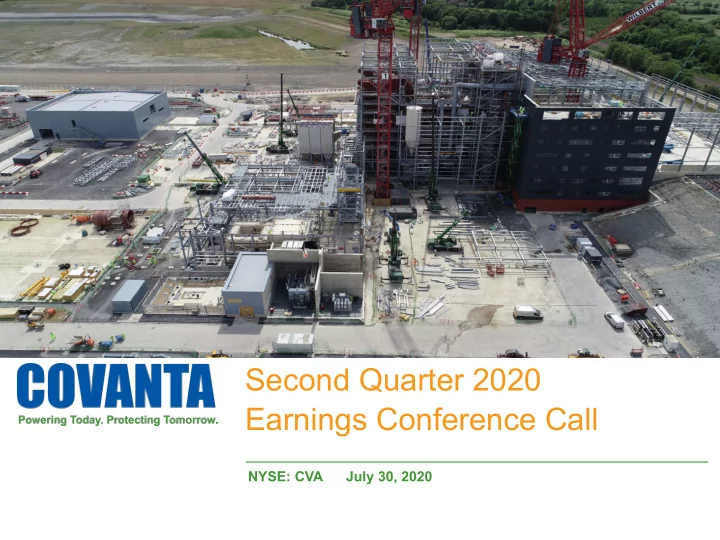
Second Quarter 2020 Earnings Conference Call NYSE: CVA July - - PowerPoint PPT Presentation
Second Quarter 2020 Earnings Conference Call NYSE: CVA July 30, 2020 Cautionary Statements All information included in this earnings presentation is based on continuing operations, unless otherwise noted. Forward-Looking Statements
NYSE: CVA July 30, 2020
July 30, 2020
2
All information included in this earnings presentation is based on continuing operations, unless otherwise noted. Forward-Looking Statements Certain statements in this press release may constitute “forward-looking” statements as defined in Section 27A of the Securities Act of 1933, as amended (the “Securities Act”), Section 21E of the Securities Exchange Act of 1934 (the “Exchange Act”), the Private Securities Litigation Reform Act of 1995 (the “PSLRA”) or in releases made by the Securities and Exchange Commission (“SEC”), all as may be amended from time to time. Such forward- looking statements involve known and unknown risks, uncertainties and other important factors that could cause the actual results, performance or achievements of Covanta Holding Corporation and its subsidiaries (“Covanta”)
Forward-looking statements can be identified by, among other things, the use of forward-looking language, such as the words “plan,” “believe,” “expect,” “anticipate,” “intend,” “estimate,” “project,” “may,” “will,” “would,” “could,” “should,” “seeks,” or “scheduled to,” or other similar words, or the negative of these terms or other variations of these terms or comparable language, or by discussion of strategy or intentions. These cautionary statements are being made pursuant to the Securities Act, the Exchange Act and the PSLRA with the intention of obtaining the benefits of the “safe harbor” provisions of such laws. Covanta cautions investors that any forward-looking statements made by Covanta are not guarantees or indicative of future performance. Important assumptions and other important factors, risks and uncertainties that could cause actual results to differ materially from those forward-looking statements with respect to Covanta include, but are not limited to: the risks and uncertainties affecting Covanta's business described in periodic securities filings by Covanta with the SEC. Important factors, risks, and uncertainties that could cause actual results of Covanta and the JV to differ materially from those forward-looking statements include, but are not limited to: seasonal or long-term fluctuations in the prices of energy, waste disposal, scrap metal and commodities, and Covanta's ability to renew or replace expiring contracts at comparable prices and with other acceptable terms; adoption of new laws and regulations in the United States and abroad, including energy laws, tax laws, environmental laws, labor laws and healthcare laws; advances in technology; difficulties in the operation of our facilities, including fuel supply and energy delivery interruptions, failure to obtain regulatory approvals, equipment failures, labor disputes and work stoppages, and weather interference and catastrophic events; failure to maintain historical performance levels at Covanta's facilities and Covanta's ability to retain the rights to operate facilities Covanta does not own; Covanta's and the joint ventures ability to avoid adverse publicity or reputational damage relating to its business; difficulties in the financing, development and construction of new projects and expansions, including increased construction costs and delays; Covanta's ability to realize the benefits of long-term business development and bear the costs of business development over time; Covanta's ability to utilize net
regulations; concentration of suppliers and customers; geographic concentration of facilities; increased competitiveness in the energy and waste industries; changes in foreign currency exchange rates; limitations imposed by Covanta's existing indebtedness and its ability to perform its financial obligations and guarantees and to refinance its existing indebtedness; exposure to counterparty credit risk and instability of financial institutions in connection with financing transactions; the scalability of its business; restrictions in its certificate of incorporation and debt documents regarding strategic alternatives; failures of disclosure controls and procedures and internal controls
risks and uncertainties affecting Covanta's businesses described in periodic securities filings by Covanta with the SEC. In addition, the current COVID-19 pandemic is significantly impacting the national and global economy and commodity and financial markets. The full extent and impact of the pandemic is unknown and to date has included extreme volatility in financial and commodity markets, a significant slowdown in economic activity, and has raised the prospect of a global recession. The public and private sector response has led to significant restrictions on travel, temporary business closures, quarantines, global stock market volatility and a general reduction in consumer and construction activity globally. Matters outside our control have affected our business and operations and may or may continue to: limit travel of Company representatives to our business units domestically and internationally; adversely affect the health and welfare of our personnel; reduce the volume of waste materials into our facilities and/or the price at which we are able to attract such materials; or prevent important vendors and contractors from performing normal and contracted activities. If significant portions of our workforce are unable to work effectively, including because of illness, quarantines, government actions, travel restrictions, facility closures, social distancing requirements or other restrictions in connection with the pandemic, our operations could be materially
events. Although Covanta believes that its plans, cost estimates, returns on investments, intentions and expectations reflected in or suggested by such forward-looking statements are reasonable, actual results could differ materially from a projection or assumption in any forward-looking statements. Covanta's and the joint ventures future financial condition and results of operations, as well as any forward-looking statements, are subject to change and to inherent risks and uncertainties. The forward-looking statements contained in this press release are made only as of the date hereof and Covanta does not have, or undertake, any obligation to update or revise any forward-looking statements whether as a result of new information, subsequent events or otherwise, unless otherwise required by law. Note: All estimates with respect to future periods are as of July 30, 2020. Covanta does not have or undertake any obligation to update or revise any forward-looking statements whether as a result of new information, subsequent events or otherwise, unless otherwise required by law. Discussion of Non-GAAP Financial Measures We use a number of different financial measures, both United States generally accepted accounting principles (“GAAP”) and non-GAAP, in assessing the overall performance of our business. To supplement our assessment
measures of Adjusted EBITDA and Free Cash Flow as described below, and used in this release, are not intended as a substitute or as an alternative to net income or cash flow provided by operating activities as indicators of
limiting their usefulness for comparison purposes. The presentations of Adjusted EBITDA and Free Cash Flow are intended to enhance the usefulness of our financial information by providing measures which management internally use to assess and evaluate the overall performance of its business and those of possible acquisition or divestiture candidates, and highlight trends in the overall business. Note: Throughout this presentation, certain amounts may not total due to rounding.
July 30, 2020
3
ü Strong Q2 results
ü Waste markets recovering from initial pandemic levels
ü Navigating challenging operating environment
ü Key long-term value and sustainability drivers intact
sustainable solutions
July 30, 2020
4
July 30, 2020
5
1) Includes waste and service revenue, energy and metals volume, metals processing, wholesale energy load serving, and construction activity.
(Unaudited)
July 30, 2020
6
1) Includes waste and service revenue, energy and metals volume, metals processing, wholesale energy load serving, plant operating costs, construction activity, insurance proceeds, and overhead. 2) Energy price includes capacity payments and all RECs. (Unaudited)
July 30, 2020
7
1) Includes capital type expenditures at client owned facilities. (Unaudited)
July 30, 2020
8
(Unaudited, in millions) YTD 2020 FY 2019 FY 2020 Estimate Total Ash Processing System $8 $9 ~$15 New York City MTS contract
1 13 1 Acquisitions
10 17 10 - 15 Total growth investments $19 $56 $25 - $30 Proceeds from asset sales (3) $3 $28 $3
Note: 2020 outlook for acquisitions, UK investments and proceeds from asset sales to be updated as transactions are completed. 1) Organic growth programs are focused primarily on growing waste, energy, and metal revenue generated by our existing assets. 2) Includes early site work in UK, Protos land, and investments in Earls Gate, Newhurst and Zhao County, net of third-party project equity collateralized loan for Zhao County. 3) Includes gross cash received for sales and premiums/development fees received for development projects.
July 30, 2020
9
(Face value; unaudited, in millions) 6/30/2020 12/31/2019 12/31/2018 Cash and cash equivalents $39 $37 $58 Corporate debt: Secured $680 $659 $671 Unsecured 1,744 1,744 1,694 Total corporate debt $2,424 $2,403 $2,365 Project debt 126 131 150 Total debt $2,550 $2,534 $2,515 Net debt (1) $2,507 $2,483 $2,438 Stockholders’ equity $280 $376 $487 Credit Ratios: Consolidated leverage ratio (1) 6.0x 6.1x 5.6x Senior Credit Facility Leverage Ratio (2) 2.2x 2.2x 2.2x
1) Consolidated Leverage Ratio is equal to net debt, calculated as total principal amount of debt outstanding less cash and cash equivalents, debt service principal-related restricted funds ($1 million at June 30, 2020) and escrowed construction financing proceeds ($3 million at June 30, 2020), divided by Adjusted EBITDA, excluding Dublin project proportional Adjusted EBITDA but including dividends from the Dublin project. 2) Leverage ratio as calculated for senior credit facility covenant. Effectively represents leverage at Covanta Energy, LLC and subsidiaries and ratio is pro forma for acquisitions.
July 30, 2020
10
July 30, 2020
11
▪ Same store WtE tip fee revenue:
divestitures), with sequential improvement from May ▪ Environmental services lower due to COVID-19, with variable cost offset limiting EBITDA impact
▪ Increasing availability of contracted MSW and WtE profiled waste to support tip fee prices ▪ Environmental services revenue improving, though lower year-over-year ▪ Exact pace and slope of recovery is uncertain ▪ Expect higher than typical volume of planned and unplanned downtime in 2H20
1) Excludes liquid waste.
(in millions, except price) Q2 2020 Q2 2019 2020E Waste & Service Revenue: WtE tip fees $158 $162 WtE service fees 114 116 465 - 475 Environmental services 31 37 Municipal services 60 62 Other 10 10 Intercompany (28) (28) Total $344 $359 WtE Tons: (1) Tip fee contracted 2.2 2.3 10.6 - 10.8 Tip fee uncontracted 0.5 0.4 Service fee 2.5 2.7 Total 5.2 5.4 WtE Tip Fee Revenue/Ton: Contracted $54.37 $54.16 Uncontracted $78.71 $89.06 Average Tip Fee $59.10 $59.66
(Unaudited)
*Assumes no material operational disruptions due to COVID-19
July 30, 2020
12
(in millions, except price) Q2 2020 Q2 2019 2020E Energy Revenue: Energy sales $57 $58 $260 - $270 Capacity 10 12 40 Other (1) 11 2 45 Total $78 $72 $345 - $355 MWh Sold: Contracted 0.5 0.5 2.1 Hedged (2) 0.9 0.7 3.8 Market 0.2 0.4 0.6 - 0.7 Total 1.5 1.6 6.5 - 6.6 Revenue per MWh: (3) Contracted $69.06 $66.00 $65 Hedged (2) $23.76 $26.42 $31 Market $17.85 $21.69 $15 - $19 Average $37.25 $37.19 $40 - $41
▪ Same store WtE energy revenue down $1 million on slightly lower production ▪ Other energy revenue increase primarily driven by wholesale load serving contracts won earlier in 2020
▪ Energy prices remain weak on low natural gas, but with improved forward outlook for 2021 ▪ Hedge activity:
similar to 2020 hedges
and benefiting from strong summer demand ▪ No meaningful power contract transitions at tip fee plants until after 2024
1) Primary components are wholesale energy load serving revenue not included in Energy sales line, such as transmission and ancillaries, and for 2020, RECs sold bundled with energy. 2) Hedged MWhs and revenue includes hedge from wholesale energy load serving. 3) Excludes capacity and other energy revenue. (Unaudited)
*Assumes no material operational disruptions due to COVID-19
July 30, 2020
13
(Unaudited, in millions, except price) 2018A 2019A 2020E 2021E 2022E 2023E 2024E MWh Sold – CVA Share: Contracted 2.1 2.1 2.1 2.1 2.1 2.0 2.0 Hedged (1) 3.1 3.0 3.8 2.7 0.8 0.2
1.3 1.3 0.7 1.7 3.7 4.3 4.5 Total MWh Sold 6.5 6.4 6.6 6.6 6.6 6.5 6.5 Market Sales (MWh) by Geography: PJM East 0.6 0.6 0.1 0.8 2.0 2.5 2.7 NEPOOL 0.2 0.3 0.1 0.3 1.1 1.2 1.2 NYISO 0.1 0.1 0.1 0.2 0.3 0.3 0.3 Other 0.3 0.3 0.3 0.4 0.3 0.4 0.4 Total Market Sales 1.3 1.3 0.7 1.7 3.7 4.3 4.5 Revenue per MWh: (2) Contracted $66.59 $65.80 $65 Hedged (1) $32.88 $34.29 $31 Market $37.12 $26.31 ~$17 Average Revenue per MWh $44.68 $42.81 ~$40 Capacity Revenue (3) $52 $44 $40 $40
Note: hedged generation as presented above reflects only existing hedges. 1) Hedged MWhs and revenue per MWh includes hedge from wholesale energy load serving. 2) Excludes capacity and other energy revenue. 3) Capacity revenue is approximate, includes bilateral agreements and only represents full year periods in which auctions have already settled.
Note: Production estimates for 2020 - 2024 are based on assumed operating performance and contract structures
*Assumes no material operational disruptions due to COVID-19
July 30, 2020
14
▪ Ferrous revenue down $3 million on lower HMS ▪ Non-ferrous:
for aluminum and copper
improved yields and sales timing
▪ Key metals indices remain subdued:
▪ TAPS continues to progress through testing and commissioning phase; production ramping over the balance of the year
($ in millions, except price; tons in thousands) Q2 2020 Q2 2019 2020E Metals Revenue: Ferrous $10 $13 $35 - $45 Non-ferrous 9 8 35 - 45 Total $20 $21 $70 - $90 Tons Recovered: Ferrous 116 111 450 - 460 Non-ferrous 12 12 47 - 52 Tons Sold: Ferrous 99 95 380 - 390 Non-ferrous 8 7 32 - 37 Revenue per Ton Sold: Ferrous $104 $132 $85 - $115 Non-ferrous $1,123 $1,255 $1,050 - $1,150 Average HMS index price (1) $208 $271 $200 - $225 Average Old Cast Aluminum (2) $0.37 $0.45 ~$0.37
1) 2020 and 2019 average #1 Heavy Melt Steel composite index ($ / gross ton) as published by American Metal Market. 2) 2020 and 2019 average Old Cast Aluminum Scrap ($ / pound) calculated using the high price as published by American Metal Market. (Unaudited)
*Assumes no material operational disruptions due to COVID-19
July 30, 2020
15
▪ 2020 second quarter maintenance lower than prior year due to outage deferrals ▪ COVID-19 cost impacts:
▪ Wholesale load serving costs higher than last year due to additional contracts
▪ 2020 WtE maintenance outlook increased on impact of COVID-19 and expected higher costs to complete ▪ 2H20 spend higher than typical due to outage deferrals, with notably greater mix of capex ▪ Other plant operating expense to reflect:
start-up and wholesale energy load serving
lower variable costs for environmental services
(in millions) Q2 2020 Q2 2019 2020E Plant Maintenance Expense: WtE $79 $81 $305 - $315 Other 2 2 Total $81 $83 Maintenance Capex: WtE $27 $31 $140 - $150 Other 4 3 15 Total $32 $34 $155 - $165 Total WtE Maintenance Spend $106 $112 $445 - $465 Other Plant Operating Expense: WtE $182 $183 Other 77 89 Total $259 $272 Other Operating Expense $14 $16 (Unaudited) *Assumes no material operational disruptions due to COVID-19
July 30, 2020
16
1) Adjustment for impact of adoption of FASB ASC 853 – Service Concession Arrangements. 2) Adjustment beginning in 2018 to equity in income from unconsolidated investments to adjust for the proportional impact of depreciation & amortization, interest expense, and taxes at the unconsolidated subsidiary (Proportional Adjusted EBITDA).
Q2 Full Year LTM (Unaudited, in millions) 2020 2019 2019 2018 June 30, 2020 Net (loss) income $(13) $(21) $10 $152 $(19) Depreciation and amortization expense 56 55 221 218 225 Interest expense 34 36 143 145 139 Income tax (benefit) expense (4) (3) (7) (29) (15) Impairment charges — 1 2 86 20 Accretion expense — — 2 2 — Severance and reorganization costs 1 1 13 5 5 Stock-based compensation expense 6 7 25 24 24 Loss on asset sales 2 1 4 1 3 Capital type expenditures at client owned facilities (1) 5 7 34 37 33 Net loss (gain) on sale of business and investments — 2 (49) (217) (9) Loss on extinguishment of debt — — — 15 — Business development and transaction costs — 1 2 3 1 Property insurance recoveries, net — — — (18) — Adjustments to reflect Adjusted EBITDA from unconsolidated investments (2) 6 6 25 23 25 Other 3 1 3 10 9 Adjusted EBITDA $96 $94 $428 $457 $443
July 30, 2020
17
1) Adjustment for impact of adoption of FASB ASC 853 – Service Concession Arrangements. 2) Adjustment beginning in 2018 to reconcile equity in income from unconsolidated investments to proportional Adjusted EBITDA. 3) Adjustment for the impact of the adoption of ASU 2016-18 effective January 1, 2018. As a result of adoption, the statement of cash flows explains the change during the period in the total of cash, cash equivalents, and amounts generally described as restricted cash or restricted cash equivalents. Therefore, changes in restricted funds are eliminated in arriving at net cash, cash equivalents, and restricted funds provided by operating activities.
Q2 Full Year (Unaudited, in millions) 2020 2019 2019 2018 Adjusted EBITDA $96 $94 $428 $457 Cash paid for interest, net of capitalized interest (9) (12) (152) (136) Cash paid for taxes, net — (3) (5) (2) Capital type expenditures at client owned facilities (1) (5) (7) (34) (37) Equity in net income from unconsolidated investments — (3) (6) (6) Adjustments to reflect Adjusted EBITDA from unconsolidated investments (2) (6) (6) (25) (23) Dividends from unconsolidated investments 3 5 9 13 Adjustment for working capital and other 15 (18) 11 (28) Net cash provided by operating activities $94 $50 $226 $238 Changes in restricted funds - operating (3) — 5 20 4 Maintenance capital expenditures (32) (34) 106 (142) Free Cash Flow $62 $21 $140 $100
July 30, 2020
18
Free Cash Flow Free Cash Flow is defined as cash flow provided by operating activities, plus changes in restricted funds - operating, less maintenance capital expenditures, which are capital expenditures primarily to maintain
liquidity to determine amounts we can reinvest in our core businesses, such as amounts available to make acquisitions, invest in construction of new projects, make principal payments on debt, or amounts we can return to our stockholders through dividends and/or stock repurchases. In order to provide a meaningful basis for comparison, we are providing information with respect to our Free Cash Flow for the three and six months ended June 30, 2020 and 2019 reconciled for each such period to cash flow provided by operating activities, which we believe to be the most directly comparable measure under GAAP. Adjusted EBITDA We use Adjusted EBITDA to provide additional ways of viewing aspects of operations that, when viewed with the GAAP results provide a more complete understanding of our core business. As we define it, Adjusted EBITDA represents earnings before interest, taxes, depreciation and amortization, as adjusted for additional items subtracted from or added to net income including the effects of impairment losses, gains or losses on sales, dispositions or retirements of assets, adjustments to reflect the Adjusted EBITDA from our unconsolidated investments, adjustments to exclude significant unusual or non-recurring items that are not directly related to our operating performance plus adjustments to capital type expenses for our service fee facilities in line with our credit agreements. We adjust for these items in our Adjusted EBITDA as our management believes that these items would distort their ability to efficiently view and assess our core operating trends. As larger parts of our business are conducted through unconsolidated investments, we adjust EBITDA for our proportionate share of the entity's depreciation and amortization, interest expense, tax expense and other adjustments to exclude significant unusual or non-recurring items that are not directly related to the entity's operating performance. in order to improve comparability to the Adjusted EBITDA of our wholly owned entities. We do not have control, nor have any legal claim to the portion of our unconsolidated investees' revenues and expenses allocable to our joint venture partners. As we do not control, but do exercise significant influence, we account for these unconsolidated investments in accordance with the equity method of accounting. Net income (losses) from these investments are reflected within our consolidated statements of operations in Equity in net income from unconsolidated investments. In order to provide a meaningful basis for comparison, we are providing information with respect to our Adjusted EBITDA for the three and six months ended June 30, 2020 and 2019, reconciled for each such period to net income and cash flow provided by operating activities, which are believed to be the most directly comparable measures under GAAP. Our projections of the proportional contribution of our interests in the Joint Venture to our Adjusted EBITDA and Free Cash Flow are not based on GAAP net income/loss or Cash flow provided by operating activities, respectively, and are anticipated to be adjusted to exclude the effects of events or circumstances in 2020 that are not representative or indicative of our results of operations and that are not currently
an Adjusted EBITDA projection.