Searching and trapping for Mulgara in the Pilbara Graham Thompson - - PowerPoint PPT Presentation

searching and trapping for mulgara in the pilbara
SMART_READER_LITE
LIVE PREVIEW

Searching and trapping for Mulgara in the Pilbara Graham Thompson - - PowerPoint PPT Presentation

Searching and trapping for Mulgara in the Pilbara Graham Thompson Scott Thompson www.terrestrialecosystems.com Dasycercus sp. www.terrestrialecosystems.com Motivation for this research Failure to identify Mulgara habitat The above statement


slide-1
SLIDE 1

www.terrestrialecosystems.com
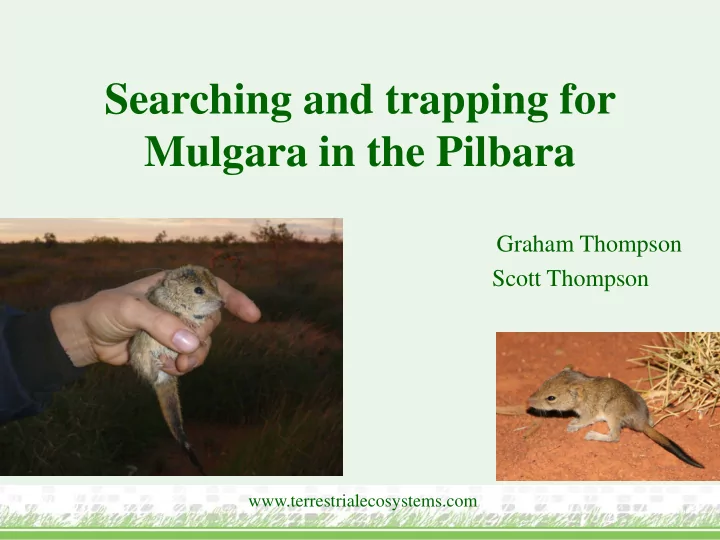
Searching and trapping for Mulgara in the Pilbara

Graham Thompson Scott Thompson

slide-2
SLIDE 2

www.terrestrialecosystems.com

Dasycercus sp.

slide-3
SLIDE 3

www.terrestrialecosystems.com

Motivation for this research

The above statement was taken from an EPBC referral in 2012 for a site within 1km of the area that has the highest recorded density of Mulgara in the Pilbara and where the habitat was almost identical!

Failure to identify Mulgara habitat

slide-4
SLIDE 4

www.terrestrialecosystems.com

Motivation for this research

This area probably supported Mulgara, and was not referred under the EPBC Act

Failure to identify Mulgara habitat

slide-5
SLIDE 5

www.terrestrialecosystems.com

Motivation for this research

Failure to detect burrows

slide-6
SLIDE 6

www.terrestrialecosystems.com

Motivation for this research

Mis-identification of burrows

slide-7
SLIDE 7

www.terrestrialecosystems.com

Mulgara burrows

  • How many people doing field work in the Pilbara have actually dug Mulgara from a

burrow or followed a Mulgara to a burrow and know what Mulgara burrows look like?

slide-8
SLIDE 8

www.terrestrialecosystems.com

Insufficient trapping effort

Motivation for this research

slide-9
SLIDE 9

www.terrestrialecosystems.com

Mulgara burrows in the Pilbara

  • ‘D’ shaped entrance
  • Underground tunnels are generally 60-70mm wide, narrowest at about 40mm
slide-10
SLIDE 10

www.terrestrialecosystems.com

Simple Mulgara burrow

Elevation not to scale

Thompson and Thompson JRSWA 2007, 90:195-202

slide-11
SLIDE 11

www.terrestrialecosystems.com

Complex Mulgara burrow

Elevation not to scale

Thompson and Thompson JRSWA, 2007, 90: 195-202

slide-12
SLIDE 12

www.terrestrialecosystems.com

Complex Mulgara burrow

Elevation not to scale

Thompson and Thompson JRSWA, 2007, 90:195-202

slide-13
SLIDE 13

www.terrestrialecosystems.com

Spinifex Hopping Mouse borrow

Thompson and Thompson JRSWA 2007, 90: 111-113

slide-14
SLIDE 14

www.terrestrialecosystems.com

Mulgara burrows in the Pilbara

  • Varying number of entrances
  • Entrances can be in the open or hidden under spinifex and

shrubs

  • Burrows have interconnecting tunnels
  • Each Mulgara probably has multiple burrows
slide-15
SLIDE 15

www.terrestrialecosystems.com

Four case studies all are from the Pilbara, where:

– the terrain is generally flat; – hard, sandy surface, often with surface stones; – low shrubs or hard spinifex of varying densities and heights; and – the landscape is often burnt.

slide-16
SLIDE 16

www.terrestrialecosystems.com

Case study 1

Thompson and Thompson , JRSWA , 2007, 90: 195-202

slide-17
SLIDE 17

www.terrestrialecosystems.com

Case study 1

Methods

  • Searched in June 2006 (22 person hrs –

44ha)

  • Trapped (750 trap-nights) and all burrows

were dug out in Jan 2007

Results

  • Only 9 burrows found in the 2006 search
  • 65 burrows dug out after fire in Jan 2007
  • 4 Mulgara trapped, 5 more dug out
  • Mulgara trapped on nights 1, 2, 3 and 4
  • 190 trap-nights per Mulgara caught

Conclusions

  • A lot of new burrow dug between June and

December or burrows were not found during searches in June 2006

  • Mulgara are difficult to trap in a resource

limited environment

  • Digging out all burrows ensures you catch

all Mulgara

  • Burrows easier to find after it was burnt

Thompson and Thompson , JRSWA , 2007, 90: 195-202

slide-18
SLIDE 18

www.terrestrialecosystems.com

Case study 2

Thompson and Thompson, Australian Mammalogy, 2008, 30: 65-70

slide-19
SLIDE 19

www.terrestrialecosystems.com

Case study 2

Methods

  • 9,900 trap-nights (Jan-Feb 2007, Jun

2007) in 210ha

Results

  • Very few Mulgara burrows seen
  • 50 Mulgara trapped
  • 220 trap-nights per Mulgara
  • 395 D. rosamondae, 1 N. alexis,

27 P. desertor, 179 M. musculus, and 1,212 P. hermannsburgensis trapped

Conclusions

  • Mulgara passed multiple baited traps
  • n multiple nights before they were

caught

  • Mulgara are difficult to trap, even in

areas of high density

  • May not be living in ‘typical’ burrows
  • r burrows

Thompson and Thompson, Australian Mammalogy, 2008, 30: 65-70

slide-20
SLIDE 20

www.terrestrialecosystems.com

Case study 3

slide-21
SLIDE 21

www.terrestrialecosystems.com

Case study 3

Methods

  • Traps set at 25m centres for 5 or 8

nights (May 2013)

  • Traps set at 25m centres
  • 3,367 trap-nights

Results

  • 2 Mulgara caught on nights 3 and 5
  • 3 burrows recorded that could have

been N. alexis or D. blythi

  • 23 P. desertor, 24 M. musculus,

30 D. rosamondae, 26 N. alexis, and 46 P. hermannsburgensis caught Conclusions

  • Mulgara passed multiple baited traps
  • n multiple nights before they were

caught

  • Burrows are difficult to locate in

dense vegetation

slide-22
SLIDE 22

www.terrestrialecosystems.com

Case study 4

slide-23
SLIDE 23

www.terrestrialecosystems.com

Case study 4

Methods

  • 1,881 baited traps, 9,740 trap-nights
  • Traps set at 25m centres

Results

  • 2 Mulgara caught on nights 6

and 7

  • 19 D. rosamondae, 430 N. alexis,

25 M. musculus, 17 P. desertor, 196 P. hermannsburgensis caught

  • 3 N. alexis burrows found

Conclusions

  • Mulgara passed multiple baited traps
  • n multiple nights before they were

caught

  • Burrows are difficult to locate in

dense vegetation

slide-24
SLIDE 24

www.terrestrialecosystems.com

Case study conclusions

  • searching in mature, high or dense spinifex and low shrubs resulted in

many burrows not being detected;

  • it was relatively easy to misidentify burrows used by Mulgara;
  • Mulgara passed multiple baited traps on multiple nights before they were

caught;

  • in a high density population a minimum of 200 trap-nights / individual was

necessary to capture most Mulgara; and

  • five nights of trapping was not sufficient to catch all Mulgara in an area

when traps were placed at 25m centres (16 traps per ha).

slide-25
SLIDE 25

www.terrestrialecosystems.com

Recommendations

  • Assuming that Mulgara are living in burrows, searches to record the

presence of Mulgaras in an area should only occur when: – the height of spinifex or shrubs is less than 50cm; – the vegetation cover is less than 40%; and – the search effort is greater than two persons/hr/ha.

  • In areas where the height of spinifex and shrubs is greater than 50cm and

the vegetation cover greater than 40%, then the area should be trapped instead of grid searching;

slide-26
SLIDE 26

www.terrestrialecosystems.com

Recommendations

  • The minimum trapping effort to detect or remove all Mulgaras from an area

should be 16 traps per ha (25m centres) with traps set for a minimum of seven nights; and

  • When the purpose of the trapping program is to catch and/or record all

Mulgara in an area, trapping should cease when no Mulgara have been caught within 400m of the trap for three consecutive nights.