Search-Based Agents Computing Driving Directions Appropriate in - - PowerPoint PPT Presentation

search based agents computing driving directions
SMART_READER_LITE
LIVE PREVIEW

Search-Based Agents Computing Driving Directions Appropriate in - - PowerPoint PPT Presentation

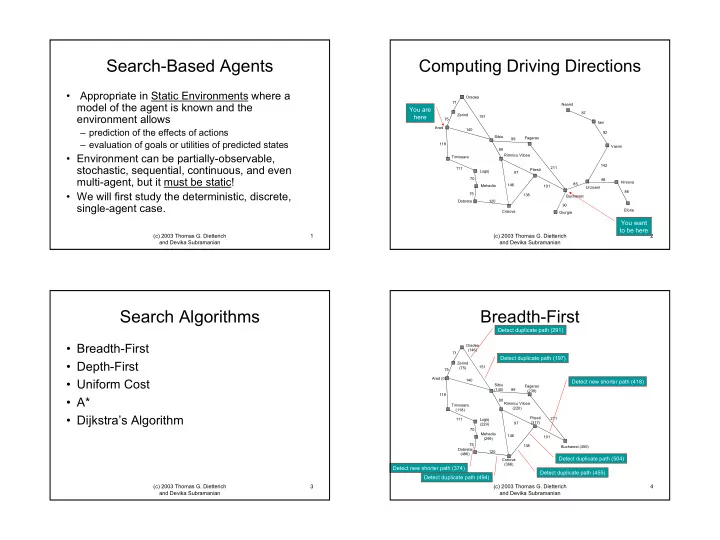
Search-Based Agents Computing Driving Directions Appropriate in Static Environments where a Oradea 71 model of the agent is known and the Neamt You are 87 Zerind environment allows here 151 75 Iasi Arad prediction of the


slide-1
SLIDE 1

1

(c) 2003 Thomas G. Dietterich and Devika Subramanian 1

Search-Based Agents

  • Appropriate in Static Environments where a

model of the agent is known and the environment allows

– prediction of the effects of actions – evaluation of goals or utilities of predicted states

  • Environment can be partially-observable,

stochastic, sequential, continuous, and even multi-agent, but it must be static!

  • We will first study the deterministic, discrete,

single-agent case.

(c) 2003 Thomas G. Dietterich and Devika Subramanian 2

Computing Driving Directions

Arad Oradea Zerind Timisoara Lugoj Dobreta Sibiu Rimnicu Vilcea Fagaras Pitesti Mehadia Craiova Bucharest Giurgia Urzicenl Neamt Iasi Vasini Hirsova Eforie 71 75 118 140 151 99 80 111 70 75 120 146 97 138 101 211 85 90 142 92 87 98 86

You are here You want to be here

(c) 2003 Thomas G. Dietterich and Devika Subramanian 3

Search Algorithms

  • Breadth-First
  • Depth-First
  • Uniform Cost
  • A*
  • Dijkstra’s Algorithm

(c) 2003 Thomas G. Dietterich and Devika Subramanian 4

Oradea (146) 71

Breadth-First

Arad (0) 75 Zerind (75) 118 Timisoara (118) Lugoj (229) 111 Mehadia (299) 70 75 Dobreta (486) 120 140 Sibiu (140) 151 Rimnicu Vilcea (220) 80 Fagaras (239) 99 Craiova (366) 146 Pitesti (317) 97 138 Bucharest (450) 211 101

Detect duplicate path (291) Detect new shorter path (418) Detect duplicate path (455) Detect duplicate path (504) Detect new shorter path (374) Detect duplicate path (494) Detect duplicate path (197)

slide-2
SLIDE 2

2

Breadth-First

Oradea (146) 71 Arad (0) 75 Zerind (75) 118 Timisoara (118) Lugoj (229) 111 Mehadia (299) 70 75 Dobreta (486) 120 140 Sibiu (140) 151 Rimnicu Vilcea (220) 80 Fagaras (239) 99 Craiova (366) 146 Pitesti (317) 97 138 Bucharest (450) 211 101

Arad (0) Sibiu (140) Zerind (75) Timisoara (118) Arad (150) Oradea (146) Arad (280) Fagaras (239) Oradea (291) Arad (236) Lugoj (229) Sibiu (197) Sibiu (338) Bucharest (450) Rimnicu Vilcea (220) Timisoara (340) Mehadia (299) Sibiu (300) Pitesti (317) Craiova (366) Lugoj (369) Dobreta (374) Craiova (455) Rimnicu Vilcea (317) Bucharest (418) Rimnicu Vilcea (482) Dobreta (486) Pitesti (504) Medhadia (449) Craiova (494) Zerind (217)

(c) 2003 Thomas G. Dietterich and Devika Subramanian 6

Formal Statement of Search Problems

  • State Space: set of possible “mental” states

– cities in Romania

  • Initial State: state from which search begins

– Arad

  • Operators: simulated actions that take the agent

from one mental state to another

– traverse highway between two cities

  • Goal Test:

– Is current state Bucharest?

(c) 2003 Thomas G. Dietterich and Devika Subramanian 7

General Search Algorithm

function GENERAL-SEARCH( problem, strategy) returns a solution, or failure initialize the search tree using the initial state of problem loop do if there are no candidates for expansion then return failure choose a leaf node for expansion according to strategy if the node contains a goal state then return the corresponding solution else expand the node and add the resulting nodes to the search tree end

Strategy: first-in first-out queue (expand oldest leaf first)

(c) 2003 Thomas G. Dietterich and Devika Subramanian 8

Leaf Selection Strategies

  • Breadth-First Search: oldest leaf (FIFO)
  • Depth-First Search: youngest leaf (LIFO)
  • Uniform Cost Search: cheapest leaf (Priority

Queue)

  • A* search: leaf with estimated shortest total path

length g(x) + h(x) = f(x)

– where g(x) is length so far – and h(x) is estimate of remaining length – (Priority Queue)

slide-3
SLIDE 3

3

(c) 2003 Thomas G. Dietterich and Devika Subramanian 9

A* Search

  • Let h(x) be a “heuristic function” that gives

an underestimate of the true distance between x and the goal state

– Example: Euclidean distance

  • Let g(x) be the distance from the start to x,

then g(x) + h(x) is an lower bound on the length of the optimal path

(c) 2003 Thomas G. Dietterich and Devika Subramanian 10

Euclidean Distance Table

374 Zerind 244 Lugoj 199 Vaslui 226 Iasi 80 Urziceni 151 Hirsova 329 Timisoara 77 Giurgiu 253 Sibiu 176 Fagaras 193 Rimnicu Vilcea 161 Eforie 100 Pitesti 242 Dobreta 380 Oradea 160 Craiova 234 Neamt Bucharest 241 Mehadia 366 Arad

(c) 2003 Thomas G. Dietterich and Devika Subramanian 11

A* Search

Arad (0+366=366) Sibiu (140+253=393) Zerind (75+374=449) Timisoara (118+329=447) Fagaras (239+176=415) Oradea (291+380=671) Bucharest (450+0=450) Rimnicu Vilcea (220+193=413) Pitesti (317+100=417) Craiova (366+160=526) Craiova (455+160=615) Bucharest (418+0=418)

All remaining leaves have f(x) ≥ 418, so we know they cannot have shorter paths to Bucharest

(c) 2003 Thomas G. Dietterich and Devika Subramanian 12

Dijkstra’s Algorithm

  • Works backwards from the goal
  • Each node keeps track of the shortest

known path (and its length) to the goal

  • Equivalent to uniform cost search starting

at the goal

  • No early stopping: finds shortest path from

all nodes to the goal

slide-4
SLIDE 4

4

(c) 2003 Thomas G. Dietterich and Devika Subramanian 13

Local Search Algorithms

  • Keep a single current state x
  • Repeat

– Apply one or more operators to x – Evaluate the resulting states according to an Objective Function J(x) – Choose one of them to replace x (or decide not to replace x at all)

  • Until time limit or stopping criterion

(c) 2003 Thomas G. Dietterich and Devika Subramanian 14

Hill Climbing

current state

  • bjective function

state space global maximum local maximum “flat” local maximum shoulder

  • Simple hill climbing:

apply a randomly-chosen

  • perator to the current

state

  • If resulting state is better,

replace current state

  • Steepest-Ascent Hill

Climbing:

  • Apply all operators to

current state, keep state with the best value

  • Stop when no

successors state is better than current state

(c) 2003 Thomas G. Dietterich and Devika Subramanian 15

Gradient Ascent

  • In continuous state spaces, x = (x1, x2, …, xn)

is a vector of real values

  • Continuous operator: x := x+ ∆x for any

arbitrary vector ∆x (infinitely many operators!)

  • Suppose J(x) is differentiable. Then we can

compute the direction of steepest increase of J by the first derivative with respect to x, the gradient:

(c) 2003 Thomas G. Dietterich and Devika Subramanian 16

Gradient Descent Search

  • Repeat

– Compute Gradient ∇J – Update x := x + η ∇J

  • Until ∇J ≈ 0
  • η is the “step size”, and it must be chosen

carefully

  • Methods such as conjugate gradient and

Newton’s method choose η automatically

slide-5
SLIDE 5

5

(c) 2003 Thomas G. Dietterich and Devika Subramanian 17

Visualizing Gradient Ascent

If η is too large, search may overshoot and miss the maximum or

  • scillate forever

(c) 2003 Thomas G. Dietterich and Devika Subramanian 18

Problems with Hill Climbing

current state

  • bjective function

state space global maximum local maximum “flat” local maximum shoulder

  • Local optima
  • Flat regions
  • Random restarts can

give good results

(c) 2003 Thomas G. Dietterich and Devika Subramanian 19

Simulated Annealing

  • T = 100 (or some large value)
  • Repeat

– Apply randomly-chosen operator to x to obtain x′. – Let ∆E = J(x′) – J(x) – If ∆E > 0, switch to x′ – Else switch to x′ with probability

  • exp [∆E/T] (large negative steps are less likely)
  • T := 0.99 * T (“cool” T)
  • Slowly decrease T (“anneal”) to zero
  • Stop when no changes have been accepted for many

moves

  • Idea: Accept “down hill” steps with some probability to

help escape from local minima