Schema Refinement and Normal Forms Chapter 19 Database Management - - PDF document

schema refinement and normal forms
SMART_READER_LITE
LIVE PREVIEW

Schema Refinement and Normal Forms Chapter 19 Database Management - - PDF document

Schema Refinement and Normal Forms Chapter 19 Database Management Systems, 3ed, R. Ramakrishnan and J. Gehrke 1 The Evils of Redundancy Redundancy is at the root of several problems associated with relational schemas: redundant


slide-1
SLIDE 1

Database Management Systems, 3ed, R. Ramakrishnan and J. Gehrke 1

Schema Refinement and Normal Forms

Chapter 19

Database Management Systems, 3ed, R. Ramakrishnan and J. Gehrke 2

The Evils of Redundancy

Redundancy is at the root of several problems

associated with relational schemas:

redundant storage, insert/delete/update anomalies

Integrity constraints, in particular functional

dependencies, can be used to identify schemas with such problems and to suggest refinements.

Main refinement technique: decomposition (replacing

ABCD with, say, AB and BCD, or ACD and ABD).

Decomposition should be used judiciously:

Is there reason to decompose a relation? What problems (if any) does the decomposition cause?

Database Management Systems, 3ed, R. Ramakrishnan and J. Gehrke 3

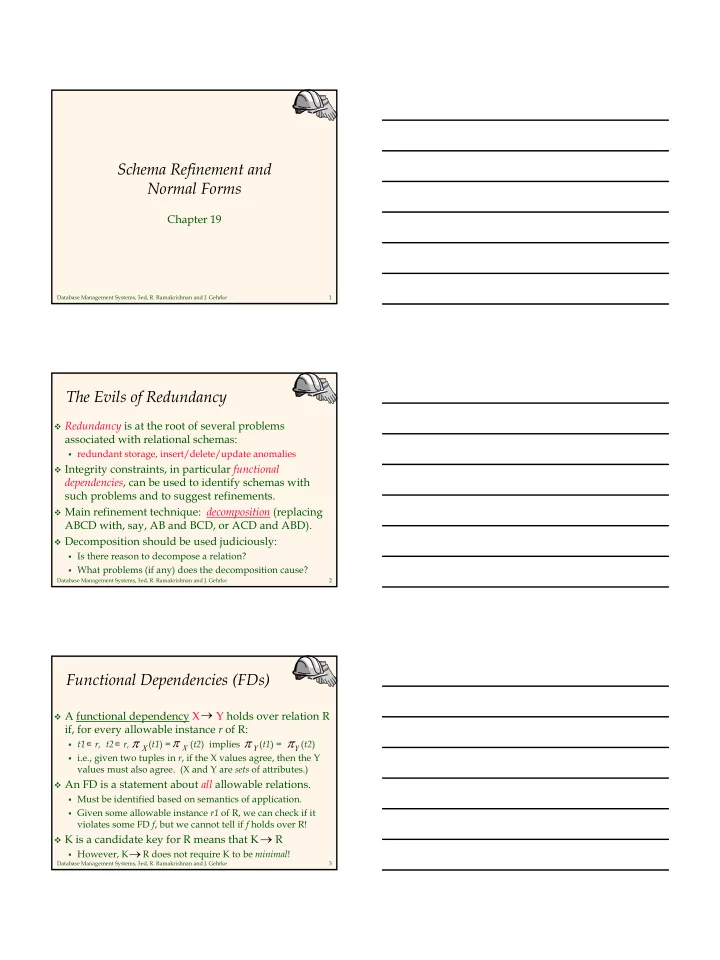
Functional Dependencies (FDs)

A functional dependency X Y holds over relation R

if, for every allowable instance r of R:

t1 r, t2 r, (t1) = (t2) implies (t1) = (t2) i.e., given two tuples in r, if the X values agree, then the Y

values must also agree. (X and Y are sets of attributes.)

An FD is a statement about all allowable relations.

Must be identified based on semantics of application. Given some allowable instance r1 of R, we can check if it

violates some FD f, but we cannot tell if f holds over R!

K is a candidate key for R means that K R

However, K R does not require K to be minimal!

∈ ∈ π X

π X π Y πY

→ →

slide-2
SLIDE 2

Database Management Systems, 3ed, R. Ramakrishnan and J. Gehrke 4

Example: Constraints on Entity Set

Consider relation obtained from Hourly_Emps:

Hourly_Emps (ssn, name, lot, rating, hrly_wages, hrs_worked)

Notation: We will denote this relation schema by

listing the attributes: SNLRWH

This is really the set of attributes {S,N,L,R,W,H}. Sometimes, we will refer to all attributes of a relation by

using the relation name. (e.g., Hourly_Emps for SNLRWH)

Some FDs on Hourly_Emps:

ssn is the key: S SNLRWH rating determines hrly_wages: R W

→ →

Database Management Systems, 3ed, R. Ramakrishnan and J. Gehrke 5

Example (Contd.)

Problems due to R W : Update anomaly: Can

we change W in just the 1st tuple of SNLRWH?

Insertion anomaly: What if

we want to insert an employee and don’t know the hourly wage for his rating?

Deletion anomaly: If we

delete all employees with rating 5, we lose the information about the wage for rating 5!

S N L R W H 123-22-3666 Attishoo 48 8 10 40 231-31-5368 Smiley 22 8 10 30 131-24-3650 Smethurst 35 5 7 30 434-26-3751 Guldu 35 5 7 32 612-67-4134 Madayan 35 8 10 40 S N L R H 123-22-3666 Attishoo 48 8 40 231-31-5368 Smiley 22 8 30 131-24-3650 Smethurst 35 5 30 434-26-3751 Guldu 35 5 32 612-67-4134 Madayan 35 8 40 R W 8 10 5 7

Hourly_Emps2 Wages Will 2 smaller tables be better?

Database Management Systems, 3ed, R. Ramakrishnan and J. Gehrke 6

Reasoning About FDs

Given some FDs, we can usually infer additional FDs:

ssn

did, did lot implies ssn lot

An FD f is implied by a set of FDs F if f holds

whenever all FDs in F hold.

  • = closure of F is the set of all FDs that are implied by F.

Armstrong’s Axioms (X, Y, Z are sets of attributes):

Reflexivity: If X Y, then Y X Augmentation: If X Y, then XZ YZ for any Z Transitivity: If X Y and Y Z, then X Z

These are sound and complete inference rules for FDs!

→ → →

F +

→ → → → → →

slide-3
SLIDE 3

Database Management Systems, 3ed, R. Ramakrishnan and J. Gehrke 7

Reasoning About FDs (Contd.)

Couple of additional rules (that follow from AA):

Union: If X Y and X Z, then X YZ Decomposition: If X YZ, then X Y and X Z

Example: Contracts(cid,sid,jid,did,pid,qty,value), and:

C is the key: C CSJDPQV Project purchases each part using single contract: JP C Dept purchases at most one part from a supplier: SD P

JP C, C CSJDPQV imply JP CSJDPQV SD P implies SDJ JP SDJ JP, JP CSJDPQV imply SDJ CSJDPQV

→ → → → → → →

→ → → → → → → → → →

Database Management Systems, 3ed, R. Ramakrishnan and J. Gehrke 8

Reasoning About FDs (Contd.)

Computing the closure of a set of FDs can be

  • expensive. (Size of closure is exponential in # attrs!)

Typically, we just want to check if a given FD X Y is

in the closure of a set of FDs F. An efficient check:

Compute attribute closure of X (denoted ) wrt F:

  • Set of all attributes A such that X A is in
  • There is a linear time algorithm to compute this.

Check if Y is in

Does F = {A B, B C, C D E } imply A E?

i.e, is A E in the closure ? Equivalently, is E in ?

X+

X+ F+ A+ F+

→ → → → →

Database Management Systems, 3ed, R. Ramakrishnan and J. Gehrke 9

Normal Forms

Returning to the issue of schema refinement, the first

question to ask is whether any refinement is needed!

If a relation is in a certain normal form (BCNF, 3NF

etc.), it is known that certain kinds of problems are avoided/minimized. This can be used to help us decide whether decomposing the relation will help.

Role of FDs in detecting redundancy:

Consider a relation R with 3 attributes, ABC.

  • No FDs hold: There is no redundancy here.
  • Given A B: Several tuples could have the same A

value, and if so, they’ll all have the same B value!

slide-4
SLIDE 4

Database Management Systems, 3ed, R. Ramakrishnan and J. Gehrke 10

Boyce-Codd Normal Form (BCNF)

Reln R with FDs F is in BCNF if, for all X A in

A X (called a trivial FD), or X contains a key for R.

In other words, R is in BCNF if the only non-trivial

FDs that hold over R are key constraints.

No dependency in R that can be predicted using FDs alone. If we are shown two tuples that agree upon

the X value, we cannot infer the A value in

  • ne tuple from the A value in the other.

If example relation is in BCNF, the 2 tuples

must be identical (since X is a key).

F+ →

X Y A x y1 a x y2 ?

Database Management Systems, 3ed, R. Ramakrishnan and J. Gehrke 11

Third Normal Form (3NF)

Reln R with FDs F is in 3NF if, for all X A in

A X (called a trivial FD), or X contains a key for R, or A is part of some key for R.

Minimality of a key is crucial in third condition above! If R is in BCNF, obviously in 3NF. If R is in 3NF, some redundancy is possible. It is a

compromise, used when BCNF not achievable (e.g., no ``good’’ decomp, or performance considerations).

Lossless-join, dependency-preserving decomposition of R into a

collection of 3NF relations always possible.

F+ →

Database Management Systems, 3ed, R. Ramakrishnan and J. Gehrke 12

What Does 3NF Achieve?

If 3NF violated by X A, one of the following holds:

X is a subset of some key K

  • We store (X, A) pairs redundantly.

X is not a proper subset of any key.

  • There is a chain of FDs K X A, which means that

we cannot associate an X value with a K value unless we also associate an A value with an X value.

But: even if reln is in 3NF, these problems could arise.

e.g., Reserves SBDC, S C, C S is in 3NF, but for

each reservation of sailor S, same (S, C) pair is stored.

Thus, 3NF is indeed a compromise relative to BCNF.

→ → → → →

slide-5
SLIDE 5

Database Management Systems, 3ed, R. Ramakrishnan and J. Gehrke 13

Decomposition of a Relation Scheme

Suppose that relation R contains attributes A1 ... An.

A decomposition of R consists of replacing R by two or more relations such that:

Each new relation scheme contains a subset of the attributes

  • f R (and no attributes that do not appear in R), and

Every attribute of R appears as an attribute of one of the

new relations.

Intuitively, decomposing R means we will store

instances of the relation schemes produced by the decomposition, instead of instances of R.

E.g., Can decompose SNLRWH into SNLRH and RW.

Database Management Systems, 3ed, R. Ramakrishnan and J. Gehrke 14

Example Decomposition

Decompositions should be used only when needed.

SNLRWH has FDs S SNLRWH and R W Second FD causes violation of 3NF; W values repeatedly

associated with R values. Easiest way to fix this is to create a relation RW to store these associations, and to remove W from the main schema:

  • i.e., we decompose SNLRWH into SNLRH and RW

The information to be stored consists of SNLRWH

  • tuples. If we just store the projections of these tuples
  • nto SNLRH and RW, are there any potential

problems that we should be aware of? → →

Database Management Systems, 3ed, R. Ramakrishnan and J. Gehrke 15

Problems with Decompositions

  • There are three potential problems to consider:

Some queries become more expensive.

  • e.g., How much did sailor Joe earn? (salary = W*H)

Given instances of the decomposed relations, we may not

be able to reconstruct the corresponding instance of the

  • riginal relation!
  • Fortunately, not in the SNLRWH example.

Checking some dependencies may require joining the

instances of the decomposed relations.

  • Fortunately, not in the SNLRWH example.
  • Tradeoff: Must consider these issues vs. redundancy.
slide-6
SLIDE 6

Database Management Systems, 3ed, R. Ramakrishnan and J. Gehrke 16

Lossless Join Decompositions

Decomposition of R into X and Y is lossless-join w.r.t.

a set of FDs F if, for every instance r that satisfies F:

  • (r) (r) = r

It is always true that r (r) (r)

In general, the other direction does not hold! If it does, the

decomposition is lossless-join.

Definition extended to decomposition into 3 or more

relations in a straightforward way.

It is essential that all decompositions used to deal with

redundancy be lossless! (Avoids Problem (2).) π X

π Y

> <

⊆ π X

> < π Y

Database Management Systems, 3ed, R. Ramakrishnan and J. Gehrke 17

More on Lossless Join

The decomposition of R into

X and Y is lossless-join wrt F if and only if the closure of F contains:

X Y X, or X Y Y

In particular, the

decomposition of R into UV and R - V is lossless-join if U V holds over R. → →

∩ ∩

→ A B C 1 2 3 4 5 6 7 2 8 1 2 8 7 2 3 A B C 1 2 3 4 5 6 7 2 8 A B 1 2 4 5 7 2 B C 2 3 5 6 2 8

Database Management Systems, 3ed, R. Ramakrishnan and J. Gehrke 18

Dependency Preserving Decomposition

Consider CSJDPQV, C is key, JP C and SD P.

BCNF decomposition: CSJDQV and SDP Problem: Checking JP C requires a join!

Dependency preserving decomposition (Intuitive):

If R is decomposed into X, Y and Z, and we enforce the FDs

that hold on X, on Y and on Z, then all FDs that were given to hold on R must also hold. (Avoids Problem (3).)

Projection of set of FDs F: If R is decomposed into X, ...

projection of F onto X (denoted FX ) is the set of FDs U V in F+ (closure of F ) such that U, V are in X. → → → →

slide-7
SLIDE 7

Database Management Systems, 3ed, R. Ramakrishnan and J. Gehrke 19

Dependency Preserving Decompositions (Contd.)

Decomposition of R into X and Y is dependency

preserving if (FX union FY ) + = F +

i.e., if we consider only dependencies in the closure F + that

can be checked in X without considering Y, and in Y without considering X, these imply all dependencies in F +.

Important to consider F +, not F, in this definition:

ABC, A B, B C, C A, decomposed into AB and BC. Is this dependency preserving? Is C A preserved?????

Dependency preserving does not imply lossless join:

ABC, A B, decomposed into AB and BC.

And vice-versa! (Example?)

→ → → → →

Database Management Systems, 3ed, R. Ramakrishnan and J. Gehrke 20

Decomposition into BCNF

Consider relation R with FDs F. If X Y violates

BCNF, decompose R into R - Y and XY.

Repeated application of this idea will give us a collection of

relations that are in BCNF; lossless join decomposition, and guaranteed to terminate.

e.g., CSJDPQV, key C, JP C, SD P, J S To deal with SD P, decompose into SDP, CSJDQV. To deal with J S, decompose CSJDQV into JS and CJDQV

In general, several dependencies may cause violation

  • f BCNF. The order in which we ``deal with’’ them

could lead to very different sets of relations! → → → → → →

Database Management Systems, 3ed, R. Ramakrishnan and J. Gehrke 21

BCNF and Dependency Preservation

In general, there may not be a dependency preserving

decomposition into BCNF.

e.g., CSZ, CS Z, Z C Can’t decompose while preserving 1st FD; not in BCNF.

Similarly, decomposition of CSJDQV into SDP, JS

and CJDQV is not dependency preserving (w.r.t. the FDs JP C, SD P and J S).

However, it is a lossless join decomposition. In this case, adding JPC to the collection of relations gives

us a dependency preserving decomposition.

  • JPC tuples stored only for checking FD! (Redundancy!)

→ → → → →

slide-8
SLIDE 8

Database Management Systems, 3ed, R. Ramakrishnan and J. Gehrke 22

Decomposition into 3NF

Obviously, the algorithm for lossless join decomp into

BCNF can be used to obtain a lossless join decomp into 3NF (typically, can stop earlier).

To ensure dependency preservation, one idea:

If X Y is not preserved, add relation XY. Problem is that XY may violate 3NF! e.g., consider the

addition of CJP to `preserve’ JP C. What if we also have J C ?

Refinement: Instead of the given set of FDs F, use a

minimal cover for F. → → →

Database Management Systems, 3ed, R. Ramakrishnan and J. Gehrke 23

Minimal Cover for a Set of FDs

Minimal cover G for a set of FDs F:

Closure of F = closure of G. Right hand side of each FD in G is a single attribute. If we modify G by deleting an FD or by deleting attributes

from an FD in G, the closure changes.

Intuitively, every FD in G is needed, and ``as small as

possible’’ in order to get the same closure as F.

e.g., A B, ABCD E, EF GH, ACDF EG

has the following minimal cover:

A B, ACD E, EF G and EF H

M.C. → Lossless-Join, Dep. Pres. Decomp!!! (in book)

→ → → → → → → →

Database Management Systems, 3ed, R. Ramakrishnan and J. Gehrke 24

Refining an ER Diagram

1st diagram translated:

Workers(S,N,L,D,S) Departments(D,M,B)

Lots associated with workers.

Suppose all workers in a

dept are assigned the same lot: D L

Redundancy; fixed by:

Workers2(S,N,D,S) Dept_Lots(D,L)

Can fine-tune this:

Workers2(S,N,D,S) Departments(D,M,B,L)

lot dname budget did since name Works_In Departments Employees ssn lot dname budget did since name Works_In Departments Employees ssn

Before: After:

slide-9
SLIDE 9

Database Management Systems, 3ed, R. Ramakrishnan and J. Gehrke 25

Summary of Schema Refinement

If a relation is in BCNF, it is free of redundancies that

can be detected using FDs. Thus, trying to ensure that all relations are in BCNF is a good heuristic.

If a relation is not in BCNF, we can try to decompose

it into a collection of BCNF relations.

Must consider whether all FDs are preserved. If a lossless-

join, dependency preserving decomposition into BCNF is not possible (or unsuitable, given typical queries), should consider decomposition into 3NF.

Decompositions should be carried out and/or re-examined

while keeping performance requirements in mind.