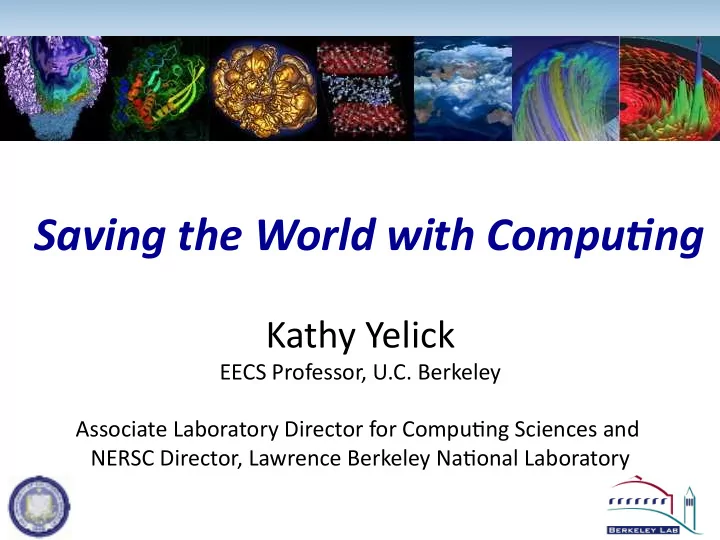
! Saving'the'World'with'Compu5ng Kathy&Yelick & - - PowerPoint PPT Presentation

saving the world with compu5ng kathy yelick eecs
SMART_READER_LITE
LIVE PREVIEW

! Saving'the'World'with'Compu5ng Kathy&Yelick & - - PowerPoint PPT Presentation

! Saving'the'World'with'Compu5ng Kathy&Yelick & EECS&Professor,&U.C.&Berkeley & & Associate&Laboratory&Director&for&Compu@ng&Sciences&and&


slide-1
SLIDE 1

Saving'the'World'with'Compu5ng

!

Kathy&Yelick &

EECS&Professor,&U.C.&Berkeley & & Associate&Laboratory&Director&for&Compu@ng&Sciences&and& NERSC&Director,&Lawrence&Berkeley&Na@onal&Laboratory &

slide-2
SLIDE 2

Using!Computers!for!! Science!and!Engineering!

Computers&are&used&to& understand&things&that&are:&

  • too&big&
  • too&small&
  • too&fast&
  • too&slow&
  • too&expensive&or&&
  • too&dangerous&&

for&experiments&

EnergyMefficient& combus@on&engines& Industrial&products& and&processes& Proteins&and&diseases& like&Alzheimer's& Understanding&the& universe&

slide-3
SLIDE 3

Simulation: The Third Pillar of Science

Simulation Theory Experiment

slide-4
SLIDE 4

Addressing!Challenges!using! Compu<ng !

  • Two&of&the&most&significant&challenges&

– Our&changing&world:&understanding&climate& change,&alterna@ve&energy&sources,&mi@ga@on& techniques,&etc.& – Health&and&medicine:&understanding&the&human& body,&development&of&treatments,&and&disease& preven@on&

slide-5
SLIDE 5

Climate Modeling Energy Analysis Combustion Carbon Capture & Sequestration Biofuels Artificial Photosynthesis Developing World Efficiency Solar PV Energy Storage

Carbon Cycle 2.0 Initiative at Berkeley Lab

slide-6
SLIDE 6

Climate Modeling for Analyzing Impacts Optimized Combustion Burners Flows through Porous Media for CCS Metagenomics for BioFuels Quantum Dynamics

  • f Photosynthesis

Developing World Materials for Efficient Lighting Materials for Solar PV Chemistry for Catalysis in Batteries

Computing for Carbon Cycle 2.0

slide-7
SLIDE 7

1979!Hurricane!Season !

Movie&from&Michael&Wehner&and&Prabhat&at&LBNL

&

slide-8
SLIDE 8

Data!Structures!for!Simula<ons !

slide-9
SLIDE 9

Climate!Change!Requires!Lots!of!Data!

Simula@on&of&1938&hurricane&hi[ng&New&York&

validate that the computer models are working as expected

slide-10
SLIDE 10

Mi<ga<ng!Global!Climate!Change

!

Can global warming impacts be diminished if greenhouse gases are cut?

.

Average surface air temperatures rise by >3°C if emissions increase at current rate Temperatures rise by <2°C across nearly all populated areas if emissions are cut by 70%

slide-11
SLIDE 11

Simulations Aid in the Energy Efficient Devices

  • Combustion simulations improve future designs

– Model fluid flow, burning and chemistry – Uses advanced math algorithms – Petascale (1015 ops/sec) systems today

  • Need exascale (1018 ops/sec) computing to design

for alternative fuels, new devices

Energy efficient, low emissions technology licensed by industry Simulations reveal features not visible in lab experiments

12&

slide-12
SLIDE 12

Simula<ng!New!Kinds!of!BaLeries !

13&

slide-13
SLIDE 13

Simula<ons!to!Get!Rid!of!CO2

!

  • Carbon&sequestra@on:&&"The&process&of&removing&carbon&from&

the&atmosphere&or&from&flue&gasses&and&deposi@ng&it&in&a& reservoir.”&

  • CaO&+&CO2&&&CaCO3&

George Pau, LBNL

slide-14
SLIDE 14

Towards!a!Digital!Human:! ! The!20+!Year!Vision !

  • Imagine&a&digital&body&double&&

– 3D&imageMbased&medical&record& – Includes&diagnos@c,&pathologic,&and&

  • ther&informa@on&
  • Used&for:&

– Diagnosis& – Less&invasive&surgeryMbyMrobot& – Experimental&treatments&

slide-15
SLIDE 15

Digital!Human!Today:!Imaging !

  • The&Visible&Human&Project&

– 18,000&digi@zed&sec@ons&of&the&body&

  • Male:&1mm&sec@ons,&released&in&1994&
  • Female:&.33mm&sec@ons,&released&in&1995&

– Goals&

  • study&of&human&anatomy&
  • tes@ng&medical&imaging&algorithms&

– Current&applica@ons:&&

  • educa@onal,&diagnos@c,&treatment&planning,&

virtual&reality,&ar@s@c,&mathema@cal&and& industrial&

  • Used&by&>&1,400&licensees&in&42&countries&

Image Source: www.madsci.org"

slide-16
SLIDE 16

Experimental!Data:!Visible!Human !

slide-17
SLIDE 17

Heart!Simula<on !

Movie&from&Boyce&Griffiths&PhD&thesis,&NYU

&

slide-18
SLIDE 18

Heart!Simula<on !

Movie&from&Charles&Peskin&and&Dave&McQueen&at&NYU &

slide-19
SLIDE 19

Organ!Simula<on !

Cardiac&cells/muscles&

SDSC,%Auckland,%UW,%Utah%

Cardiac flow"

NYU, UCB, UCD…!

Lung transport"

Vanderbilt!

Lung flow"

  • U. Iowa (Lin &

Hoffman)!

Cochlea"

Caltech, UMichigan!

Kidney mesh generation"

Dartmouth!

Electrocardiography"

Johns Hopkins,…!

Skeletal mesh generation" Brain"

UCSD (ElIisman), IBM!

Just a few of the efforts at understanding and simulating parts of the human body"

slide-20
SLIDE 20

Screening Proteins

  • Large number of simulations covering a variety of

related proteins,…

Dynameomics Database Improve understanding of disease and drug design, e.g., 11,000 protein unfolding simulations stored in a public database. [V. Daggett, UW]

21&

slide-21
SLIDE 21

Big!D!and!Big!C:!Compu<ng!on!Big! Data!to!help!Cure!Cancer !

Enlarge This Image David Patterson ESSAY

Computer Scientists May Have What It Takes to Help Cure Cancer

By DAVID PATTERSON Published: December 5, 2011

The war against cancer is increasingly moving into

  • cyberspace. Computer scientists may have the best skills to

fight cancer in the next decade — and they should be signing up in droves. One reason to enlist: Cancer is so

  • pervasive. In his Pulitzer Prize-

winning book, “The Emperor of All Maladies,” the oncologist Siddhartha Mukherjee writes that cancer is a disease of frightening fractions: One-fourth of deaths in the United States are caused by cancer; one-third of women will face cancer in their lifetimes; and so will half of men. As he wrote, “The question is not if we will get this immortal disease, but when.”

RECOMMEND TWITTER LINKEDIN SIGN IN TO E-MAIL PRINT REPRINTS SHARE

Search All NYTimes.com Subscribe: Digital / Home Delivery Log In Register Now Help HOME PAGE TODAY'S PAPER VIDEO MOST POPULAR TIMES TOPICS

Science

WORLD U.S. N.Y. / REGION BUSINESS TECHNOLOGY SCIENCE HEALTH SPORTS OPINION ARTS STYLE TRAVEL JOBS REAL ESTATE AUTOS

slide-22
SLIDE 22

Why!Study!Computer!Science? !

1) Because&computers&can&help&solve& important&problems& 2) Because!programming!is!fun!and!there!are ! plenty!of!new!problems!to!solve!

slide-23
SLIDE 23

Black!Swans!of!Compu<ng !

slide-24
SLIDE 24

2012!Compu<ng!with!1992! Technology !

slide-25
SLIDE 25

Units!of!Measure!in!High! Performance!Compu<ng!(HPC) !

  • High!Performance!Compu<ng!(HPC)!units!are:!

– Flops:!floa<ng!point!opera<ons! – Flops/s:!floa<ng!point!opera<ons!per!second! – Bytes:!size!of!data!(a!double!precision!floa<ng!point!number!is!8)! !

  • Typical!sizes!are!millions,!billions,!trillions…!

Kilo ! !Kflop/s!=!103!flop/sec !Kbyte!=!210!=!1024!~!1,000!bytes! Mega !Mflop/s!=!106!flop/sec !Mbyte!=!220!=!1048576!~!106!bytes! Giga! !Gflop/s!=!109!flop/sec !Gbyte!=!230!~!109!bytes! Tera! !Tflop/s!=!1012!flop/sec !Tbyte!=!240!~!1012!bytes!! Peta! !Pflop/s!=!1015!flop/sec !Pbyte!=!250!~!1015!bytes! Exa ! !Eflop/s!=!1018!flop/sec !Ebyte!=!260!~!1018!bytes! ZeLa !Zflop/s!=!1021!flop/sec !Zbyte!=!270!~!1021!bytes! YoLa !Yflop/s!=!1024!flop/sec !Ybyte!=!280!~!1024!bytes!! ! ! ! ! ! ! !!

2008& 1998& 1988&

slide-26
SLIDE 26

1.E+08& 1.E+09& 1.E+10& 1.E+11& 1.E+12& 1.E+13& 1.E+14& 1.E+15& 1.E+16& 1.E+17& 1.E+18& 1990& 1995& 2000& 2005& 2010& 2015& 2020&

High End Computing Revolutions

Application Performance Growth

(Gordon Bell Prizes)

29

Attack of the “killer micros”

Attack of the “killer cellphones”? First Exascale Application?

(billion-billion

  • perations / sec)

The rest of the computing world gets parallelism

slide-27
SLIDE 27

The!Fastest!Computers!(for!Science)! Have!Been!Parallel!for!a!Long!Time !

  • Fastest&Computers&in&the&world:&top500.org&
  • Our&Hopper&Computer&has&150,000&cores&and&

>&1&Petaflop&(1015&math&opera@ons&/&second)&

  • Programming&and&debugging&are&

challenging&

30&

Supercompu7ng%is% done%by%parallel% programming% %

slide-28
SLIDE 28

goal

usual scaling

2005 2010 2015 2020

Energy!Challenge!for!Compu<ng !

At&~$1M&per&MW,&energy&costs&are&substan@al&

31&

Google Details, and Defends, Its Use of Electricity

Google

An&exaflop&in&2020&would&use&~200& MW&with&“usual”&scaling&

ge

Every time a person runs a Google search, watches a YouTube video

  • r sends a message through

Gmail, the company’s data centers full of computers use electricity. Those data centers around the world continuously draw almost 260 million watts — about a quarter of the output of a nuclear power plant.

The worldwide data center power in was about 26 gigawatts in 2010 (up from 17 in 2005)

slide-29
SLIDE 29

New!Processor!Designs!are!Needed! to!Save!Energy'

  • The&server&is&about&10x&faster&than&the&cell&phone&processor&
  • But&uses&1000x&more&power&&cell&phone&is&100x&more&efficient&
  • Why:&Power&is&propor@onal&to&V2f,&and&increasing&frequency&(f)&

also&requires&increase&voltage&V&&cube&

  • Next&computers&built&from&graphics,&games,&cell&phones,…&

32&

Cell phone processor (0.1 Watt, 4 Gflop/s) Server processor (100 Watts, 50 Gflop/s)

slide-30
SLIDE 30

1.E-01 1.E+00 1.E+01 1.E+02 1.E+03 1.E+04 1.E+05 1.E+06 1.E+07 1970 1975 1980 1985 1990 1995 2000 2005 2010

Transistors (in Thousands)

All!Computers!are!Parallel!Computers !

  • Power&density&limit&single&

processor&clock&speeds&&

  • Cores&per&chip&is&growing&
  • How&to&program&them?&

– Parallel&loops& – Parallel&map& – Parallel&divideMandM conquer& – (Message&passing)&

33&

1.E-01 1.E+00 1.E+01 1.E+02 1.E+03 1.E+04 1.E+05 1.E+06 1.E+07 1970 1975 1980 1985 1990 1995 2000 2005 2010

Transistors (in Thousands) Frequency (MHz) Power (W) Cores

slide-31
SLIDE 31

Power!Limits!Compu<ng! Performance!Growth !

34&

10 100 1,000 10,000 100,000 1,000,000 1985 1990 1995 2000 2005 2010 2015 2020 Year of Introduction

The Expectation Gap

Performance Expectation Gap

Processor industry was running at "maneuvering speed

  • David Liddle
slide-32
SLIDE 32

Why!Study!Computer!Science? !

1) Because&computers&can&help&solve& important&problems& 2) Because&computers&are&fun&to&program& 3) Because!computers!make!a!good!career!

slide-33
SLIDE 33

36&

Computa<on!in!Music!

(David!Wessel)!

  • Musicians&have&an&insa@able&

appe@te&for&computa@on&&&

– More&channels,&instruments,&more& processing,&more&interac@on!& – Latency&must&be&low&(5&ms)&&& – Must&be&reliable&(No&clicks)&&

  • Music&Enhancer&

– Enhanced&sound&delivery&systems&for&home& sound&systems&using&large&microphone&and& speaker&arrays& – Laptop/Handheld&recreate&3D&sound&over& ear&buds&

  • Hearing&Augmenter&

– Handheld&as&accelerator&for&hearing&aid&

Berkeley Center for New Music and Audio Technology (CNMAT) created a compact loudspeaker array: 10-inch-diameter icosahedron incorporating 120 tweeters.

slide-34
SLIDE 34
slide-35
SLIDE 35

Computa<onal!Science!is!Necessarily!Collabora<ve!

… as from the beginning the work has been a team effort involving many able and devoted co- workers in many laboratories. As I am sure you will appreciate, a great many diverse talents are involved in such developments and whatever measure of success is achieved is dependent on close and effective collaboration.

Ernest O. Lawrence UC Berkeley Professor of Physics Founder of Lawrence Berkeley National Laboratory In his Nobel Lecture, December 11, 1951

Internships Available: http://csee.lbl.gov/

slide-36
SLIDE 36

Why!Study!Computer!Science? !

1) Because&computers&can&help&solve& important&problems& 2) Because&computers&are&fun&to&program& 3) Because&computers&make&a&good&career& 4) Because!you!will!get!to!work!with!lots!of! great!people!