
SLIDE 1
Sarah B Traiger Brenda Konar University of Alaska Fairbanks
Sarah B Traiger Brenda Konar University of Alaska Fairbanks - - PowerPoint PPT Presentation
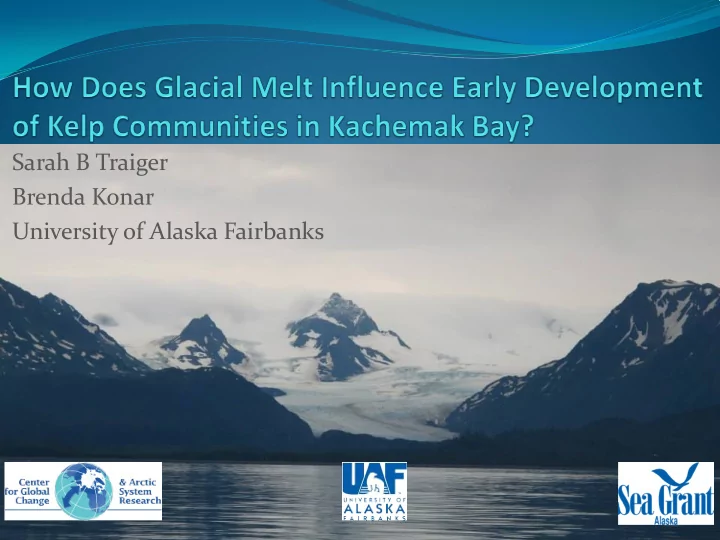
Sarah B Traiger Brenda Konar University of Alaska Fairbanks Introduction Harding Icefield, lost 34 km 3 since 1950s Kachemak Glacier lost 16 m elevation (Adalgeirosdottir et al 1998) Glacial discharge changes environmental conditions
Sarah B Traiger Brenda Konar University of Alaska Fairbanks
Harding Icefield, lost 34 km3 since 1950s Kachemak Glacier lost 16 m elevation
(Adalgeirosdottir et al 1998)
Glacial discharge changes environmental conditions
nutrients, salinity sedimentation, light
Negative effects on seaweed
and sessile invertebrates
Future changes
Increase spatial extent of
discharge
Altered timing Increase discharge
http://glacierhub.org/2014/07/28/scientists-find-yet-another-negative-impact-of-glacial-melt-ocean-acidification/
Kachemak Bay circulation Observed differences between inner
and outer bay (Spurkland & Iken 2011)
Outer bay has more diverse and
higher abundance of kelp
Only Saccharina latissima in
inner bay
Only one small population of
Nereocystis luetkeana in inner bay
Field & Walker 2003
mortality over time or differences in initial recruitment?
Research Questions: 1. How does recruitment and succession vary across Kachemak Bay?
patterns of recruitment and succession?
Recruitment = the appearance of new individuals Succession = how community structure changes over time
Recruitment and Succession
In March 2013 placed 6 cleared rocks at
each site along 10 m depth contour
April and biweekly May-Sept 2013 & 2014 Counted all organisms and estimated
percent cover on tops of each rock Environmental Variables
April and biweekly throughout
summer 2013 & 2014
Sedimentation rate Temperature,
Light, Salinity
Nutrient Concentration
Transform: Log(X+1) Resemblance: S17 Bray Curtis similarity
Community structure differed among sites
PERMANOVA, p = 0.0001
SiteCode
PG JB PB BC MC BB
2D Stress: 0.12
5 10 15 20 25
x/900 cm2 Kelp recruits (< 2 cm)
PG PB BC MC BB
50 100 150 200 250 300 350 400
x/900 cm2 Kelp recruits (< 2 cm)
JB
2014 2014 2013 2013
PERMANOVA , p = 0.003
5 10 15 20 25 30 35 40 45
Lum/ft2
Irradiance
Southern-outer Inner&Bishop's Central
2014 2013 0.5 1 1.5 2 2.5 3 3.5 4 4.5 5
µM
NH4
2014 2013 1 2 3 4 5 6 7 8
Inorganic mg/cm2*d
Inorganic Sedimentation rates
2014 2013
Transform: Log(X+1) Resemblance: S17 Bray Curtis similarity
SiteCode
PG JB PB BC MC BB
NH4 Temperature
2D Stress: 0.11
Environmental factors
explained 28% of variation in recruitment and succession (DistLM)
2 4 6 8 10 12 14 ° C
Temperature
PG JB PB BC MC BB 2014 2013
Other important factors?
Time Series analyses Influence of mobile invertebrates and nearby kelp Quantify kelp microscopic stages across Kachemak Bay
using genetics
Kasitsna Bay Lab: Mike Geagel Hans Pedersen Connie Geagle Kris Holderied
Volunteer divers: Katrin Iken Lander Ver Hoef Alexandra Ravelo Kim Powell Richard Doering Eric Wood Anne Benolkin Alyssa Lind Elizaveta Ershova Martin Schuster Ira Hardy Shae Bowman
Committee Members: Stephen Okkonen Sarah Hardy
Robert & Kathleen Bryd Student Competition