S e a r c h f
- r
U l t r a H i g h E n e r g y p h
- t
- n
s a t t h e P i e r r e A u g e r O b s e r v a t
- r
y & c
- n
t r i b u t i
- n
t
- A
u g e r P r i me
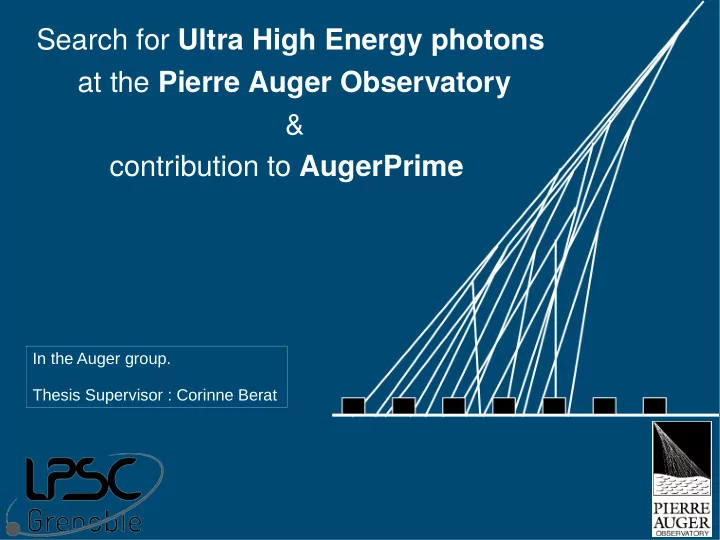
In the Auger group. Thesis Supervisor : Corinne Berat
S e a r c h f o r U l t r a H i g h E n e r g - - PowerPoint PPT Presentation
S e a r c h f o r U l t r a H i g h E n e r g y p h o t o n s a t t h e P i e r r e A u g e r O b s e r v a t o r y & c o n t r i b u t i o n t o A u g e r P r i me
In the Auger group. Thesis Supervisor : Corinne Berat
T h e s i s M
i t
i n g P r e s e n t a t i
J u l i e n S
c h a r d
2
T h e s i s M
i t
i n g P r e s e n t a t i
J u l i e n S
c h a r d
UHECRs & EAS U l t r a H i g h E n e r g y C
m i c R a y s ( U H E C R s ) :
l t r a h i g h e n e r g i e s : E > 1
1 8
e V
e r y l i m i t e d fm u x : < 1 . k m
. y e a r
e a t u r e s i n t h e s p e c t r u m
u c l e u s f r
H t
e & n e u t r a l s ( n / γ / ν ) 4
T h e s i s M
i t
i n g P r e s e n t a t i
J u l i e n S
c h a r d
UHECRs & EAS
CRs ɣ ν
5
T h e s i s M
i t
i n g P r e s e n t a t i
J u l i e n S
c h a r d
UHECRs & EAS Multi-Messenger era of astrophysics :
Complementarity between the
+: straight line
+: straight line, no interaction
+: direct accelerator probe
CRs ɣ ν
The 3 fluxes are linked! The 3 fluxes are linked! 6
T h e s i s M
i t
i n g P r e s e n t a t i
J u l i e n S
c h a r d
UHECRs & EAS UHECRs interact with Earth’s atmosphere : generates an Extensive Air Shower (EAS) 3 main components :
At ground : ~5.1010 particles (estimation for a 1019eV p-shower) 7
T h e s i s M
i t
i n g P r e s e n t a t i
J u l i e n S
c h a r d
UHECRs & EAS UHECRs interact with Earth’s atmosphere : generates an Extensive Air Shower (EAS) 3 main components :
Advantages of the EAS :
Disadvantages of the EAS :
energy
8
T h e s i s M
i t
i n g P r e s e n t a t i
J u l i e n S
c h a r d
PAO & AugerPrime The Pierre Auger Observatory (PAO) :
Fluorescence Detector (FD) : Surface Detector (SD) :
Cherenkov Detector
located in 4 buildings.
atmosphere above the array
10
T h e s i s M
i t
i n g P r e s e n t a t i
J u l i e n S
c h a r d
PAO & AugerPrime The Pierre Auger Observatory (PAO) :
Fluorescence Detector (FD) : Surface Detector (SD) :
Cherenkov Detector
located in 4 buildings.
atmosphere above the array
Water Cherenkov Detector (WCD) : Secondary particles (highly relativistic) going through the detector produce Cherenkov light. Sensitive to e±, γ, μ Collect timing and signal to reconstruct the showers. 11
T h e s i s M
i t
i n g P r e s e n t a t i
J u l i e n S
c h a r d
PAO & AugerPrime The Pierre Auger Observatory (PAO) :
Fluorescence Detector (FD) : Surface Detector (SD) :
Cherenkov Detector
located in 4 buildings.
atmosphere above the array
Fluorescence Telescope : An EAS excite the nitrogen molecules in the atmosphere → Fluorescence Emission Telescopes collect this UV light Direct measurement
energy 12
T h e s i s M
i t
i n g P r e s e n t a t i
J u l i e n S
c h a r d
PAO & AugerPrime The Pierre Auger Observatory (PAO) :
Fluorescence Detector (FD) : Surface Detector (SD) :
Cherenkov Detector
located in 4 buildings.
atmosphere above the array
13
T h e s i s M
i t
i n g P r e s e n t a t i
J u l i e n S
c h a r d
PAO & AugerPrime Hybrid Detection : Able to use the FD to calibrate the SD’s energy reconstruction Other complementary detection possible…
14
T h e s i s M
i t
i n g P r e s e n t a t i
J u l i e n S
c h a r d
PAO & AugerPrime
energies
the WCD, to disentangle muon/EM components
to detect the showers radio-emissions 15
T h e s i s M
i t
i n g P r e s e n t a t i
J u l i e n S
c h a r d
SSDs & Validation Objectives :
place as the WCD
Detector’s signal :
is dominated by the photons and muons.
17
T h e s i s M
i t
i n g P r e s e n t a t i
J u l i e n S
c h a r d
SSDs & Validation
1200 SSDs built in 6 countries : 90 SSDs built at LPSC The scintillator boards are used as external triggers :
scintillators (up and down)
a user-defined time window (800 ns before trigger and 300 ns after trigger)
Important involvement by the SDI, electronics and administrative departments 18
T h e s i s M
i t
i n g P r e s e n t a t i
J u l i e n S
c h a r d
SSDs & Validation
For each triggered event (50k per run) :
Minimum Ionising Particle (MIP) :
Minimum energy deposited by a through-going relativistic particle (i.e muon)
Single Photo-Electron (SPE) peak :
signal picked-up by the PMT for a single photoelectron inside the detector
19
T h e s i s M
i t
i n g P r e s e n t a t i
J u l i e n S
c h a r d
SSDs & Validation
For each triggered event (50k per run) :
Minimum Ionising Particle (MIP) :
Minimum energy deposited by a through-going relativistic particle (i.e muon)
Single Photo-Electron (SPE) peak :
signal picked-up by the PMT for a single photoelectron inside the detector
20
T h e s i s M
i t
i n g P r e s e n t a t i
J u l i e n S
c h a r d
Photon Search Why are photon primaries interesting? :
confirm the GZK effect
Greisen Zatsepin Kuzmin effect : Interaction between UHECRs and Cosmic Microwave Background photons. Above an energy threshold : Emin ~ 1019eV 22
T h e s i s M
i t
i n g P r e s e n t a t i
J u l i e n S
c h a r d
Photon Search
23
T h e s i s M
i t
i n g P r e s e n t a t i
J u l i e n S
c h a r d
Photon Search Two official analyses in Auger collaboration :
24
T h e s i s M
i t
i n g P r e s e n t a t i
J u l i e n S
c h a r d
Photon Search Muon peak Decay-tail Deconvolution filter ck → c’k Same peak after deconvolution Same integral:
Core of the Muonicity Method : perform a linear deconvolution to remove the exponential decay-tail of a muon signal while integrating the total muon-signal.
25
T h e s i s M
i t
i n g P r e s e n t a t i
J u l i e n S
c h a r d
Photon Search
For each station j deconvolute the VEM trace, identify the peaks :
Core of the Muonicity Method : perform a linear deconvolution to remove the exponential decay-tail of a muon signal while integrating the total muon-signal. 26
T h e s i s M
i t
i n g P r e s e n t a t i
J u l i e n S
c h a r d
Photon Search
Value calculated on trace, for proton and photon showers : Value predicted by proton-trained Machine Learning model :
→ → the model is supposed to better reconstruct proton- (closer to ) the model is supposed to better reconstruct proton- (closer to )
Machine Learning Model :
Training with proton simulations Training with proton simulations Predict a value from parameters Predict a value from parameters
27
T h e s i s M
i t
i n g P r e s e n t a t i
J u l i e n S
c h a r d
Photon Search Simplified pipeline of the Muonicity Method On its own and without further parameter tuning, the Muonicity variable has some separation power Merit Factor η=0.91 → Can we extract more discrimination from the muonic component of the SD traces? 28
T h e s i s M
i t
i n g P r e s e n t a t i
J u l i e n S
c h a r d
Photon Search Simplified pipeline of the Muonicity Method Muonicity :
29
T h e s i s M
i t
i n g P r e s e n t a t i
J u l i e n S
c h a r d
Simplified pipeline of the Smoothing Method Smoothing :
Photon Search 30
T h e s i s M
i t
i n g P r e s e n t a t i
J u l i e n S
c h a r d
Simplified pipeline of the Smoothing Method Smoothing :
Photon Search 31 Smoothing variable’s separation power : Merit Factor η=1.50 → Let’s combine the 2 variables!
T h e s i s M
i t
i n g P r e s e n t a t i
J u l i e n S
c h a r d
Photon Search
32
T h e s i s M
i t
i n g P r e s e n t a t i
J u l i e n S
c h a r d
–
Wr
e a p r
e d u r e t
t a n d a r d i z e t h e S S D s c
s t r u c t i
p r
e s s
–
H e l p e d d e s i g n a n d i n s t a l l t h e S S D s t e s t s e t u p
–
P e r f
m e d t h e S S D s v a l i d a t i
s
–
I m p l e m e n t e d d i s c r i m i n a t i
s e r v a b l e s c a l c u l a t i
i n s i d e t h e A u g e r f r a m e w
k
–
D e s i g n e d :
fm e x i b l e m e t h
f
p h
/ p r
d i s c r i m i n a t i
p i p e l i n e f
M V A b a s e d
m a c h i n e l e a r n i n g
h i f t s , F
m a t i
s & O u t r e a c h :
–
P a r t i c i p a t e d t
D s h i f t s a n d b e t a
e s t e d t h e S D s h i f t s
–
O u t r e a c h t
c h
a r s
–
L a b e l R E I
–
S O S s c h
, I S A P P s c h
Conclusion 33
T h e s i s M
i t
i n g P r e s e n t a t i
J u l i e n S
c h a r d
–
–
–
–
–
Outlook 34
T h e s i s M
i t
i n g P r e s e n t a t i
J u l i e n S
c h a r d
Back-up Differences in the “shape” of the showers :
CRs Differences in the composition of the showers :
atmosphere
36
T h e s i s M
i t
i n g P r e s e n t a t i
J u l i e n S
c h a r d
Back-up Core of the Smoothing Method : extract the muonic component of the trace by performing a sliding-window averaging to remove spikes The smoothened trace is then compared to the original trace to obtain a st-level variable : fmu fmu here, has the same role as Speaks in the Muonicity Method 37
T h e s i s M
i t
i n g P r e s e n t a t i
J u l i e n S
c h a r d
Back-up
38
T h e s i s M
i t
i n g P r e s e n t a t i
J u l i e n S
c h a r d
Back-up 39
T h e s i s M
i t
i n g P r e s e n t a t i
J u l i e n S
c h a r d
Back-up 40
T h e s i s M
i t
i n g P r e s e n t a t i
J u l i e n S
c h a r d
Back-up 41