RIGHT TO PRIVACY, ITS DEVELOPMENT SANCTITY AND RELEVANCE WITH - - PDF document

right to privacy its development sanctity and relevance
SMART_READER_LITE
LIVE PREVIEW

RIGHT TO PRIVACY, ITS DEVELOPMENT SANCTITY AND RELEVANCE WITH - - PDF document

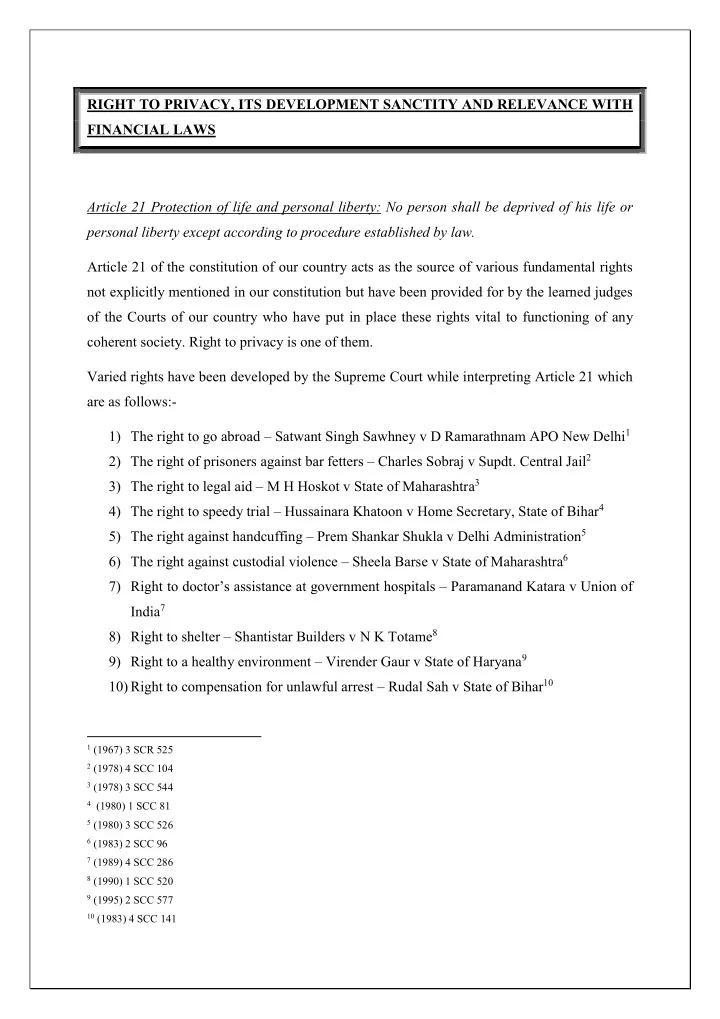
RIGHT TO PRIVACY, ITS DEVELOPMENT SANCTITY AND RELEVANCE WITH FINANCIAL LAWS Article 21 Protection of life and personal liberty: No person shall be deprived of his life or personal liberty except according to procedure established by law.


slide-1
SLIDE 1

RIGHT TO PRIVACY, ITS DEVELOPMENT SANCTITY AND RELEVANCE WITH FINANCIAL LAWS Article 21 Protection of life and personal liberty: No person shall be deprived of his life or personal liberty except according to procedure established by law. Article 21 of the constitution of our country acts as the source of various fundamental rights not explicitly mentioned in our constitution but have been provided for by the learned judges

  • f the Courts of our country who have put in place these rights vital to functioning of any

coherent society. Right to privacy is one of them. Varied rights have been developed by the Supreme Court while interpreting Article 21 which are as follows:- 1) The right to go abroad – Satwant Singh Sawhney v D Ramarathnam APO New Delhi1 2) The right of prisoners against bar fetters – Charles Sobraj v Supdt. Central Jail2 3) The right to legal aid – M H Hoskot v State of Maharashtra3 4) The right to speedy trial – Hussainara Khatoon v Home Secretary, State of Bihar4 5) The right against handcuffing – Prem Shankar Shukla v Delhi Administration5 6) The right against custodial violence – Sheela Barse v State of Maharashtra6 7) Right to doctor’s assistance at government hospitals – Paramanand Katara v Union of India7 8) Right to shelter – Shantistar Builders v N K Totame8 9) Right to a healthy environment – Virender Gaur v State of Haryana9 10) Right to compensation for unlawful arrest – Rudal Sah v State of Bihar10

1 (1967) 3 SCR 525 2 (1978) 4 SCC 104 3 (1978) 3 SCC 544 4 (1980) 1 SCC 81 5 (1980) 3 SCC 526 6 (1983) 2 SCC 96 7 (1989) 4 SCC 286 8 (1990) 1 SCC 520 9 (1995) 2 SCC 577 10 (1983) 4 SCC 141

slide-2
SLIDE 2

Development The concept of privacy has developed from natural liberty and is considered a fundamental natural law. It is considered a part of the rights vested in the individual by laws of the nature.11 “Natural rights mean simply interests which we think ought to be secured; demands which human beings may make which we think ought to be satisfied. It is perfectly true that neither law nor state creates them. But it is fatal to all sound thinking to treat them as legal conceptions. For legal rights, the devices which law employs to secure such of these interests as it is expedient to recognize, are the work of the law and in that sense the work of the state.”12 Privacy is considered a natural right as stated earlier and it is inalienable in nature, this conception has developed over a period of time and has been contemplated in many cases before it was laid down as a part of Article 21 by the Supreme Court. The first important case decided by the Supreme Court regarding Right to Privacy was Kharak Singh v State of U.P.13 The court in this case held that though the Constitution of the country does not guarantee right to privacy under Article 21 Part 3 of the constitution but unauthorized intrusion into a person’s home and causing him disturbance was considered violation of a Common Law right based on the principle, developed in the Semayne's case (1604) 5 Coke 91 : 1 Sm. L.C. 104, of “every man's house is his castle” The connotation life under Article 21 was not considered that of mere animal existence but was to be construed upon as a right to personal liberty.14 This view of Field J. was adopted by the Supreme Court in the Case of Kharak Singh.

11 William Blackstone Commentary on laws of England,1765 12 Roscoe Pound, The Spirit of the Common Law, Marshall Jones Company (1921), at page 92 13 AIR 1963 SC 1295 [19] 14 Munn v. Illinois (1877) 94 U.S. 113

slide-3
SLIDE 3

Justice Subbarao in that time interpreted Article 21 correctly as it was interpreted by the Judges in the case of Justice Puttaswamy 55 years after the judgement was delivered. Following is the paragraph from his judgement “Further, the right to personal liberty takes in not only a right to be free from restrictions placed on his movements, but also free from encroachments on his private life.It is true our Constitution does not expressly declare a right to privacy as a fundamental right, but the said right is an essential ingredient of personal liberty. Every democratic country sanctifies domestic life; it is expected to give him rest, physical happiness, peace of mind and security. In the last resort, a person's house, where he lives with his family, is his "castle" : it is his rampart against encroachment on his personal liberty.”15 He supported the contention that Article 21 was comprehensive in itself and included the Right to Privacy in itself as it was an integral and essential part of the personal liberty of an individual. The second case in which Right to Privacy came into discussion before the eminent judges of

  • ur Supreme Court was Gobind v State of M.P.16

The court in this case buttressed the position of privacy as an important constituent of personal

  • liberty. The Court then quoted a passage from the judgment of Frankfurter J. in Wolf v.

Colorado17 to the effect that the security of one's privacy against arbitrary intrusion by the police is basic to a free society and that the knock at the door, whether by day or by night, as a prelude to a search, without authority of law but solely on the authority of the police, did not need the commentary of recent history to be condemned as inconsistent with the conception of human rights enshrined in the history and the basic Constitutional documents of English- speaking peoples. The above paragraph shows how the bent of the judges was slowiy swaying in the was of the minority judgement of J. Subbarao who had held at the first instance that Right to privacy was an integral part of Article 21 of the Constitution of our country. The judges relied on the definition given in Harvard Law review by Charles Warren and Louis D. “The right to be let alone-was an interest that man should be able to assert directly and not derivatively from his

15 AIR 1963 SC 1295 [38] 16 1975 2 SCC 148 17 [1949] 338 U.S. 25

slide-4
SLIDE 4

efforts to protect other interests. To protect man's "inviolate personality" against the intrusive behaviour so increasingly evident in their time.”18 This definition talks about preventing a man’s congenital right to privacy and it being asserted and protected without him being have to make any more efforts. The judges in the present landmark case considered privacy to be the personal intimacies of the home, the family, marriage, motherhood, procreation and child rearing.19 The court though sided with the Judgement in Kharak Singh20 but it widened the scope of the privacy doctrine in our country. The court as held in case of Kharak Singh held that the regulations regarding unreasonable searches formed a part of the procedure established by law and considered regulations regarding them as valid. The case of Maneka Gandhi v Union of India21 dealt with the concept of procedure established by law as laid down in the case of Gobind v state of MP. Following is the exerpt from the judgement at paragraph 122. “Procedure which ideals with the modalities of regulating, restricting or even rejecting a fundamental right falling within, Article 21 has to be fair, not foolish, carefully designed to effectuate, not to' subvert, the substantive right itself. Thus understood, 'procedure' must rule

  • ut anything arbitrary, freakish or bizarre. A valuable constitutional right can be canalised only

by civilised processes. You cannot claim that it is a legal procedure If the passport is granted

  • r refused by taking loss, ordeal of fire of by other strange or mystical methods. Nor is it,

tenable if life is taken by a crude or summary process of enquiry. What is fundamental is life and liberty. What is procedural is the manner of its exercise. This quality of fairness in the process is emphasised by the strong word 'established which means 'settled firmly' not wantonly whimsically.” In this case it was held that the procedure established by law needs to be fair just and reasonable and not arbitrary or bizarre. This intern overturned the reasoning of the court in the case of

18 4 Harvard Law Rev. 193 19 1975 2 SCC 148 [24] 20 AIR 1963 SC 1295 21 AIR 1978 SC 597

slide-5
SLIDE 5

Gobind22 and Kharak Singh23 as bizarre provisions were not considered to be part of procedure established by law and for a procedure to be established by law it must be just fair and

  • reasonable. This in turn changed the pigeon holes in which a procedure could take refuge under

procedure established by law and Right to privacy as a common law principle was not considered violated and the instances in which it was considered violated. This principle was further expounded by the court in the case of R M Malkani v State of Maharashtra24 in which the court held that the court would provide protection to innocent individuals whose phones were being intercepted without any justification but the same protection would not be available to those who possesd some threat to the nation. Right to privacy was also considered a statutory right by Indian Courts under section 2(d) of The Protection of Human Rights Act 1993 “Human Rights" means the rights relating to life, liberty, equality and dignity of the individual guaranteed by the Constitution or embodied in the International Covenants and enforceable by courts in India. This definition of Human rights had been concluded to include Privacy by the courts in the case of Phoolan Devi v Shekhar Kapur.25 This definition of brought into purview Article 12 of the UDHR and Srticel 17 of ICCPR and expanded the scope of Right to Privacy in India. The Supreme Court in the case of State of Maharashtra v Madhukar Narayan Mardikar held that “Even a woman of easy virtue is entitled to privacy and no one can invade her privacy as and when he likes. So also it is not open to any and every person to violate her person as and when he wishes. She is entitled to protect her person if there is an attempt to violate it against her

  • wish. She is equally entitled to the protection of law. Therefore, merely because she is a woman
  • f easy virtue, her evidence cannot be thrown overboard.”26

The right to privacy in this case was adorned to all classes of citizens and the bodily privacy of a woman was respected by the Supreme Court. The distinction based on virtue of a woman as

22 1975 2 SCC 148 23 AIR 1963 SC 1295 24 AIR 1973 SC 157 25 1995 57 DLT 154 26 (1991) 1 SCC 57 (62)

slide-6
SLIDE 6

devised by the High Court in this case was held to be against principles of equality enshrined in Part 3 of the Constittion. The Supreme Court in the case of PUCL v Union of India27 deliberated on the concept that Right to Privacy was not mentioned expressly in the Constitution. The 2 judge Bench opined that there could be 2 possible interpretations to this. The first being that the Constitution did not provide for any such right to the people & the second being that the Constitution did not expressly delineated such right. Selvi and others v State of Karnataka & others28 a three-judge bench accepted a distinction between physical and mental privacy, and explored the connection between the right to privacy and the right against self-incrimination. It was held that subjecting individuals to practises such as narco-analysis and polygraph examination without their consent amounted to a superfluous interference with personal liberty and mental privacy. The latest judgement of the Supreme Court in the case of Justice K.S. Puttaswamy (retd.), & Anr. v Union Of India And Ors29 provides for the following privacies:- Bodily privacy: Privacy of the physical body against violations and restraints of bodily movement Spacial Privacy: Privacy of a space, such as family life and intimate relations Communicational Privacy: Right against access to communication, or control over it Proprietary Privacy: Right to use property as a means to shield facts or information Intellectual Privacy: Privacy of thought, mind, opinions and beliefs Decisional Privacy: The ability to make intimate decisions Associational Privacy: Privacy of the choice of who to interact with Behavioral Privacy: The ability to control the extent of access even while conducting publically visible activities

27 (2004) 12 SCC 108 28 (2010) 7 SCC 263 29 (2017) 10 SCC 1

slide-7
SLIDE 7

Informational Privacy: An interest in preventing information about the self from being dissemination, and controlling the extent of access to the information The central theme is that privacy is an intrinsic part of life, personal liberty and of the freedoms guaranteed by Part III which entitles it to protection as a core of constitutional doctrine. The protection of privacy by the Constitution liberates it, as it were, from the uncertainties of statutory law which, as we have noted, is subject to the range of legislative annulments open to a majoritarian government. Any abridgment must meet the requirements prescribed by Article 21, Article 19 or the relevant freedom. The Supreme Court brought the right to privacy on the pedestal with other fundamental rights and inducted it in Article 21 of the Constitution and it had to be interpreted keeping in mind Article 21 and Article 19 of the Indian Constitution. In the lead judgement the judges considered human personality as manifested in the ability to make decisions on matters intimate to human life and privacy was considered to emerge out of the integrity of the body and the sanctity of the mind. Privacy is considered integral for taking decisions of one’s innate life. Privacy is a fundamental part of a heterogeneous society like

  • India. The judges accepted the idea that privacy is related to a person and not a place and can’t

be denied to a person on grounds of place. As illustrated in the diagram above. The judges in the case agreed with the view that privacy is part of the basic liberties of a person. The court also discussed about the significance of information privacy. The cookies being installed by websites and powerful algorithms being used by companies in the age of BIG

Liberties

Privacy

slide-8
SLIDE 8

DATA to extract personal information relating to the consumers. For instance customers searching pregnancy related tips were found to be persuaded by the BIG DATA companies to buy baby products after a period of time. Though the right to data protection has been enshrined by the Govt. under the aegis of such 43A of the Information Act 2008 but it only deals with leak of information by a body corporate and not Government and compensation under the said section is only payable when no reasonable security practices and procedures are not taken by the Body corporate, if the body corporate has taken reasonable care then it is not liable to pay compensation. The act also deals with different types of data like personal information or sensitive personal data or information and thus allows circumventing of the law as the companies can grade and segregate the data they collect by invading the privacy of the individuals and still need not pay any compensation for the same. Sec 72 of the Act deals with Breach of confidentiality. This section lays a lot on emphasis on

  • consent. The confidentiality in this case is considered to be breached if it done without consent.

This section is misused by the Data magnet companies as the make the consumers signing up with their portals or downing their applications agree to haphazard conditions in the form of electronic standard form of contracts thus obtaining the consent which is not true consent in nature and it’s for the courts to decide whether such consent should be considered as part of sec 72 of the Act. The government has constituted Justice BN Shrikrishna Committee to analyse the data protection under Aadhar and the findings of this committee will in turn help in curing the loopholes of the Information Act 2008 “Proportionality is an essential facet of the guarantee against arbitrary state action because it ensures that the nature and quality of the encroachment on the right is not disproportionate to the purpose of the law. Hence, the three-fold requirement for a valid law arises out of the mutual inter-dependence between the fundamental guarantees against arbitrariness on the one hand and the protection of life and personal liberty, on the other. The right to privacy, which is an intrinsic part of the right to life and liberty, and the freedoms embodied in Part III is subject to the same restraints which apply to those freedoms.”30

30 (2017) 10 SCC 1

slide-9
SLIDE 9

The doctrine of proportionality was readopted in this case and the judges wanted the application

  • f Article 21 to be proportional to the freedom entrusted upon the people. If the process being

adopted is not proportional to the freedom given then the sanction fails the proportionality and is ought to be struck down by the law. This is a different view taken by the Supreme Court than the Gobind case cited above. The Supreme Court reiterated the provision that Right to privacy and life and not created by the constitution but are just secured by it and as it is not created by the Constitution the Constitution does not have the Right to take it away but can only place reasonable restrictions on the same by ensuring anonymity in the information collected by the

  • Government. These restrictions have to be just and reasonable. Right to privacy was considered

to have a normative and a descriptive level and thus it was considered at the border and well as a vital part of the right to life and liberty. This stand taken is quite different from the previous notions of privacy as privacy was always considered an integral part of right to life and not considered separately or on the border line of Right to life giving it separate existence from Right to life. As discussed above at page 1 of this essay, Right to life under Article 21 includes various rights but these rights are not explicitly described in the Constitution and hence Justice Chelameshwar inclined towards to this view and considered Right to privacy as among the rights which have not been explicitly written in black in white in the Constitution. The court in the last page of its order held that “The right to privacy is protected as an intrinsic part of the right to life and personal liberty under Article 21 and as a part of the freedoms guaranteed by Part III of the Constitution.”31

31 (2017) 10 SCC 1

slide-10
SLIDE 10

Finacial Laws and Right to Privacy The right to privacy has been considered to be a part of financial laws from quite an early time and facets of privacy law applicable to financial laws have also developed with the development of the financial laws. Financial Laws and Right to privacy have a strong interface. The first important case where Right to privacy was involved in case of financial laws was Shankar Aggarwal v SBI32. In this case the bankers complained about its customer who deposited a large quantum of ₹1000 notes. The High court held that though secrecy should be maintained in all circumstances by the Bank but n case it has a higher social duty like it had in this case the Bank was ought to provide with this information to the Ministry of Finance as the Social cost in this case (the damage it would cause to the society due to this malpractice encouraging hoarding of black money into banks) was exorbitant. It laid down 2 situations under which the Banker could abrogate from performing its duty about maintaining secrecy of its customers firstly If under the Banking statutes he is mandated to do so & secondly The social cost is much higher and causes harm to the society. The concept of secrecy between the customer and its bank it is included in the Financial Institutions Act 1983. Under this Act banking authorities are mandate to take an oath of secrecy and they don’t disclosure the accounts of their customers to a third party. Sec 3(1) of the places an onus on the bankers to act with accordance to the custom of the trade and to not violate the privacy of its customers. A banker’s duty is to maintain complete secrecy about the dealing of its customers. The idea of secrecy was more expanded by the Credit information Companied Act 2005. Under the aegis of this act the main objective was to maintain accuracy and security of credit

  • information. The problem with this act is that, like the Financial Institutions Act 1983 the
  • nus on data protection on only the parties related to the disbursal of credit and not parties

having interest in the credit allocation but are not directly involved in credit disbursement are not held liable for data protection under this Act, this is also clear from reading sec. 20 of the 2005 Act which makes the principles applicable only to the credit information company, credit institution and specified user. Thus reducing the scope of the Act and the protection of the

32 AIR 1987 Cal 29

slide-11
SLIDE 11

Right to privacy. But the Puttuswamy judgement in turn develop new area of Jurisprudence in this area. Search, Seizure & Raids with respect to CrPC, Income Tax Act & CGST Act. Criminal Procedure Code(CrPC), 1973 In the case of District Registrar and Collector v Canara Bank33. In this case the doctrine of proportionality was developed and a two-judge bench explicitly recognised that a right to privacy has been developed by our Supreme Court from the provisions of Article 19(1)(a), Article 19(1)(d) and Article 21 in the absence of specific constitutional provisions. The Court also held that the right to privacy ‘deals with persons and not places’ The principal provision to search and seizures has been laid down under the CrPC. Sec 165 of the Code of Criminal Procedure (CrPC) deals with search by a police officer and is considered as the primary section when the procedure established by law is taken into consideration while determining whether Article 21 is breached. In terms of a search and seizure proviso or section in an act it is deemed to be considered to be violative of the right to privacy. The CrPC allows courts to issue a search warrant in cases where:-

  • 1. When it has reasonable apprehension that the person summoned would not be able to

produce the sufficient evidence.

  • 2. The court has reason to believe that such evidence is not in possession of any other

person.

  • 3. The court believes that the purposes of the inquiry and trial shall be serve by such

search. These tests may be argued to be against privacy and not considered to fall within the straight jacket of a reasonable process because it is on the discretion of the court and the judges but to give shape and make it more reasonable various conditions have been prescribed in the CrPC to pass the bar of reasonability. Provisions like presence of 2 people from the neighbour hood make the process more reasonable.

33 (2005) 1 SCC 496

slide-12
SLIDE 12

The Supreme Court in the case of State of Maharashtra v Natwarlal Damodardas Soni34 held that “Assuming that the search was illegal it would not affect either the validity of the seizure and further investigation by the Customs Authorities or the validity of the trial which followed

  • n the complaint of the Assistant Collector of Customs.”

In my opinion this reasoning developed by the Supreme Court in the above mentioned case should considered per incuriam as this does not take into consideration the reasonability and proportionality test ensued in Article 21 of the Constitution which has a strong precedential

  • backing. Assuming a search to be illegal and still considering the proof obtained to be valid

which can either be doctored or false as the search through which it was obtained is illegal will amount to setting a bad precedent. Not vitiating the seizure in itself would create a lot of problems and lead to slipways which would again get into the time of Police Raj as the police would start misusing this power without obtaining proper warrants from the Courts and the Courts would be in power to accept this evidence as it would not be vitiated. This in turn would create a paradox as though the Right to privacy is recognised and like any other right which falls under the broad wings of Article 21 of the Part 3 of the Constitution it should only be curtailed (as it can’t be taken because it is just secured and not enshrined by the Constitution) though a just and fair procedure but the procedure in this case is neither just nor fair in my

  • pinion if such raids are provided legal backing.

Income tax Act,1961 Section 132 & 132 B of the Income tax act deal with the power of search and seizure. Here is section 132 of the Income Tax Act. Where the Commissioner, in consequence of information in his possession, has reason to believe that— (a) any person to whom a summons under sub-section (2). of section 37 of the Indian Income-tax Act, 1922(11 of 1922) or under sub-section (2) of section 131 of this Act, or a notice under sub-section (4) of section 22 of the Indian Income-tax Act, 1922 or under sub-section (1) of section 142 of this Act was issued to produce, or cause to be produced, any books of account or other documents has omitted or

34 1980 SCR (2) 340

slide-13
SLIDE 13

failed to produce, or cause to be produced, such books of account or other documents as required by such summons or notice, or (b) any person to whom a summons or notice as aforesaid has been or might be issued will not, or would not, produce or cause to be produced any books of account or

  • ther documents which will be useful for, or relevant to, any proceeding under

the Indian Income-tax Act, 1922 (II of 1222), or under this Act, or (c) any person is in possession of any articles or things including money wholly disproportionate to his know sources of income, particulars or which will be useful for, or relevant to, any proceeding under the Indian Income-tax Act, 1922 (II of 1922), or this Act, he may authorise any Inspecting Assistant Commissioner or any Income-tax Officer to enter and search any building or place where he has reason to suspect that such books of account,

  • ther documents, articles or things including money are kept and if as a result of the search

such books of account, other documents, articles or things including money are found, the Inspecting Assistant Commissioner or the Income-tax Officer, as the case may be, may— (i) seize any such books of account or other documents ; (ii) place marks of identification on any such books of account or other documents or make

  • r cause to be made extracts or copies therefrom ;

(iii) make a note or an inventory of any articles or things including money found which, in his opinion, will be useful for, or relevant to, any proceeding under the Indian Income- tax Act,, 1922, or this Act. This sub section is quite interesting as it also deals with the reasonable belief as discussed in the case of CrPC and suffers from the same logical paradox as discussed by me earlier. The Supreme Court Cases used by me are as follows. 1) ITO v. Seth Bros35 “If the action is maliciously taken or power under the section is exercised for a collateral purpose, it is liable to be struck down by the Court. If the conditions for exercise of the power are not satisfied the proceeding is liable to be quashed.”

35 (1969) 2 SCC 324

slide-14
SLIDE 14

The Supreme Court in this case held that if the search and seizure is performed maliciously then the court should not take that search and seizure into consideration and should scrap its findings. While a contradictory view was taken by the Court in the next case which I would like to discuss. 2) Bhupendra Ratilal Thakkar v CIT 36 “Where the test of admissibility of evidence lies in relevancy, unless there is an express or necessarily implied prohibition in the Constitution or other law evidence obtained as a result

  • f illegal search or seizure is not liable to be shut out.”

The Supreme Court in the above case held that there should be an express or necessary implied prohibition in the Constitution for not accepting evidence obtained through illegal measures. It held that as no such provision was available hence the evidence obtained through such search and seizure operation is valid. In my opinion the reasonable characteristic that needs to be present while ascertaining the procedure established by law for curtailing the rights under article 21 is an implied prohibition

  • f not accepting such evidence. Apart from this the contention that there should be a malafide

intention as held by the court in the case of ITO v Sheth Bros is also not reasonable as a malafide intent is difficult to prove in such cases which would in turn result into such evidence being accepted by the courts and this in turn would violate the sacrosanct nature of article 21 and the Right to privacy of the people of this country. CGST Act, 2017 The CGST Act uses the word “reasonable” under Sec 67 of the Act and lays down 2 conditions. Where the proper officer, not below the rank of Joint Commissioner, has reasons to believe that (a) a taxable person has suppressed any transaction relating to supply of goods or services or both or the stock of goods in hand, or has claimed input tax credit in excess of his entitlement

36 (1976) 1 SCC 381

slide-15
SLIDE 15

under this Act or has indulged in contravention of any of the provisions of this Act or the rules made thereunder to evade tax under this Act; or (b) any person engaged in the business of transporting goods or an owner or operator of a warehouse or a godown or any other place is keeping goods which have escaped payment of tax or has kept his accounts or goods in such a manner as is likely to cause evasion of tax payable under this Act. he may authorise in writing any other officer of central tax to inspect any places of business of the taxable person or the persons engaged in the business of transporting goods or the owner

  • r the operator of warehouse or godown or any other place.

In the case of the CGST Act the power is given to the Joint commissioner and can be exercised by any officer of the Central Tax department whereas in the case of Income tax the power is provided to official above Commissioner level which shows a logical fallacy because the powers are different at both the levels and so is the responsibility of the commissioner and Joint Commissioner thus their experience also varying, also any central tax officer being allowed to carry out the raid would result in discrepancy as he may be of a level where the officer does not know he modalities of the law and the curtailing of the Fundamental Right of Privacy may be given in the hands of an official who does not understand the importance of such a right and this would in turn result into abuse of his/her power. This point was held by the Supreme Court in the case of ITO v Seth Bros 37. “Since by the exercise of the power a serious invasion is made upon the rights, privacy and freedom of the tax-payer, the power must be exercised strictly in accordance with the law and

  • nly for the purposes for which the law authorizes it to be exercised.”

In my opinion this anomalies between the provisions of the taxation law regarding curtailment

  • f the Right to Privacy has resulted in liquidation of the Right to Privacy of the people and

result into the procedure established by law emphasised by the constitution and many Supreme Court cases not being followed.

37 (1969) 2 SCC 324

slide-16
SLIDE 16

BIBLIOGRAPHY CASES  Satwant Singh Sawhney v D Ramarathnam APO New Delhi  Charles Sobraj v Supdt. Central Jail  M H Hoskot v State of Maharashtra  Hussainara Khatoon v Home Secretary, State of Bihar  Prem Shankar Shukla v Delhi Administration  Sheela Barse v State of Maharashtra  Paramanand Katara v Union of India  Shantistar Builders v N K Totame  Virender Gaur v State of Haryana  Rudal Sah v State of Bihar  Kharak Singh v State of U.P.  Semayne's case  Munn v. Illinois  Gobind v State of M.P  Wolf v. Colorado  Maneka Gandhi v Union of India  R M Malkani v State of Maharashtra  State of Maharashtra v Madhukar Narayan Mardikar  PUCL v Union of India  Selvi and others v State of Karnataka & others  Justice K.S. Puttaswamy (retd.),  & Anr. v Union Of India And Ors  Shankar Aggarwal v SBI  District Registrar and Collector v Canara Bank  State of Maharashtra v Natwarlal Damodardas Soni  ITO v. Seth Bros  Bhupendra Ratilal Thakkar v CIT

slide-17
SLIDE 17

ARTICLES  4 Harvard Law Rev. 193 BOOKS  William Blackstone Commentary on laws of England,1765  Roscoe Pound, The Spirit of the Common Law, Marshall Jones Company, (1921)