
SLIDE 1
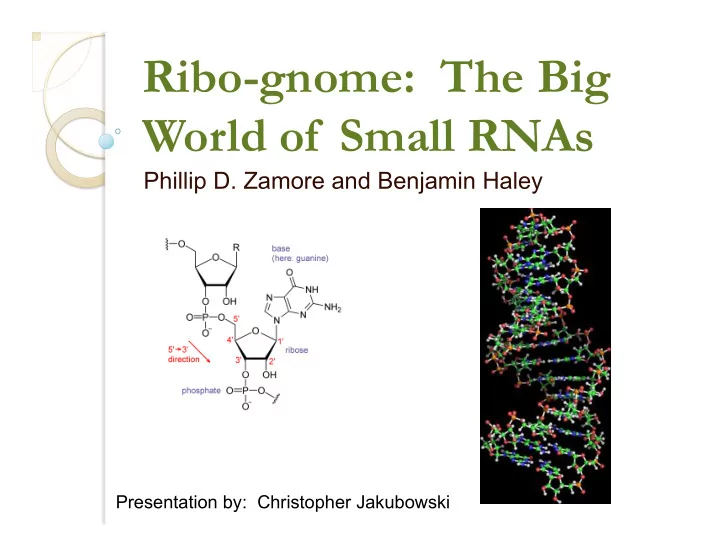
Ribo-gnome: The Big World of Small RNAs
Phillip D. Zamore and Benjamin Haley
Presentation by: Christopher Jakubowski
Ribo-gnome: The Big World of Small RNAs Phillip D. Zamore and - - PowerPoint PPT Presentation
Ribo-gnome: The Big World of Small RNAs Phillip D. Zamore and Benjamin Haley Presentation by: Christopher Jakubowski Three Classes of small RNAs miRNAs siRNAs rasiRNAs RNA silencing pathway Double strand molecules must
Phillip D. Zamore and Benjamin Haley
Presentation by: Christopher Jakubowski
miRNAs siRNAs rasiRNAs
Double strand
Three methods of
Binding pocket
Argonaute Dicer Binding pocket
found in an assortment
have only been found in plants, animals, and their viruses
found two RNA transcripts from lin-4 locus and lin-4 could base pair sites within lin-14
then directed to cut a single phosphodiester bond leading to destruction
protein translation is prevented
Animal miRNAs usually act in this mode because of
partial complementarity
What happens? 1.
Direct degradation of nascent polypeptide
2.
“Freeze” ribosomes in place
Theories called into question
alter stability of hundreds of mRNAs
cleavage
How do miRNAs make mRNA less stable then?
mRNA degraded slowly Quick Degradation
Specific liver cells, Huh7, produce miR-122 Hepatitis C virus (HCV) can only replicate in Huh7 cells Connection between presence of miR-122 in
permissive Huh7 cells?
Sequence of miR-122 with the seed sequences surrounded by a box 3’ UTR of HCV 5’ UTR of HCV
Jopling, Catherine L. "Modulation of Hepatitis C Virus RNA Abundance by a Liver-Specific MicroRNA." Science 309 (2005): 309.
Abundance of autonomously replicating, HCV RNA replicon
was tested during miR-122 inactivation
Associated with heterochromatin
Marked by H3K9 methylation or
Topics:
RITS = RNA induced transcriptional silencing complex
In outer regions of
centromere in S. pombe
Needed for chromosome
segregation
Repetitive sequences
compose out regions (similar to mammals)
Argonaute can also slice
transcripts and RdRP can make further substrates increasing efficiency
RdRP can act here
Previous model requires transcription across silenced
regions
In plants, RNA polymerase IV transcribes silent
heterochromatin
RNA-dependent RNA polymerase (RdRP) can then make
substrate for dicer
Pol II can create targets for small RNAs as well as trigger
for small RNA production
CTD of Pol II might interact with silencing machinery, then
Argonaute proteins with loaded siRNA are recruited
Experiments in S. cerevisiae
Transcription but no repression!
Large Subunit
Required for RNA silencing in worms and yeast Polymerase β nucleotidyltransferase superfamily
(includes polyA polymerases)
Chen, C. C. "A Member of the Polymerase Nucleotidyltransferase Superfamily Is Required for RNA Interferance in C. elegans." Current Biology 15 (2005): 378.
RdRP! RdRP!
Embryonic stems cells lacking Dicer, Argonaute
proteins, or dsRNA-binding partners die rapidly
Defects due to either loss of miRNA or silent
heterochromatin
Bernstein, E. "Dicer is essential for mouse development." Nature Genetics 35 (2003): 215.
Oct4 expression E7.5 comparison brachyury
Bernstein, E. "Dicer is essential for mouse development." Nature Genetics 35 (2003): 215. Bernstein, E. Nature 409 (2001): 363. Chen, C. C. "A Member of the Polymerase Nucleotidyltransferase Superfamily Is Required for RNA Interferance in C. elegans." Current Biology 15 (2005): 378. Hammond, Scott M. "Argonaute2, a Link Between Genetic and Biochemical Analyses of RNAi." Science 293 (201): 1146. Jopling, Catherine L. "Modulation of Hepatitis C Virus RNA Abundance by a Liver-Specific MicroRNA." Science 309 (2005): 309. Onodera, Yasuyuki, and Jeremy R. Haag. "Plant Nuclear RNA Polymerase IV Mediates siRNA and DNA Methylation-Dependent Heterochromatin Formation." Cell 120 (2005): 613.
Watson, James D., Tania A. Baker, Stephen P. Bell, Alexander Gann, Michael Levine, and Richard Losick. Molecular Biology of the Gene. 6th ed. Cold Spring Harbor: Cold Spring Harbor Laboratory P, 2008. Zamore, Phillip D., and Benjamin Haley. "Ribo-gnome: The Big World of Small RNAs." Science 309 (2005): 1519-524.