
SLIDE 1
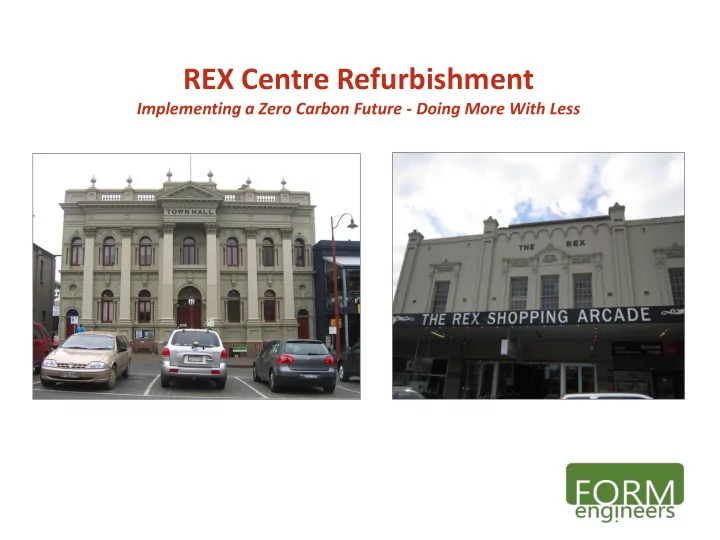
REX Centre Refurbishment
Implementing a Zero Carbon Future - Doing More With Less
REX Centre Refurbishment Implementing a Zero Carbon Future - Doing - - PowerPoint PPT Presentation
REX Centre Refurbishment Implementing a Zero Carbon Future - Doing More With Less http://www.abc.net.au/radionational/programs/breakfast/friday-panel-the-population-debate/3056752
Implementing a Zero Carbon Future - Doing More With Less
http://www.abc.net.au/radionational/programs/breakfast/friday-panel-the-population-debate/3056752
http://www.climatechange.gov.au/international/international-action/global-context-australias-place
http://visual.ly/global-carbon-footprint
Implementing a Zero Carbon Future - Doing More With Less
Building Re-use and Integration of Building Form and Volume The substantial thermal mass of the building has been adapted to beneficially stabilise the internal temperature of the occupied spaces and present a comfortable working and collaborative environment throughout the year. As a result of the ‘office’ portion of the building being earth-banked, access to natural daylight and connectivity to the external environment has been created by the inclusion of lightwells and external green spaces. The existing double/triple height volumes have been integrated into the environmental design by allowing hot, stale air to congregate at high level for extraction while the occupied levels are supplied with 100% fresh air to deliver the exemplar standards of a ‘WELL’ building The double height lightwells have automated opening portions linked to air-quality (CO2) sensors to ventilate the stale air from the building without the need for a mechanical extract/fan driven system. The same system allows for night-cooling of the thermal mass during summer without the need for a mechanical cooling system. Reusing the building structure ensures the REX Centre maximises the opportunity to reduce unnecessary construction waste and preserve community identity and connectivity to heritage. Integrated Solar Photo-voltaic Panels Integration of a 15kW roof-mounted solar photovoltaic array on the north aspect of the existing roof
demand, the remainder is exported t the grid. The mixed-use nature of the building improves load-mapping opportunities (based on the expected operational profile for the different spaces) maximising the beneficial use of the solar energy generated, reducing export to gird and the need for dedicated (battery) energy storage. Modelled Improvement Strategies Enhanced thermal insulation on the roof of the building to minimise heat-loss, gas consumption and energy running costs throughout the year while improve internal comfort. High efficiency light fittings have been selected with daylight/motion detection sensors throughout the building with addressable control systems to provide a ‘soft’ lighting environment Gas hydronic heating systems deliver efficient heating to the building. As heating is a substantial energy requirement for the building throughout the year, this philosophy results in a low operational carbon footprint.
thermal mass and results in a significantly smaller boiler plant size Future Proofing of the Building via Micro-turbine Integration Co-generation of electrical energy and waste heat recovery from a gas-powered microturbine engine of-sets the electricity that would traditionally be drawn from the grid while providing zero-carbon heating without the need to operate the boiler system. Having the ability to produce electricity for the building will provide resilience in the event of a power failure to the local electricity network and reduce the demand on the external electrical grid during periods of high usage. Similarly the boiler heating system will operate as a stand-by during periods where the micro-turbine is not operating off of a single gas supply to both systems. Future Proofing of the Building using ‘Clean’ Anaerobic Digestion gas Potentially in the near future, the installation proposed at the Daylesford Transfer Station will decompose organic matter and clean it up to a level that will allow combustion within a micro-turbine engine. Transporting this ‘clean’ ‘green’ gas for consumption within the building’s micro-turbine and boiler plant will result in the building delivering a net carbon neutral operation.
Fresh-air supply supplemented with natural ventilation Utilise high volume and heavy thermal mass for passive cooling Hydronic radiator heating operating 24/7 Photovoltaic roof installation shielding building from direct solar gain Gas-fired turbine exporting electricity and producing zero carbon heating Utilising bio-gas will deliver a zero carbon building in operation
1,500mm 2,000mm 4,000mm 400mm
84kg of material was decomposed 10 hours decomposition time 6 litres a minute of gas on average 3.6m3 of methane collected after 10 hours Equates to 120m3 – 150m3 of methane 3 tonnes of waste a day Or a 65 kW engine for 6 hours 300 kW – 400 kW of recovered heat
Methane Water Capital Cost $405k Electricity Heating Capital Cost $790k
Collected / Converted Organic Waste
Daylesford Hub Reduced Waste to Landfill Predicted Increase in Energy Costs Fertilised Digestate
18,000 m2 solar heating plant Marstal District Heating, Ærø High-tech energy plant. Waste incineration plant, inaugurated 2003, situated in Esbjerg in the western part of Denmark http://www.dbdh.dk/artikel.asp?id=464&mid=24
http://bravenewclimate.com/2011/05/12/renewables-are-not-sufficient-p2/
http://bravenewclimate.com/2013/07/16/new-critique-aemo-100pc-renew/
Wall Thermal Improvement 10% Energy Saving 3% Energy Increase
1 2 3 4 5 6 7 8 9 10 11 12 13 14 15 16 17 18 19 20 21 22 23 24 25
WoL Payback per Fabric Element (Walls)
Heating and Cooling Improvment Adjusted Heating only Saving
Type Typical module efficiency * Area Requirement High-performance hybrid 20%-22% 6 - 7m2/kWp Monocrystalline silicone 15%-18% 7 - 8m2/kWp Polycrystalline silicone 12%-14% 7 - 8m2/kWp Thin-film CIS 6%-10% 14-18m2/kWp
Mark Barrie: Design Director for Form Engineers specialising in Low Carbon Infrastructure and Off-Grid Building Design M:- 0435 715 859 E:- m.barrie@formengineers.com.au
Implementing a Zero Carbon Future - Doing More With Less