Rewards before Punishments Identify the real reason for behavior - - PowerPoint PPT Presentation

rewards before punishments
SMART_READER_LITE
LIVE PREVIEW

Rewards before Punishments Identify the real reason for behavior - - PowerPoint PPT Presentation

Rewards before Punishments Identify the real reason for behavior Strategies/ Behavior Encouragement Yes Executive Function Deficiency? No Stop, Think & Try again Give child tools to succeed! Reference: Russell Barkleys


slide-1
SLIDE 1

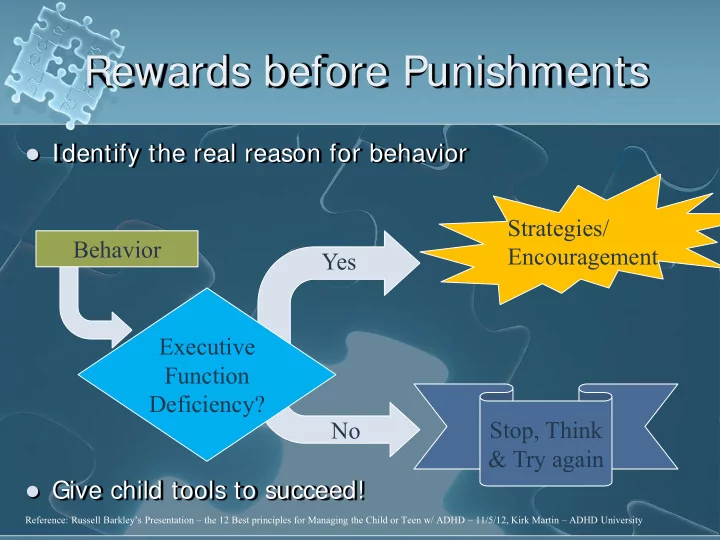
Rewards before Punishments

 Identify the real reason for behavior  Give child tools to succeed!

Reference: Russell Barkley’s Presentation – the 12 Best principles for Managing the Child or Teen w/ ADHD – 11/5/12, Kirk Martin – ADHD University

Behavior Strategies/ Encouragement Stop, Think & Try again Yes Executive Function Deficiency? No

slide-2
SLIDE 2

Talk Less, Touch More

 Act, Don’t Yak!!  Clear concise directions  Repeat instructions back  Hand signals or secret signs  Special job  Eye contact

 Encouragement  Praise the process and effort!

Reference: Russell Barkley’s Presentation – the 12 Best principles for Managing the Child or Teen w/ ADHD – 11/5/12, “Mindset” – Carol Dweck

slide-3
SLIDE 3

Flexibility

 This child will do things differently  Homework standing up, standing on their head, or jumping

rope

 Frequent Breaks  Keep blood sugar up while doing chores or homework –

chewing helps stimulate their brain

 Music, TV, other stimuli can be on for some kids to

concentrate

 Children can listen while fidgeting  Eye Contact  Experiment – what works for your child?  Your child is unique – traditional parenting may not work

Reference: Russell Barkley’s Presentation – the 12 Best principles for Managing the Child or Teen w/ ADHD – 11/5/12

slide-4
SLIDE 4

Disability Perspective

 Remember this is a hidden disability!  ADHD delays a child’s capacity for self-control and

independence

 Remember – ADHD is a neurological and genetic

disability – not a choice or a result of poor parenting

 30% Rule  Reduce your child’s chronological age by 30% to

find their executive age – age of self-regulation

 Developmentally “catch-up” by 27-30 years of age

Reference: Russell Barkley’s Presentation – the 12 Best principles for Managing the Child or Teen w/ ADHD – 11/5/12

slide-5
SLIDE 5

30% Rule

 Ages: Chronological vs Developmental

Adapted from Russell Barkley’s Presentation – the 12 Best principles for Managing the Child or Teen w/ ADHD – 11/5/12

6 8 10 12 14 16 18

4.2 5.5 7 8.4 9.8 11.2 12.6

slide-6
SLIDE 6

Education on ADHD

 For Parents, Teachers & Students  Age appropriate explanation  Executive Functions  Brain Learning  Growth Mindset  Strategies/Interventions

Reference: Russell Barkley’s Presentation – the 12 Best principles for Managing the Child or Teen w/ ADHD – 11/5/12

slide-7
SLIDE 7

Mindfulness

 Mindful Parenting/Teaching

 React or respond  Response to your expectation  Pause and then respond

 Mindfulness for ADHD

 Reset your inhibitory system  Pause and allow your mind to process

 Automatic Pilot vs Mindfulness (Present

Moment Awareness)

“The Mindfulness Prescription for Adult ADHD” – Lidia Zylowska

slide-8
SLIDE 8

Exercise

 “In order for man to succeed in life,

God provided him with two means, education and physical activity. Not separately, one for the soul and the

  • ther for the body, but for the two
  • together. With these two means, man

can attain perfection.” --Plato

“Spark – The Revolutionary New Science of Exercise and The Brain” – John J. Ratey with Eric Hagerman

slide-9
SLIDE 9

Exercise

 Can the signals get through?  How fluidly does the information travel?  Dopamine & norepinephrine  Balances the arousal center  Transmission fluid for the basal ganglia

Brain center that controls physical movement  coordinates the flow of information

“Spark – The Revolutionary New Science of Exercise and The Brain” – John J. Ratey with Eric Hagerman

slide-10
SLIDE 10

Exercise

 Spark Your Brain  Exercise sparks your brain function to improve

learning on three levels:

 First, it improves your mind's alertness,

attention, mood, and motivation.

 Second, it prepares and encourages nerve cells to

bind to one another, which is the cellular basis for logging in new information.

 Third, it spurs the development of new nerve cells

from stem cells in the hippocampus.

“Spark – The Revolutionary New Science of Exercise and The Brain” – John J. Ratey with Eric Hagerman

slide-11
SLIDE 11

Exercise

 For ADHD

 Exercise raises the baseline levels of essential neurotransmitters:

dopamine and norepinephrine

 “Wakes up” essential areas in the brain responsible for attention and

consciousness

 Complex motor movement – exercises the areas of the brain

involved in all cognitive functions – prefrontal cortex

“Spark – The Revolutionary New Science of Exercise and The Brain” – John J. Ratey with Eric Hagerman

slide-12
SLIDE 12

Interventions: Academic

slide-13
SLIDE 13

Organizational Skills

 The problem  Losing Materials  Failing to record homework assignments & due dates  Not completing or handing in assignments on time  Hinder academic performance & scholastic attainment  Outcomes  Lead to diminished confidence  Diminished engagement in school  Contribute to family conflict  Lower Grades

Reference: Russell Barkley’s Presentation – the 12 Best principles for Managing the Child or Teen w/ ADHD – 11/5/12, “Organizational Skills Training for Children with ADHD” Abikoff, Gallagher, and Spira

slide-14
SLIDE 14

Organizational Skills

“Time management is single most important factor in future success” – Russell Barkley

 Long-term Process  Visual – Hands on  Important to teach them how – not do it for them  E.g. Learning to ride a bike

Reference: Russell Barkley’s Presentation – the 12 Best principles for Managing the Child or Teen w/ ADHD – 11/5/12, “Organizational Skills Training for Children with ADHD” Abikoff, Gallagher, and Spira

Auditory

slide-15
SLIDE 15

Organizational Skills Training

 4 Broad Domains of Difficulties  Tracking Assignments  Managing Materials  Time Management  Task Planning  Organizational Skills Training targets these

four domains instead of overall executive function training

“Organizational Skills Training for Children with ADHD” Richard Gallagher, Howard B. Abikoff and Elana G Spira

slide-16
SLIDE 16

Organizational Skills Training

  • 1. Set expectations with

Parents/Teachers

  • 2. Set up motivation system
  • 3. Tracking Assignments
  • Daily Assignment Record
  • Assignment and Test Calendar
  • 4. Managing Materials

“Organizational Skills Training for Children with ADHD” Richard Gallagher, Howard B. Abikoff and Elana G Spira

slide-17
SLIDE 17

Organizational Skills Training

  • 5. Backpack Checklist – Memory Ring
  • 6. Understanding Time & Calendars
  • 7. Time Management
  • 8. Time Planning
  • Telling Time
  • Estimating Time to complete
  • 9. Task Planning

“Organizational Skills Training for Children with ADHD” Richard Gallagher, Howard B. Abikoff and Elana G Spira

slide-18
SLIDE 18

Daily Assignment Record

  • Squares

for each Subject

  • How to

denote Action

  • Smiley

face for no HW

“Organizational Skills Training for Children with ADHD” Richard Gallagher, Howard B. Abikoff and Elana G Spira

slide-19
SLIDE 19

Take Home Folder

“Organizational Skills Training for Children with ADHD” Richard Gallagher, Howard B. Abikoff and Elana G Spira

slide-20
SLIDE 20

Time Detective Worksheet

“Organizational Skills Training for Children with ADHD” Richard Gallagher, Howard B. Abikoff and Elana G Spira

slide-21
SLIDE 21

Estimating Time

“Organizational Skills Training for Children with ADHD” Richard Gallagher, Howard B. Abikoff and Elana G Spira

slide-22
SLIDE 22

Study Skills

 Study Space – at home

 Least number of distractions  Library Hours for everyone

 How do I like to do my homework?  When do I like to do my homework?  Where do I like to do my homework?  Set the foundation for study skills  Be Flexible!

The ADHD handbook for Schools – Harvey C Parker, “ The “Putting on the Brakes” Activity Book for Young People with ADHD” – Patricia O. Quinn, Judith

  • M. Stern
slide-23
SLIDE 23

Externalize Time

Children w/o ADHD

Reference: Russell Barkley’s Presentation – the 12 Best principles for Managing the Child or Teen w/ ADHD – 11/5/12

Children w/ ADHD

slide-24
SLIDE 24

Externalize Time

 Internal sense of time is not reliable  Break longer tasks into smaller tasks if

possible

 Make Time and Time

passage visual

Reference: Russell Barkley’s Presentation – the 12 Best principles for Managing the Child or Teen w/ ADHD – 11/5/12

slide-25
SLIDE 25

Externalize Working Memory

 Externalize reminders – make them visual,

colorful

 Rhythm – like in Kindergarten to help memory  Point of Performance Reminders – Memory Ring  Homework – Planners  Rehearse “When-then” plans  Color coding, Rhythm . . .  Partner with Parents & School - continuous,

consistent reinforcement

Reference: Russell Barkley’s Presentation – the 12 Best principles for Managing the Child or Teen w/ ADHD – 11/5/12

slide-26
SLIDE 26

Foldables for Young Children

Chris Zeigler Dendy – Chicago Public Schools Presentation on Academic Challenges & Interventions, March 27-28, 2014

slide-27
SLIDE 27

Memory Bracelet

Chris Zeigler Dendy – Chicago Public Schools Presentation on Academic Challenges & Interventions, March 27-28, 2014

slide-28
SLIDE 28

Memory Rings

slide-29
SLIDE 29

Scribble Band

Chris Zeigler Dendy – Chicago Public Schools Presentation on Academic Challenges & Interventions, March 27-28, 2014

slide-30
SLIDE 30

White Board Paddle

slide-31
SLIDE 31

Maximizing Memory Retention

Chris Zeigler Dendy – Chicago Public Schools Presentation on Academic Challenges & Interventions, March 27-28, 2014

slide-32
SLIDE 32

Working Memory

 Brain breaks – 15% increase blood oxygen in brain  Movement/exercise – “Miracle Gro” for brain cells –

creates new neurons

 Laugh/chew gum – increase blood flow to brain  “Water breaks” – move neuron signals through

brain and keep lungs moist to transfer oxygen to blood

 Glucose foods/crunchy foods – boost performance

and accuracy of memory & attention

Chris Zeigler Dendy – Chicago Public Schools Presentation on Academic Challenges & Interventions, March 27-28, 2014

slide-33
SLIDE 33

Structure

 Structure

 Helps ease transitions  Reduces anxiety  Comforting for Elementary School Children

 Post Class Rules  Make Classroom Routines  Give Appropriate Supervision – Children

with ADHD require more supervision

 Reduce Potential Distractions

Reference: Russell Barkley’s Presentation – the 12 Best principles for Managing the Child or Teen w/ ADHD – 11/5/12

slide-34
SLIDE 34

Allow for movement

 Children w/ ADHD want to please, assign

them specific tasks to keep them engaged & moving if possible

 Allow for movement during the day  Don’t eliminate recess as consequence  Increase Active Class Participation  Encourage Hands-on Learning  Sensory Strips  Cross-body movement

Reference: Russell Barkley’s Presentation – the 12 Best principles for Managing the Child or Teen w/ ADHD – 11/5/12, Kirk Martin – ADHD University

slide-35
SLIDE 35

“Brain Break”

 Pick a stick:  Machine gun feet  Jumping jacks  Head, knees, toes  “Simon Says”  Dance to music  March to Music

Reference: Chris Zeigler Dendy Academic Challenges & Interventions for the Chicago Public Schools

slide-36
SLIDE 36

Make Problem-solving manual

 Working Memory deficits inhibits their ability to

problem solve – keeping the problem in mind

 Break tasks into pieces  Make those pieces physical – blocks, shapes,

counters, skittles, etc.

 Help them to use their hands in problem solving  Let them decide how to best problem solve  standing on their head, music on, eating, etc.  Helps to keep their brains engaged

Reference: Russell Barkley’s Presentation – the 12 Best principles for Managing the Child or Teen w/ ADHD – 11/5/12

slide-37
SLIDE 37

Graphics Organizers

Chris Zeigler Dendy – Chicago Public Schools Presentation on Academic Challenges & Interventions, March 27-28, 2014

slide-38
SLIDE 38

Brain Surgeons

Teachers & Parents are brain Surgeons!! They change

children’s brains!

Chris Zeigler Dendy – Chicago Public Schools Presentation on Academic Challenges & Interventions, March 27-28, 2014

slide-39
SLIDE 39

Puzzle Exercise

 Puzzle  I have many characteristics that make

me unique & valuable

 I'm Complex  I have many layers

Judy Richardson-Mahre – Partners in Parenting

slide-40
SLIDE 40

Puzzle Exercise

 You each have a puzzle piece  Look at that piece – what is the

picture?

Judy Richardson-Mahre – Partners in Parenting

slide-41
SLIDE 41

Look at the whole person – not just 1 puzzle piece

Judy Richardson-Mahre – Partners in Parenting

slide-42
SLIDE 42

Puzzle Exercise

 Draw your self-portrait  Turn the sheet over and list your puzzle pieces  Unique attributes, gifts, talents, struggles  Each of us is unique and valuable  We are complex  One attribute cannot define us!  We may not be what our parents expected or

wanted, but we are what they got!

 We each have a purpose unique to our talents,

gifts and passions!

Adapted from Russell Barkley & Thomas Brown explanation of Executive Functions. Additional contributors: Holly West Jones and Judy E Bandy

slide-43
SLIDE 43

Conclusion

 ADHD is a neurobiological condition that causes a

delay in Executive Functioning

 ADHD is highly treatable when you understand the

ADHD brain

 Magnify each child’s unique gifts, talents and

strengths while bolstering their struggles

 Be flexible and forgiving with your children and

yourself

 Encourage a Growth Mindset  Coach and Teach your child

slide-44
SLIDE 44

Questions?

slide-45
SLIDE 45

Additional Resources

 ADDitudemag.com  RussellBarkley.org  DrThomasEBrown.com  ADDwarehouse.com  TimeTimer.com  TotallyADD.com  CelebrateCalm.com – ADHD University  www.famouspeoplearehuman.com/famous-

people-adhd.htm

slide-46
SLIDE 46

References

ADHD Throughout the Years. (2014, 10/6/2014). Centers for Disease Control and Prevention. Retrieved from http://www.cdc.gov/ncbddd/adhd/timeline.html

Ansbacher, H. L., & Ansbacher, R. R. (1956). The Individual Psychology of Alfred Adler. New York, NY: Harper & Row, Publishers, Inc.

Babinski, D. E., Pelham Jr., W. E., Molina, B. S., Waschbusch, D. A., Gnagy, E. M., Yu, J., ... Biswas, A. (2011, August 20, 2011). Women with Childhood ADHD: Comparisons by Diagnostic Group and Gender. Annual meeting of The Association of Behavioral and Cognitive Therapies, 420-429. http://dx.doi.org/10.1007/s10862-011-9247-4

Barkley, R. (2012). Barkley Deficits in Executive Functioning Scale, Children and Adolescents. New York: The Guilford Press.

Barkley, R. (2012). The 12 Best Principles for Managing the Child or Teen with ADHD. In ADHD Symposium (pp. -1-15). Minnetonka, MN: Groves Academy.

Barkley, R. A. (2005 ). ADHD and the Nature of Self-Control. New York: Guilford Press.

Barkley, R. A. (2011). The Nature of ADHD: The Executive Functions and Self-Regulation. In ADHD Symposium (pp. 1-13). Minnetonka, MN: Groves Academy.

Barkley, R. A. (2013). Taking Charge of ADHD; The Complete Authoritative Guide for Parents (Third ed.). New York: Guilford Press.

Barkley, R. A., Murphy, K. R., & Fischer, M. (2008). ADHD in Adults: What the Science Says. [Kindle version]. Retrieved from http://www.amazon.com/ADHD-Adults-What-Science-Says-ebook/dp/B005DIAS60/ref= sr_1_sc_1?ie= UTF8&qid= 1388774720&sr= 8-1- spell&keywords= adhd+ in+ adul+ what+ the+ science+ says

Beaver, K. M., Nedelec, J. L., Rowland, M. W., & Schwartz, J. A. (2012). Genetic Risks and ADHD symptomatology: Exploring the Effects of Parental Antisocial behaviors in an Adoption-Based Study. Child Psychiatry Human Development, 293-305. http://dx.doi.org/10.1007/s10578- 011-0263-0

Bell, R., & Peiper, H. (2000). The A.D.D. and A.D.H.D. Diet! Sheffield MA: Safe Goods/New Century Publishing.

Bertin, M. (2011). The Family ADHD Solution. New York, NY: Palgrave Macmillan.

Brain Matures a Few Years Late in ADHD, But Follows Normal Pattern. (2007). Retrieved from http://www.nimh.nih.gov/news/science- news/2007/brain-matures-a-few-years-late-in-adhd-but-follows-normal-pattern.shtml

Brown, T. E. (2005). Attention Deficit Disorder, The Unfocused Mind in Children and Adults. New Haven: Yale University Press.

Brown, T. E. (2008, February 2008). Executive Describing Six Aspects of a Complex Syndrome. Attention, 12-17. Retrieved from http://www.drthomasebrown.com/pdfs/Executive_Functions_by_Thomas_Brown.pdf

Cooper-Kahn, J., & Dietzel, L. (2008). Late, Lost, and Unprepared A Parents’ Guide to Helping Children with Executive Functioning. United States of America: Woodbine House.

Copeland, E. D., & Love, V. L. (1995). Attention without Tension A Teacher’s Handbook on Attention Disorders (ADHD and ADD). Plantation, FL: Specialty Press, Inc.
slide-47
SLIDE 47

References

Davis, J. M., Takahashi, T., Shinoda, H., & Gregg, N. (2012). Cross-cultural comparisons of ADHD symptoms among Japanese and US university

  • students. International Journal of Psychology, 47, 203-210. http://dx.doi.org/10.1080/00207594.2011.614617

Diagnostic and Statistical Manual of Mental Disorders . (2013). In Diagnostic and Statistical Manual of Mental Disorders (Fifth Edition, pp. xiii- 947). Arlington, VA: American Psychiatric Association.

Doidge, N. (2007). The Brain that Changes Itself. United States of America: Viking Penguin.

Dreikurs, R., & Solz, V. (1990). Children, The Challenge. New York: Hawthorn Books.

Driscoll, C. O., Heary, C., Hennessy, E., & McKeague, L. (2012). Explicit and implicit stigma towards peers with mental health problems in childhood and adolescence. The Journal of Child Psychology and Psychiatry, 53, 1054-1062. http://dx.doi.org/10.1111/j.1469- 7610.2012.02580.x

Duhigg, C. (2012). The Power of Habit. New York, NY USA: Random House.

Dweck, C. (2010). How can you change from a fixed mindset to a growth mindset? Mindset. Retrieved from http://mindsetonline.com/changeyourmindset/firststeps/index.html

Dweck, C. (July 25, 2013, July 25, 2013). Professor Carol Dweck ’Teaching a growth mindset’ at Young Minds 2013 [Video file]. Retrieved from http://www.youtube.com/watch?v= kXhbtCcmsyQ

Dweck, C. S. (2006). Mineset; The New Psychology of Success. United States of America: Ballantine Books, Inc.

Ebbinghaus, H. (1885). Memory A Contribution to Experimental Psychology. [Ebook on Google]. Retrieved from books.google.com/books?hl= en&lr= &id= oRSMDF6y3l8C&oi= fnd&pg= PA62&dq= ebbinghaus+ memory+ a+ contribution+ to+ experimental+ psych

  • logy&ots= RktWNzcYbE&sig= fhwjwcLjxk2x8dqXGbt0fDXfLOw# v= onepage&q= ebbinghaus% 20memory% 20a% 20contribution% 20to% 20experi

mental% 20psychology&f= false

Flick, G. L. (1998). ADD/ADHD Behavior-Change Resource Kit. San Francisco, CA: Jossey-Bass.

Gallagher, R., Abikoff, H. B., & Spira, E. G. (2014). Organizational Skills Training for Children with ADHD An Empirically Supported Treatment. New York, NY: The Guilford Press.

Garon, N., Bryson, S. E., & Smith, I. M. (2008). Executive Function in Preschoolers: A Review Using an Integrative Framework. Psychological Bulletin, 134, 31-60. http://dx.doi.org/10.1037/0033-2909.134.1.31

Hansen, S. A. (2013). The Executive Functioning Workbook for Teens; Help for Unprepared, Late and Scattered Teens. Canada: Raincoast Books.

Henry, L. A., & Bettenay, C. (2010). The Assessment of Executive Functioning in Children. Child and Adolescent Mental Health, 15, 110-119. http://dx.doi.org/10.111/j/1475-3588.2010.00557.x

Lew, A., & Bettner, B. (1998). Responsibility in the Classroom A Teacher’s Guide to Understanding and Motivating Students. Newton Centre, MA: Connexions Press.

Lew, A., & Bettner, B. (2010). A Parent’s Guide to Understanding and Motivating Children. Newton Centre, MA: Connexions Press.

slide-48
SLIDE 48

References

Martin, Kirk. (2013). ADHD University Raise Confident, Positive Kids [CD]. Abingdon, MD: Celebrate Calm.

Parker, H. C. (2005). The ADHD Handbook for Schools Effective Strategies for Identifying and Teaching Students with Attention- Deficit/Hyperactivity Disorder. Plantation, FL: Specialty Press.

Parker, H. C. (2005). The ADHD Workbook for Parents; A Guide for Parents of Children Ages 2-12 with Attention-Deficit/Hyperactivity Disorder. Plantation, FL: Specialty Press, Inc.

Quinn, P. O., & Stern, J. M. (1993). The “Putting on the Brakes” Activity Book for young people with ADHD. New York, NY: Magination Press.

Quinn, P. O., & Stern, J. M. (2009). Putting on the Brakes Activity Book for Kids with ADD or ADHD (Second ed.). Washington, D.C.: Magination Press.

Ramsay, J. R., & Rostain, A. L. (2011). CBT Without Medications for Adult ADHD: An Open Pilot Study of Five Patients. Journal of Cognitive Psychotherapy: An International Quarterly, 25, 277-286. http://dx.doi.org/10.1891/0889-8391.25.4.277

Ratey, J. J., & Hagerman, E. (2008). Spark The revolutionary new science of exercise and the brain. New York, NY: Little, Brown and Company.

Ricci, M. C. (2013). Mindsets in the Classroom Building a Culture of Success and Student Achievement in Schools. Waco, TX: Prufrock Press, Inc.

Sacks, O. (2007). Musicophilia: Tales of Music and the Brain. New York: Alfred A. Knopf.

Schaub, J. M. (1998). your kid has ADHD, Now What? Minneapolis, MN: Beaver’s Pond Press.

Siegel, D. J. (2007). The Mindful Brain. New York, NY: W.W. Norton & Company, Inc.

Stumpf, T., & Schaefer Stumpf, D. (2014). Journal of an ADHD Kid; The Good, the bad, and the useful. Bethesda, MD: Woodbine House, Inc.

Zeigler Dendy, C. A. (2006). Teenagers with ADD and ADHD A Guide for Parents and Professionals (Second ed.). Bethesda, MD: Woodbine House, Inc.

Zeigler Dendy, C. A. (2008, February 2008). Understanding the Link Between Executive Functions and School Success. Attention, 18-21. Retrieved from http://www.chadd.org/LinkClick.aspx?fileticket= 7bNWHgdjeLo% 3D

Zeigler Dendy, C. A. (2014). Academic Challenges & Interventions. In Chicago Public Schools Symposium (Handouts Pg 1-7). Chicago Public Schools: Chicago Public Schools.

Zeigler Dendy, C. A., & Zeigler, A. (2003). A Bird’s Eye View of Life with ADD and ADHD: Advice from Young Survivors. United States of America: Cherish the Children.

Zentall, S. S. (2006). ADHD and Education Foundations, Characteristics, Methods, and Collaboration. Upper Saddle River, New Jersey: Pearson Education, Inc.

Zylowska, L. (2012). The Mindfulness Prescription for Adult ADHD. United States of America: Trumpeter Books.

www.famouspeoplearehuman.com/famous-people-adhd.htm. (n.d.). www.famouspeoplearehuman.com/famous-people-adhd.htm