Revised Part 2 Regulations Compliance Impact for Treatment Programs, - - PowerPoint PPT Presentation

revised part 2 regulations compliance
SMART_READER_LITE
LIVE PREVIEW

Revised Part 2 Regulations Compliance Impact for Treatment Programs, - - PowerPoint PPT Presentation

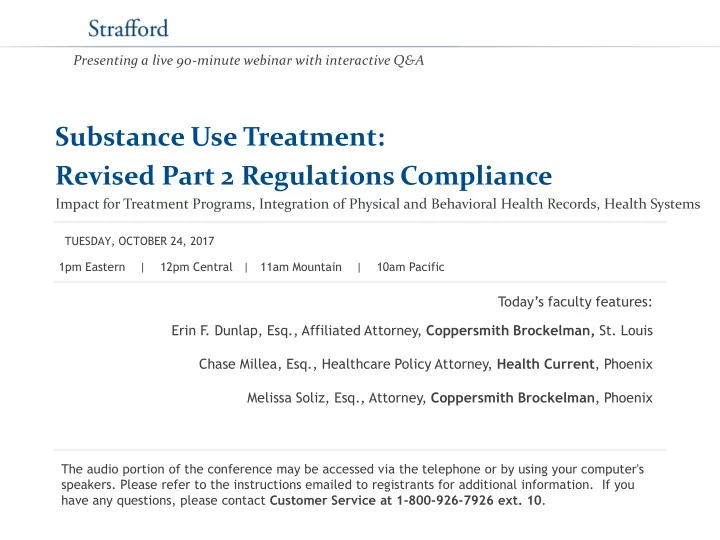
Presenting a live 90-minute webinar with interactive Q&A Substance Use Treatment: Revised Part 2 Regulations Compliance Impact for Treatment Programs, Integration of Physical and Behavioral Health Records, Health Systems TUESDAY, OCTOBER 24,


slide-1
SLIDE 1

The audio portion of the conference may be accessed via the telephone or by using your computer's

  • speakers. Please refer to the instructions emailed to registrants for additional information. If you

have any questions, please contact Customer Service at 1-800-926-7926 ext. 10.

Presenting a live 90-minute webinar with interactive Q&A

Substance Use Treatment: Revised Part 2 Regulations Compliance

Impact for Treatment Programs, Integration of Physical and Behavioral Health Records, Health Systems Today’s faculty features:

1pm Eastern | 12pm Central | 11am Mountain | 10am Pacific TUESDAY, OCTOBER 24, 2017

Erin F . Dunlap, Esq., Affiliated Attorney, Coppersmith Brockelman, St. Louis Chase Millea, Esq., Healthcare Policy Attorney, Health Current, Phoenix Melissa Soliz, Esq., Attorney, Coppersmith Brockelman, Phoenix

slide-2
SLIDE 2

Tips for Optimal Quality

Sound Quality If you are listening via your computer speakers, please note that the quality

  • f your sound will vary depending on the speed and quality of your internet

connection. If the sound quality is not satisfactory, you may listen via the phone: dial 1-866-927-5568 and enter your PIN when prompted. Otherwise, please send us a chat or e-mail sound@straffordpub.com immediately so we can address the problem. If you dialed in and have any difficulties during the call, press *0 for assistance. Viewing Quality To maximize your screen, press the F11 key on your keyboard. To exit full screen, press the F11 key again.

FOR LIVE EVENT ONLY

slide-3
SLIDE 3

Continuing Education Credits

In order for us to process your continuing education credit, you must confirm your participation in this webinar by completing and submitting the Attendance Affirmation/Evaluation after the webinar. A link to the Attendance Affirmation/Evaluation will be in the thank you email that you will receive immediately following the program. For additional information about continuing education, call us at 1-800-926-7926

  • ext. 35.

FOR LIVE EVENT ONLY

slide-4
SLIDE 4

Program Materials

If you have not printed the conference materials for this program, please complete the following steps:

  • Click on the ^ symbol next to “Conference Materials” in the middle of the left-

hand column on your screen.

  • Click on the tab labeled “Handouts” that appears, and there you will see a

PDF of the slides for today's program.

  • Double click on the PDF and a separate page will open.
  • Print the slides by clicking on the printer icon.

FOR LIVE EVENT ONLY

slide-5
SLIDE 5

AGENDA (1/2)

 Overview of 42 C.F.R. Part 2  Applicability of 42 C.F.R. Part 2

 What information?  Who is subject?

 Revised 42 C.F.R. Part 2: The Highlights

 Consent requirements  Disclosures without patient consent  Impact on Part 2 programs and other lawful holders of

Part 2 information

5

slide-6
SLIDE 6

AGENDA (2/2)

 Physical and Behavioral Health Integration and

Data Exchange

Continued barriers to integration

Limitations of Consent2Share  Best Practices for Compliance

Segmentation, segregation and access controls

Data submission policies and procedures

Consent management and forms

Qualified Service Organization Agreements and “contract agent” arrangements

6

slide-7
SLIDE 7

42 C.F.R. Part 2 Overview

The 42 C.F.R. Part 2 regulations implement the Confidentiality of Substance Use Disorder Treatment Records Statute (42 U.S.C. § 290dd-2), which provides heightened privacy protection to protected health information that identifies a patient as a substance - abuser and is obtained by a federally-assisted substance use disorder program. The Part 2 regulations supplement other privacy laws, including HIPAA and other state confidentiality laws.

7

slide-8
SLIDE 8

History of 42 C.F.R. Part 2 (1/2)

1970 & 1972

Congress enacted two statutes—the “Alcohol and Drug Abuse Acts”—that restricted the use and disclosure of information identifying individuals as alcohol and drug abusers.

P.L. 91-616; P.L. 92-255 37 Fed. Reg. 24636

1975

Part 2 regulations established.

40 Fed. Reg. 27802

1987

Modest substantive changes.

52 Fed. Reg. 21798

8

slide-9
SLIDE 9

History of 42 C.F.R. Part 2 (2/2)

2004, 2010-11 & 2014

SAMHSA guidance issued.

See SAMHSA.gov

2016 & 2017

Proposed revision in 2016 and revised regulations went in effect on March 20, 2017. Supplemental Notice

  • f Proposed Rule

Making (SNPRM) (comment period closed on Feb. 17, 2017).

81 FR 6987; 82 FR 6052; 82 FR 8346; 82 FR 5485

What’s Next?

Proposed legislative changes on the horizon.

SB 1850/HB3545 (2017)

9

slide-10
SLIDE 10

Applicability of 42 C.F.R. Part 2 (1/3)

 Framework for Determining Applicability:  What information? Is it Part 2 information?  From whom? Is the original source of the Part 2

information a Part 2 program?

 How was it received? Am I Part 2 program or lawful

holder of Part 2 information? 10

slide-11
SLIDE 11

Applicability of 42 C.F.R. Part 2 (2/3)

What is Part 2 Information?

Protected health information that identifies a person as a substance abuser; AND

Is obtained by a Part 2 program. 42 C.F.R. § 2.12(a).

What is a Part 2 Program? *FACT SPECIFIC DETERMINATION*

An individual or entity (including a unit or personnel within a general medical facility) who holds itself out as providing and provides substance use disorder (SUD) diagnosis, treatment, or referral for treatment; and

Is federally assisted (e.g., is contracted with the federal government, licensed by the federal government to provide SUD treatment, receives any federal funds, or is a 501(c)(3) non-profit). 42 C.F.R. §§ 2.11 (definitions of “Part 2 program” and “program), 2.12(b)(b) (“federal assistance”).

Examples: Treatment or rehabilitation programs, employee assistance programs, programs within general hospitals, school-based programs, and private practitioners who hold themselves

  • ut as providing, and provide substance use disorder treatment. 42 C.F.R. § 2.12(e).

What is not?

Examples: Providing SBIRT—screening, brief intervention, and referrals for substance use disorder treatment—within a general health care setting (e.g., emergency room), so long as it is not the primary function of the medical staff providing it. 82 FR 6052.

11

slide-12
SLIDE 12

Applicability of 42 C.F.R. Part 2 (3/3)

Who are other lawful holders?

Third Party Payors

Entities that have direct administrative control over the Part 2 program (e.g., a general medical facility in which a substance use disorder treatment unit is located)

Consent recipients who receive the Part 2 information with the prohibition on re-disclosure notice

Qualified Service Organizations (QSOs) and their contract agents pursuant to contract

Researchers and auditors who receive Part 2 information without patient consent 42 C.F.R. §§ 2.12(d), 2.11 (QSOs), 2.52 (researchers), 2.53 (auditors); 82 F.R. 6052, 6068.

12

slide-13
SLIDE 13

Don’t forget HIPAA and State Laws….

Dual compliance with HIPAA and state law is required.

HIPAA

Additional Authorization Requirements

Notice of Privacy Practices

 Patient Rights 

Security

State Laws

42 C.F.R. § 2.20: “. . . . If a disclosure permitted under the regulations in this part is prohibited under state law, neither the regulations in this part nor the authorizing statute may be construed to authorize any violation of that state

  • law. However, no state law may either authorize or compel any disclosure

prohibited by the regulations in this part.”

13

slide-14
SLIDE 14

Overview of Changes in 2017 Final Rule

2017 Final Rule: 82 FR 6052

What hasn’t changed

 Applicability  Patient consent still

required for TPO

 No new exceptions

to consent requirement

 Prohibition on re-

disclosure still required (but updated language)

Summary of Changes

Definitions: modernized to be consistent with current terminology in the field.

Some alignment with HIPAA: security & record destruction

Notice to Patient: contact info for reporting violations

Consent Requirements

Exceptions to Consent

Updated Prohibition on Re-Disclosure Notice

SNPRM: disclosures to subcontractors; abbreviated re-disclosure notice

Today’s Focus

Changes to Consent Requirements

Changes to Consent Exceptions

14

slide-15
SLIDE 15

Overview of Consent Structure & Exceptions

 Rule of Thumb: Patient consent is required, unless an exception applies.  Exceptions:  Medical emergency, 42 C.F.R. § 2.51.  Research, 42 C.F.R. § 2.52.  Audit and evaluations, 42 C.F.R. § 2.53.  Court orders, 42 C.F.R. Subpart E.  Direct administrative controls, 42 C.F.R. § 2.12(c)(3).  Qualified Service Organizations (QSOs) and their contract agents,

42 C.F.R. § 2.12(c)(4). & SAMHSA’s 2010 & 2011 guidance.

 Child abuse/neglect, 42 C.F.R. § 2.12(c)(6).  Cause of death, 42 C.F.R. § 2.15(b).

15

slide-16
SLIDE 16

Overview of Consent Requirements, 42 C.F.R. § 2.31

Patient name, signature and date. Special rules apply if the patient is a minor, incompetent or deceased and when a personal representative may sign. 42 C.F.R. §§ 2.14, 2.15.

From whom. The specific name or general designation. SAMHSA abandoned proposal to eliminate the general designation option. 82 FR 6052, at 6077 & 6087.

To whom (BIG CHANGES!). It’s complicated under the 2017 Final Rule. . . .

Amount and Kind (SEE WHAT’S NEW!).

  • Purpose. SAMHSA added clarifying language that disclosure must be limited to that which is

necessary to carry out the stated purpose in accordance with 42 C.F.R. § 2.13(a).

  • Revocation. Consent is subject to revocation at any time, except if consent already relied

upon.

Expiration date or event.

List of Disclosures (NEW!). Ability to generate is required if a general designation consent is used.

Additional Requirements: Disclosures to central registries and elements of the criminal justice systems (e.g., probation/parole) must meets additional requirements in 42 C.F.R. §§ 2.34 and 2.35.

16

slide-17
SLIDE 17

Revised Consent Requirements: To Whom, 42 C.F.R. § 2.31(a)(4)

1987 Standard: The name or title of the individual or the name of the

  • rganization to which disclosure is to be made. SAMHSA prohibited use of

a general designation, such as “all my healthcare providers.”

2017 Final Rule: 2017 Final Rule offers essentially 3 options, including a general designation

 Name of entity (or individuals) with a treating provider relationship

(e.g., XYZ Clinic) or health plan.

 Name of individual that does not have a treating provider relationship

(e.g., Jane Doe)

 General Designation*: name of entity without a treatment provider

relationship (e.g., HIO, ACO, CIN, research institution) and name of entities with a treating provider relationship, individuals, or general designation of individuals/entities/class limited to those with a treating provider relationship (past, current or future).

Treating Provider Relationship, 42 C.F.R. § 2.11.

17

slide-18
SLIDE 18

82 FR 6052, 6080

18

slide-19
SLIDE 19

List of Disclosures, 42 C.F.R. § 2.13(d)

 Required if a General Designation Consent form is used.  Consent form must include a statement notifying patients that they

have a right to make a written request for a list of disclosures (up to 2 years). 42 C.F.R. § 2.31(a)(4)(i)(B)(3)(i).

 List of Disclosures requirements (42 C.F.R. § 2.13(d)):

 Must respond within 30 days.  For each disclosure list the name of the entities, date and brief

description.

 Compliance burden is on the intermediary entity (e.g., HIO, ACO,

research institution).

 Ability to generate a “list of disclosures” must exist before a general

designation consent is used. 82 FR 6052, 6056-57, 6072.

19

slide-20
SLIDE 20

Revised Consent Requirements: Amount and Kind, 42 C.F.R. § 2.31(a)(3)

1987 Standard: How much and what kind of information is to be disclosed.

2017 Final Rule: How much and what kind of information is to be disclosed, including an explicit description of the substance use disorder information that may be disclosed.

SAMHSA’s “Granular Consent” Interpretation: Interpreted by SAMHSA to allow for the disclosure of “all substance use disorder information,” but

  • nly if more detailed options are included other than “all or nothing.” 82

FR 6052, at 6086.

Does this conflict with the plain language of the regulations?

 Does this conflict with SAMHSA’s acknowledgment (82 FR 6091) that it lacks

statutory authority to require data segmentation?

20

slide-21
SLIDE 21

Revised Medical Emergency Exception, 42 C.F.R. § 2.51

1987 Standard: . . . patient identifying information may be disclosed to medical personnel who have a need for information about a patient for the purpose of treating a condition which poses an immediate threat to the health of any individual and which requires immediate medical intervention.

2017 Final Rule: . . . patient identifying information may be disclosed to medical personnel to the extent necessary to meet a bona fide medical emergency in which the patient’s prior informed consent cannot be obtained.

Impact: greater discretion in determining whether a medical emergency exists. 82 FR 6052, 6094.

What Didn’t Change?

Individual determination of a medical emergency is required. Automation is not permitted. 82 FR 6052, 6095.

Emergency exception cannot be used to circumvent the consent requirement. 82 FR 6052, 6094-95.

Intermediary entities must give notice to the Part 2 program that is the source of the Part 2 data upon

  • disclosure. 82 FR 6052, 6096.

Public Health Emergencies?: It’s unclear whether this exception applies to federal or state declarations of a public health emergency related to the opioid epidemic. SAMHSA has stated it will issue subregulatory guidance. 82 FR 6052, 6079.

21

slide-22
SLIDE 22

Revised QSO Exception, 42 C.F.R. §§ 2.11 & 2.12(c)(4)

 2017 Final Rule Changes to the QSO Definition (42 C.F.R. § 2.11):

 Replaced “medical . . . services” with “medical staffing.”  Added “population health management.” Preamble describes as

“increasing desired health outcomes through monitoring and identifying individual patients within a group.” 82 FR 6052, 6066 & 6068.

 Declined to include “care coordination” or clarify how “care

coordination” differs from “population health management.” 82 FR 6052, 6067.

 What does it mean?

 QSO exception cannot be used to circumvent the consent requirement

where the disclosure is used for treatment purposes. 82 FR 6052, 6067.

 Disclosures for “population health services” must be limited to the office or

unit responsible for population health management in the organization; it does not permit disclosure to the entire organization. 82 FR 6052, 6066-67.

22

slide-23
SLIDE 23

Revised Research Exception, 42 C.F.R. § 2.52

Significant changes to the research exception.

Part 2 programs and other lawful holders of Part 2 information may now disclose to researchers for scientific research if the disclosing entity is subject to, and in compliance with, HIPAA and/or the Common Rule.

Recipient researchers are subject to the Part 2 regulations.

Data linkages to public and private repositories are permitted. But requires

Review by IRB;

Researchers must not disclose Part 2 information to law enforcement; and

Data repositories must comply with 42 C.F.R. Part 2; destroy linked data after providing information to researchers; and ensure Part 2 information is not provided to law enforcement.

23

slide-24
SLIDE 24

Impact on Part 2 Programs and Other Lawful Holders

 Part 2 programs: unlikely to cause significant

changes in day-to-day operations.

 Other Lawful Holders: some increased flexibility,

such as disclosures for research.

 Data integration and health information

exchange: Challenges in aligning patient rights, improved access, and existing technology 24

slide-25
SLIDE 25

Data Integration

 Data Integration

Data integration is the combination of multiple types of data from various different sources into a single infrastructure, such as clinical data

  • repository. The impetus over the last decade has been to integrate

behavioral and physical health information. Challenges:

 Differences in coding methodologies for physical and

behavioral health entities

 Resource strain for adapting to new technology  Shifting regulatory landscape

25

slide-26
SLIDE 26

Health Information Exchange

 Health Information Exchange

Health information exchanges are the key to data integration, as it permits providers, plans and other components of the healthcare system to timely share patient information. It is an integral component of the health information technology (HIT) infrastructure. Development:

 Statewide HIE Coordinators/Grant Funding  Sequoia Project – e-Health exchange  Strategic Health Information Exchange Collaborative, Patient

Centered Data Home

 Improved Interoperability

26

slide-27
SLIDE 27

Adapting to Regulatory Requirements

Applicable Regulations:

 Federal: HIPAA, 42 C.F.R. Part 2,

GINA

 State (Arizona):

 Health Information Organization

(A.R.S. § 36-3801 et seq.)

 Genetic Testing (A.R.S. § 12-2801 et seq.)  Mental Health (A.R.S. § 36-509(A))  Communicable Disease (A.R.S. § 36-

664(A))

27

slide-28
SLIDE 28

Part 2 Implementation Barriers

Continued Challenges with Hosting Part 2 Information

Data segregation is still required because no exception for TPO.

May result in over-restricting access to co-mingled Part 2 and behavioral/physical health information.

Implementing Consent Requirements

Amount & Kind: lack of data segmentation and standardization makes granular consent difficult to implement.

To Whom: the “treating provider relationship” limitations on when an entity’s name can be used has the unintended consequence of prohibiting access by public health authorities charged with combating the opioid epidemic and probation departments who monitor the patient’s compliance with drug treatment probation requirements. The need for multiple consent forms (e.g. general designation produces substantial administrative burden.

28

slide-29
SLIDE 29

Part 2 Implementation Barriers

Prohibition on Re-Disclosure Notice

 Display difficulties due to length  SNPRM would permit a truncated display (82 FR 5485, 5487) 

General Designation Consents / List of Disclosures

 Implementation difficulties  How will patients make their requests to intermediaries? 82 FR 6052,

6072.

Medical Emergencies

Establishing appropriate safeguards to ensure and document a “bona fide medical emergency”

29

slide-30
SLIDE 30

Limitations of Consent2Share

SAMHSA’s Consent2Share: is an open source tool for consent management and data segmentation designed to integrate with existing EHR and HIE systems. It’s access control services are designed to be compliant with 42 C.F.R. Part 2. The goal of C2S is to enable more patient control over what information is shared among providers, health plans,

  • etc. (e.g. allowing patient to exclude medications, lab results)

Limitations:

 Inconsistencies in coding methodologies and means of data

transfer (e.g. CCD, HL7, PDF)

 Inability to guarantee every document in a patient’s record will

be completely scrubbed of information the patient wishes to restrict disclosure

 Administrative burden

30

slide-31
SLIDE 31

Best Practices

 Data segmentation  Segregation of Part 2 information  Technological and administrative access controls  Data submission policies and procedures (for

intermediary entities)

 Consent management and forms  Qualified Service Organization Agreements and

“contract agent” arrangements

31

slide-32
SLIDE 32

Additional Resources

SAMHSA Guidance

2010 HIE FAQs, https://www.samhsa.gov/sites/default/files/faqs-applying- confidentiality-regulations-to-hie.pdf

2011 Confidentiality FAQs, https://www.samhsa.gov/about-us/who-we- are/laws-regulations/confidentiality-regulations-faqs

2014 Listening Session & Comments, https://www.samhsa.gov/about-us/who- we-are/laws-regulations/public-comments-confidentiality-regulations

42 CFR Part 2: Final Rule Overview Webinar, https://www.youtube.com/watch?v=DUPTlYwz6fU

 Legal Action Center, Sample Consent Forms,

https://lac.org/resources/substance-use-resources/confidentiality- resources/sample-forms-confidentiality/

32

slide-33
SLIDE 33

Contact Information

Erin F. Dunlap Coppersmith Brockelman edunlap@cblawyers.com Chase Millea Health Current chase.millea@healthcurrent.org Melissa Soliz Coppersmith Brockelman msoliz@cblawyers.com

33