Response Prediction of Compliant Structures in Hypersonic Flow Jack - - PowerPoint PPT Presentation

response prediction of compliant structures in hypersonic
SMART_READER_LITE
LIVE PREVIEW

Response Prediction of Compliant Structures in Hypersonic Flow Jack - - PowerPoint PPT Presentation

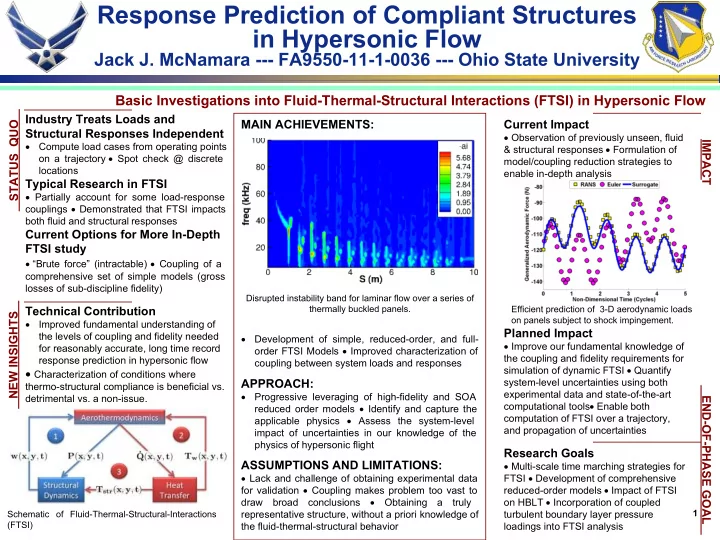
Response Prediction of Compliant Structures in Hypersonic Flow Jack J. McNamara --- FA9550-11-1-0036 --- Ohio State University Basic Investigations into Fluid-Thermal-Structural Interactions (FTSI) in Hypersonic Flow STATUS QUO Industry Treats


slide-1
SLIDE 1

1 Schematic of Fluid-Thermal-Structural-Interactions (FTSI)

Response Prediction of Compliant Structures in Hypersonic Flow

Jack J. McNamara --- FA9550-11-1-0036 --- Ohio State University

Industry Treats Loads and Structural Responses Independent

 Compute load cases from operating points

  • n a trajectory  Spot check @ discrete

locations

Typical Research in FTSI

 Partially account for some load-response couplings  Demonstrated that FTSI impacts both fluid and structural responses

Current Options for More In-Depth FTSI study

 “Brute force” (intractable)  Coupling of a comprehensive set of simple models (gross losses of sub-discipline fidelity)

Technical Contribution

 Improved fundamental understanding of the levels of coupling and fidelity needed for reasonably accurate, long time record response prediction in hypersonic flow

 Characterization of conditions where

thermo-structural compliance is beneficial vs. detrimental vs. a non-issue.

MAIN ACHIEVEMENTS:

 Development of simple, reduced-order, and full-

  • rder FTSI Models  Improved characterization of

coupling between system loads and responses

APPROACH:

 Progressive leveraging of high-fidelity and SOA reduced order models  Identify and capture the applicable physics  Assess the system-level impact of uncertainties in our knowledge of the physics of hypersonic flight

ASSUMPTIONS AND LIMITATIONS:

 Lack and challenge of obtaining experimental data for validation  Coupling makes problem too vast to draw broad conclusions  Obtaining a truly representative structure, without a priori knowledge of the fluid-thermal-structural behavior

Current Impact

 Observation of previously unseen, fluid & structural responses  Formulation of model/coupling reduction strategies to enable in-depth analysis

Planned Impact

 Improve our fundamental knowledge of the coupling and fidelity requirements for simulation of dynamic FTSI  Quantify system-level uncertainties using both experimental data and state-of-the-art computational tools Enable both computation of FTSI over a trajectory, and propagation of uncertainties

Research Goals

 Multi-scale time marching strategies for FTSI  Development of comprehensive reduced-order models  Impact of FTSI

  • n HBLT  Incorporation of coupled

turbulent boundary layer pressure loadings into FTSI analysis

Basic Investigations into Fluid-Thermal-Structural Interactions (FTSI) in Hypersonic Flow

END-OF-PHASE GOAL IMPACT

Disrupted instability band for laminar flow over a series of thermally buckled panels. Efficient prediction of 3-D aerodynamic loads

  • n panels subject to shock impingement.

STATUS QUO NEW INSIGHTS

slide-2
SLIDE 2

2

  • Dr. Jack

McNamara

Associate Professor

  • Mechanical &

Aerospace Engineering

  • Senior

Member AIAA

  • 2011 Recipient
  • f AFOSR YIP

Award

  • 2014 – 2015

Defense Science Study Group

Structural Responses at High Speeds Exhibit Strong Sensitivities to Varying Characteristics

  • f Boundary Layer Turbulence

1Deshmukh, R., McNamara, J., and Culler, A., “Response of Skin Panels to Combined Self and Boundary

Layer Induced Fluctuating Pressure, AIAA-2013-1744.

Panel response, as measured by center point displacement, varies widely with different models for boundary layer turbulence1.

slide-3
SLIDE 3

3

New CFD Surrogate to Enable First Comparison with AFRL Experiment Studying Shocks Impinging on Compliant Surfaces

Surrogate shows excellent agreement with actual CFD prediction of 3D flows with shock impingements2

2Crowell, A. “Model Reduction of Computational Aerothermodynamics for Multi-Discipline Analysis in High Speed Flows,” Ph.D.

Thesis, The Ohio State University, 2013.

120 seconds of thermo-structural response - CFD surrogate:8 hours on one core; actual (RANS) analysis:217,000 hours on 94 cores (@ ~100,000 cells/core).

slide-4
SLIDE 4

4

Your Highlight Should Answer the Red Questions – green (2nd priority) and black (3rd priority) questions are nice, but optional

by George H. Heilmeier, President and CEO of Bellcore

  • What are you trying to do? Articulate your objectives using absolutely

no jargon.

  • How is it done today, and what are the limits of current practice?
  • What's new in your approach and why do you think it will be

successful?

  • Who cares? If you're successful, what difference will it make?
  • What are the risks and the payoffs?
  • How much will it cost? How long will it take?
  • What are the midterm and final "exams" to check for success?

Additionally…

  • Does this work address the objectives of the portfolio to which it is

being submitted?

  • Are there opportunities to collaborate with other efforts – both

internally and externally?

Heilmeier's Catechism