Resilience and Resilience Capacities Measurement Options November 8, - - PowerPoint PPT Presentation

resilience and resilience capacities measurement options
SMART_READER_LITE
LIVE PREVIEW

Resilience and Resilience Capacities Measurement Options November 8, - - PowerPoint PPT Presentation

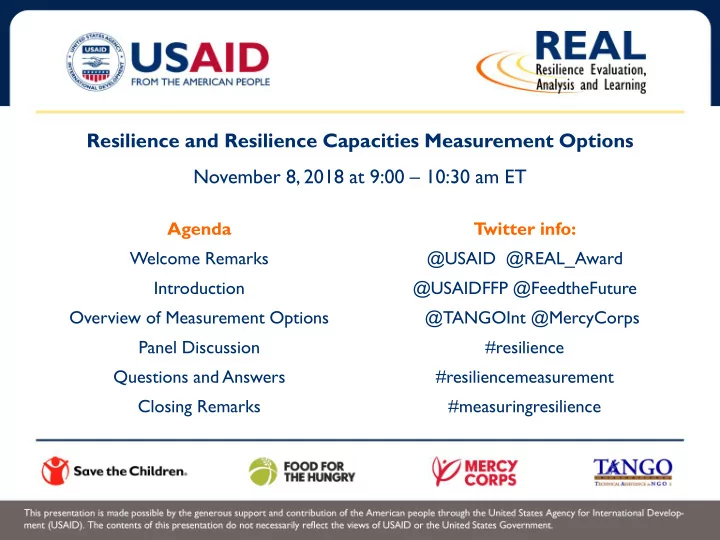
Resilience and Resilience Capacities Measurement Options November 8, 2018 at 9:00 10:30 am ET Agenda T witter info: Welcome Remarks @USAID @REAL_Award Introduction @USAIDFFP @FeedtheFuture Overview of Measurement Options @TANGOInt


slide-1
SLIDE 1

Agenda Welcome Remarks Introduction Overview of Measurement Options Panel Discussion Questions and Answers Closing Remarks T witter info: @USAID @REAL_Award @USAIDFFP @FeedtheFuture @TANGOInt @MercyCorps #resilience #resiliencemeasurement #measuringresilience

Resilience and Resilience Capacities Measurement Options November 8, 2018 at 9:00 – 10:30 am ET

slide-2
SLIDE 2

Presenters and Panelists

Tiffany M. Griffin Adviser, Monitoring, Evaluation, and Strategic Analysis USAID Center for Resilience

RESILIENCE AND RESILIENCE CAPACITIES MEASUREMENT OPTIONS

NOV 8, 2018

Katherine Arnold Associate Director, Monitoring, Evaluation, and Learning

  • Dept. of Hunger and Livelihoods,

Save the Children Olga Petryniak Senior Director, Global Resilience Mercy Corps Arif Rashid Monitoring and Evaluation Team Lead USAID Office of Food for Peace Tim Frankenberger President and Co-founder TANGO International Janina Mera Monitoring and Evaluation Advisor USAID Bureau for Food Security

slide-3
SLIDE 3

Customized Standardization

  • NOT an oxymoron!
  • Context is important
  • SOME uniformity has

advantages

Practicality

  • Documents designed with

the users in mind

  • Resource-intensity and 6

years of testing drove the

  • ptions

Complement to Other Resources

  • Guidance Notes
  • Short Course

Series/Webinars

  • Evidence Briefs
  • Assessment Tools
  • Case Studies

Important Caveats / Considerations

  • Food security-centric
  • HH/Community-centric
  • Resist the urge to adopt the

“easiest” way forward

  • Categories are not “fixed”

RESILIENCE AND RESILIENCE CAPACITIES MEASUREMENT OPTIONS

slide-4
SLIDE 4

USAID-funded food security activities require consistent and context-specific ways to measure resilience and resilience capacity in order to ensure effective resilience programming and continuous improvement based

  • n evidence.

Resilience / Resilience Capacities Measurement Options

Photo credit: Zacharias Abubeker/Save the Children

slide-5
SLIDE 5

Resilience/Resilience Capacities Measurement Options

USAID RESILIENCE AND RESILIENCE CAPACITIES MEASUREMENT OPTIONS

NOVEMBER 2018

Resilience and Resilience Capacities Measurement Options Household Questionnaire Community Questionnaire Methodological Guidance Enumerator Guidance

slide-6
SLIDE 6
  • Provides an introduction to and

comparison of several measurement approaches for analyzing resilience (i.e., Light, Intermediate, and Full), each of which reflects a different level of effort and budget in terms of the survey instrument and analysis used (i.e., number of questions asked and analyzed).

  • Intermediate and Light approaches

use subsets of the questions, responses, and analysis of the Full approach.

Save the Children USAID RESILIENCE AND RESILIENCE CAPACITIES MEASUREMENT OPTIONS

NOVEMBER 2018

Resilience/Resilience Capacities Measurement Options

Photo credit: TANGO International
slide-7
SLIDE 7

Full approach – resilience focus countries; full “menu” of questions, responses, and analyses Intermediate approach – programs in countries promoting resilience but not resilience focus countries; subset from Full menu Light approach – programs in countries that are not resilience focus countries; minimal subset from Full menu

USAID RESILIENCE AND RESILIENCE CAPACITIES MEASUREMENT OPTIONS

NOVEMBER 2018

Resilience/Resilience Capacities Measurement Options

slide-8
SLIDE 8

Comparison of full, intermediate, and light approaches

USAID RESILIENCE AND RESILIENCE CAPACITIES MEASUREMENT OPTIONS

NOVEMBER 2018
slide-9
SLIDE 9

Protocol considerations for the Light, Intermediate and Full resilience approaches

NOVEMBER 2018

USAID RESILIENCE AND RESILIENCE CAPACITIES MEASUREMENT OPTIONS

slide-10
SLIDE 10

Household and Community Questionnaires

  • Together, the household and

community questionnaires make up the resilience instrument.

  • Must be used in conjunction with

the FFP core questionnaire.

  • In the FFP questionnaire, certain

modules or questions must remain and others must be deleted when used with the resilience instrument.

  • Replacement questions included in

an annex if not used with FFP questionnaire.

USAID RESILIENCE AND RESILIENCE CAPACITIES MEASUREMENT OPTIONS

NOVEMBER 2018 Photo credit: Karyn Fox, TANGO International
slide-11
SLIDE 11

Enumerator Guidance

  • Provides specific instructions for enumerators to help them interpret

questions and responses in the household and community questionnaires.

  • Not all questions are included:

− Yes/no questions that do not require further explanation.

USAID RESILIENCE AND RESILIENCE CAPACITIES MEASUREMENT OPTIONS

NOVEMBER 2018
slide-12
SLIDE 12

Methodological Guidance

  • Provides specific instructions for calculating individual

components of resilience capacity as well as the three resilience indices absorptive, adaptive, and transformative capacity and an

  • verall resilience index.
  • Represents the Full approach (i.e., complete “menu” of

questions, responses, and analyses).

USAID RESILIENCE AND RESILIENCE CAPACITIES MEASUREMENT OPTIONS

NOVEMBER 2018
slide-13
SLIDE 13

Resilience Indices and Components of Resilience Capacity: Full Approach

USAID RESILIENCE AND RESILIENCE CAPACITIES MEASUREMENT OPTIONS

NOVEMBER 2018
slide-14
SLIDE 14

Methodological Guidance

USAID RESILIENCE AND RESILIENCE CAPACITIES MEASUREMENT OPTIONS

NOVEMBER 2018
slide-15
SLIDE 15

1. Access to cash savings. This indicator is a binary (dummy) variable equal to 1 if the respondent reported that a household member regularly saves cash.

  • Survey question: R601

2. Access to remittances. This indicator is a binary (dummy) variable equal to 1 if the respondent reported that the household receives remittances.

  • Survey questions: R1101, R1103, R1105, R1107

3. Asset ownership index. Asset ownership is measured using the number of consumer durables, productive assets, and livestock owned.

  • Survey questions: BL H7.02, H7.03, R201, R201A

USAID RESILIENCE AND RESILIENCE CAPACITIES MEASUREMENT OPTIONS

NOVEMBER 2018

Methodological Guidance

slide-16
SLIDE 16

Thank You

TANGO International Tim Frankenberger tim@tangointernational.com www.fsnnetwork.org/REAL resiliencemeasurement@gmail.com

slide-17
SLIDE 17

Panel Discussion

slide-18
SLIDE 18

Resilience M&E in Implementation

Examples from the Sabal program in Nepal

1) Inform program design and TOC 2) Inform M&E system and tools

  • Baseline survey
  • Routine monitoring

3) Review and revise TOC 4) Frame how we talk about resilience

Resilience M&E tools used to:

slide-19
SLIDE 19

Ethiopia PRIME

slide-20
SLIDE 20

PRIME Ethiopia

Baseline and Counterfactual challenges…

slide-21
SLIDE 21

PRIME Ethiopia

PRIME Post-Shock Measurement Framework

slide-22
SLIDE 22

Nepal PAHAL

slide-23
SLIDE 23

PAHAL Nepal

PAHAL Models

slide-24
SLIDE 24

PAHAL Nepal

PAHAL Models

slide-25
SLIDE 25

PAHAL Nepal

PAHAL Measures of Resilience Strategies

slide-26
SLIDE 26

Key Considerations

slide-27
SLIDE 27

Questions & Answers

Photo credit: TANGO International Photo credit: TANGO International
slide-28
SLIDE 28

Thank You

www.fsnnetwork.org/REAL www.tangointernational.com www.mercycorps.org/research/resilience www.savethechildren.org