Regulation and observed Regulation and observed successes in South - - PowerPoint PPT Presentation

regulation and observed regulation and observed
SMART_READER_LITE
LIVE PREVIEW

Regulation and observed Regulation and observed successes in South - - PowerPoint PPT Presentation

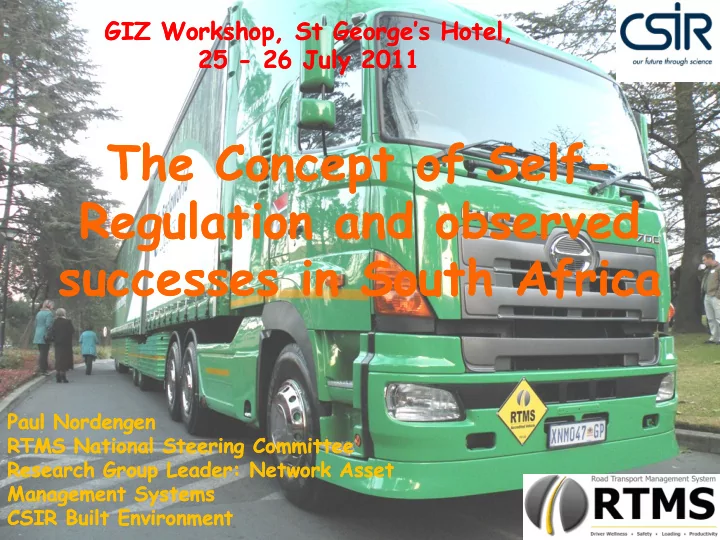
GIZ Workshop, St Georges Hotel, GIZ Workshop, St Georges Hotel, 25 - 26 July 25 26 July 2011 2011 The Concept of Self- The Concept of Self - Regulation and observed Regulation and observed successes in South Africa successes in


slide-1
SLIDE 1

The Concept of Self The Concept of Self-

  • Regulation and observed

Regulation and observed successes in South Africa successes in South Africa

Slide # 1

Paul Nordengen Paul Nordengen RTMS National Steering Committee RTMS National Steering Committee Research Group Leader: Network Asset Research Group Leader: Network Asset Management Systems Management Systems CSIR Built Environment CSIR Built Environment

GIZ Workshop, GIZ Workshop, St George’s Hotel, St George’s Hotel, 25 25 - 26 July 26 July 2011 2011

slide-2
SLIDE 2

CONTENTS

  • The bigger picture
  • Freight issues in South Africa
  • The concept of self-regulation
  • (Some) observed successes
slide-3
SLIDE 3

What are the big issues?

ROAD ROAD FREIGHT FREIGHT TRANSPORT TRANSPORT

GLOBAL GLOBAL COMPETETIVENESS COMPETETIVENESS QUALITY QUALITY OF LIFE OF LIFE SUSTAINABLE SUSTAINABLE ENVIRONMENT ENVIRONMENT

Transport efficiency Cost of logistics Cross-border delays Optimum road maintenance Road safety Congestion Cost of logistics Road condition Road crashes Road condition Energy consumption Emissions “maintaining and preserving natural systems”

slide-4
SLIDE 4

Key Elements in Road Freight Transport

  • Road infrastructure
  • Vehicles (design, maintenance

& operation)

  • Drivers
slide-5
SLIDE 5
slide-6
SLIDE 6
slide-7
SLIDE 7
slide-8
SLIDE 8
slide-9
SLIDE 9
slide-10
SLIDE 10
slide-11
SLIDE 11
slide-12
SLIDE 12
slide-13
SLIDE 13
slide-14
SLIDE 14
slide-15
SLIDE 15

Brake & Tyre Watch Results

Location Inspected Discontinued % City Deep 24 21 88% Middelburg 35 24 69% Centurion 41 17 42% Midway KZN 26 10 38% Kroonstad 8 7 92% Brackenfell, W. Cape 25 25 100% Bloemfontein 54 26 48% Pietermaritzburg 12 11 92% Port Elizabeth 15 6 40% Rustenburg 7 5 72% Polokwane 11 10 91% Midway KZN 24 20 83% Bloemfontein 24 20 83%

TOTAL 306 202 66%

slide-16
SLIDE 16

Sl

slide-17
SLIDE 17
slide-18
SLIDE 18

Sl

slide-19
SLIDE 19
slide-20
SLIDE 20

Slide # 20

2 4 6 8 10 12 2001 2002 2003 2004 2005 2006

Year Fatal crash rate

Aust Can France Denmark USA South Africa Switzerland

Fatal truck crash per 100 million vehicle kilometres travelled

Source: OECD report, Moving Freight with Better Trucks, 2010

Heavy Vehicle Fatal Crash Rates

slide-21
SLIDE 21

Slide # 21

0% 2% 4% 6% 8% 10% 12% 14% 16% United States Japan Brazil South Africa

Condition of surfaced roads

0% 20% 40% 60% 80% 100% 1988 1990 1992 1994 1996 1998 2000 2002 2004 2006 2008 Very Poor Poor Fair Good Very Good

slide-22
SLIDE 22

Problem Statement Summary

  • Typical problems regarding heavy vehicle operations

in South Africa: Crashes involving heavy vehicles,

  • verloading, congestion and a high cost of logistics
  • Traditional approach of law enforcement is not

sufficiently effective

  • Is there another approach?

– Self-regulation (voluntary compliance) – Responsibility of consignor and consignee in freight transport (recently-approved legislation) – Performance-Based Standards (PBS)

slide-23
SLIDE 23
slide-24
SLIDE 24

Slide # 24

Road Safety

Fair Competition between modes &

  • perators

Infrastructure Protection

OVERLOAD CONTROL

National Overload Control Strategy

Implemented by National, Provincial and Local Authorities

Infrastructure & Equipment

  • Main routes (major facilities)
  • Alternative routes (minor facilities/screening)
  • Monitoring (HS-WIM)
  • Alternative weighing equipment
  • Private weighbridges

Information sharing & Public Awareness

  • Overload website
  • Overload information booklet

Operations

  • Human Resources
  • PPP
  • Training
  • Guideline document

for law enforcement

Self-regulation

  • Road Transport

Management System (RTMS)

  • Performance-Based

Standards (PBS)

Legislation

  • Consignors/Consignees
  • 5% Tolerance
  • User charges
  • Habitual Overloaders
  • Public Prosecutors
  • Alternative weighing equipment
  • AARTO

Co-operation

  • Provinces
  • Local authorities
  • Department of Justice
  • Private sector
slide-25
SLIDE 25
slide-26
SLIDE 26

Slide # 26

The Road Transport Management System

  • RTMS is an industry–led, government-supported,

voluntary, self-regulation scheme that encourages consignees, consignors and road transport operators to implement a management system (a set of standards) with

  • utcomes that contribute to preserving road

infrastructure, improving road safety and increasing productivity.

  • Key focus areas are:
  • load optimisation
  • driver wellness
  • vehicle maintenance
  • productivity
slide-27
SLIDE 27
slide-28
SLIDE 28

Road Transport Management System: Rules of Compliance

  • Maintain a haulage fleet inventory
  • Assess the vehicle mass before each trip
  • Verify mass determination method
  • Vehicle and load safety
  • Vehicle maintenance
  • Driver wellness (fatigue and health)
  • Provide training & education
  • Assign tasks and responsibilities
  • Keep records and documentation
  • Perform internal reviews
slide-29
SLIDE 29
slide-30
SLIDE 30

Management of Driver Wellness

slide-31
SLIDE 31

Vehicle & Load Safety

31

slide-32
SLIDE 32

Management of Driver Wellness

32

slide-33
SLIDE 33

33

Management of Driver Wellness

slide-34
SLIDE 34

RTMS benefits

  • Whilst overloading is contained, there is also the opportunity to optimize payload.

Records show that RTMS members have a higher average payload, yet overload less, than non-members;

  • Drivers are more likely to be better looked after, e.g. health, training, due to

auditing;

  • The safety record of the company will most likely improve;
  • Vehicles are better maintained, have less breakdowns and so give better utilization;
  • The business will run better. There will be less wastage and the “bottom line” will

be improved;

  • There is the opportunity for management to be exposed to and take on board

improved and standardized systems from the RTMS (best practice);

  • The owners and top management will have an improved insight as to what actually

happens in their companies. Not just what they are told by staff;

  • Staff in the companies will have to carry out what they say they do, since they will

be audited on an annual basis

slide-35
SLIDE 35

Heavy Vehicle Overloading trends in the forestry industry in South Africa

Source: Forestry RTMS monthly report, May 2011

RTMS Accreditation in South Africa: Forestry

slide-36
SLIDE 36

RTMS in forestry: Payload distribu- tion

20 40 60 80 100 120 140 160 180 200 220 240 260 280 300 320 340 50200 50600 51000 51400 51800 52200 52600 53000 53400 53800 54200 54600 55000 55400 55800 56200 56600 57000 57400 57800 58200 58600 Load (kg)

  • No. of Vehicles

20 40 60 80 100 120 140 160 180 200 50200 50800 51400 52000 52600 53200 53800 54400 55000 55600 56200 56800 57400 58000 58600 59200 59800 60400 61000 Load (kg)

  • No. of Occurances

20 40 60 80 100 120 140 160 180 200 220 240 50000 50400 50800 51200 51600 52000 52400 52800 53200 53600 54000 54400 54800 55200 55600 56000 56400 56800 57200 57600 58000 58400 58800 59200 59600 60000 Load (kg)

  • No. of Occurances

10 20 30 40 50 60 70 80 90 100 50000 50600 51200 51800 52400 53000 53600 54200 54800 55400 56000 56600 57200 57800 58400 59000 59600 60200 60800 61400 62000 Load (kg)

  • No. of Occurances

5 10 15 20 25 5 5 8 5 1 6 5 2 4 5 3 2 5 4 5 4 8 5 5 6 5 6 4 5 7 2 5 8 5 8 8 5 9 6 6 4 6 1 2 6 2 6 2 8 6 3 6 6 4 4 6 5 2 Load (kg)

  • No. of Occurances

5 10 15 20 25 50000 50600 51200 51800 52400 53000 53600 54200 54800 55400 56000 56600 57200 57800 58400 59000 59600 60200 60800 61400 62000 62600 63200 Load (kg)

  • No. of Occurances
slide-37
SLIDE 37

Heavy Vehicle

  • verloading and

speeding trends in the coal industry in South Africa

Source: Coal RTMS monthly report, Aug 2009

RTMS Accreditation in South Africa: Coal

0% 10% 20% 30% 40% 50% 60% 70% 80% 90% 2008(YTD) 2009(YTD) Jan`08 Feb`08 Mar`08 Apr`08 May`08 Jun`08 Jul`08 Aug`08 Sep`08 Oct`08 Nov`08 Dec`08 Jan`09 Feb`09 Mar`09 Apr`09 May`09 Jun`09 Jul`09

  • al

OT

  • al

OT

10 15 20 25 30 35 40 45 50 Jan`08 Feb`08 Mar`08 Apr`08 May`08 Jun`08 Jul`08 Aug`08 Sep`08 Oct`08 Nov`08 Dec`08 Jan`09 Feb`09 Mar`09 Apr`09 May`09 Jun`09 Jul`09 Average Number of Speeding Instances per Vehicle per Day

slide-38
SLIDE 38

38

Barloworld RTMS card for drivers

slide-39
SLIDE 39

Success Stories

  • Imperial Logistics, Paarl, W. Cape (Consul

Glass)

– Most significant improvement: Improved driver attitude and motivation

slide-40
SLIDE 40

Success Stories

  • Timber Logistics Services, Umkomaas, KZN

– Reduced rollovers – Reduced turnover of drivers (due to HIV-related deaths) – Significantly improved standard of living of drivers – NOSA awards

  • NOSA KwaZulu-Natal Midlands Branch – Best Integrated and Aligned Five Star Forestry

System Occupational Environmental Programme

  • NOSA KwaZulu-Natal Midlands Branch – Best Integrated and Aligned Five Star Forestry

System Occupational Safety Programme

  • NOSA KwaZulu-Natal Midlands Branch – Best Integrated and Aligned Five Star Forestry

System Health Programme

  • NOSA EASTERN REGION – Best Integrated and Aligned Five Star System Occupational

Health Programme.

  • BRIAN HUNT – NOSA KwaZulu-Natal Midlands Branch – MANAGING DIRECTOR OF THE

YEAR.

slide-41
SLIDE 41

Success Stories

  • Timber Logistics Services, Umkomaas, KZN

– Improvement in driver wellness, leading to a reduction in absenteeism – Reduction in breakdowns and improvement in drivers reporting breakdowns – Significant reduction in driver turnover (partly as a result

  • f a reduction in HIV/AIDS-related deaths

– 50% reduction in accidents and incidents from 5.0 per million km to 2.5 per million km – Improvement in uptime

slide-42
SLIDE 42

42

CB Creydt Transport (Timber)

CB Creydt Transport Month Overloading % Jan-11 33.0% Feb-11 21.0% Mar-11 29.0% Apr-11 3.4% May-11 1.4% Jun-11 0.0%

Success Stories

0.0% 5.0% 10.0% 15.0% 20.0% 25.0% 30.0% 35.0% Jan-11 Feb-11 Mar-11 Apr-11 May-11 Jun-11

Overloading %

Jan-11 Feb-11 Mar-11 Apr-11 May-11 Jun-11

slide-43
SLIDE 43

43

Motorvia (Car carrier)

Success Stories

Before After Motorvia

  • No. of excessive speeding incidents (above 80km/h)

38 5 Motorvia Drivers tested for medical fitness 42 120 Motorvia Drivers trained on Fatigue Management (Rest, Nutrition etc.) 120

20 40 60 80 100 120

  • No. of excessive speeding

incidents (above 80km/h) Drivers tested for medical fitness Drivers trained on Fatigue Management (Rest, Nutrition etc.) Before After

slide-44
SLIDE 44

RTMS Benefits

UNITRANS Amatikulu Depot (Sugar cane)

slide-45
SLIDE 45

Control Measures Implemented

  • Driver Wellness – strict screening and medicals for

all drivers at the start of the season

  • Alcohol testing of all staff entering the premises
  • Weekly vehicle checks and immediate defect

reporting and defects fixed

  • Speed limiter on all vehicles – buzzer goes off at 81

km/hr

  • Screening of all drivers before getting into a

vehicle by Controller

  • Onboard weighing on all vehicles
slide-46
SLIDE 46

Achieved Benefits

  • Improved driver wellness
  • Improved driver training with ongoing evaluation
  • Improved vehicle performance, less down time for

major defects

  • Improved fuel consumption
  • Projected benefit of less tyre and brake wear,

improved fuel consumption and safer driving with the lowering of speed limiter to 81 km/hr

  • Overloads under 4% for last 5 months
  • Reduced number of overload fines - front axle
  • verload still a problem
slide-47
SLIDE 47

Achieved Benefits

  • Reduced crashes and incidents over R30 000

damage

– 2007 – 20 crashes, with 6 serious crashes

» 12 due to Unitrans driver fault » Several small crashes due to poor driver training

– 2008 – 9 crashes, with 5 serious crashes

» 4 due to Unitrans driver fault » Accident damage – 10% down on 2007 » 1 major crash cost of R800 000

– 2009 – 3 crashes, with 1 serious crash

» 1 due to Unitrans driver fault » Accident damage – 52% down on 2007 figure

– 2010 – 4 crashes, 1 due to driver falling asleep

» Accident damage – 47% down on 2007 figure

slide-48
SLIDE 48
  • Improved tyre wear (base of 100)

– Sep 2007 YTD 100 – Sep 2008 YTD 105 – Sep 2009 YTD 89 – Sep 2010 YTD 95

Achieved Benefits cont

slide-49
SLIDE 49

Fleet availability – 65% Fleet availability – 65% The fleet stock replacement cycle at the time was 33 years which was far above the industry norms The fleet stock replacement cycle at the time was 33 years which was far above the industry norms for vehicle replacement. Fleet the During reviewed functionally agreement Fleet management was generally viewed as a fleet maintenance service, which led to the various activities being dealt with on a decentralised somewhat fragmented basis. During the financial year 05 / 06 the organisational structure of fleet services was reviewed and consequently aligned with a proposed business model which provided functionally aligned vehicles to the operations in terms of an internal price recovery agreement.

Committed to service excellence and protection of the environment Committed to service excellence and protection of the environment

Overview 2005 - 2010 Fleet Statistics Strategy and Culture

The Electricity Services fleet comprised a fleet of 680 vehicles ranging from off road utility vehicles,

  • f

The Electricity Services fleet comprised a fleet of 680 vehicles ranging from off road utility vehicles, sedans, ldv's and panel vans to light, medium and heavy trucks as well as a variety

  • f truck mounted aerial platforms

Functional alignment - 40% Functional alignment - 40%

RTMS Accreditation RTMS Accreditation

Overview 2005 Overview 2005 - 2010 2010
slide-50
SLIDE 50

Committed to service excellence and protection of the environment Committed to service excellence and protection of the environment

KPI Improvements KPI Improvements

Statutory Compliance Statutory Compliance

Asset Management

CRANE OPERATOR CERTIFICATION AP OPERATOR CERTIFICATION

slide-51
SLIDE 51

Committed to service excellence and protection of the environment Committed to service excellence and protection of the environment

KPI Improvements KPI Improvements

Maintenance compliance Maintenance compliance

Introduction

Feb 2008 - Jan 2011

slide-52
SLIDE 52

Committed to service excellence and protection of the environment Committed to service excellence and protection of the environment

KPI Improvements KPI Improvements

Maintenance costs reduction Maintenance costs reduction

Maintenance Compl.

Projected savings due to CAPEX R&M required for 98% compliance

06/07 57%

In 06/07 Fleet were 57% compliant ito servicing. The projected savings in real terms of R9.8mil in 09/10 is due to the capital investment.

Marked improvement in fleet availability Improved public image. Less pressure on maintenance management 09/10 98%

In 09/10 Fleet were 98% compliant ito servicing.

slide-53
SLIDE 53

Committed to service excellence and protection of the environment Committed to service excellence and protection of the environment

KPI Improvements KPI Improvements

Fuel Consumption Fuel Consumption

Incident rate Benefits derived from adequate investment in fleet

Fleet functional alignment Fuel efficient technology

slide-54
SLIDE 54

Committed to service excellence and protection of the environment Committed to service excellence and protection of the environment

KPI Improvements KPI Improvements

Incident Rate Incident Rate vs vs Km travelled Km travelled

Statutory Compliant International benchmark 7.5%

slide-55
SLIDE 55
  • Currently 30 certified companies/depots

representing approx. 800 trucks

  • 10 new certifications since Jan 2011
  • Approx. 25 companies/depots in the process of

being certified

  • A small number of consignors (mines) considering

becoming RTMS certified

RTMS Progress

slide-56
SLIDE 56
  • 1 major accident per 350 000km travelled
  • Reduction of overloading frequency to 2.3%
  • 94% of drivers possessed medical fitness

certificates

  • 88% compliance to prescribed vehicle maintenance

schedule

  • Zero fatalities within audited sample (on-site and

during transit)

RTMS Audit findings (2011 YTD)

slide-57
SLIDE 57

THANK YOU THANK YOU