
SLIDE 1
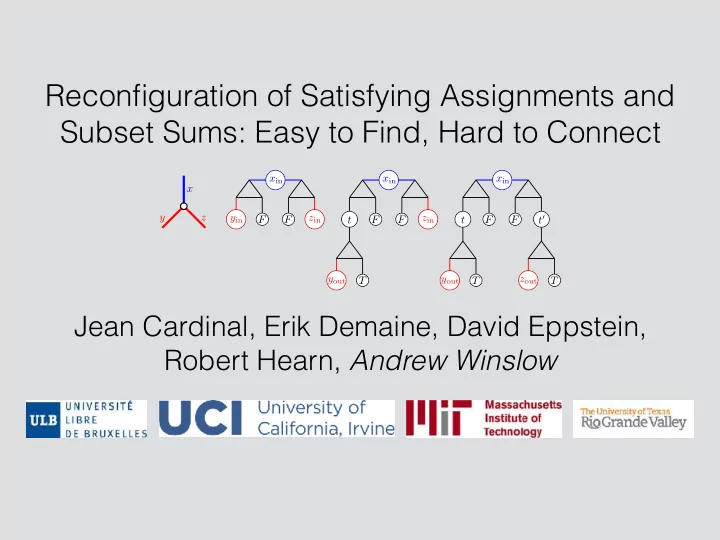
x y z yin zin xin F F yout zin xin F F t T yout xin F F t T zout T t0
Reconfiguration of Satisfying Assignments and Subset Sums: Easy to Find, Hard to Connect
Jean Cardinal, Erik Demaine, David Eppstein, Robert Hearn, Andrew Winslow
Reconfiguration of Satisfying Assignments and Subset Sums: Easy to - - PowerPoint PPT Presentation
Reconfiguration of Satisfying Assignments and Subset Sums: Easy to Find, Hard to Connect x in x in x in x y z y in z in z in F F t F F t F F t 0 y out y out z out T T T Jean Cardinal, Erik Demaine, David Eppstein, Robert Hearn,
x y z yin zin xin F F yout zin xin F F t T yout xin F F t T zout T t0
Jean Cardinal, Erik Demaine, David Eppstein, Robert Hearn, Andrew Winslow
x1 = F x2 = F x3 = F
x1 = F x2 = F x3 = F
x1 = F x2 = F x3 = T
flip x3
x1 = F x2 = F x3 = F
x1 = F x2 = F x3 = T
flip x3
x1 = T x2 = F x3 = T
flip x1
x1 = F x2 = F x3 = F
x1 = F x2 = F x3 = T
flip x3
x1 = T x2 = F x3 = T
flip x1
Keeping formula satisfied
x1 = F x2 = F x3 = F
x1 = T x2 = T x3 = F
x1 = F x2 = F x3 = F
x1 = T x2 = T x3 = F
Impossible
FFF FFT FTF FTT TFF TFT TTF TTT
FFF FFT FTF FTT TFF TFT TTF TTT
FFF FFT TFT TTF
S = {2, 3, 7} 2 + 3 + 7 = 12
S = {2, 3, 7} 2 + 3 + 7 = 12 5 + 7 = 12 S = {5, 7}
swap 2, 3 with 5
S = {2, 3, 7} 2 + 3 + 7 = 12 5 + 7 = 12 S = {5, 7}
swap 2, 3 with 5
5 + 3 + 4 = 12 S = {5, 3, 4}
swap 7 with 3, 4
S = {2, 3, 7} 2 + 3 + 7 = 12 5 + 7 = 12 S = {5, 7}
swap 2, 3 with 5
5 + 3 + 4 = 12 S = {5, 3, 4}
swap 7 with 3, 4
Keeping sum equal to target sum
S = {2, 3, 7} 2 + 3 + 7 = 12 5 + 7 = 12 S = {5, 7}
swap 2, 3 with 5
5 + 3 + 4 = 12 S = {5, 3, 4}
swap 7 with 3, 4
S = {2, 3, 7} 2 + 3 + 7 = 12 S = {2, 4, 6} 5 + 3 + 4 = 12
Keeping sum equal to target sum
S = {2, 3, 7} 2 + 3 + 7 = 12 5 + 7 = 12 S = {5, 7}
swap 2, 3 with 5
5 + 3 + 4 = 12 S = {5, 3, 4}
swap 7 with 3, 4
S = {2, 3, 7} 2 + 3 + 7 = 12 S = {2, 4, 6} 5 + 3 + 4 = 12
Impossible Keeping sum equal to target sum
Input:
Output: Yes (can be reconfigured).
Input:
Output: No (cannot be reconfigured).
problems solvable in nO(1) space
PSPACE P NP
not satisfied
One-in-three (1-in-3): satisfying assignment if 1 (but not 2 or 3) true literals per clause.
x1 = F x2 = F x3 = F x4 = T
satisfied satisfied satisfied
x1 = T x2 = F x3 = F x4 = T
not satisfied satisfied
Theorem: the 1-in-3SAT reconfiguration problem is in P (always “No”).
Theorem: the 2SAT reconfiguration problem is in P. [Gopalan et al. 2009] Theorem: the 3SAT reconfiguration problem is PSPACE-complete.
Theorem: the 1-in-3SAT reconfiguration problem is in P (always “No”).
Theorem: the 2SAT reconfiguration problem is in P. [Gopalan et al. 2009] Theorem: the 3SAT reconfiguration problem is PSPACE-complete.
Is there a SAT variant whose:
Theorem: the 1-in-3SAT reconfiguration problem is in P (always “No”).
Theorem: the 2SAT reconfiguration problem is in P. [Gopalan et al. 2009] Theorem: the 3SAT reconfiguration problem is PSPACE-complete.
Is there a SAT variant whose:
Monotone: no negated variables. Planar: graph of variables and clauses is planar. Not-All-Equal (NAE): satisfying assignment if 1 or 2 (but not 3) true literals per clause.
c1 c2 c3 c1 c2 c3 x1 x2 x3 x4
x1 = T x2 = F x3 = T x4 = T
satisfied satisfied satisfied
x1 = T x2 = T x3 = T x4 = F
satisfied not satisfied satisfied
Theorem: monotone planar NAE 3SAT reconfiguration is PSPACE-complete. Reduction is from non-deterministic constraint logic (NCL)
Monotone planar NAE 3SAT solving is in P [Moret 1988]
weight 1 weight 2 Each node needs incoming weight ≥2
weight 1 weight 2 Each node needs incoming weight ≥2
weight 1 weight 2 Each node needs incoming weight ≥2
weight 1 weight 2 Each node needs incoming weight ≥2
NCL reconfiguration is PSPACE-complete, even for:
Create a variable for orientation of each edge. Create a clause set for each node.
x1 x2 x3 x4 x5 x6
(¬x1 ∨ ¬x2 ∨ ¬x5) ∧ (x1 ∨ x2) ∧ (x1 ∨ x4) ∧ (x3 ∨ ¬x2) ∧ (x3 ∨ x6) ∧ (x5 ∨ ¬x4) ∧ (x5 ∨ ¬x6)
Theorem: monotone planar NAE 3SAT reconfiguration is PSPACE-complete. Reduction is from non-deterministic constraint logic (NCL).
(x ∨ F ∨ c) ∧ (a ∨ b ∨ c) ∧ (a ∨ y ∨ F) ∧ (b ∨ z ∨ F)
(x ∨ y ∨ F) ∧ (x ∨ z ∨ F)
Reconfiguring planar graph 4-colorings. [Bonsma, Cerceda 2009]
Reconfiguring shortest paths. [Bonsma 2013]
s t s t s t
Two options for subset sum reconfiguration:
S = {2, 3, 7} S = {5, 7}
swap 2, 3 with 5
S = {5, 3, 4}
swap 7 with 3, 4
Option 1 Option 2 S = {2, 3, 7} S = {3, 7}
remove 2
S = {3, 4, 7}
add 4
Unary Input
Two options for subset sum reconfiguration:
S = {2, 3, 7} S = {5, 7}
swap 2, 3 with 5
S = {5, 3, 4}
swap 7 with 3, 4
Option 1 Option 2 S = {2, 3, 7} S = {3, 7}
remove 2
S = {3, 4, 7}
add 4
NP-hard [Ito, Demaine 2014] Unary Input
Two options for subset sum reconfiguration:
S = {2, 3, 7} S = {5, 7}
swap 2, 3 with 5
S = {5, 3, 4}
swap 7 with 3, 4
Option 1 Option 2 S = {2, 3, 7} S = {3, 7}
remove 2
S = {3, 4, 7}
add 4
NP-hard [Ito, Demaine 2014] PSPACE-complete (This work) Unary Input
Theorem: subset sum reconfiguration via swapping x, y and x+y is strongly PSPACE-complete. Reduction is from token sliding: reconfiguring independent sets via swapping adjacent vertices.
Reconfiguration problem is PSPACE-complete, even for 3-regular graphs [DH 2005]
unary input
Two new “easy-to-solve, hard-to-connect” problems:
Open:
x y z yin zin xin F F yout zin xin F F t T yout xin F F t T zout T t0
Jean Cardinal, Erik Demaine, David Eppstein, Robert Hearn, Andrew Winslow