
SLIDE 1
Realities that m atter:
Doings and Makings of an Online Gam e
Silvia Lindtner Bonnie Nardi University of California, Irvine Department of Informatics
Realities that m atter: Doings and Makings of an Online Gam e Shu - - PowerPoint PPT Presentation
Silvia Lindtner Bonnie Nardi University of California, Irvine Department of Informatics Realities that m atter: Doings and Makings of an Online Gam e Shu in Shanghai Silvia Lindtner, lindtner@uci.edu Silvia Lindtner, lindtner@uci.edu W e
Silvia Lindtner Bonnie Nardi University of California, Irvine Department of Informatics
Silvia Lindtner, lindtner@uci.edu
Silvia Lindtner, lindtner@uci.edu
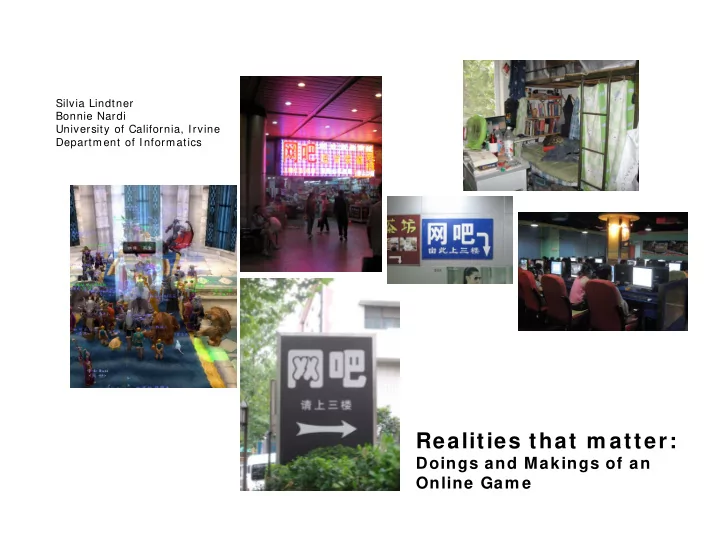
W e studied an online gam e in China: W orld of W arcraft And found: a space w here digital and physical m erge & w here socio- econom ic, political agendas, and social values shape the play space
Relative sharp distinction: e.g. Bainbridge, Turkle, Bryce and Rutter Dynam ics across digital and physical space: Castronova, Dibbel, Malaby, Miller and Slater, Wakeford Agre: "As long as we persist in opposing so-called virtual communities to the face-to-face communities of the mythical opposite extreme, we miss the ways in which real communities of practice employ a whole ecology of media as they think together about the matters that concern them"
Silvia Lindtner, lindtner@uci.edu
Realities… Virtual Reality Mixed Realities (e.g. Milgram and Kishino) Assem blies (Hindmarsh et al.) Hybrid Reality Spaces (de Souza e Silva) Hybrid Ecologies (Crabtree and Rodden)
Silvia Lindtner, lindtner@uci.edu
Silvia Lindtner, lindtner@uci.edu
Silvia Lindtner, lindtner@uci.edu
“Home has no atmosphere.” “I enjoy playing at the café because there are more people, it’s more
up late in the Internet café. I enjoy the atmosphere of people playing around me.” “My guild members and I play combat and then we rest and look at the area together. We explore the graphics and wander through different
the scenery is recreational.”
Silvia Lindtner, lindtner@uci.edu
“I f there is an empty seat next to a WoW player I go over there to sit next to him—even though it is in a really crowded
conversation about it. Sometimes we exchange seats with
I nternet café. The people here are nice, we play together, they all live around here. We know each other from playing the game.”
Trust “They [ online friends] believe in me, because they gave me their phone number first. If there is some news, they give me a call. If I give another player my phone number, I must have the feeling I can trust
“A few online friends trust me to the extent that they lend their accounts to me to play.” “I t took about a year… to exchange characters. We met each other while we were killing a monster. We had some conversations and felt we get along very well. We asked each other to take care of things. Like helped each other with quests.”
Silvia Lindtner, lindtner@uci.edu
Ren Yao - Lady Boy “Picking female as a guy doesn’t feel right. We call this person a ren yao.” Peng: “I don’t like to be mistaken for a woman. When people think you are a girl, they treat you differently… They talk to you differently. It doesn’t feel comfortable.”
Silvia Lindtner, lindtner@uci.edu
Socio- politcal hybrids Bingwen: “What’s more, in China I am not quite clear about the reason [ for the action] , perhaps it’s China’s political situation. I n the past when you died [ in the game] there were bones and skeletons but now graves are used instead. What we were told is that the skeletons are frustrating and scaring people. But I feel graves are actually scarier.”
Silvia Lindtner, lindtner@uci.edu
Socio- politcal hybrids Chao: “I t’s a grave, which didn’t exist before. You see, there’s a corpse dropping items. When you pick up those items, the corpse turns into a
there used to be a skeleton. It is a result from the upgrade, which is part of the governmental project to introduce harmony.” Longwei: “We dislike the harmony such as the disappearance of skeletons… It is feudal and introduced as part of the whole cultural environment in China.”
Silvia Lindtner, lindtner@uci.edu
Realities… Virtual Reality Mixed Realities (e.g. Milgram and Kishino) Assem blies (Hindmarsh et al.) Hybrid Reality Spaces (de Souza e Silva) Hybrid Ecologies (Crabtree and Rodden)
Silvia Lindtner, lindtner@uci.edu
Special Thanks to: Scott Mainw aring Yang W ang Lilly I rani
Silvia Lindtner, lindtner@uci.edu