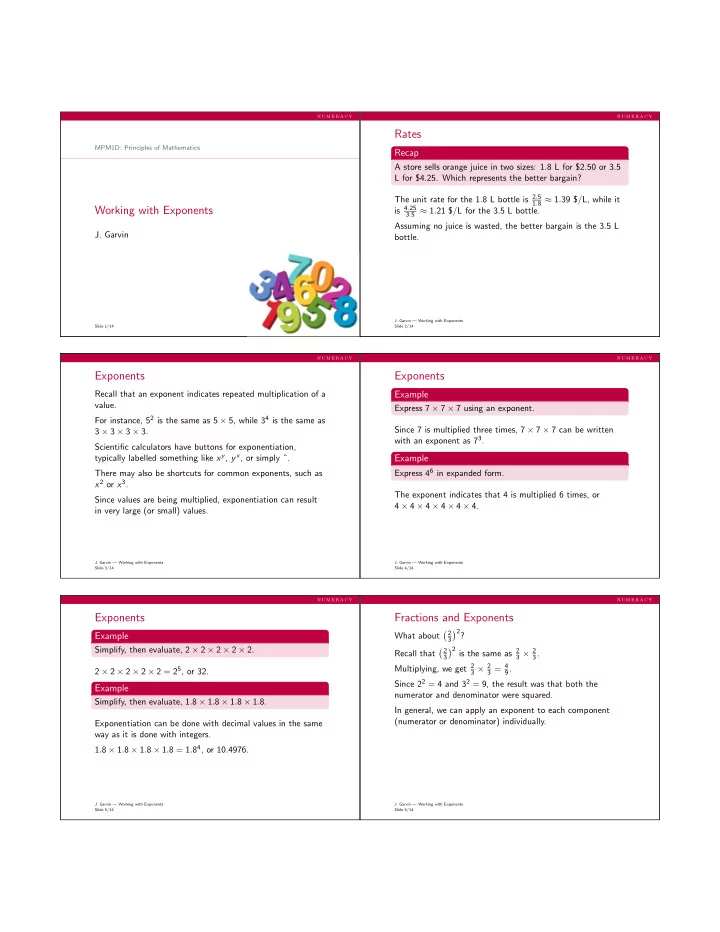
Rates MPM1D: Principles of Mathematics Recap A store sells orange - - PDF document

rates
SMART_READER_LITE
LIVE PREVIEW

Rates MPM1D: Principles of Mathematics Recap A store sells orange - - PDF document

n u m e r a c y n u m e r a c y Rates MPM1D: Principles of Mathematics Recap A store sells orange juice in two sizes: 1 . 8 L for $2 . 50 or 3 . 5 L for $4 . 25. Which represents the better bargain? The unit rate for the 1 . 8 L bottle is 2 . 5


slide-1
SLIDE 1

n u m e r a c y

MPM1D: Principles of Mathematics

Working with Exponents

  • J. Garvin

Slide 1/14

n u m e r a c y

Rates

Recap

A store sells orange juice in two sizes: 1.8 L for $2.50 or 3.5 L for $4.25. Which represents the better bargain? The unit rate for the 1.8 L bottle is 2.5

1.8 ≈ 1.39 $/L, while it

is 4.25

3.5 ≈ 1.21 $/L for the 3.5 L bottle.

Assuming no juice is wasted, the better bargain is the 3.5 L bottle.

  • J. Garvin — Working with Exponents

Slide 2/14

n u m e r a c y

Exponents

Recall that an exponent indicates repeated multiplication of a value. For instance, 52 is the same as 5 × 5, while 34 is the same as 3 × 3 × 3 × 3. Scientific calculators have buttons for exponentiation, typically labelled something like xy, yx, or simply ˆ. There may also be shortcuts for common exponents, such as x2 or x3. Since values are being multiplied, exponentiation can result in very large (or small) values.

  • J. Garvin — Working with Exponents

Slide 3/14

n u m e r a c y

Exponents

Example

Express 7 × 7 × 7 using an exponent. Since 7 is multiplied three times, 7 × 7 × 7 can be written with an exponent as 73.

Example

Express 46 in expanded form. The exponent indicates that 4 is multiplied 6 times, or 4 × 4 × 4 × 4 × 4 × 4.

  • J. Garvin — Working with Exponents

Slide 4/14

n u m e r a c y

Exponents

Example

Simplify, then evaluate, 2 × 2 × 2 × 2 × 2. 2 × 2 × 2 × 2 × 2 = 25, or 32.

Example

Simplify, then evaluate, 1.8 × 1.8 × 1.8 × 1.8. Exponentiation can be done with decimal values in the same way as it is done with integers. 1.8 × 1.8 × 1.8 × 1.8 = 1.84, or 10.4976.

  • J. Garvin — Working with Exponents

Slide 5/14

n u m e r a c y

Fractions and Exponents

What about 2

3

2? Recall that 2

3

2 is the same as 2

3 × 2 3.

Multiplying, we get 2

3 × 2 3 = 4 9.

Since 22 = 4 and 32 = 9, the result was that both the numerator and denominator were squared. In general, we can apply an exponent to each component (numerator or denominator) individually.

  • J. Garvin — Working with Exponents

Slide 6/14

slide-2
SLIDE 2

n u m e r a c y

Exponents

Example

Evaluate 2

5

3. Since 23 = 8 and 53 = 125, 2

5

3 = 23

53 = 8 125.

Example

Evaluate 1

10

6. Since 16 = 1 and 106 = 10 000 000, 1

10

6 =

1 10 000 000.

  • J. Garvin — Working with Exponents

Slide 7/14

n u m e r a c y

Negative Exponents

Negative values can also be raised to an exponent. For example, (−4)2 is the same as (−4) × (−4) = 16, since the product of two negative values is positive. This is not the same as −42, which is the same as −(4 × 4) = −16. In the latter example, the exponent is applied only to the value 4. Be careful.

  • J. Garvin — Working with Exponents

Slide 8/14

n u m e r a c y

Negative Exponents

Example

Evaluate (−5)3. (−5)3 is the same as (−5) × (−5) × (−5) = −125.

Example

Evaluate −2.54. Since the exponent does not apply to the negative, −2.54 = −39.0625.

  • J. Garvin — Working with Exponents

Slide 9/14

n u m e r a c y

Negative Exponents

We can make some generalizations about the sign of an exponentiated value by examining both the value and the exponent. Multiplying two negatives produces a positive, multiplying three negatives produces a negative, multiplying four negatives produces a positive, etc. In general, if a negative value has an even exponent, then its final value will be positive. If a negative value has an odd exponent, then its final value will be negative.

  • J. Garvin — Working with Exponents

Slide 10/14

n u m e r a c y

Negative Exponents

Example

Is the value (−2)17 positive or negative? Since 17 is an odd number, (−2)17 will be negative. Its actual value is −131 072.

Example

Is the value −58 positive or negative? Even though the exponent is positive, −58 = −390 625, which is negative. This is because the exponent only applies to the 5 itself, which is then negated. Remember to be careful!

  • J. Garvin — Working with Exponents

Slide 11/14

n u m e r a c y

Working with Exponents

Example

Evaluate 23 × 72. According to the order of operations, exponentiation precedes multiplication. 23 × 72 = 8 × 49 = 392

  • J. Garvin — Working with Exponents

Slide 12/14

slide-3
SLIDE 3

n u m e r a c y

Working with Exponents

Example

Evaluate 32 × 33. As before, exponentiate first. 32 × 33 = 9 × 27 = 243 Note that 243 = 35, and that 32+3 = 35. We will cover this result in more detail in the next lesson.

  • J. Garvin — Working with Exponents

Slide 13/14

n u m e r a c y

Questions?

  • J. Garvin — Working with Exponents

Slide 14/14