Radial Velocity Limitations To The Detection Of Giant Planets 8 6 - - PowerPoint PPT Presentation

radial velocity limitations to the detection of giant
SMART_READER_LITE
LIVE PREVIEW

Radial Velocity Limitations To The Detection Of Giant Planets 8 6 - - PowerPoint PPT Presentation

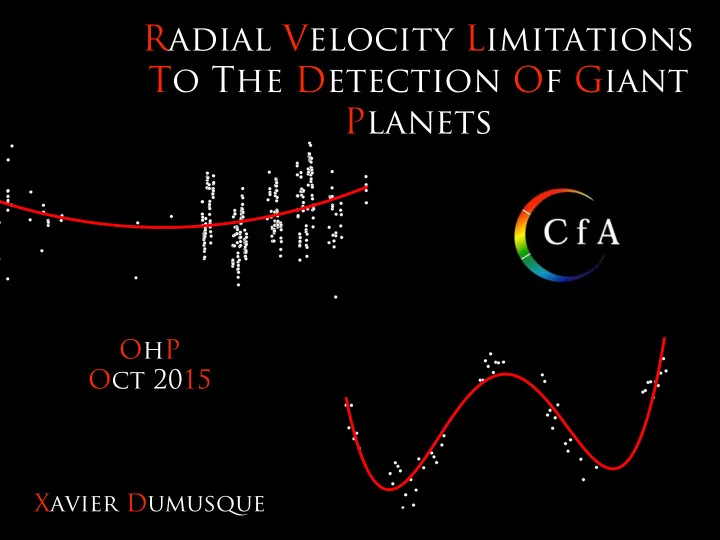
Radial Velocity Limitations To The Detection Of Giant Planets 8 6 4 2 0 2 4 6 8 10 52500 53000 53500 54000 54500 55000 55500 56000 56500 57000 OhP 4 Oct 2015 2 0 2 4 Xavier Dumusque 55000 55020


slide-1
SLIDE 1

55000 55020 55040 55060 55080 55100 55120 55140 55160 −4 −2 2 4 52500 53000 53500 54000 54500 55000 55500 56000 56500 57000 −10 −8 −6 −4 −2 2 4 6 8

Radial Velocity Limitations To The Detection Of Giant Planets

Xavier Dumusque

OhP Oct 2015

slide-2
SLIDE 2

Stellar Signals


Lindegren &
 Dravins 03

Oscillations Granulation Active regions Gravitational
 Redshift Magnetic
 Cycles Flares

< 15 min ~ 1 h 15 min - 2 d 10 - 50 d ~ 10 yrs 10 d - 10 yrs < 10 cm/s (Cegla+12)

Kjeldsen+ 95, Bouchy & Carrier 01, Butler+ 04, Bedding & Kjeldsen 07 Makarov 10, Dumusque+ 11 Dumusque+ 12 , Meunier+ 13 Saar 09, Reiners 09


a few m/s (Dumusque+ 11) 1-20 m/s (Lovis+ 11) a few m/s (Dumusque+ 11)

Del-Moro+ 04, Del-Moro 04 Cegla+ 12, Cegla+ 14 Saar & Donahue 97, Queloz+ 01 Hatzes 02, Meunier+ 10, Boisse+ 11, Dumusque+ 11, Lanza+ 11, Aigrain+12, Boisse+ 12, Dumusque+ 14

  • a few m/s to km/s (Meunier+ 10)

<1 m/s (only active M)
slide-3
SLIDE 3

Hot Jupiter Orbiting an Active Star

1 MJ 3.5 d 130 m/s 1 m/s

ACTIVE

slide-4
SLIDE 4

Stellar Signals


Lindegren &
 Dravins 03

Oscillations Granulation Active regions Gravitational Redshift Magnetic Cycles Flares

< 15 min ~ 1 h 15 min - 2 d 10 - 50 d ~ 10 yrs 10 d - 10 yrs < 10 cm/s

Kjeldsen+ 95, Bouchy & Carrier 01, Butler+ 04, Bedding & Kjeldsen 07 Makarov 10 Dumusque+ 12 Saar 09, Reiners 09

a few m/s 1-20 m/s a few m/s

Del-Moro+ 04, Del-Moro 04 Cegla+ 12, Cegla+ 14 Saar & Donahue 97, Queloz+ 01 Hatzes 02, Meunier+ 10, Boisse+ 11, Dumusque+ 11, Lanza+ 11, Aigrain+12, Boisse+ 12, Dumusque+ 14

  • <1 m/s

a few m/s to km/s (Meunier+ 10)

slide-5
SLIDE 5

FLUX

  • CONVECTION

Spots are cooler and fainter Plages are hotter and brighter Convection outside active regions, inhibition

  • f convection inside

Active regions a few m/s (Meunier+ 10)

Saar & Donahue 97, Queloz+ 01, Hatzes 02, Lagrange+ 10, Boisse+ 11, Dumusque+ 11, Boisse+ 12, Dravins 81, Lindegren & Dravins 03, Saar 03, Saar 09, Lanza+ 11, Meunier+ 10, Aigrain+12, Dumusque+ 14

slide-6
SLIDE 6

Active regions a few m/s (Meunier+ 10)

FLUX

slide-7
SLIDE 7

Active regions a few m/s (Meunier+ 10)

FLUX

slide-8
SLIDE 8

Credit: Vasco Henrique

slide-9
SLIDE 9

CONVE CTION

Active regions a few m/s (Meunier+ 10)

Matthias Rempel, NCAR

slide-10
SLIDE 10

FLUX CONVE CTION

SOAP 2.0 Dumusque+ 2014

Active regions a few m/s (Meunier+ 10)

slide-11
SLIDE 11

RV BIS SPAN

SPOT

dominates for fast rotators the flux effect is dominant

SOAP 2.0 Dumusque+ 2014

slide-12
SLIDE 12

RV - Bis Span correlation

SOAP 2.0 Dumusque+ 2014

Vsini = 2 km/s Vsini = 5 Vsini = 8 Vsini = 11

slide-13
SLIDE 13

Active regions

Anti-Correlation between RV and BIS SPAN

Queloz+ 01

HD166435 Vsini = 7.7 Vsini = 8

slide-14
SLIDE 14

Active regions

Active regions rotates with the star:


  • > Signal at the rotational period and harmonics

Boisse+ 11

slide-15
SLIDE 15

Active regions

Active regions rotates with the star:


  • > Signal at the rotational period and harmonics

Fit sin waves at the rotational period and harmonics

Boisse+ 11

slide-16
SLIDE 16

Active regions

This Method has been applied successfully to: Corot-7b (Queloz+ 09, Boisse+ 11) HD189733b (Boisse+ 11) GJ674b (Boisse+ 11) Iota Horb (Boisse+ 11) Alpha CEn Bb (Dumusque+ 12)

slide-17
SLIDE 17
  • OBS. BIAS

RV surveys tends to reject active stars

Younger

Active stars are generally younger

Formation Look in the past of Hot

Jupiters (migration, Kozai)

Searching for Hot Jupiters Around Active Stars

slide-18
SLIDE 18

Jupiter Analog Orbiting a Quiet Star

1 MJ 11 yrs 12 m/s 1 m/s

QUIET

slide-19
SLIDE 19

Stellar Signals


Lindegren &
 Dravins 03

Oscillations Granulation Active regions Gravitational Redshift Magnetic
 Cycles Flares

< 15 min ~ 1 h 15 min - 2 d 10 - 50 d ~ 10 yrs 10 d - 10 yrs < 10 cm/s

Kjeldsen+ 95, Bouchy & Carrier 01, Butler+ 04, Bedding & Kjeldsen 07 Makarov 10, Dumusque+ 11 Dumusque+ 12 , Meunier+ 13 Saar 09, Reiners 09

a few m/s 1-20 m/s (Lovis+ 11) a few m/s

Del-Moro+ 04, Del-Moro 04 Cegla+ 12, Cegla+ 14 Saar & Donahue 97, Queloz+ 01 Hatzes 02, Meunier+ 10 Boisse+ 11, Dumusque+ 11, Lanza+ 11, Aigrain+12, Boisse+ 12, Dumusque+ 14

  • <1 m/s

a few m/s to km/s

slide-20
SLIDE 20

Jupiter 11 years 12 m/s

52500 53000 53500 54000 54500 55000 55500 56000 56500 57000 −10 −8 −6 −4 −2 2 4 6 8

Solar Magnetic Cycle 11 years ~ 8 m/s

Lovis+ 2011

slide-21
SLIDE 21

Year

2005 1975 1990

Year

2005 1975 1990 200

Monthly spot number S-index Lockwood+ 2007

Magnetic Cycles 1-20 m/s (Lovis+ 11)

NASA / Solar Physics

slide-22
SLIDE 22

Magnetic Cycles

−5.05 −5.00 −4.95 −4.90 −4.85

Log(R'hk)

53000 53500 54000 54500 55000 55500 56000 56500 57000

JD - 2400000 (d)

−10 −5 5 10

RV (m/s)

HARPS data

slide-23
SLIDE 23

Magnetic Cycles 1-20 m/s (Lovis+ 11)

  • More active regions,

  • > more convective blueshift inhibition
  • > positive RV (Meunier+ 10,Lindegren & Dravins 03)
slide-24
SLIDE 24

Magnetic Cycles

−4.98 −4.96 −4.94 −4.92 −4.90 −4.88 −4.86

RV (m/s)

−8 −6 −4 −2 2 4 6 8

Log(R'hk)

Meunier+ 13 HARPS data

slide-25
SLIDE 25

Magnetic Cycles

53000 53500 54000 54500 55000 55500 56000 56500 57000 −10 −5 5 10

RV (m/s)

53000 53500 54000 54500 55000 55500 56000 56500 57000 −10 −5 5 10

RV corrected (m/s)

Meunier+ 13 HARPS data

slide-26
SLIDE 26

Detection

Possible to find Jupiter analogs correcting for magnetic cycles

Formation

Influence of Giant planets in Solar System like configurations

Searching for Jupiters Around Quiet Stars

slide-27
SLIDE 27

Pushing Further our Understanding of Stellar Signals

slide-28
SLIDE 28

Star The Sun

NASA/SDO

Dumusque, X.

slide-29
SLIDE 29

Star The Sun

NASA/SDO

Dumusque, X.

slide-30
SLIDE 30
  • X. Dumusque, D. Phillips, A. Glenday, D. Latham, R. Walsworth


and collaborators at the TNG and Geneva Observatory

HARPS-N Solar Telescope

  • X. Dumusque
slide-31
SLIDE 31

Solar Telescope

Solar Telescope to feed the sunlight into HARPS-N

  • X. Dumusque, A. Glenday, D. Phillips et al. in prep.

Correction using Sun integrated disc photometry (SORCE satellite) Goal: Understand stellar signal and detection of Venus

slide-32
SLIDE 32

Take Away

  • Hot Jupiter
  • Rotational Activity can be a problem
  • We have the tools to correct for it
  • Study of young systems to understand hot

jupiter formation

  • Jupiter-like
  • Magnetic cycles can be a problem
  • Can be correct using activity index
  • Study The Formation of the Solar-System
slide-33
SLIDE 33

EnD