
SLIDE 1
QUANTLIB USER MEETING (QLUM) 2017
Sponsored by: IKB · DEUTSCHE INDUSTRIEBANK AG | DÜSSELDORF Cosponsored by: d-fjne QUATERNION
NOVEMBER 30th 2017
Venue: IKB Deutsche InDustrIeBanK aG | DÜsseLDOrF
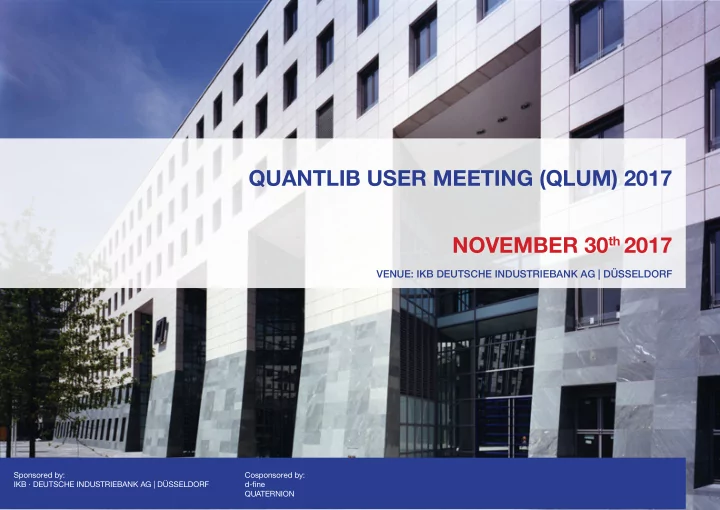
QUANTLIB USER MEETING (QLUM) 2017 NOVEMBER 30 th 2017 Venue: IKB - - PowerPoint PPT Presentation
QUANTLIB USER MEETING (QLUM) 2017 NOVEMBER 30 th 2017 Venue: IKB Deutsche InDustrIeBanK aG | DsseLDOrF Sponsored by: Cosponsored by: IKB DEUTSCHE INDUSTRIEBANK AG | DSSELDORF d-fjne QUATERNION QUANTLIB The QuantLib project is aimed at
Sponsored by: IKB · DEUTSCHE INDUSTRIEBANK AG | DÜSSELDORF Cosponsored by: d-fjne QUATERNION
Venue: IKB Deutsche InDustrIeBanK aG | DÜsseLDOrF
The QuantLib project is aimed at provi- ding a comprehensive software framework for quantitative fjnance. QuantLib is a free/
and risk management in real-life. QuantLib is written in C++ with a clean ob- ject model, and is then exported to diffe- rent languages such as C#, Objective Caml, Java, Perl, Python, GNU R, Ruby, and Sche-
ject uses ObjectHandler to export an object-
end-user platforms including Microsoft Ex- cel and OpenOffjce.org Calc. Appreciated by quantitative analysts and developers, it is intended for academics and practitioners alike, eventually promo- ting a stronger interaction between them. QuantLib offers tools that are useful both for practical implementation and for advanced modeling, with features such as market con- ventions, yield curve models, solvers, PDEs, Monte Carlo (low-discrepancy included), exotic options, VAR, and so on. Finance is an area where well-written open- source projects could make a tremendous difference:
time- effective, operative implementation of cutting edge pricing models and hedging
ly forced to re-invent the wheel every time. Even standard decade-old models, such as Black-Scholes, still lack a public robust
good quants are wasting their time writing C++ classes which have been already writ- ten thousands of times.
the open, QuantLib will both encourage peer review of the tools themselves, and demonstrate how this ought to be done for scientifjc and commercial software. Open standards are the only fair way for science and technology to evolve. The library could be exploited across dif- ferent research and regulatory institutions, banks, software companies, and so on. Being a free/ open- source project, quants contributing to the library would not need to start from scratch every time.
tually used in the real world and contribute to it in a meaningful way. This would poten- tially place them in a privileged position on the job market.
hand, which vastly reduces the amount of low-level work necessary to build models, so to be able to focus on more complex and interesting problems.
base code and/or benchmark, while being able to engage in creating more innovative solutions that would make them more com- petitive on the market.
for standard pricing and risk management practices.
The QuantLib Workshop in 2011 held at HSH Nordbank was the initial inspiration for IKB to have a regular meeting where people could exchange their ideas and experience about QuantLib. IKB (cosponsored by d-fjne and Quaternion) therefore decided to have the fjrst QuantLib User Meeting in 2013 held at IKB in Düsseldorf. There has been positive feedback to the fjrst meeting which is why we decided to continue in 2014, 2015 and 2016. The talks always represented a good mixture of subjects ranging from very quantitative
general aspects like how to effectively use scripting languages like R in QuantLib. We want to carry on this tradition for 2017.
Check out the talks section to see what is planned for this upcoming event.
Preliminary agenda, please use the registration link to indicate whether you would like a speaking slot. 09:00 – 09:45 USER REGISTRATION 09:45 – 10:00 Michael von den Driesch: Greeting 10:00 – 10:45 Luigi Ballabio: How is QuantLib doing? 10:45 – 11:30 Sebastian Schlenkrich (d-fjne) Structured Payoff Scripting in QuantLib 11:30 – 12:15 Peter Caspers, Roland Lichters (Quaternion) Open Source Risk Engine update: Release 3, Use Cases, Credit Preview Cash-Settled Swaption pricing 12:15 – 13:45 LUNCH BREAK 13:45 – 14:30 Bernd Lewerenz (HSH Nordbank) Uncertain Volatility Model: Solving the Black Scholes Barenblatt Equation with the method of lines 14:30 – 15:15 Werner Kürzinger (HSH Nordbank) Aspects of Pricing Irregular Swaptions with QuantLib 15:15 – 15:45 COFFEE BREAK 15:45 – 16:30 Andres Hernandez Model Calibration with Neural Networks 16:30 – 17:15 Ioannis Rigopoulos Deriscope: The Object Oriented way to access QuantLib in Excel 17:30 – 18:00 Vasily Nekrasov Popularizing QuantLib among students: past experience and future perspectives 18:00 – 18:15 Michael von den Driesch: Closing 19:00 – DRINKS AND DINNER (Alter Bahnhof | Düsseldorf-Oberkassel)
ADDRESS IKB Deutsche Industriebank AG Wilhelm-Bötzkes-Strasse 1 40474 Düsseldorf
The number of seats is limited to 70. There is no registration fee. Seats can‘t be guaranteed. Please be fair. Only apply for a seat if you really plan to attend.
Register here
CONTACT Michael.Driesch@ikb.de