Q2 2009 CONFERENCE CALL C O R P O R A T E P A R T I C I P A N T S - - PDF document

q2 2009 conference call
SMART_READER_LITE
LIVE PREVIEW

Q2 2009 CONFERENCE CALL C O R P O R A T E P A R T I C I P A N T S - - PDF document

Q2 2009 CONFERENCE CALL C O R P O R A T E P A R T I C I P A N T S Caution Regarding Forward-Looking Statements Viki Lazaris Bank of Montreals public communications often include written or oral forward-looking statements. Statements of BMO


slide-1
SLIDE 1

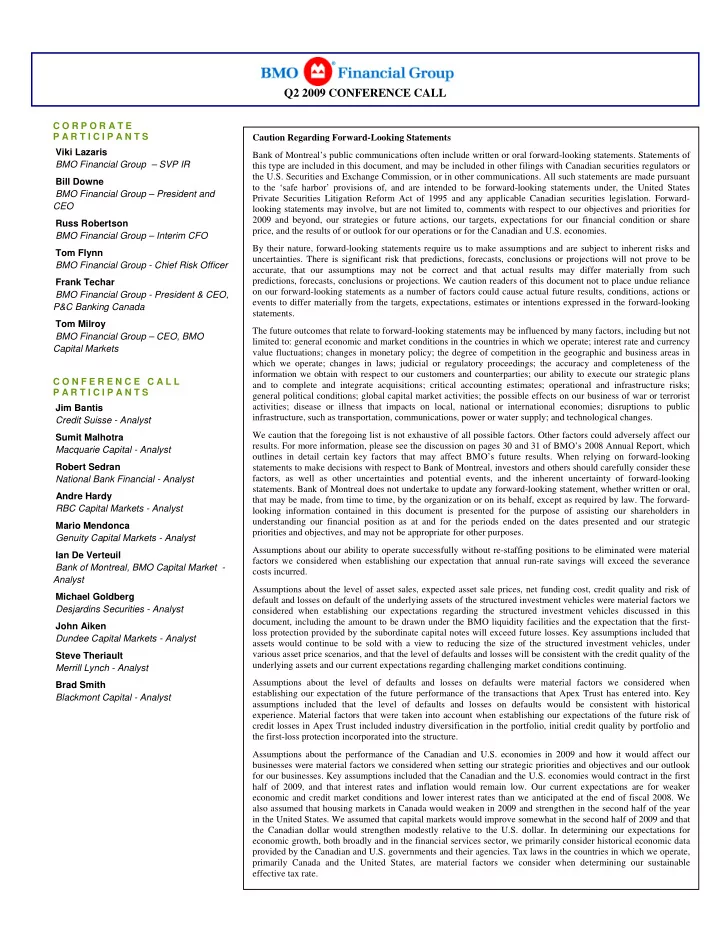
C O R P O R A T E P A R T I C I P A N T S Viki Lazaris BMO Financial Group – SVP IR Bill Downe BMO Financial Group – President and CEO Russ Robertson BMO Financial Group – Interim CFO Tom Flynn BMO Financial Group - Chief Risk Officer Frank Techar BMO Financial Group - President & CEO, P&C Banking Canada Tom Milroy BMO Financial Group – CEO, BMO Capital Markets C O N F E R E N C E C A L L P A R T I C I P A N T S Jim Bantis Credit Suisse - Analyst Sumit Malhotra Macquarie Capital - Analyst Robert Sedran National Bank Financial - Analyst Andre Hardy RBC Capital Markets - Analyst Mario Mendonca Genuity Capital Markets - Analyst Ian De Verteuil Bank of Montreal, BMO Capital Market - Analyst Michael Goldberg Desjardins Securities - Analyst John Aiken Dundee Capital Markets - Analyst Steve Theriault Merrill Lynch - Analyst Brad Smith Blackmont Capital - Analyst

Q2 2009 CONFERENCE CALL

Caution Regarding Forward-Looking Statements Bank of Montreal’s public communications often include written or oral forward-looking statements. Statements of this type are included in this document, and may be included in other filings with Canadian securities regulators or the U.S. Securities and Exchange Commission, or in other communications. All such statements are made pursuant to the ‘safe harbor’ provisions of, and are intended to be forward-looking statements under, the United States Private Securities Litigation Reform Act of 1995 and any applicable Canadian securities legislation. Forward- looking statements may involve, but are not limited to, comments with respect to our objectives and priorities for 2009 and beyond, our strategies or future actions, our targets, expectations for our financial condition or share price, and the results of or outlook for our operations or for the Canadian and U.S. economies. By their nature, forward-looking statements require us to make assumptions and are subject to inherent risks and

  • uncertainties. There is significant risk that predictions, forecasts, conclusions or projections will not prove to be

accurate, that our assumptions may not be correct and that actual results may differ materially from such predictions, forecasts, conclusions or projections. We caution readers of this document not to place undue reliance

  • n our forward-looking statements as a number of factors could cause actual future results, conditions, actions or

events to differ materially from the targets, expectations, estimates or intentions expressed in the forward-looking statements. The future outcomes that relate to forward-looking statements may be influenced by many factors, including but not limited to: general economic and market conditions in the countries in which we operate; interest rate and currency value fluctuations; changes in monetary policy; the degree of competition in the geographic and business areas in which we operate; changes in laws; judicial or regulatory proceedings; the accuracy and completeness of the information we obtain with respect to our customers and counterparties; our ability to execute our strategic plans and to complete and integrate acquisitions; critical accounting estimates; operational and infrastructure risks; general political conditions; global capital market activities; the possible effects on our business of war or terrorist activities; disease or illness that impacts on local, national or international economies; disruptions to public infrastructure, such as transportation, communications, power or water supply; and technological changes. We caution that the foregoing list is not exhaustive of all possible factors. Other factors could adversely affect our

  • results. For more information, please see the discussion on pages 30 and 31 of BMO’s 2008 Annual Report, which
  • utlines in detail certain key factors that may affect BMO’s future results. When relying on forward-looking

statements to make decisions with respect to Bank of Montreal, investors and others should carefully consider these factors, as well as other uncertainties and potential events, and the inherent uncertainty of forward-looking

  • statements. Bank of Montreal does not undertake to update any forward-looking statement, whether written or oral,

that may be made, from time to time, by the organization or on its behalf, except as required by law. The forward- looking information contained in this document is presented for the purpose of assisting our shareholders in understanding our financial position as at and for the periods ended on the dates presented and our strategic priorities and objectives, and may not be appropriate for other purposes. Assumptions about our ability to operate successfully without re-staffing positions to be eliminated were material factors we considered when establishing our expectation that annual run-rate savings will exceed the severance costs incurred. Assumptions about the level of asset sales, expected asset sale prices, net funding cost, credit quality and risk of default and losses on default of the underlying assets of the structured investment vehicles were material factors we considered when establishing our expectations regarding the structured investment vehicles discussed in this document, including the amount to be drawn under the BMO liquidity facilities and the expectation that the first- loss protection provided by the subordinate capital notes will exceed future losses. Key assumptions included that assets would continue to be sold with a view to reducing the size of the structured investment vehicles, under various asset price scenarios, and that the level of defaults and losses will be consistent with the credit quality of the underlying assets and our current expectations regarding challenging market conditions continuing. Assumptions about the level of defaults and losses on defaults were material factors we considered when establishing our expectation of the future performance of the transactions that Apex Trust has entered into. Key assumptions included that the level of defaults and losses on defaults would be consistent with historical

  • experience. Material factors that were taken into account when establishing our expectations of the future risk of

credit losses in Apex Trust included industry diversification in the portfolio, initial credit quality by portfolio and the first-loss protection incorporated into the structure. Assumptions about the performance of the Canadian and U.S. economies in 2009 and how it would affect our businesses were material factors we considered when setting our strategic priorities and objectives and our outlook for our businesses. Key assumptions included that the Canadian and the U.S. economies would contract in the first half of 2009, and that interest rates and inflation would remain low. Our current expectations are for weaker economic and credit market conditions and lower interest rates than we anticipated at the end of fiscal 2008. We also assumed that housing markets in Canada would weaken in 2009 and strengthen in the second half of the year in the United States. We assumed that capital markets would improve somewhat in the second half of 2009 and that the Canadian dollar would strengthen modestly relative to the U.S. dollar. In determining our expectations for economic growth, both broadly and in the financial services sector, we primarily consider historical economic data provided by the Canadian and U.S. governments and their agencies. Tax laws in the countries in which we operate, primarily Canada and the United States, are material factors we consider when determining our sustainable effective tax rate.

slide-2
SLIDE 2

Q2 2009 – BMO Financial Group - Earnings Conference Call – May 26, 2009

P R E S E N T A T I O N Operator Good afternoon, and welcome to the BMO Financial Group's second-quarter 2009 conference call for May 26, 2009. Your host for today will be Viki Lazaris, Senior Vice President of Investor Relations. Ms. Lazaris, please go ahead. Viki Lazaris - Bank of Montreal - SVP-IR Thank you. Good afternoon, everyone. Thanks for joining us today. Presenting today are Bill Downe, BMO's Chief Executive Officer; Russ Robertson, Chief Financial Officer; and Tom Flynn, our Chief Risk Officer. The following members of the management team are also here this afternoon -- Tom Milroy from BMO Capital Markets; Gilles Ouellette from the Private Client Group; Frank Techar, Head of P&C Canada; Ellen Costello from P&C US; and Barry Gilmour, Head

  • f Technology and Operations.

After the presentations, the management team will be available to answer questions from prequalified analysts. To give everyone an

  • pportunity to participate, we ask that you please ask one or two questions and then re-queue.

At this time, I would like to caution our listeners by stating the following on behalf of those speaking today. Forward-looking statements may be made during this call and there are risks that actual results could differ materially from forecasts, projections or conclusions in the forward-looking statements. Certain material factors and assumptions were applied in drawing the conclusions or making the forecasts or projections in these forward-looking statements. You can find additional information about such material factors and assumptions and the material factors that could cause actual results to so differ in our caution regarding forward-looking statements set forth in our news release or on the investor relations website. With that said, I can hand things over to Bill. Bill Downe - BMO Financial Group - President, CEO Thanks, Viki, and good afternoon. As noted, my comments may include forward-looking statements. Let me start by saying we are pleased with our second quarter, which reflected continuing success of our focus on customers. Russ will cover the detailed financial results in more depth, but let me review some of the big picture numbers. Net income for the second quarter of fiscal 2009 was $358 million, with an ROE of 8.1%. This includes after-tax charges of $80 million in respect of the capital markets environment, as well as $80 million for severance costs. On an adjusted basis, cash earnings-per-share were $0.93. The underlying momentum in our businesses is highlighted by our pre-provision pre-tax earnings of $885 million after adjusting for the severance expense. This compares with $940 million a year ago, and to be within 6% of last year's number in the context of the current environment speaks to the success of our core business performance. With the visibility provided by these strong operating results, the biggest question mark now affecting BMO's earnings outlook, indeed that of our industry as a whole, relates to future credit losses. As we look at the balance of 2009 and early 2010, we expect PCLs to remain elevated. However, we have not seen and are not expecting to see a further broad-based spike-up in PCLs. In the US, provisions have moved up faster than in Canada, and if the economy improves later this year, some predict US provisions could begin to plateau. Provisions in Canada remain relatively low, but may well increase as we move through the recession. That said, we are reassured by the fact that our delinquencies are lower than the industry peer average. 2

slide-3
SLIDE 3

Q2 2009 – BMO Financial Group - Earnings Conference Call – May 26, 2009

Our quarter-end Tier 1 capital ratio was 10.7% and our Tangible common equity to risk-weighted asset ratio was 8.2%. We've maintained these high ratios while simultaneously reducing our off-balance-sheet exposures. Clearly, we are a top-tier North American bank in terms of balance sheet strength, positioning us well to take advantage of opportunities for growth arising from the current environment. Let's turn now to the results of our operating groups. Before I start, please note these numbers reflect BMO's expected loss

  • methodology. Tom will provide some color on the actual losses later in the call.

If there is a theme that I'd point to in terms of group performance, it is that in Q2 we reinforced and built on the solid results and momentum demonstrated in Q1. First and foremost, this strong performance was highlighted by the results of our P&C Canada

  • business. The group earned $350 million in the quarter despite a slowing economy. Our customer focus continues to pay off in

measurable progress. We've made gains on our loyalty scores relative to the competition and increased both our market share and products-per-customer ratio. In Personal Banking, we experienced significant year-over-year increases in both loans and deposits, up 18% and 6%, respectively. In Commercial Banking, revenue growth was 10% year-over-year. We continued to increase market share in pursuit of our goal to move from number two to number one in the Canadian market. As expected, loan growth slowed amid economic weakness and continued competition. Our P&C US business earned $27 million on a cash basis this quarter, and we continue our strong focus on managing expenses and on acquiring new customers in both Consumer and Commercial banking. We are experiencing success with deposits growing and our retail net promoter score improving. We are focused on positioning Harris for enhanced success in the next cycle. When gross impaired loans come down, the cost of carrying non-accrual loans is expected to moderate. The net income impact in the quarter was negative US $11 million. Obviously, the US banking industry is experiencing unprecedented times. This means strong banks like Harris have an opportunity to capitalize by reinforcing our competitive position, the strength of our brand and gaining share. We are also taking advantage of new opportunities for organic growth as the erosion of big network banks in the Midwest has

  • pened the door for us. We are taking an aggressive, customer-focused approach, and personal banking net new households

increased by approximately 5400 year-over-year, and personal deposits are up $1.3 billion, or 9%, versus the prior year. In the Commercial area, we've added 40 new business bankers. Recent mortgage application volume is the highest it has been in six years, representing clean, high-quality mortgages, approximately half of which are for new customers. As you may have seen, Harris has just been awarded a number one ranking in the US Midwest region for customer satisfaction in retail banking by JD Power & Associates. We are delighted but not surprised by this ranking, which underscores the success of our bank-wide commitment to customers. BMO Capital Markets had another solid quarter with earnings of $249 million, and the results mainly reflect the benefit of a diversified portfolio of businesses that align with a client-focused strategy; strong performance in debt products, foreign exchange products and financial products; improved spreads in corporate lending in both Canada and the US; solid investment banking revenues; and finally, cost containment initiatives that are really taking hold. This diverse business has been able to earn through a number of valuation issues. Clearly, there are strengths in our wholesale platform that enable robust revenue performance even in the current environment. Finally, our Private Client Group earned $62 million in the quarter and held its own, while positioning the business for success when the economy and markets return to more typical conditions. Wealth Management results include BMO Life Assurance, our recent Canadian life insurance acquisition. We are very excited about this transaction. It substantially accelerated our life insurance strategy, moving BMO from a small player to one of the top 10 in the Canadian life insurance market. We now have deeper manufacturing capability, a stronger product offering, more scale and access to the dominant insurance distribution channel. 3

slide-4
SLIDE 4

Q2 2009 – BMO Financial Group - Earnings Conference Call – May 26, 2009

For our customers in the Private Client Group, there is a strong link between their insurance and their wealth management needs, and we are now substantially better positioned to serve them. While it is still early, we are already seeing the impact on the business

  • f the BMO brand with good receptivity in distribution channels and excellent customer response.

Wrapping up, there are two primary messages you can take from our Q2 results. First, our customer-focused strategy is working Despite the current recessionary environment, we are building revenue and positioning our businesses for the future. And second, we are committed to managing expenses across our businesses. We've cut discretionary spending and we are ensuring that our investment spend is focused on customer-related initiatives. It is this expense focus that gave rise to the decision to simplify our management structure and further strengthen our bank. We are reducing layers and broadening mandates in order to improve productivity and enhance overall performance. We expect that once the changes to our management structure are complete, annual run-rate savings will exceed the severance costs incurred in this quarter. Our focus will be to ensure that we maintain the quality and effectiveness of our customer service while maintaining sufficient resources to manage growth. We recognize that it is our focus on customers that has driven our improved market traction, and we are confident that this will continue. And with that, I will turn the discussion over to Russ. Russ Robertson - BMO Financial Group – Interim CFO Thanks, Bill, and good afternoon. As of some of my comments may be forward-looking, please note the caution regarding forward- looking statements on slide 1. On slide 3, you can see the reported second-quarter earnings were $358 million, or $0.61 per share, compared to $1.25 last year. On a cash basis, earnings were $0.63, and our Tier 1 capital ratio remains strong at 10.7%. Our core businesses performed well in the context of the current market environment. Credit costs remain elevated as expected at this point in the cycle. Adjusting for the capital markets environment charges and the severance costs, cash EPS was $0.93. Turning to slide 4, revenue at $2.7 billion was up 9% quarter-over-quarter, in large part due to the higher charges recorded in Q1 and significantly improved revenues in Corporate Services. As expected, and as I discussed last quarter, the negative carry on funding has moderated and results in Corporate reflect this. We anticipate similar improvements over the next few quarters given current market conditions. Year-over-year revenues increased 1% on a reported basis, with strong growth in P&C and BMO Capital Markets. Revenue was lower in Wealth Management and in Corporate Services due to the market environment. The stronger US dollar increased revenue by $138 million year over year. Net interest income was $1.3 billion in Q2, up $163 million year-over-year, driven mainly by improved spreads in our P&C groups and business growth in Capital Markets. This growth was partially offset by a significant decline in Corporate Services. Compared to Q1, net interest income remained relatively flat despite three fewer days in the quarter, as results benefited from improvements in Corporate Services. Looking more specifically at margins, total bank margin was up seven basis points year-over-year and four basis points quarter-

  • ver-quarter. On a group basis in P&C Canada, the increase over both comparative quarters was due to continued securitization of

low-margin mortgages, higher volumes in more profitable products, as well as actions to mitigate the impact of rising long-term funding costs and favorable prime rates relative to BA rates, partially offset by lower mortgage refinancing fees. Margins in P&C US were up 12 basis points year-over-year and flat quarter-over-quarter. Despite absorbing six basis points from weaker credit markets, the year-over-year increase is attributable to continued focus on pricing and new deposit generation. 4

slide-5
SLIDE 5

Q2 2009 – BMO Financial Group - Earnings Conference Call – May 26, 2009

In Capital Markets, margins increased 53 basis points year-over-year and two basis points quarter-over-quarter. The increase year-

  • ver-year is due to higher corporate lending in interest-rate sensitive businesses that have been able to take advantage of market

conditions and higher trading spreads. Turning to slide 6, non-interest revenue was impacted in the quarter by capital markets environment charges in BMO Capital Markets totaling $117 million pre-tax, $80 million after-tax, or $0.15 per share. This compares to the prior quarter charge of $528 million pre-tax, $359 million after-tax, or $0.69 per share. In the quarter, we recorded a $215 million pre-tax charge related to BMO's credit protection vehicle, Apex. This is broken down as $41 million for unrealized mark-to-market losses on BMO's investment in the vehicle's mid-term notes and a one-time charge of $174 million in connection with the renegotiation of the total return swap or TRS on $600 million of notes. The $174 million is made up of, first of all, $78 million related to the write-off of the asset value on the original TRS and $96 million relating to restructuring the TRS to match the maturity of the notes at a fixed price. Going forward, we expect lower income volatility from Apex. Extending the TRS is expected to significantly reduce P&L volatility on the $600 million of notes. Our exposure on the $815 million of notes is down to a carrying value of $0.50 on the dollar or $407 million. This covers most of our credit exposure on the two weakest tranches, making the base smaller on which any further charges would be taken. No actual losses have been incurred. In the quarter, we also had a benefit for credit valuation adjustments of $98 million pre-tax as a result of corporate counterparties’ credit spreads narrowing relative to BMO's. In the second quarter, we also incurred merchant banking losses, both realized and unrealized, of $53 million and CDS losses of $119 million versus merchant banking losses of $60 million and CDS gains of $48 million in Q1 '09. There have been numerous changes in accounting in the US over the past quarter, so I thought I would take a moment to clarify how these will impact BMO. On consolidation of off-balance sheet entities, FAS 140, these changes do not apply to any of our off- balance-sheet entities, with the exception of our bank securitization vehicles that hold our mortgages and credit card loans. Any change in accounting would be reflected in our US GAAP disclosure in 2011. Our other off-balance sheet entities, Apex, the SIVs, and our multi-seller conduits fall under the variable interest entity accounting rules, FIN 46, where we only consolidate if expected losses are greater than 50%. On the changes to the requirements on impairment of debt securities that do not trade in an active market, we are expecting changes in Canadian GAAP in the third quarter. We do not expect these changes to have a material impact on our results going forward. As you can see on page 18 of the supplementary package, our unrealized losses on debt securities are only $23 million before tax. Turning to slide 7, there are a number of large items impacting expenses this quarter. I won't go through all of the components noted

  • n the slide, but when you adjust for a number of notable items, like foreign exchange, severance and acquired businesses, we see
  • ur core expenses coming down. We stated in prior quarters that we are managing our expenses carefully in this environment, and

it is evident that our focus is paying off. On slide 9, you will see that our risk-weighted assets were $184.6 billion, down $8 billion over Q1 as risk-weighted assets decreased in the loan and trading portfolios. Our Tier 1 capital ratio was a strong 10.7% in the quarter. Before I turn things over to Tom, please note this quarter's results included a one-month impact of BMO Life Assurance. As slide 10 details, the purchase price was $330 million. We acquired $3.2 billion of assets, of which there are no material level three rated

  • assets. In the third quarter, you will see our entire BMO insurance business reported in the Private Client Group, shifting

approximately $50 million of net revenue per quarter from P&C Canada to PCG. In conclusion, our core businesses are performing well, our capital and liquidity levels continue to be strong and we are continuing to manage and reduce our expenses. 5

slide-6
SLIDE 6

Q2 2009 – BMO Financial Group - Earnings Conference Call – May 26, 2009

With that, I will turn things over to Tom. Tom Flynn - BMO Financial Group - Chief Risk Officer Thanks, Russ, and good afternoon. Before I begin, I draw your attention to the caution regarding forward-looking statements. I'll start with slide 3, where we provide a breakdown of our loan portfolio. As shown, almost 70% of our loans are in Canada and one quarter are in the US. Within the Canadian portfolio, 60% of assets are consumer loans. Of this total, 85% is secured. On the consumer side, 94% of advances are secured. Our US portfolio mix is 41% consumer, with commercial and capital market loans making up the larger portion. Slide 4 provides details on our US loan book. We've provided this kind of information for the last few quarters. US commercial real estate represents a small portion of the total loan portfolio, specifically US $3.8 billion, or 2.7%. Within this sector, developer loans are under US $1.2 billion. As you would expect, this portfolio is being actively managed. The US consumer portfolios are relatively evenly spread across first mortgage, home equity and auto loans. Given the environment, provisions here continue to be elevated and are highest in home equity. That said, our consumer lending practices were more conservative than the industry overall, and as a result, our loss rates are lower. On slide 5, the chart on the left shows that impaired loan formations during the quarter were $694 million, essentially flat to last

  • quarter. The segmentation shows that the majority of formations are from the US, consistent with past quarters. Commercial real

estate represents a meaningful portion of US formations, but we are also seeing more broad based weakness than we have before. On the right-hand side of the page, you see that Gross Impaired Loan balances totaled $3 billion, up $306 million from last quarter. The US represents roughly two-thirds of this amount. I would like to note that we have been managing and monitoring our auto-related portfolios for some time. We do not expect any losses resulting from the GM dealership closures to be significant. We have also conducted stress testing on all of our auto-related exposures and remain comfortable with our exposure to the

  • industry. We have no direct exposure to Chrysler and no direct exposure to GM, after considering credit protection that we have

bought on a loan of under $15 million. On slide 6, we detail our loan provision by business group. The consolidated specific provision was $372 million in the quarter, $56 million lower than Q1, which was $428 million. Consistent with our expectations, US developer-related provisions were lower in Q2 than Q1. This was the main driver of the lower total provision number. The P&C Canada Consumer and Commercial portfolio continues to perform well. Provisions are not significantly changed from a year ago, excluding a one-time increase of $41 million related to a change in the provisioning approach for the personal loan portfolio. As expected, P&C US provisions are down from last quarter due to lower developer-related provisions. Provisions in this business remain elevated given the US housing market and economic conditions. Lastly, Capital Markets provisions were comparable to last quarter and are concentrated in the US. Turning to slide 7, you can see a segmentation of the provision by geography and sector. The Canadian provision was $127 million. The Consumer segment continues to the largest component of that. The US provision was $245 million. US commercial real estate and manufacturing account for the majority of US provisions. Manufacturing related items were diversified across a number of sub- sectors. 6

slide-7
SLIDE 7

Q2 2009 – BMO Financial Group - Earnings Conference Call – May 26, 2009

We have also continued to be very active in writing off impaired loans and their related specific allowances. Over the past four quarters, our write-downs of impaired loans and reductions in specific allowances have been equal to 90% of specific provisions

  • taken. These write-downs leave us with cleaner impaired loan and allowance balances. Write-downs do, however, have the effect of

lowering the ratio of allowance for credit losses to impaired loans. Slide 8 shows that we continue to have leading performance in Canadian consumer credit. This is a direct result of maintaining our disciplined approach to lending. 85% of the Canadian consumer portfolio is secured, and 88% is secured excluding credit cards. On slide 9, you see that the US story is consistent. While losses have increased given the environment, we've maintained a strong position relative to peers. To sum up now on the credit front for the quarter, we feel good about the performance that we had in the Canadian portfolios on both the consumer and the non-consumer sides. Provisions were higher in the US, but the portfolio is only one-quarter of our total loan book and so the provisions are readily absorbable. Looking forward, with the economy remaining under pressure and unemployment increasing, provisions are expected to continue to be elevated, but within a manageable range. Slide 10 provides an update on credit protection and structured investment vehicles. The slides we were using here for the last few quarters also had updates on a few other topical items. On those, I would note that there have not been any developments in our US asset-backed commercial paper conduit during the quarter. With respect to monolines, our exposure continues to be moderate. There were rating downgrades on counterparties in this area during the quarter, but the underlying assets that are related are of sound quality. Turning now to the items addressed on the slide and first to the credit protection vehicle, Apex. As a reminder, the vehicle provides credit protection on a largely investment-grade portfolio that has the benefit of first loss protection amounts. As mentioned the last few quarters, BMO's exposure to the weakest two tranches is approximately $450 million gross, i.e. before considering $407 million in charges we have taken. The probability of realized credit losses exceeding the marks we have taken is considered low given the credit quality of the underlying assets and the extent of the first loss protection in place. As Russ mentioned, we recorded a charge on this entity in the quarter largely in connection with the transaction to extend the term of a total return swap. Turning to the structured investment vehicles, we provide senior ranked funding to facilitate the orderly windup of these vehicles. We continue to expect the subordinate capital notes to protect our senior funding from loss and view the market value of the underlying assets as being impacted by market illiquidity. There has not been a significant change in the overall situation here during the quarter. That concludes my presentation, and we can now move to Q&A. Q U E S T I O N A N D A N S W E R Operator (Operator Instructions) Jim Bantis, Credit Suisse. Jim Bantis - Credit Suisse - Analyst Good afternoon. I've just got two questions for you. Just looking at the NIMs again on the retail side, and I know Russ gave a detailed explanation on what some of the drivers were, but if we could talk about the sustainability of some of those management actions, and to the extent that the NIMs could continue to expand in the upcoming quarters. 7

slide-8
SLIDE 8

Q2 2009 – BMO Financial Group - Earnings Conference Call – May 26, 2009

And then secondly, I guess, a question for Tom Milroy. I was surprised that the trading revenues had declined as much as they did because it seemed coming out of the US banking first quarter that trading revenues were pretty robust in February, March, as well as in April. And I just wanted to see if there was any particular loss that may have taken down the equities trading business. Or maybe you can give us a little bit of color, maybe the pacing on the trading revenues wasn't as smooth as I anticipated. Bill Downe - BMO Financial Group - President, CEO Thanks, Jim. With respect to the net interest margin in retail, I think Frank can provide a little more comfort around sustainability. But we do think that management action is paying off and showing up on a pretty consistent basis. Frank Techar - BMO Financial Group - President & CEO of P&C Banking Canada Thanks, Jim. I will just start by saying we are very happy with the quarter. This is the third strong quarter in a row for P&C Canada. And we really didn't have many surprises this quarter, which makes us feel good, to Bill's point, around our management actions. The decisions that we have taken in support of our strategy and our brand promise are having an impact, and I think we've seen that

  • ver the last couple of reporting periods.

Russ touched on the specifics around the margin that really was a big driver for our revenue growth this quarter at 7.8%. We are continuing to grow our high-spread products, and that's having an impact on our margins. Securitization of our mortgage book this quarter, basically moving low-spread products off the balance sheet, and that mix change has had a big impact. We have seen favorable prime to BA spreads. That was a bit of a surprise. I think over the last couple of quarters and consistent with the competition we have taken pricing actions to offset the impact of the longer-term funding costs that we are seeing. So we are feeling really good about the margin to this point in time. And looking forward, our expectation is that the improvement in margins may moderate. We would expect not to see as much securitization activity as we go through the second part of the year. We may see a slowdown in deposit growth over the last half of the year. And we are a good way through the repricing activity, both

  • n the Consumer side and the Commercial side, that we've put into play.

So my expectation as we go through the last couple of quarters is we will see our margins start to flatten out and perhaps maybe slightly down, given that we can't anticipate or predict the competitive environment and competitive response, as well as the uncertainty around the term funding marketplaces. Jim Bantis - Credit Suisse - Analyst Thanks, Frank. Has most of the commercial loan portfolio been repriced at this point? Frank Techar - BMO Financial Group - President & CEO of P&C Banking Canada I think we are a majority of the way through. We've obviously been very sensitive to having conversations with each one of our customers, our commercial customers. I think we've done a fantastic job of that. I would say that virtually all of those conversations have taken place. Some of the renegotiations have not taken effect yet at this time, so we've still got a bit more of it to come through the last couple of quarters. Jim Bantis - Credit Suisse - Analyst Got it. Thank you. 8

slide-9
SLIDE 9

Q2 2009 – BMO Financial Group - Earnings Conference Call – May 26, 2009

Tom Milroy - BMO Financial Group - CEO of BMO Capital Markets Jim, just a reply. In terms of the trading revenues, they continue to be strong, albeit not at the Q1 level. One of the things that you probably noted was that the Apex numbers went through trading revenues in this quarter; in the previous quarter, they actually went through securities gains and losses. That being said, in the first quarter, we did take some gains in some of the positions we had in the books, and we are seeing somewhat lower returns in both the interest-rate-sensitive businesses and in our FX business. And as you pointed out, lower revenue in the equity trading business. So we continue to expect that they will be strong going forward, albeit maybe not at the Q1 levels. Operator Sumit Malhotra, Macquarie Capital. Sumit Malhotra - Macquarie Capital - Analyst Good afternoon. First question is for Tom Flynn on the Structured Investment Vehicles. First off, just wanted to make sure I have my numbers right. For Links and Parkland, respectively, is the quarter-over-quarter decline in market value 7% and 11%? Does that sound right? Tom Flynn - BMO Financial Group - Chief Risk Officer Just give me one second here. That sounds about right, but potentially a little bit high. I don't have the quarter-over-quarter rate in front of me, though. Sumit Malhotra - Macquarie Capital - Analyst

  • Okay. If we go with the assumption is okay, it's a little bit bigger than I thought it would be given this was one of the first quarters

during this cycle that we've actually seen some of the credit spreads improve. In your view, is this still just a, as some of your comments indicated, it is still a liquidity issue more than an asset quality issue? You've given us the ratings of these assets. Is there anything you can offer us in terms of actual default rates that we are seeing in these assets in the portfolios? Tom Flynn - BMO Financial Group - Chief Risk Officer We have not seen significant defaults in the portfolio at all over the last couple of years. And the way we look at this is that the assets are of high quality, and we've given you the ratings. And the size of the subordinate capital notes that protect our Senior funding position is 12% to 13% of the asset value, and we think adequate to protect us from loss, given the underlying asset quality. But short answer is we have not been experiencing any significant level of defaults in the portfolio. Sumit Malhotra - Macquarie Capital - Analyst If I switch over to NIM again, and I'll make it a two-part question, the first one probably for Russ -- or they might actually both be for

  • Russ. If I think about the NIM on an all-bank basis ex of trading, it looks like it is down about 12 basis points year-over-year, but

P&C Canada is up 30. If I look at your two biggest peers in P&C Canada, their NIM in that segment is down about 15 or 20 year-

  • ver-year.

So some of the other banks have talked about transfer pricing methodology, and obviously, the Corporate Services NII has continued to move lower over the last year. Is there anything on the transfer pricing side or do you see this NIM improvement as real for this segment and it has nothing to do with any kind of pricing between the operations? 9

slide-10
SLIDE 10

Q2 2009 – BMO Financial Group - Earnings Conference Call – May 26, 2009

Russ Robertson - BMO Financial Group - Interim CFO No, it is real. The negative revenues you see in Corporate Services is due to some asset liability management, some mismatch that we had that properly belongs in Corporate Services, the transfer pricing that we've been using, the methodology has been consistent over the past year. And we believe that the net interest margin in retail is real. Sumit Malhotra - Macquarie Capital - Analyst Okay, and I'll wrap up. I think it is in your slides, again, Russ, on slide 11 -- you give us the term funding maturity profile. If I'm looking at this right, you have about $11 billion of term debt that comes through in 2010. If we look out a little bit here, a little bit longer term, and you think about having to replace this and maybe securitization activity, Frank, and to the fact it may not be as robust going forward, how do you feel about this debt repricing and the impact it has on the all-bank NIM at the Bank of Montreal? Russ Robertson - BMO Financial Group - Interim CFO First of all, we've completed our term funding requirements for the current year and our cash position is quite strong. If the term markets do not come back, we will be looking for securitization programs or government programs we suspect would be there for us as well. Very difficult to predict what effect that would have on NIM going forward. We are not aware of any significant impact, if anyone wanted to comment on that. Bill Downe - BMO Financial Group - President, CEO I don't think there is a lot more to say on the topic, other than that in 2008, when there were market opportunities, we pre-funded

  • 2009. And as Russ said, the maturity calendar for 2010 isn't big relative to what we typically have in a year. And if spreads come in

and there is good opportunity to replace those maturities in advance, we'll do it. But we are not expecting that refinancing calendar to put pressure on NIM, and I think that was really the bottom line of your question. Sumit Malhotra - Macquarie Capital - Analyst Yes, what I was getting at is if you think you're two-thirds of the way through the repricing schedule or repricing opportunity on the loan side, will we see some pressure on NIM if this term debt has to be refinanced at higher rates. But it sounds like it is a wait-and- see on that basis. Bill Downe - BMO Financial Group - President, CEO Yes, I think it is. Sumit Malhotra - Macquarie Capital - Analyst Thanks very much. Operator Robert Sedran, National Bank Financial. 10

slide-11
SLIDE 11

Q2 2009 – BMO Financial Group - Earnings Conference Call – May 26, 2009

Robert Sedran - National Bank Financial - Analyst Good afternoon. Just wanted to take you back to the provision numbers for a second. If you remove the $41 million from the change in methodology in P&C Canada, you would have been around $330 million this quarter. Now, you mentioned -- I guess both Bill and Tom mentioned that losses could still migrate higher from here. But should we look at the $330 million level as the one from which the losses may gradually rise? I mean, if you look at Canadian P&C on a year-over-year basis after accounting for the $41 million, you are actually down in provisioning. How do you feel about the level reported this quarter in terms of a go-forward number? Tom Flynn - BMO Financial Group - Chief Risk Officer Well, the reported number obviously is the $372 million. That does include a one-time bump for $41 million, so that would take you down to $330 million. Last quarter, we were at $428 million, and we told you that US developer provisions were inflated because we worked the portfolio hard from a workout perspective. And you see that provisions there have dropped by about $75 million in the

  • quarter. And last quarter, we also had a $25 million fraud issue in our credit card business.

So last quarter, we had about $100 million of not quite normal stuff inflating the provision. So both numbers come down to about $330 million if you adjust both quarters for unusual items. And our expectation here is that provisions will remain elevated, as the economy continues to weaken, and unemployment continues to increase; and those things are going to have an impact on our provisioning. But I think what we are seeing is more of a gradual increase in delinquencies and impaireds are building in a pretty typical perspective, or pretty typical way as opposed to a broad-based spike-up in our provisions. Robert Sedran - National Bank Financial - Analyst

  • Okay. So the couple of unusuals -- I mean, barring unusuals in future periods, which are always there, but you feel reasonably

comfortable with the $330 million as a level -- understanding that things are going to move higher, but as a level from which things may move higher, it is not a bad start, in other words? Bill Downe - BMO Financial Group - President, CEO Rob, I think that is fair. The provisions don't happen on a straight line. So you could have an impaired loan that requires a provision, and it could add 30 or 40 in a quarter, depending on which part of the portfolio it comes in. So I think we are cautious in redefining the plateau down at that level. But that said, we are happy it came in, in the quarter where it did. Robert Sedran - National Bank Financial - Analyst

  • Okay. And just turning to the balance sheet. On a sequential basis, period-end loans were down considerably more than average
  • balances. Can you help me understand how much of that 5% or 6% decline was from currency translation, and can you talk about

the impact on revenue going forward? We've had a fair amount of discussion about NIMs; just wondering what the outlook on the asset side is. Tom Flynn - BMO Financial Group - Chief Risk Officer It's Tom Flynn, I'll start with that and then others might want to jump in. The currency clearly strengthened towards the end of the quarter, and that would account for a portion of the reason for period-end loans being down by more than the average amount. 11

slide-12
SLIDE 12

Q2 2009 – BMO Financial Group - Earnings Conference Call – May 26, 2009

We've also seen some reductions in our business and government loans, and they were down on the quarter in a source currency --

  • n a source currency basis. And that I think is just a reflection of some normal activity in the portfolio, but also some reduction in the

portfolio reflective of where we are in the cycle. I'm not sure that we are expecting any significant impact on either NIM or revenue from those changes. Bill Downe - BMO Financial Group - President, CEO I think Frank has something to add, as well. Frank Techar - BMO Financial Group - President & CEO of P&C Banking Canada Just from a P&C perspective, the thing I would add is you are right, our margins have been up nicely over the last couple of quarters and our loan growth is slowing. But we are still seeing really nice growth in the Consumer portfolio with risk that we want on the balance sheet. The Commercial book, you know, while the growth is down, still grew this quarter. And really, when you look at the decline, the decline has come from two reasons. The first one is we are seeing demand slow, but we have taken some management actions as well as we've gone into the slowdown in the economy. So I guess the point I'd just like to make is we can and will take management action in the future, and I believe that we can see growth start to pick up when the time is right. So I don't think we are into a long-term decline necessarily in the growth in our balance sheet in P&C. Robert Sedran - National Bank Financial - Analyst Okay, thanks. And I guess on the off chance that some of your peers are listening, somebody should thank you for reporting on your

  • wn day.

Bill Downe - BMO Financial Group - President, CEO Well, we are happy to please in any way we can. Operator Andre Hardy, RBC Capital Markets. Andre Hardy - RBC Capital Markets - Analyst

  • Thanks. My first one relates to unusuals. And I realize it is not easy for you to determine what is unusual or not. But there are a fair

amount of negatives that were in the quarter that you didn't classify as unusuals, whether it is the CDS or the mark-to-market on your own debt or the merchant banking losses. Were there any unusual positives that you also didn't exclude from what you reported? Is that why you chose to exclude what seemed to be a pretty significant number of …(inaudible – multiple speakers) Bill Downe - BMO Financial Group - President, CEO There are no unusual positives that come to mind that we didn't talk about. And I think our objective was just to be as clean in the reporting of the quarter as we can and consistent with previous periods. So it is a pretty matter of fact lineup, Andre. 12

slide-13
SLIDE 13

Q2 2009 – BMO Financial Group - Earnings Conference Call – May 26, 2009

Tom Flynn - BMO Financial Group - Chief Risk Officer Just one comment on the mark-to-market on our own debt, which I think was a charge of about $70 million in the quarter. There was an offsetting hedge to that position that goes the other way. And so on a net basis, there is no significant P&L associated with that item. Andre Hardy - RBC Capital Markets - Analyst That's helpful. Thank you. And the other one comes back to Sumit's question about whether there were offsets in Corporate -- negative offsets from the positive margins in terms of trends you are seeing on the P&C side. Maybe a way to ask the question a little differently to try to understand what's going on there. You are telling us that you pre-funded the balance sheet last year. So did you, in other words, go out and raise money at a high cost that was sitting around earning hardly anything, and as it gets lent out, that negative impact reduces. Which is why Russ is saying that in the next couple quarters, the Corporate segment should do better? Is that what's happening? Russ Robertson - BMO Financial Group - Interim CFO Well, we raised -- we did pre-fund. I would say that was exacerbated somewhat by our forecast of asset growth being perhaps higher than it turned out to be, and our deposit growth turned out to be much stronger than what we had thought it would be. And as a result, yes, we did end up with surplus cash. We're managing that cash in Corporate as best we can to minimize any negative carry, as we've disclosed. We have term maturities the last half of the year, so the majority of that cash will be used up by the end of the year. So that's one reason the Corporate negative revenues will improve. And the other main reason, as we disclosed last quarter, was the one to three month reset, and that was causing some negative

  • carry. We did not change our transfer pricing to the groups. So that sits in Corporate, but we have taken a number of actions to

mitigate that cost. And so, that amount is reducing -- that one to three month last quarter, I think, was $120 million. It is $80 million this quarter and will be $40 million in Q3, probably $20 million in Q4. Andre Hardy - RBC Capital Markets - Analyst Thanks a lot. Operator Mario Mendonca, Genuity Capital Markets. Mario Mendonca - Genuity Capital Markets - Analyst Russ, you said something in your opening remarks about unrealized losses on debt securities and how it may not be important to BMO - the change in accounting in Q3, and you made a reference to a page in the supplementary package. Could you run through that one more time? Russ Robertson - BMO Financial Group - Interim CFO Yes, it is on page 18, we disclosed that the unrealized loss on our debt securities sitting in available for sales is $23 million, and the change that we are expecting in Q3 -- and this is the Canadian response to what happened in the United States on the FASB. 13

slide-14
SLIDE 14

Q2 2009 – BMO Financial Group - Earnings Conference Call – May 26, 2009

If you look at page 18, if you look in the unrealized gains or losses on securities other than trading, if you look in Q2 2009, you will see corporate debt is negative $23 million. And the point we were making on that is that this change will be unlike the US, the Canadian accounting setters will not follow the US change, but in fact will follow IFRS. And so they will allow these debt securities to be reclassified from available for sale to loans. That is the IFRS. That is the international accounting standard. And you will follow loan accounting, so it will achieve the same result, which as you know in the US, the intent was to -- the mark on debt securities to disaggregate it between what was truly a credit provision versus a market or liquidity provision. And banks would only have to take to P&L the amount that relates to credit. The Canadian standard setters did not agree with that approach and said, let's follow the IAS standard which would allow you to reclassify those debt securities to loans. And you, in the loan model, would have the same effect where you only mark a loan for

  • credit. You don't mark a loan for liquidity or market.

So our point we are trying to make to you is that we will not see a significant benefit, from that accounting pronouncement in Q3 that I think many people have anticipated may have a significant impact on the banks. It may have a bigger impact on other banks, but

  • n BMO it is very small.

Mario Mendonca - Genuity Capital Markets - Analyst And is it the bank's intention to reclassify the $11 billion or so in corporate debt? Russ Robertson - BMO Financial Group - Interim CFO I think we have to wait and see what the accounting rules actually state, because we've not seen any -- there has been no guidance provided yet, so we don't know what exactly the rules will be. Mario Mendonca - Genuity Capital Markets - Analyst

  • Okay. My second question relates to -- and you will forgive me, it is the margin again. While I entirely understand that the margin is

real in domestic, because of the substantial swings we've seen in segmented margins, not only at BMO but across the group, for

  • utsiders when you see that kind of a swing, it loses some of its meaning and maybe even a little bit of the credibility, and I think that

is why people use the word real. So Frank Techar spoke to what he thought would happen with margins over time in the domestic business, domestic retail business. Could someone speak to what you think would happen to the consolidated margin over time? And if you can discuss it excluding the trading NII and the trading assets, that would be helpful. If you can't, just maybe the way you look at it. Tom Flynn - BMO Financial Group - Chief Risk Officer I'll take a crack at that and then others can jump in. To me, what is happening here from a margin perspective is you've got the market at work. And wholesale funding costs for banks have gone up over the last two years, and in response, the price of credit for bank clients has gone up. And that adjustment has worked itself through the system over really a fair period of time. And it's not clear to me that at the end of the day, you will end up with a significant change either way to the net core business lending margin that we have as a bank or as an industry. And a lot of the pricing action that we've talked about relates to reflecting the reality that it is appropriate for us to pass on our higher cost of doing business to our customers, and others are doing the same. So I'm not clear that you get a significant shift one way or the other when the dust settles. Mario Mendonca - Genuity Capital Markets - Analyst But from a core perspective -- that is kind of the way we look at it, as well -- the margin would be down, say, 10 to 12 basis points year over year. And frankly, I acknowledge what you're suggesting, Tom, that that's actually not a big change for a year given everything that has gone on. 14

slide-15
SLIDE 15

Q2 2009 – BMO Financial Group - Earnings Conference Call – May 26, 2009

What could you say about that margin going forward, though? Is that 10 basis point move, is it something you could get back when you reprice, or is that -- where we are now? Is that essentially where we are going to be? Bill Downe - BMO Financial Group - President, CEO I think it is uncertain what the rate environment is going to be. But if we don't -- if we are not able to get it back, then it will get translated into the funds transfer pricing into the business, and right now we don't anticipate that will happen. So I think we are looking for stability in the business's funding costs for the remainder of the year and an improvement, if you like, in the center. So to the answer that you were given, we actually think that spreads will return to balance where we have recovered the increase in the funding costs in our pricing. Mario Mendonca - Genuity Capital Markets - Analyst Thank you. Operator Ian De Verteuil, Bank of Montreal. Ian De Verteuil - Bank of Montreal, BMO Capital Markets - Analyst Thank you. There was a comment on page 11 of the Note to Shareholders that there were $55 million of impaired loan sales in the

  • quarter. Were there any gains or losses on those sales?

Tom Flynn - BMO Financial Group - Chief Risk Officer There were no significant gains or losses on the sales. And we just took an opportunity to sell a few loans at a price that we thought was attractive value. Ian De Verteuil - Bank of Montreal, BMO Capital Markets - Analyst So broadly speaking, the carrying value of the impaired portfolio was trued up in the market, but to a small extent here? Tom Flynn - BMO Financial Group - Chief Risk Officer That's correct. Ian De Verteuil - Bank of Montreal, BMO Capital Markets - Analyst

  • Okay. The second question is really to I guess challenge this issue of $330 million being a run rate for provisions on a quarterly
  • basis. As I look at your slide 6, Tom, you've got $11 million of provisions in Commercial P&C Canada, so that's $44 million for the
  • year. This appears to be a $30 billion commercial loan portfolio. If that number were $100 million a quarter as opposed to $10

million, would that be unusual during recessionary periods? 15

slide-16
SLIDE 16

Q2 2009 – BMO Financial Group - Earnings Conference Call – May 26, 2009

Tom Flynn - BMO Financial Group - Chief Risk Officer I'm glad we've come back to this issue, because I don't think we want to leave the impression that $330 million is our expectation for where provisions are going to be. I think it is an accurate reflection of the number that we've had over the last two quarters, adjusting for the items that we talked about. And clearly if you look at the line you are looking at, which is Canadian P&C Commercial and down below at Capital Markets Canada, those levels of loan losses are very, very low, and not consistent with the level of loss that you would expect in a recessionary environment. And I think it is reasonable to expect that as we move through the cycle, we'll see an uptick in both of those categories. Ian De Verteuil - Bank of Montreal, BMO Capital Markets - Analyst One of the things I've done is look at what the average loss rates are in the Commercial and the Corporate book. And isn't 1 plus percent, that is not a stretch in terms of an annual loss rate on a business loan book in a very harsh economic environment, is it? Tom Flynn - BMO Financial Group - Chief Risk Officer I think you tend to get a -- you can get a difference between the Corporate line and the Commercial line. Ian De Verteuil - Bank of Montreal, BMO Capital Market - Analyst Which one is higher? Tom Flynn - BMO Financial Group - Chief Risk Officer The Corporate historically has been a source of higher volatility. So you might get some divergence between the two lines, but I think your statement is a reasonable one. Ian De Verteuil - Bank of Montreal, BMO Capital Markets - Analyst Thank you. Operator Michael Goldberg, Desjardins Securities. Michael Goldberg - Desjardins Securities - Analyst

  • Thanks. A couple of questions. First of all for Tom, on slide 6 of your presentation, you have a segmentation of the loss provision

that differs from the segmentation that is done in the Supp Pack. Can you explain the difference? Tom Flynn - BMO Financial Group - Chief Risk Officer What page are you looking at in the Supp Pack? 16

slide-17
SLIDE 17

Q2 2009 – BMO Financial Group - Earnings Conference Call – May 26, 2009

Michael Goldberg - Desjardins Securities - Analyst I'm looking at the individual segment income statements. Tom Flynn - BMO Financial Group - Chief Risk Officer Okay, sure. For purposes of reporting our operating group segmented income, we use what we call an expected loss approach. And what that means is we record as a provision in each of the businesses the expected credit loss for the business. And then in Corporate, we have an adjustment equal to the difference between the sum of the expected lines and the actuals. Not many banks do this. We do it because we think it better reflects the true cost of credit in the business through the credit cycle. And what we've tried to do on page 6 and also in some expanded disclosure in the MD&A is present the actual realized credit losses that we have for each of the businesses. Michael Goldberg - Desjardins Securities - Analyst I'm not sure I understand you. What are the actual realized credit losses? They are not net charge-offs. Tom Flynn - BMO Financial Group - Chief Risk Officer They are on page 6. Michael Goldberg - Desjardins Securities - Analyst No, I know that. But I mean what do these numbers mean? How do you determine these numbers different from the numbers that you are using in the individual segments? Tom Flynn - BMO Financial Group - Chief Risk Officer The numbers on page 6 are determined consistent with Canadian GAAP and accounting practice. And we make judgments about the amount of provision we need for impaired loans in each of our businesses and make those judgments in the quarter. In our segmented group reporting, we report provision loss based on a modeled expected loss, not the actual activity that occurred in the quarter for the business. And again, the reason is to try to charge the business for an average level of credit loss through the cycle, so that you get a picture of a more normalized income earnings power for the business. Some people like that approach. Some people don't like that approach. It has been ours for a long time. And what we've tried to do with the expanded disclosure that we show here is give the numbers in keeping with the approach that most of our peers would use. Michael Goldberg - Desjardins Securities - Analyst Well, I guess I'm just wondering with that approach, as you said, it's an expected loss through the cycle. And we are into a phase of the cycle where credit is deteriorating, and yet your models are indicating relatively low losses in the segment results. Are you really comfortable with the validity of the models that you're using? Bill Downe - BMO Financial Group - President, CEO Let me take a moment here and just talk specifically about how it works practically, because I want to make sure that you have it. If we make $100 million loan today or a $100 loan today, we actually take the estimate of what the loss on that loan will be at the time 17

slide-18
SLIDE 18

Q2 2009 – BMO Financial Group - Earnings Conference Call – May 26, 2009

that it is booked, and book that in the individual business. So we are underwriting against expected loss in each one of the businesses, and we provide that disclosure so that you can see what the consequences of the decision is expected to be at the time that it is made. And what happens in the cycle -- and this is a very instructive time -- that as credit spreads widen and you have higher defaults, the models actually kick out elevating expected losses. So we are seeing higher expected losses in loans that are booked. But it's the loss that is booked in the current period against the loan that is made in the current period. Now, take that $100 loan and let's say 1% of them end up with a covenant default. We estimate what the loss is at the time of default, and we run that through the provision for credit loss. You can go back over this -- Michael, you can go back over this disclosure over a long period of time, perhaps a decade, and track the expected loss against the ultimately realized loss. And what you see is they actually have been over time very close to on balance. And you have in this way a full disclosure; you can see what the expected loss is by business and you can see what the actual losses incurred are. Michael Goldberg - Desjardins Securities - Analyst

  • Okay. I have another question also. You said that there is a hedge to the $72 million mark-to-market on your own debt, that mark-to-

market charged this quarter. Where is that hedge reported? Is it in trading revenue also, and how much was it this quarter? Tom Flynn - BMO Financial Group - Chief Risk Officer Yes, both the hedge and the mark on the liability are in trading, so they net within trading. And there is no significant net P&L when you net the two items out. They basically wash. Michael Goldberg - Desjardins Securities - Analyst

  • Okay. Don't you think it would be useful to break out that component also, as well as the impact of the held-for-trading liability?

Tom Flynn - BMO Financial Group - Chief Risk Officer That's a fair comment, and we'll think about that for next quarter. Michael Goldberg - Desjardins Securities - Analyst Thank you. Operator John Aiken, Dundee Capital Markets. John Aiken - Dundee Capital Markets - Analyst I just wanted to touch on expenses, if I may. I was a little bit surprised to see the rationalization of branches within Canada, given the fact that -- the expansion that you've been doing. Frank, is this consolidation of branches going forward, or have there actually been exiting of certain geographic areas within the country? Frank Techar - BMO Financial Group - President & CEO of P&C Banking Canada John, earlier this year, we announced that we were closing approximately 100 in-store branch locations. These are small footprint

  • perations that we had across the country in grocery stores.

18

slide-19
SLIDE 19

Q2 2009 – BMO Financial Group - Earnings Conference Call – May 26, 2009

John Aiken - Dundee Capital Markets - Analyst

  • Okay. Thanks, Frank. I appreciate that.

And Bill or Russ, in terms of the $118 million severance that came through, you are talking about being able to recoup that in expense reductions going forward. Are there other initiatives outside of employment or salaries that you can point to for additional cost cutting? Russ Robertson - BMO Financial Group - Interim CFO We look at this in three buckets -- the discretionary spend, the infrastructure spend and our employee costs. And on the discretionary spending, we have initiatives in place across the bank. Some of those areas are with goals of reducing costs by 25%. It's traveling and other entertainment, etc. Those are proving to be quite effective. Everyone in the bank understands the importance

  • f this, and we are seeing results.

In the infrastructure area, we are talking with all of our major suppliers and our people within the bank, looking at it two ways. One, to see if we can get better pricing from our suppliers, looking to our suppliers for help in how they may deliver their service and products to us more effectively and more inexpensively. At the same time, we're looking within the bank of ways of reducing demand

  • n some of these major suppliers. And that, again, is in early stages, but we believe that will be successful.

And then lastly, on the severance side, as Bill mentioned, this is a focus on organizational simplification. It is focused on the management areas of the bank. It is focused on all groups within the bank. We are looking at delayering. We are looking at broadening spans of control, as I said, to simplify the organization. And at the same time, do not in any way affect our customer

  • service. And as a result, we accrued for $118 million. And the annual run rate savings will exceed that amount.

John Aiken - Dundee Capital Markets - Analyst

  • Great. Thanks, Russ.

Operator Steve Theriault, Merrill Lynch. Steve Theriault - Merrill Lynch - Analyst Good afternoon, everyone. I would like to come at the Corporate segment in a slightly different way, and I appreciate your comments that the negative carry should moderate over the next few quarters. But if we back out the $80 million of severance that I think is allocated to that segment, and we get to a $250 million loss, I have to say, I was surprised that the loss was that high given that PCLs are down sequentially and that the decline in BA and LIBOR rates were much less pronounced than they were in the first quarter. So I guess should I be surprised? And two, maybe you could talk a bit about the drivers of the loss this quarter outside of the usuals, and how much linkage there really is there to short-term rates and how much maybe that linkage has changed just over -- since the first quarter. Thanks. Russ Robertson - BMO Financial Group - Interim CFO Those elements -- the PCLs in Corporate, $215 million pre-tax, that is down from $272 million. That is the amount above expected loss that we record in Corporate, so it is still a very significant part of that overall loss of $328 million. I'm looking at page 11 in the supplementary package. 19

slide-20
SLIDE 20

Q2 2009 – BMO Financial Group - Earnings Conference Call – May 26, 2009

In the severance, as you mentioned, pre-tax, that would be $118 million that we booked in Corporate; did not put it in the groups. The surplus cash amount would be around $50 million pre-tax. And in fact was higher than Q1 because the surplus cash and the assumptions we made around growth and deposits seemed to come home and impacted us late in Q1. So in dealing with the surplus cash in aggregate, it has been a bigger number in Q2, so that's $50 million. And the one-to-three month issue, as I mentioned in Q1, was $120 million; and in current quarter is $80 million. That is a short-term issue in terms of one- to three-month interest rates. We've mitigated that with basis swaps to the extent we can deal with that. We are also dealing -- putting in place cross currency hedges, because we are funding a lot of the US book through Canadian funding and swapping it into the United States. So those are the major elements that make up the $300 million loss in Corporate. Steve Theriault - Merrill Lynch - Analyst

  • Okay. I had been looking at -- it was mentioned, I think, in the first quarter that the dramatic decline in BAs and in LIBOR was one of

the major drivers. And that's certainly less so the case this quarter. But I can circle back with you on that. Russ Robertson - BMO Financial Group - Interim CFO Yes, -- no, that is correct. As the rates were dropping, the short-term rates, the one-month rate drops more quickly than the three- month rate. And because we are funding on a three-month reset basis and charging the groups on a one-month basis, that negative carry was ending up in Corporate. And that did moderate in Q2. That narrowed. I think on the Canadian side, it has basically, I think, been eliminated. It is still wide in the United States. Steve Theriault - Merrill Lynch - Analyst

  • Okay. A couple other quick ones, if I may, on Apex. I noticed in the disclosure an element that discussed $1 billion undrawn Senior

demand facility. Is this something new, because I don't recall seeing that in the annual or in the Q1 disclosures? And the other quick one was for Russ on his -- again, going back to slide 11, Russ. I'm not sure, but I'm wondering if you can take a cut at how much of the wholesale term funding is fixed versus floating in nature. Tom Flynn - BMO Financial Group - Chief Risk Officer I'll take the first question related to Apex. The $1 billion facility that you are referring to was put in place in the first quarter, and we reported on it then. And it is to deal with the remote possibility of losses above the $3.3 billion that we have in the funded collateral and the Senior funding facility of $1.1 billion that sits on top of the trust. And really it was put in place in Q1 as a result of very wide credit default credit spreads. So it is not new this quarter. It was in place last quarter. In terms of the funding question, maybe I'll take that one, too, in terms of the fixed versus floating. Our approach with respect to asset liability management is to hedge the interest rate risk that we have in the loan book. And so we raise funding in either a fixed rate form or a floating-rate form, depending on what is most attractive from a market pricing perspective. But then we have a process of managing the net interest rate risk that we have in the bank. And basically, we fund our floating rate loans with floating-rate funding and our fixed-rate loans with matched fixed-rate funding. So net, there is little exposure to rates. There is a bit of a difference in terms of how things reset. And so our loans typically reprice on a one-month basis and our swaps on a three. And so when we had the sharp drop in one-month prime and BA rates, that cost us some money, as Russ has talked about. But that is really, I think, a pretty extraordinary circumstance that was a result of the turmoil that we had in the market over the last little while. 20

slide-21
SLIDE 21

Q2 2009 – BMO Financial Group - Earnings Conference Call – May 26, 2009

Steve Theriault - Merrill Lynch - Analyst

  • Great. Thanks, guys.

Operator Brad Smith, Blackmont Capital. Brad Smith - Blackmont Capital - Analyst Looking at the tiered capital at 10.7%, that the entire improvement sequentially came from a reduction in your risk-weighted assets, and when I looked a little bit closer on page 23 of your supp pack at the risk-weighted asset determination actually, it is split about -- it is down about $8.5 billion, split equally between market and credit risk. My question is on the credit risk side, under the Corporate component, including specialized lending, there is a rather large increase in the exposure at default estimate at $149,751MM. And yet there is a significant decline in the overall risk-weighted amount itself. Do you know if there was a change in your methods there, or if that is reflecting a change in the expectation of default itself? Tom Flynn - BMO Financial Group - Chief Risk Officer There was no significant change in the method that we are using in this approach. I think what that is -- and I'm not certain, and we can get back to you -- but I think the bump-up that you are seeing there is related to an increase in repos, and so an increase in assets that have a very low risk weighting. And that is why overall, you've seen credit RWA decline in the quarter. Brad Smith - Blackmont Capital - Analyst

  • Thanks. Then in addition to that, down under your line -- I believe it is securitization, the exposure at default remains almost

unchanged, and yet there is a $4 billion increase in the risk-weighted amount, which is about a 50% increase in it. Is there something changed in that portfolio that is giving rise to that? Tom Flynn - BMO Financial Group - Chief Risk Officer There are two things going on in that portfolio. We did make some, I would say, fairly minor modifications to the RWA expression of the exposures that we have there, and that resulted in some increase. And then as well, we had some migration in the underlying portfolios, and that resulted in the balance of the increase. Brad Smith - Blackmont Capital - Analyst So would that reflect the fact that what is left there has -- it has a higher risk profile, I guess -- more risk-weighted asset associated with it? Tom Flynn - BMO Financial Group - Chief Risk Officer That's correct. Brad Smith - Blackmont Capital - Analyst Okay, great. Thanks a lot. 21

slide-22
SLIDE 22

Q2 2009 – BMO Financial Group - Earnings Conference Call – May 26, 2009

Operator Thank you . I would now like to turn the meeting back over to Mr. Bill Downe. Bill Downe - BMO Financial Group - President, CEO

  • Okay. Thanks very much, operator. And I would like to finish by thanking all of you for your participation in today's call.

Before signing off, I would like to leave you with a few thoughts about where we are headed. The most significant factor affecting our return to pre-recession earnings is going to be the pace of economic recovery in North America. And we are obviously pleased by the performance of our businesses. However, we also recognize that until such time as economic health returns, our results, like those of our peers, are going to reflect an uncertain world. Our economic forecast calls for return to GDP growth in North America in 2010, and if we are correct, this should mitigate the risk of external shocks and enable us to fully realize on the bank's strong earning power. But we are focusing on what we can do. And while we can't control the environment, we can manage our business to maximize returns today and position the bank for success in the next cycle. We are committed to and continuing to fundamentally improve this bank, and in that regard, I can tell you we are tracking to plan and we are planning for the future. Again, thank you for your participation. We look forward to reporting to you after the next quarter, and good afternoon. 22