Proving discrimination: The shift of the burden of proof and access - - PDF document

proving discrimination the shift of the burden of proof
SMART_READER_LITE
LIVE PREVIEW

Proving discrimination: The shift of the burden of proof and access - - PDF document

Proving discrimination: The shift of the burden of proof and access to evidence Rachel Crasnow Barrister Context In 2012, Europeans were asked about which protected characteristics were seen by employers as causing problems for job


slide-1
SLIDE 1

1

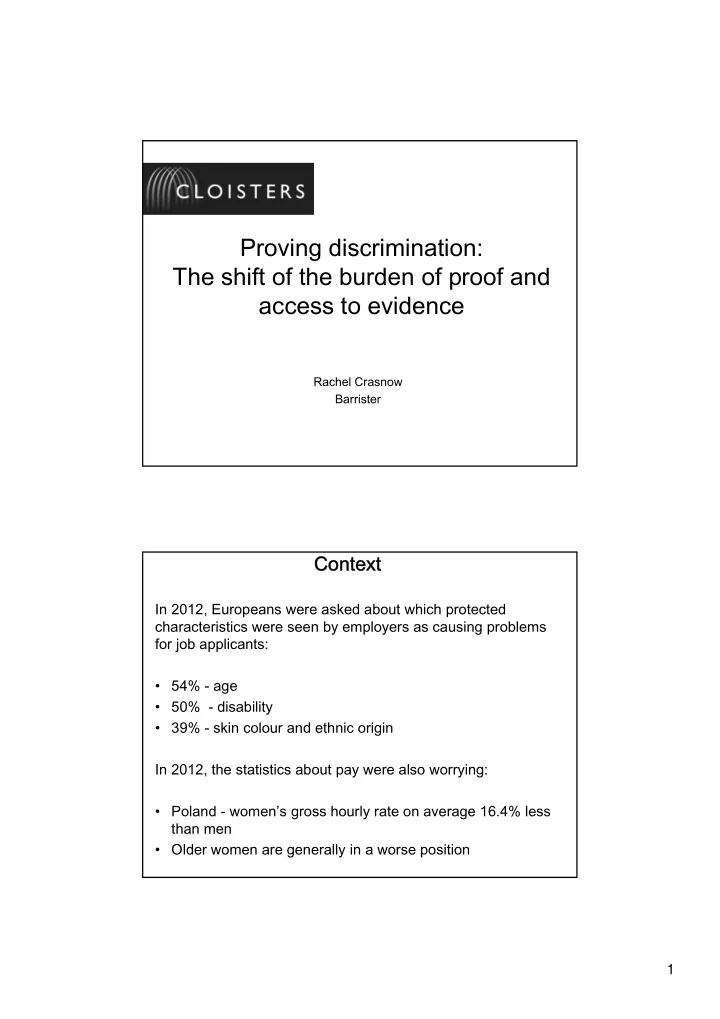
Rachel Crasnow Barrister

Proving discrimination: The shift of the burden of proof and access to evidence

Context

In 2012, Europeans were asked about which protected characteristics were seen by employers as causing problems for job applicants:

  • 54% - age
  • 50% - disability
  • 39% - skin colour and ethnic origin

In 2012, the statistics about pay were also worrying:

  • Poland - women’s gross hourly rate on average 16.4% less

than men

  • Older women are generally in a worse position
slide-2
SLIDE 2

2

What are the evidential hurdles in discrimination cases?

  • Perpetrators don’t admit to discrimination, or

they are unaware of it

  • Information proving discrimination is in the

hands of the perpetrator

  • Statistics are required
  • Justification defences

How has the EU responded to these challenges?

slide-3
SLIDE 3

3

Shifting burden of proof

  • Stage 1: claimant to prove prima facie case
  • f discrimination
  • Stage 2: respondent to prove no

discrimination

  • Case law – Danfoss, Enderby
  • Directives

In practice, what evidence is required to shift the burden of proof?

Stage 1

  • Comparability: Brunhoffer
  • Lack of transparency: Danfoss
  • Segregation: Enderby
  • Conduct of connected / influential parties:

ACCEPT

  • Historic discrimination: Firma Feryn NV
slide-4
SLIDE 4

4

How can employers rebut the burden of proof

  • nce it has shifted?

Stage 2

  • Advancing a positive case vs. proving a

negative

  • Firma Feryn
  • ACCEPT

Obtaining evidence

  • Kelly
  • Meister
  • Respect for national rules
  • But, not at the expense of effectiveness
slide-5
SLIDE 5

5

Conclusion

  • Shifting burden of proof is a powerful tool
  • Extent to which national rules relating to

matters like disclosure will be influenced by the CJEU is less clear

  • Potential for interesting future legal

developments

rc@cloisters.com 0207 827 4083