Project Szchenyi 2013 Bridging past to present Vienna to - - PowerPoint PPT Presentation

project sz chenyi 2013
SMART_READER_LITE
LIVE PREVIEW

Project Szchenyi 2013 Bridging past to present Vienna to - - PowerPoint PPT Presentation

District Cooperation Vienna-Budapest from below Project Szchenyi 2013 Bridging past to present Vienna to Budapest, LMP to Die Grnen, Austria to Hungary, citizens to citizens... Discovering potentials to ourselves 9th Green


slide-1
SLIDE 1

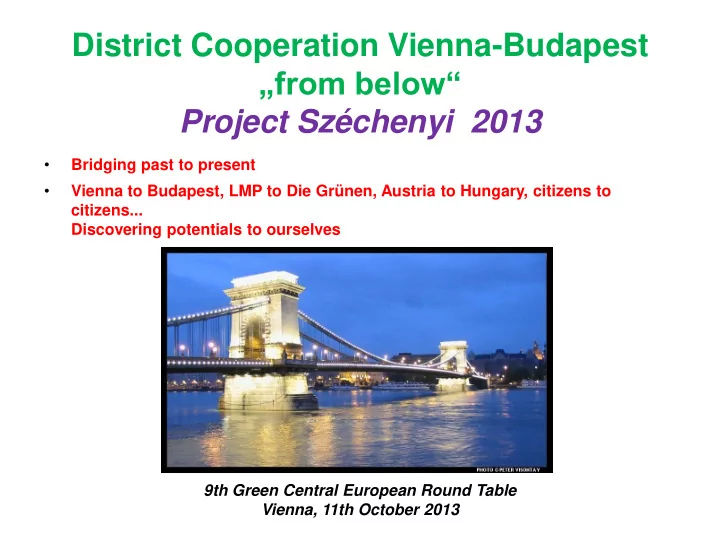
District Cooperation Vienna-Budapest „from below“ Project Széchenyi 2013

  • Bridging past to present
  • Vienna to Budapest, LMP to Die Grünen, Austria to Hungary, citizens to

citizens... Discovering potentials to ourselves 9th Green Central European Round Table Vienna, 11th October 2013

slide-2
SLIDE 2

Döbling

Since 1890/92 part of Vienna as District 19.

Long history of settlement, Limes Road in Roman Times, former villages (founded in the Middle Ages) still visible today. Area: 25 km² Inhabitants (1st January 2013): 68,892 Located in the northwest of Vienna between Danube River and „Wienerwald“ (Vienna Woods) with wineyards on some of the hills. Today considered to be an „upper class district“, but nevertheless one with working class traditions (Karl-Marx-Hof housing estate).

slide-3
SLIDE 3

Kispest

Since 1950 part of Budapest as District 19.

First settlement (colony) around 1870, city status from 1922-1950. Area: 9.4 km² Inhabitants (2011): c. 62,000 Located on the Pest side (East of Danube River) of Budapest. The north of the district is dominated by council estates (prefabricated panel block buildings) from the 1970ies and 1980ies, in the south family homes and the Wekerle-telep residential area prevail.

slide-4
SLIDE 4

The Working Framework- Towards European Town-Twinning

Kispest (Budapest, District 19)

  • January 2013 - Invitation for Comprehensive

Partnership with Döbling (based on mutual history and shared visions)

  • March 2013, Visit by Gerhard Jordan (Die

Grünen Vienna) in Kispest, informal meeting with District Mayor Péter Gajda and his team

  • Approach defined: grass-roots based,

bottom-up approach to city partnership

  • Priority themes defined: István Széchenyi

(222nd birthday commemoration)

  • Various educational, cultural and social

projects drafted for further co-operation

  • Project coordination: Zoltán Zarándy (LMP-

Budapest Education Committee)

Döbling (Vienna, District 19)

  • February, 2013 - invitation accepted, first

study visit programme proposal sent out

  • March 2013, Field visit made by Gerhard

Jordan (Die Grünen Vienna) to Kispest

  • April-September: Széchenyi

Commemoration Day Prepared, „red-green“ cooperation on district level

  • 21st September 2013 - Széchenyi

Commemoration, Wreath Laying Ceremony, Conference and Workshop

  • Meeting of City Leaders and Civic

Participants

  • Project coordination: Gerhard Jordan (Die

Grünen Vienna)
slide-5
SLIDE 5

First steps of cooperation

27th March 2013: Visit of Gerhard Jordan (Die Grünen Vienna) in Kispest, informal meeting with District Mayor Péter Gajda. 11th July 2013: Preparatory meeting with Döbling politicians Heinz Hieber (local councillor, Green Group Spokesperson) and Anton Mandl (Deputy Mayor of District 19, Social Democrat).

slide-6
SLIDE 6

A Man for Humanity Count István (Stefferl) Széchenyi 1791-1860

A Journey from Vienna to Döbling - From the Past to the Future Reflections by Zoltán Zarándy (LMP Education Committee, City of Budapest)

6 Memorial Day to the 222nd Birthday

  • f the Hungarian Reform Politician

Count ISTVÁN SZÉCHENYI 21st September 2013

slide-7
SLIDE 7

Happy 222nd Birthday, Stefferl!

  • Why Széchenyi?
  • Why NOT Széchenyi?
  • Why Remember Széchenyi? Why NOT?
  • Who was Széchenyi?

Who knows Széchenyi in Austria / in Europe?? Who knows Bach (Austrian PM in the 1860ies) in Hungary? Do we know each other?

  • Happy Birthday Stefferl!

To his 222nd Birthday discover ourselves – and our common heroes.

slide-8
SLIDE 8

Széchenyi - Hero or Victim? A Dilemma 4U - Shakespeare

Mission Impossible: in 10+ Minutes about over 60+ years of Széchenyi Széchenyi and a few key concepts to understand Széchenyi’s Conflicts in Work and Life

  • A man of action and 100s of projects
  • Love vs. Passion
  • Husband vs. Lover
  • Marital fidelity/faith vs. Affairs
  • (Catholic) Dogmatism vs. Enlightenment
  • Virtue vs. Sins
  • Confession vs. Absolution
  • Credibility vs. Doubt
  • Treason vs. Trust
  • Monarchy vs. Republic
  • Hungary vs. Austria (no Football!)
slide-9
SLIDE 9

Civilizer Széchenyi – „Time is Money – Geschäft ist Geschäft“

Projects for Modernisation – Model England:

  • Horse Racing (first on a location in subsequent

Kispest)

  • Model Estate (Nagycenk near Sopron)
  • Public transport development (Rails: Pest-Vác, Pest-

Szolnok, Steam Shipping: Danube, Tisza, Balaton)

  • Steam Mills, Regulation of rivers
  • And: Széchenyi, the Bridge-Builder…
slide-10
SLIDE 10

Széchenyi and his Impact

  • A „Megastar“ in Hungarian political thinking
  • A Reflection of Hungarian Identities
  • An Idol in National Consciousness
  • A Prisoner of Politics: under Franz Joseph I. no Forgiveness

until 1898. Until 1925 no Access to Széchenyi Heritage in Austria.

  • Miklós Horthy - Positive Developments - Minister for Culture

Klebelsberg - Wiener Haus-, Hof- und Staatsarchiv + Collegium Hungaricum

  • Stalinist Dictator Mátyás Rákosi – Hate against Széchenyi
  • János Kádár – „Compromise“ with Conservative Liberalism in

Theatre, Literature, Films and Social Sciences – but: Prof. Domokos Kosáry (historian, 1956 imprisoned in Vác) wrote about Széchenyi‘s Döbling years.

slide-11
SLIDE 11

The Rest – is Silence … Hope for Future from Döbling

2013 and 2014: we are facing forthcoming elections

in Europe - just held in Austria, next year in Hungary One has to solve the crisis, creating a new understanding of our past, present and future We need clear moments - Quiet - Reflection - Role models and solidarity - in order to survive this „madhouse“. We can „flee to Döbling“ to find good partners and co-operation. Thanks to Széchenyi - and his followers in Döbling and Budapest. For new project plans and ideas please contact: zarandyzoltan@gmail.com

slide-12
SLIDE 12

The Széchenyi Commemoration in Döbling, 21st September 2013

Wreath Laying Ceremony in front of the buidling where István Széchenyi commited suicide in 1860 (Obersteinergasse 20)

Politicians from Vienna - from left to right: Deputy Mayor of Döbling Anton Mandl and Federal Councillor Stefan Schennach (SPÖ), District Councillor Heinz Hieber and City Assembly Member Monika Vana (DIE GRÜNEN) - and from Budapest: Mayor of Kispest Péter Gajda (MSZP) and Zoltán Zarándy (Green Party LMP - Politics can be Different).

slide-13
SLIDE 13

The Széchenyi Commemoration in Döbling, 21st September 2013

Wreath Laying Ceremony (moderated by actress Mercedes Echerer) and subsequent Commemoration event at Haus der Begegnung Döbling, Gatterburggasse 2 at Obersteinergassexxx

slide-14
SLIDE 14

The Széchenyi Commemoration in Döbling, 21st September 2013

Interviews with politicians from Döbling and with a „Klubrádió“ representative from Budapest

slide-15
SLIDE 15

The Széchenyi Commemoration in Döbling, 21st September 2013

Speeches and historical presentations

slide-16
SLIDE 16

Plans for the Future

„Széchenyi Project 2.0“ – Educational partnership: School-twinning 2014 – Karl-Marx-Hof & Wekerle Housing Estate: Mutual visits and joint exhibition on everyday life in two settlements in the 19th districts

  • f Vienna and Budapest

– Bilateral visits of NGO representatives and politicians from Döbling and Kispest – Vienna (Döbling) and Honvéd (Kispest) Football Clubs - both of them underwent some sort of „Golden Era“ in the mid-1950ies - shall be put into contact for partnership – EU town-twinning project generation within „Europe for Citizens“ 2014-20 Programme – Cultural exchange between „kmo“ Center Kispest (Teleki utca 50) and a similar institution from Döbling

slide-17
SLIDE 17

School twinning

GRG 19 is the abbreviation of Bundesgymnasium & Bundesrealgymnasium Billrothstrasse 73 - a Secondary School built in 1965 just behind the former sanatorium (today district court of Döbling) where István Széchenyi lived from 1848 until 1860. It seems that there are teachers interested in the Széchenyi topic and also in developing common projects with a partner school in Kispest. Erkel Ferenc Általános Iskola (Ferenc Erkel Primary School) is located at Hungária út 11, in the so-called Wekerle Estate in the 19th district of Budapest. The building was constructed in 1912. Pupils up to 14 years are educated here. One of the key aspects is teaching German language - predestining this school to become partner of GRG 19.

slide-18
SLIDE 18

Common exhibition

Karl-Marx-Hof in the neighbourhood Heiligenstadt (Eastern part of Döbling) is one of the most well-known council estates in Vienna, with more than 1,300 flats (a so-called „superblock“). It was built between 1927 and 1930 by Karl Ehn. During the Civil War of February 1934, fighting took place here. In 2010, a little museum on the history of the Social Democratic „Red Vienna“ (1919-1934) opened in the former laundry. Wekerletelep is a settlement with approx. 10,000 inhabitants in the Western Part of Budapest‘s 19th district. It was built between 1908 and 1925 by famous Hungarian architects like Károly Kós, Dezső Zrumeczky and Lajos Schodits and named after a Hungarian Prime Minister who had been in office several times between 1892 and 1918. Built for local workers and clerks, the estate appears like an independent village, centered around a main square.

slide-19
SLIDE 19

Sports and Culture

Friendly matches between the teams and/or junior teams of First

Vienna FC (left: Vienna Stadium at Hohe Warte) and Honvéd Football Club may involve citizens from Döbling and Kispest; Cooperation of „kmo“ Cultural Center (right) with an institution from Döbling like VHS will do so, too.

slide-20
SLIDE 20

THANK YOU

FOR YOUR ATTENTION !

Zoltán Zarándy Budapest Gerhard Jordan Vienna