
SLIDE 1
!
Probability*and*Statistics* for*Computer*Science**
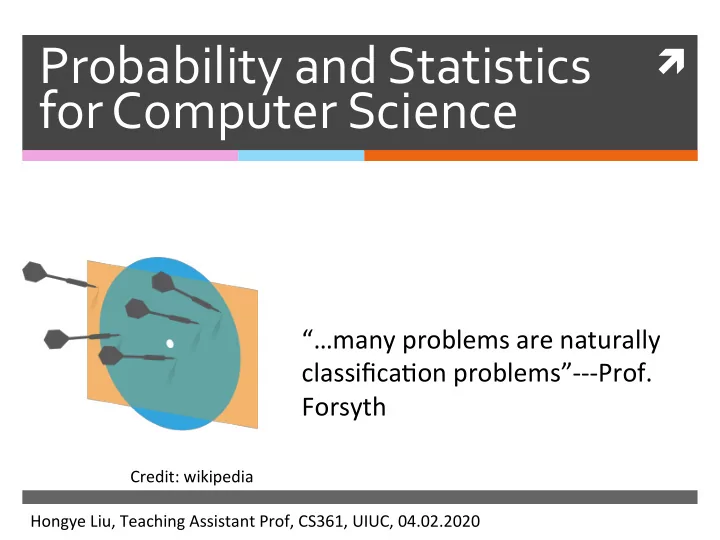
“…many!problems!are!naturally! classifica4on!problems”666Prof.! Forsyth!
Hongye!Liu,!Teaching!Assistant!Prof,!CS361,!UIUC,!04.02.2020! Credit:!wikipedia!
Probability*and*Statistics* ! for*Computer*Science** - - PowerPoint PPT Presentation
Probability*and*Statistics* ! for*Computer*Science** many!problems!are!naturally! classifica4on!problems666Prof.! Forsyth! Credit:!wikipedia! Hongye!Liu,!Teaching!Assistant!Prof,!CS361,!UIUC,!04.02.2020! Last*time*
!
“…many!problems!are!naturally! classifica4on!problems”666Prof.! Forsyth!
Hongye!Liu,!Teaching!Assistant!Prof,!CS361,!UIUC,!04.02.2020! Credit:!wikipedia!
Review!of!Covariance!matrix! Dimension!Reduc4on! Principal!Component!Analysis! Examples!of!PCA!
Demo%of%Principal%Component%
Analysis%
Introduc4on!to!classifica4on!
Demo*of*the*PCA*by*solving* diagonalization*of*covariance*matrix*
Mean centering
Rotate
the
data
to
eigenvectors
Project
the dots
Demo:*PCA*of*Immune*Cell*Data*
There!are!38816!white!
blood!immune!cells!from! a!mouse!sample!
Each!immune!cell!has!
40+!features/ components!
Four!features!are!used!
as!illustra4on.!
There!are!at!least!3!cell!
types!involved!
T!cells! B!cells! Natural!killer!cells!
planner
coordinator Executor
he send
into
killer of
invading
ma l .
Scatter*matrix*of*Immune*Cells*
There!are!38816!white!
blood!immune!cells!from! a!mouse!sample!
Each!immune!cell!has!
40+!features/ components!
Four!features!are!used!
as!illustra4on.!
There!are!at!least!3!cell!
types!involved!
Dark%red:!T!cells! Brown:!B!cells! Blue:!NK!cells! Cyan:!other!small!popula4on!
PCA*of*Immune*Cells**
>!res1! $values! [1]!4.7642829!2.1486896!1.3730662! 0.4968255! ! $vectors! !!!!!!!!!!![,1]!!!!!!!![,2]!!!!!!![,3]!!!!!!![,4]! [1,]!!0.2476698!!0.00801294!60.6822740!! 0.6878210! [2,]!!0.3389872!60.72010997!60.3691532! 60.4798492! [3,]!60.8298232!!0.01550840!60.5156117! 60.2128324! [4,]!!0.3676152!!0.69364033!60.3638306! 60.5013477! Eigenvalues! Eigenvectors!
T
More*featurs*used*
There!are!38816!white!
blood!immune!cells!from! a!mouse!sample!
Each!immune!cell!has!
40+%features/ components!
There!are!at!least!3!cell!
types!involved!
T!cells! B!cells! Natural!killer!cells!
Eigenvalues*of*the*covariance*matrix*
O
O
Large*variance*doesn’t*mean*important* pattern*
Principal! component!1! is!just!cell! length!
F
Principal*component*2*and*3*show* different*cell*types*
T
Principal*component*4*is*not*very* informative*
Principal*component*5*is*interesting*
Principal*component*6*is*interesting*
Scaling*the*data*or*not*in*PCA*
Some4mes!we!need!to!scale!the!data!for!each!feature!
have!very!different!value!range.!!
Afer!scaling!the!eigenvalues!may!change!significantly.! Data!needs!to!be!inves4gated!case!by!case!
Eigenvalues*of*the*covariance*matrix* (scaled*data)*
Eigenvalues! do!not!drop!
quickly! O
Principal*component*1*&*2*(scaled*data)*
Even!the!first!2! PCs!don’t!separate! the!different!types!
Q.*Which*of*these*are*true?*
A.!Feature!selec4on!should!be! conducted!with!domain!knowledge! B.!Important!feature!may!not!show!big! variance! C.!Scaling!doesn’t!change!eigenvalues!of! covariance!matrix! D.!A!&!B!
Q.*Which*of*these*are*true?*
A.!Feature!selec4on!should!be! conducted!with!domain!knowledge! B.!Important!feature!may!not!show!big! variance! C.!Scaling!doesn’t!change!eigenvalues!of! covariance!matrix! D.!A!&!B!
Demo!of!Principal!Component!
Analysis!
Introduc<on%to%classifica<on%
Learning*to*classify*
Given!a!set!of!feature!vectors!xi,!where!each!has!a!class!
label!yi,!we!want!to!train!a!classifier!that!maps!! unlabeled!data!with!the!same!features!to!its!label.!
CD45% CD19% CD11b% CD3e% Type%
6.59564671! 1.297765164! 7.073280884! 1.155202366!
1!
6.742586812! 4.692018952! 3.145976639! 1.572686963!
4!
6.300680301! 1.20613983! 6.393630905! 1.424572629!
2!
5.455310882! 0.958837541! 6.149306002! 1.493503124!
1!
5.725565772! 1.719787885! 5.998232014! 1.310208305!
1!
5.552847151! 0.881373587! 6.02155471! 0.881373587!
3!
→
→
5
l
G
X
?
' '
s 73,42
Binary*classifiers*
A!binary!classifier!maps!each!feature!vector!to!one!of!
two!classes.!
For!example,!you!can!train!the!classifier!to:!
Predict!a!gain!or!loss!of!an!investment! Predict!if!a!gene!is!beneficial!to!survival!or!not! …!
Multiclass*classifiers*
A!mul4class!classifier!maps!each!feature!vector!to!one!
For!example,!you!can!train!the!classifier!to:!
Predict!the!cell!type!given!cells’!measurement! Predict!if!an!image!is!showing!tree,!or!flower!or!car,!etc! ...!
Given*our*knowledge*of*probability*and* statistics,*can*you*think*of*any*classifiers?*
Given*our*knowledge*of*probability*and* statistics,*can*you*think*of*any*classifiers?*
We!will!cover!classifiers!such!as!nearest!
neighbor,!decision!tree,!random!forest,!Naïve! Bayesian!and!support!vector!machine.!
Nearest*neighbors*classifier*
Given!an!unlabeled!feature!vector!
Calculate!the!distance!from!x% Find!the!closest!labeled!xi% Assign!the!same!label!to!x%
Prac4cal!issues!
We!need!a!distance!metric! We!should!first!standardize!the!data! Classifica4on!may!be!less!effec4ve!for!very!high!
dimensions!
Source:!wikipedia!
Z
knows
x
O
x
Variants*of*nearest*neighbors*classifier*
In!k6nearest!neighbors,!the!classifier:!
Looks!at!the!k!nearest!labeled!
feature!vectors!xi%
Assigns!a!label!to!x%based!on!a!
majority!vote%
In!(k,!l)6nearest!neighbors,!the!classifier:!
Looks!at!the!k!nearest!labeled!feature!vectors! Assigns!a!label!to!x!if!at!least!l!of!them!agree!on!the!
classifica4on!
The green
data
pts
is
cables
" Red " if k =3
" Blue
" if
k=5
T
How*do*we*know*if*our*classifier*is*good?*
We!want!the!classifier!to!avoid!some!mistakes!on!
unlabeled!data!that!we!will!see!in!run!4me.!
Problem%1:!some!mistakes!may!be!more!costly!than!
We!can!tabulate!the!types!of!error!and!define!a!loss! func4on!
Problem%2:!It’s!hard!to!know!the!true!labels!of!the!
run64me!data!
We!must!separate!the!labeled!data!into!a!training!set! and!test/valida4on!set!
Performance*of*a*binary*classifier*
A!binary!classifier!can!make!two!types!of!errors!
False!posi4ve!(FP)! False!nega4ve!(FN)!
Some4mes!one!type!
Drug!effect!test! Crime!detec4on! We!can!tabulate!the!performance!
in!a!class!confusion!matrix!
15% 3% 7% 25! FP! TP! TN! FN!
O
l
:
F
Performance*of*a*binary*classifier*
A!loss!func4on!assigns!costs!to!mistakes! The!061!loss!func4on!treats!
FPs!and!FNs!the!same!
Assigns!loss!1!to!every!
mistake!
Assigns!loss!0!to!every!
correct!decision!
Under!the!061!loss!func4on! accuracy=! The!baseline!is!50%!which!we!get!by!
random!decision.!
TP + TN TP + TN + FP + FN
Coo
'
Performance*of*a*multiclass*classifier*
Assuming!there!are!c!classes:! The!class!confusion!matrix!is!
c!×!c!
Under!the!061!loss!func4on!
accuracy=!
ie.!in!the!right!example,!accuracy!=! 32/38=84%! The!baseline!accuracy!is!1/c.!
sum of diagonal terms sum of all terms
Source:!scikit6learn!
\ , ASg
dens :
3④ I,
:
= I
Training*set*vs.*validation/test*set*
We!expect!a!classifier!to!perform!worse!on!run64me!data!
training!
the!input!is!in!the!training!set,!but!otherwise!makes!a!random! guess!! ! To!protect!against!overfisng,!we!separate!training!set!
from!valida4on/test!set!
It’s!common!to!reserve!at!least!10%!of!the!data!for!tes4ng!
Cross\validation*
If!we!don’t!want!to!“waste”!labeled!data!on!valida4on,!!we!
can!use!crossNvalida<on!to!see!if!our!training!method!is! sound.!
Split!the!labeled!data!into!training!and!valida4on!sets!in!
mul4ple!ways!
For!each!split!(called!a!fold)!
Average!the!accuracy!to!evaluate!the!training!
methodology!
How*many*trained*models*I*can*have*for* the*leave*one*out*cross\validation?*
If!I!have!a!data!set!that!has!50!labeled!data!entries,!how! many!leave6one6out!valida4ons!I!can!have?! A.!50! B.!49! C.!50*49!
How*many*trained*models*I*can*have*for* the*leave*one*out*cross\validation?*
If!I!have!a!data!set!that!has!50!labeled!data!entries,!how! many!leave6one6out!valida4ons!I!can!have?! A.!50! B.!49! C.!50*49!
How*many*trained*models*can*I*have*with* this*cross\validation?*
If!I!have!a!data!set!that!has!51!labeled!data!entries,!I! divide!them!into!three!folds!(17,17,17).!How!many! trained!models!can!I!have?!
*The%common%prac<ce%of%using%fold%is%to%divide%the%samples%into%equal%sized%k%groups% and%reserve%one%of%the%group%as%the%test%data%set.%
51
fold =3
3-
= 17
17
us
34
t
d
c- est
How*many*trained*models*can*I*have*with* this*cross\validation?*
If!I!have!a!data!set!that!has!51!labeled!data!entries,!I! divide!them!into!three!folds!(17,17,17).!How!many! trained!models!can!I!have?!
51 17
.
.
Decision(tree:(object(classification(
The$object$classifica4on$decision(tree$can$classify$
simple$tests.$It$will$naturally$grow$into$a$tree.$
Cat( toddler( dog( chair(leg( sofa( box(
moving
nature-ing
parts
"" -
big or surge,
Training(a(decision(tree:(example(
The$“Iris”$data$set$
Setosa$ Versicolor$ Virginica$ 1?$Where?$
m
O
Phish
T
a
t
50 Seto s a
Q:(What(is(accuracy(of(this(decision(tree( given(the(confusion(matrix(?(
50 49 5 1 45
Q:(What(is(accuracy(of(this(decision(tree( given(the(confusion(matrix(?(
50 49 5 1 45
Decision(Boundary(
1.75$ 2.45$
Another(Decision(Boundary(
Credit:$Kelvin$Murphy,$“Machine$Learning:$A$Probabilis4c$Perspec4ve”,$2012$
Training(a(decision(tree(
Choose(a(dimension/feature(and(a(split(
Training(a(decision(tree(
Choose$a$dimension/feature$and$a$split$ Split(the(training(Data(into(leH:(and(right:(
child(subsets(Dl(and(Dr(
Training(a(decision(tree(
Choose$a$dimension/feature$and$a$split$ Split$the$training$Data$into$lelW$and$rightW$
child$subsets$Dl$and$Dr$
Repeat(the(two(steps(above(recursively(on(
each(child(
Training(a(decision(tree(
Choose$a$dimension/feature$and$a$split$ Split$the$training$Data$into$lelW$and$rightW$
child$subsets$Dl$and$Dr$
Repeat$the$two$steps$above$recursively$on$
each$child$
Stop(the(recursion(based(on(some(condiBons(
Training(a(decision(tree(
Choose$a$dimension/feature$and$a$split$ Split$the$training$Data$into$lelW$and$rightW$
child$subsets$Dl$and$Dr$
Repeat$the$two$steps$above$recursively$on$
each$child$
Stop$the$recursion$based$on$some$condi4ons$ Label(the(leaves(with(class(labels(
Classifying(with(a(decision(tree:(example(
The$“Iris”$data$set$
Setosa$ Versicolor$ Virginica$
Choosing(a(split(
An$informa4ve$split$
makes$the$subsets$ more$concentrated$ and$reduces$ uncertainty$about$ class$labels$
$$$ $ $ $ $ $ $ $ $ $ $ $ $
Choosing(a(split(
An$informa4ve$split$
makes$the$subsets$ more$concentrated$ and$reduces$ uncertainty$about$ class$labels$
$$$ $ $ $ $ $ $ $ $ $ $ $ $
Choosing(a(split(
An$informa4ve$split$
makes$the$subsets$ more$concentrated$ and$reduces$ uncertainty$about$ class$labels$
$$$ $ $ $ $ $ $ $ $ $ $ $ $ ✔$ ✖$
Which(is(more(informative?(
Quantifying(uncertainty(using(entropy(
We$can$measure$uncertainty$as$the$
number$of$bits$of$informa4on$needed$ to$dis4nguish$between$classes$in$a$ dataset$(first$introduced$by$Claude$ Shannon)$
We$need$Log2$2$=1$bit$to$
dis4nguish$2$equal$classes$
We$need$Log2$4$=2$bit$to$
dis4nguish$4$equal$classes$
Claude$Shannon$(1916W2001)$
Quantifying(uncertainty(using(entropy(
Entropy$(Shannon$entropy)$is$the$measure$of$
uncertainty$for$a$general$distribu4on$
If$class$i$contains$a$frac4on$P(i)$of$the$data,$we$need$$$$$$$$$$$$$$$$$$
bits$for$that$class$
The$entropy$H(D)$of$a$dataset$is$defined$as$the$weighted(
mean$of$entropy$for$every$class:$
H(D) =
c
P(i)log2 1 P(i)
log2 1 P(i)
classes
Entropy:(before(the(split(
$ $ $ $ $ $ $ $ $
= 0.971 bits
H(D) = −3 5log2 3 5 − 2 5log2 2 5
" ""
" ""
,
↳¥
GET =
Entropy:(examples(
$ $ $ $ $ $ $ $ $
= 0.971 bits
H(D) = −3 5log2 3 5 − 2 5log2 2 5
H(Dl) = −1 log21 = 0 bits
X
O
2
c.7 .
J
Entropy:(examples(
$ $ $ $ $ $ $ $ $
= 0.971 bits
H(D) = −3 5log2 3 5 − 2 5log2 2 5
H(Dl) = −1 log21 = 0 bits
H(Dr) = −1 3log2 1 3 − 2 3log2 2 3 = 0.918 bits
De Dre
Information(gain(of(a(split((
The$informa4on$gain$of$a$split$is$the$amount$of$
entropy$that$was$reduced$on$average$aler$the$split$ $
where$
ND$is$the$number$of$items$in$the$dataset$D" NDl$is$the$number$of$items$in$the$lelWchild$dataset$Dl" NDr$is$the$number$of$items$in$the$lelWchild$dataset$Dr"
I = H(D) − (NDl ND H(Dl) + NDr ND H(Dr))
Information(gain:(examples(
$ $ $ $ $ $ $ $ $
I = H(D) − (NDl ND H(Dl) + NDr ND H(Dr)) = 0.971 − (24 60 × 0 + 36 60 × 0.918) = 0.420 bits
D
re danced !
Q.(Is(the(splitting(method((global(
R
Decision
for
che lowest
entropy
is
made at
each
node
locally
for the data at
that point anffdeuture
Q.(Is(the(splitting(method((global(
Not necessarily global
Assignments*
Read!Chapter!11!of!the!textbook! Next!4me:!Decision!tree,!Random!
forest!classifier!
Prepare!for!midterm2!exam!
Midterm2*is*coming*on*Nov.*12*(Tues.)*
Start!to!prac4ce!on!the!sample!exam!linked!on!the!
course!website!
Next!Mon.!in!discussion!we!will!do!a!first!exam!
review!
We!will!have!more!exercises!a!week!later.!
Additional*References*
✺ Robert!V.!Hogg,!Elliot!A.!Tanis!and!Dale!L.!
Zimmerman.!“Probability!and!Sta4s4cal! Inference”!!
Morris!H.!Degroot!and!Mark!J.!Schervish!
"Probability!and!Sta4s4cs”!
See*you*next*time*