
SLIDE 1
Probabilis)c ¡Reasoning ¡for ¡ ¡ Assembly-‑Based ¡3D ¡Modeling ¡
Siddhartha ¡Chaudhuri, ¡Evangelos ¡Kalogerakis, ¡ ¡ Leonidas ¡Guibas, ¡Vladlen ¡Koltun ¡
¡
Stanford ¡University ¡
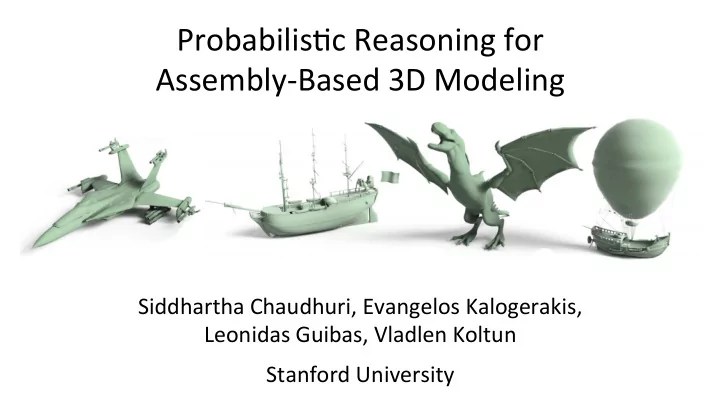
Probabilis)c Reasoning for Assembly-Based 3D Modeling - - PowerPoint PPT Presentation
Probabilis)c Reasoning for Assembly-Based 3D Modeling Siddhartha Chaudhuri, Evangelos Kalogerakis, Leonidas Guibas, Vladlen Koltun Stanford University
Siddhartha ¡Chaudhuri, ¡Evangelos ¡Kalogerakis, ¡ ¡ Leonidas ¡Guibas, ¡Vladlen ¡Koltun ¡
¡
Stanford ¡University ¡
Current shape Probabilistic model Observed data Ranked components Inference
Input repository Probabilistic model Learning
¡ ¡ ¡ ¡[Shin ¡and ¡Igarashi ¡2007] ¡ ¡ ¡ ¡ ¡ ¡ ¡& ¡ ¡ ¡ ¡ ¡ ¡ ¡ ¡[Lee ¡and ¡Funkhouser ¡2008] ¡
¡ ¡ ¡ ¡ ¡ ¡ ¡ ¡ ¡ ¡ ¡ ¡ ¡ ¡ ¡ ¡ ¡ ¡ ¡ ¡ ¡ ¡ ¡ ¡ ¡ ¡ ¡ ¡ ¡ ¡ ¡ ¡[Kraevoy ¡et ¡al. ¡2007] ¡
Crea)vity ¡support ¡in ¡3D ¡modeling ¡[Chaudhuri ¡and ¡Koltun ¡2010] ¡
Crea)vity ¡support ¡in ¡3D ¡modeling ¡[Chaudhuri ¡and ¡Koltun ¡2010] ¡
Crea)vity ¡support ¡in ¡3D ¡modeling ¡[Chaudhuri ¡and ¡Koltun ¡2010] ¡
Crea)vity ¡support ¡in ¡3D ¡modeling ¡[Chaudhuri ¡and ¡Koltun ¡2010] ¡
Crea)vity ¡support ¡in ¡3D ¡modeling ¡[Chaudhuri ¡and ¡Koltun ¡2010] ¡
Shape ¡a]ributes ¡ ¡ Dependencies ¡ between ¡a]ributes ¡
Random variables Represent with DAG
( )
( ) | ( )
i i i
P P x parents x =∏ X
{ }
i
x X =
1 2 1 3 1
( ) ( ) ( | ) ( | ) P P x P x x P x x = X
Existence ¡of ¡component ¡from ¡category ¡l
Arm(s) ¡ exist ¡ Torso(s) ¡ exist ¡
Number ¡of ¡components ¡from ¡category ¡l
# ¡of ¡Arms ¡ Torso(s) ¡ exist ¡ Arm(s) ¡ exist ¡
Adjacency ¡between ¡components ¡from ¡categories ¡l ¡and ¡l’
Arm-‑ Torso ¡ adjacency ¡ # ¡of ¡Arms ¡ Torso(s) ¡ exist ¡ Arm(s) ¡ exist ¡
Symmetry ¡rela)on ¡between ¡components ¡from ¡categories ¡ ¡l ¡and ¡l’
Arm-‑ Torso ¡ adjacency ¡ Arm-‑ Torso ¡ symmetry ¡ # ¡of ¡Arms ¡ Torso(s) ¡ exist ¡ Arm(s) ¡ exist ¡
Existence ¡of ¡component ¡from ¡style ¡cluster ¡s ¡of ¡category ¡l ¡
# ¡of ¡Arms ¡ Arm-‑ Torso ¡ adjacency ¡ Arm-‑ Torso ¡ symmetry ¡ Arm ¡style ¡2 ¡ exists ¡ Torso ¡style ¡ 1 ¡ exists ¡ Torso ¡style ¡ 2 ¡ exists ¡ Arm ¡style ¡1 ¡ exists ¡ Torso(s) ¡ exist ¡ Arm(s) ¡ exist ¡
Torso(s) ¡ exist ¡ # ¡of ¡Arms ¡ Arm-‑ Torso ¡ adjacency ¡ Arm-‑ Torso ¡ symmetry ¡ Arm ¡style ¡1 ¡ exists ¡ Arm ¡style ¡2 ¡ exists ¡ Torso ¡style ¡ 1 ¡ exists ¡ Torso ¡style ¡ 2 ¡ exists ¡ Arm(s) ¡ exist ¡
Arm(s) ¡ exist ¡ # ¡of ¡Arms ¡ Arm-‑ Torso ¡ adjacency ¡ Arm-‑ Torso ¡ symmetry ¡
Nl
Rl 0
2 4 1 0.3 1.0 0.0 0.7
Arm ¡style ¡2 ¡ exists ¡ Torso ¡style ¡ 1 ¡ exists ¡ Torso ¡style ¡ 2 ¡ exists ¡ Torso(s) ¡ exist ¡ Arm ¡style ¡1 ¡ exists ¡
Arm(s) ¡ exist ¡ # ¡of ¡Arms ¡ Arm-‑ Torso ¡ adjacency ¡ Arm-‑ Torso ¡ symmetry ¡ Arm ¡style ¡2 ¡ exists ¡ Torso ¡style ¡ 1 ¡ exists ¡ Torso ¡style ¡ 2 ¡ exists ¡ Torso(s) ¡ exist ¡
Arm ¡style ¡1 ¡ exists ¡
[Kalogerakis et al. 2010] (modified)
Arm cluster 1 Arm cluster 2 Torso cluster 1 Torso cluster 2 [Kalogerakis et al. 2010] (modified)
Arm cluster 1 Torso cluster 1 Torso cluster 2 [Kalogerakis et al. 2010] (modified) Arm cluster 2
Maximize ¡Bayesian ¡Informa)on ¡Criterion ¡ 1 log ( | , ) log 2 BIC P D G v n = − θ
Maximize ¡Bayesian ¡Informa)on ¡Criterion ¡
Likelihood term
D: training data
G: graph structure
θ: CPT entries
1 log ( | , ) log 2 BIC P D G v n = − θ
1 log ( | , ) log 2 BIC P D G v n = − θ
Penalize model complexity
v: # of independent CPT entries
n: # of training shapes
Maximize ¡Bayesian ¡Informa)on ¡Criterion ¡
Evidence
Xe= e
P( | Xe = e) ?
Evidence
Xe= e
P( Xq = q | Xe = e )
Particle-based inference Evidence
Xe= e
– Dynamic ¡ordering ¡with ¡probabilis)c ¡model ¡ – Sta)c ¡ordering ¡of ¡categories ¡and ¡components ¡ – Dynamic ¡ordering ¡with ¡[Chaudhuri ¡and ¡Koltun ¡2010] ¡
68% ¡ 25% ¡ 37% ¡
assembly-‑based ¡3D ¡modeling ¡
dependencies ¡between ¡shape ¡components ¡
rela)onships ¡
– ¡consistent ¡shape ¡segmenta&on ¡ ¡ – ¡gluing ¡and ¡cuMng ¡components ¡ – ¡edi&ng ¡geometry ¡of ¡individual ¡components ¡
Acknowledgements: ¡ ¡Aaron ¡Hertzmann, ¡Sergey ¡Levine, ¡Suchi ¡Saria, ¡ ¡ Jonathan ¡Laserson, ¡Philipp ¡Krähenbühl, ¡ ¡Daphne ¡Koller, ¡ ¡ Chris ¡Platz, ¡Hadidjah ¡Chamberlin, ¡Niels ¡Joubert ¡
¡
Our ¡project ¡web ¡page: ¡ h]p://graphics.stanford.edu/~sidch/projects/assembly/ ¡ ¡ ¡
Component features: Shape diameter Curvature Singular values from PCA Average geodesic distance Geodesic distance from
Component ¡Assembly ¡ Head ¡ Torso ¡
Slots ¡ Edge loops ¡ Boundary vertices ¡ Zones ¡
Cap ¡
[Schmidt/Singh '10] ¡
Slot frames ¡
Register Discrete Exponential Maps ¡ [Schmidt et al. '06, '10] ¡ and deform proximal ¡ regions for smooth join ¡ (note: gluing is asymmetric, not slot-to-slot) ¡
Incremental tangential motion following mouse drag ¡ “Steps over” small surface detail ¡
1-DOF rotation in plane of attachment (selected above) ¡ 2-DOF rotation for tilt ¡
Maintain point(s) of attachment ¡
Slide each attached slot individually ¡ Overall motion computed from slot displacements ¡ Motion prevented if not possible without breaking attachments ¡
Rotation axis computed from all current attachments ¡ Rotation prevented if not possible without breaking attachments ¡
Scaling pivot computed from all current attachments ¡ Scaling prevented if not possible without breaking attachments ¡
Mul)-‑select ¡
Symmetry plane of torso automatically selected for wings ¡
Two wings created, since maxl' P(Rl,l' | e) > 0 ¡
Query Bayesian Network for arg maxl' P(Rl,l' | e) ¡ l is label of selected part, l' is label of another part in the assembly ¡
Query Bayesian Network for arg maxl' P(Al,l' | e) ¡ l is label of selected part, l' is label of another part in the assembly ¡ Legs snap to torso... ¡ … but horns snap to head ¡
Modeling Area