Presenters Sylvie Doiron Omar Sherman Sylvie Doiron studied - - PowerPoint PPT Presentation

presenters
SMART_READER_LITE
LIVE PREVIEW

Presenters Sylvie Doiron Omar Sherman Sylvie Doiron studied - - PowerPoint PPT Presentation

Presenters Sylvie Doiron Omar Sherman Sylvie Doiron studied law at the University Omar Sherman is a graduate of both the of Moncton, was called to the Bar in 1990 University of Nairobi and University of and has been practicing


slide-1
SLIDE 1

Presenters

Sylvie Doiron Omar Sherman

  • Omar Sherman is a graduate of both the

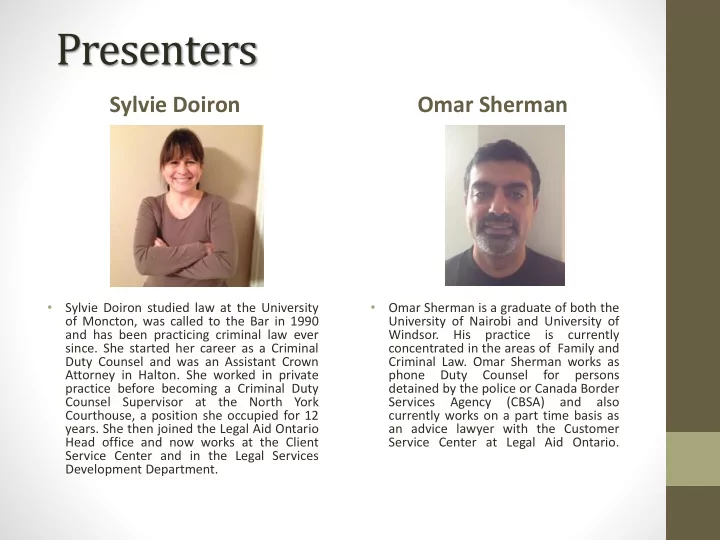
University of Nairobi and University of Windsor. His practice is currently concentrated in the areas of Family and Criminal Law. Omar Sherman works as phone Duty Counsel for persons detained by the police or Canada Border Services Agency (CBSA) and also currently works on a part time basis as an advice lawyer with the Customer Service Center at Legal Aid Ontario.

  • Sylvie Doiron studied law at the University
  • f Moncton, was called to the Bar in 1990

and has been practicing criminal law ever

  • since. She started her career as a Criminal

Duty Counsel and was an Assistant Crown Attorney in Halton. She worked in private practice before becoming a Criminal Duty Counsel Supervisor at the North York Courthouse, a position she occupied for 12

  • years. She then joined the Legal Aid Ontario

Head office and now works at the Client Service Center and in the Legal Services Development Department.

slide-2
SLIDE 2

Helping Clients Deal with Criminal Arrest

As Community Agents, you can help clients understand the issues and processes and help them deal with a very complex court system

slide-3
SLIDE 3

Welcome

Thank you for joining Legal Aid Ontario’s webinar

  • This webinar looks at some of the legal issues facing people at point
  • f arrest to help understand how we can minimize stress for clients

who may face criminal charges

  • The webinar is divided into 3 sections with a short break for

questions after each. We have listed a few questions in each section to kick start the discussion but encourage your participation too

  • We hope you enjoy it and we look forward to hearing your

comments and feedback

slide-4
SLIDE 4

Overview

1. Legal Rights 2. Vulnerable Clients 3. The Criminal Charge Cycle and Bail Hearing Process 4. Services and Supports

slide-5
SLIDE 5

Section 1 - Legal Rights

In 1990, the Supreme Court of Canada held in R. v. Brydges that it was the duty of the police, in accordance with s10(b) of the Charter

  • f Rights and Freedoms, to advise all persons who are arrested or

detained of the existence and availability of duty counsel services and legal aid plans. In accordance with this requirement, the Brydges Duty Counsel Service was established.

  • The Brydges Service is available to anyone who has been

detained or arrested in Ontario, regardless of whether the person qualifies for legal aid.

slide-6
SLIDE 6

Brydges Process

1. The law enforcement agency informs a detained or arrested individual of the right to retain and instruct counsel without delay, the right to contact any lawyer (including the availability of prompt free advice from duty counsel) and the availability of legal aid services. 2. If the accused wishes to speak with duty counsel, a law enforcement agency employee dials 1-800-265-0451 and leaves a scripted voice-mail message that includes his or her name and telephone number. 3. A duty counsel lawyer returns the call and the law enforcement agency records the name of the duty counsel before arranging a private solicitor-client conversation.

slide-7
SLIDE 7

Question Period

slide-8
SLIDE 8

Q & A’s

1. What about clients who do not understand what the police are saying due to language or mental health issues? 2. What if a client gives up this right not understanding its implications? 3. Do police listen to the calls? Is adequate privacy offered at police station or wherever the call is made? 4. Are services offered in different languages? 5. Are there Aboriginal lawyers available? What about other cultural representation? 6. Is service always prompt?

slide-9
SLIDE 9

Section 2 - Vulnerable Clients

  • Mental Health
  • Aboriginal and other Cultures
  • Domestic Assault
  • Youth

Issues

  • Support to help them understand their rights
  • Support when facing serious or complex

charges

  • Support maneuvering in our complicated

court system

  • Support to help prepare them for court

appearances

  • Support to connect them to court services
slide-10
SLIDE 10

Question Period

slide-11
SLIDE 11

Q & A’s

1. What happens if a client resists arrest which results in additional charges resulting from a mental health issue? 2. What happens to clients with physical disabilities? 3. Are clients under the influence (drugs/alcohol/medication) considered disadvantaged and how does this affect point of arrest services provided to them? 4. What if the police do not fully advise clients about their rights?

slide-12
SLIDE 12

Section 3 - The Criminal Charge Cycle

Charges are laid by police or Justice of the Peace Fingerprints and pictures are taken at police station Appearance in Court Resolution of charge

slide-13
SLIDE 13

Criminal Charges

  • Common Charges:

1. Shoplifting 2. Domestic Assault 3. Possession of Drugs 4. Fraud (cheques)

  • Other more serious charges:

1. Break and Enter 2. Theft Over 3. Assault Causing Bodily Harm

slide-14
SLIDE 14

After the Arrest

  • 1. Release from scene with

an Appearance Notice

  • 2. Release on your own

Recognizance from police station

  • 3. To Court – Bail Hearing
  • Released by JP
  • Detained
  • Plead Guilty
slide-15
SLIDE 15

Bail Hearing Process

  • What is a Bail Hearing
  • How can Duty Counsel help your clients?
  • How can Community workers help a client in court?
  • How can a client prepare for a Bail Hearing?
  • Role of a surety – responsibilities; release plans
  • Bail Conditions – importance
slide-16
SLIDE 16

Resolution of Charges

  • Guilty Plea/Sentences (types)
  • Diversion
  • Withdrawal of charges
  • Peace Bond
  • Definitions
  • Consequences
  • Warnings
slide-17
SLIDE 17

As front line workers LAO staff and Community agency staff provide many common services:

1.

Confidential conversations to help guide and advise clients

2.

Personalized information and legal assistance to understand court processes and procedures

3.

Specialized coordination to help clients understand court processes and put the pieces together for their court cases

4.

Personal and attentive care to explain best options and next steps in a friendly and simple manner

“I just have one short question…” “I don’t understand how this court system works!” “I wish I had help to figure

  • ut what to do next”

Making a Client Feel Supported

slide-18
SLIDE 18

Question Period

slide-19
SLIDE 19

Q and A’s

1. What happens if a client forgets to attend court? 2. How does a person turn themselves into police? 3. What should someone with an outstanding warrant for arrest do? 4. Does a person need to have a lawyer for a bail hearing? 5. Are Duty Counsel experienced in bail hearings? 6. How can charges be dropped? 7. How do you change bail conditions?

slide-20
SLIDE 20

Wrap Up

1. Criminal charges and arrest can be very stressful for clients 2. As front line agents, we can help minimize the stress for these clients by helping prepare them for court appearances – with information; guidance on what to expect at court; direction to self-help websites; referrals to LAO SLA lawyers; clinics or Duty Counsel 3. Legal community partnerships are becoming essential to bring professionals together to deal with the clusters of “problems” that clients are increasingly facing in their every day lives 4. As a holistic service team, it is our job to help them differentiate problems and figure out basic next steps

slide-21
SLIDE 21

Legal Aid Ontario

  • Criminal Duty Counsel; Per Diem Duty Counsel
  • Helping vulnerable clients – Section 85 appointments; Gladue court
  • Certificate Program
  • Bail/Pleas/Set-date court services
  • JOT workers
  • A legal information resource from Legal Aid Ontario http://www.lawfacts.ca/
  • 1-800-668-8258 or 416-979-1446 during regular business hours.

In Court Services…