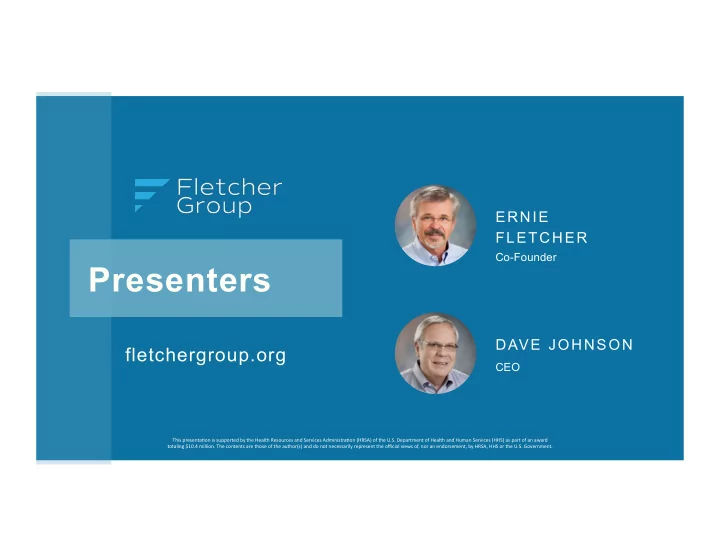
Presenters DAVE JOHNSON fletchergroup.org CEO This presenta,on - - PowerPoint PPT Presentation

presenters
SMART_READER_LITE
LIVE PREVIEW

Presenters DAVE JOHNSON fletchergroup.org CEO This presenta,on - - PowerPoint PPT Presentation

ERNIE FLETCHER Co-Founder Presenters DAVE JOHNSON fletchergroup.org CEO This presenta,on is supported by the Health Resources and Services Administra,on (HRSA) of the U.S. Department


slide-1
SLIDE 1

Presenters

ERNIE FLETCHER

Co-Founder

DAVE JOHNSON

CEO

fletchergroup.org

This ¡presenta,on ¡is ¡supported ¡by ¡the ¡Health ¡Resources ¡and ¡Services ¡Administra,on ¡(HRSA) ¡of ¡the ¡U.S. ¡Department ¡of ¡Health ¡and ¡Human ¡Services ¡(HHS) ¡as ¡part ¡of ¡an ¡award ¡ totaling ¡$10.4 ¡million. ¡The ¡contents ¡are ¡those ¡of ¡the ¡author(s) ¡and ¡do ¡not ¡necessarily ¡represent ¡the ¡official ¡views ¡of, ¡nor ¡an ¡endorsement, ¡by ¡HRSA, ¡HHS ¡or ¡the ¡U.S. ¡Government. ¡
slide-2
SLIDE 2

Host

2019 BEST PRACTICES SUMMIT

October 14–16

  • St. Louis, Missouri

narronline.org

slide-3
SLIDE 3

THE FLETCHER GROUP IS DEDICATED TO:

  • The NARR Training Portal
  • The NARR National

Directory

  • The NARR Outcomes

Portal

  • Creating new NARR

Affiliates wherever needed

ONE VOICE

The Fletcher Group works hand-in-hand with NARR to ensure a nationally unified voice for Recovery Residences.

slide-4
SLIDE 4

PARTNERS

slide-5
SLIDE 5

ENDORSEMENTS

A MODEL EVIDENCE- BASED PROGRAM

SAMHSA

A PROGRAM OF EXCELLENCE

United Nations Office On Drugs and Crime

A MODEL THAT WORKS

HHS

A BRIGHT SPOT IN TREATING PRESCRIPTION- DRUG ABUSE

Louisville Courier-Journal

slide-6
SLIDE 6

TOPICS TO DISCUSS

  • The Challenge
  • Who We Are
  • Our Facilities
  • Testimonials
  • The Role Of Our HRSA Grant
  • Target States and Counties
  • The Road Ahead

THE FLETCHER GROUP FOR RECOVERY HOUSING

slide-7
SLIDE 7

The Challenge

CONFUSION

Desperate families spend thousands of dollars with little to show.

LACK OF RESOURCES

Rural communities in particular lack the funds and resources to respond.

CHAOS

Recovery Housing is an unregulated industry prone to fraud and abuse.

slide-8
SLIDE 8

Challenges Unique To Rural Areas

HIGHER COSTS

Long-distance travel to facilities adds significantly to already high costs.

HIGHER RATES

  • f SUD incidence, morbidity,
  • verdose occurrence and

mortality.

FEWER RESOURCES

Doctors diagnosing SUDs are less likely to have the resources and training for follow-up care.

GREATER STIGMA

Smaller rural communities may experience less privacy and, as a result, more social stigma.

slide-9
SLIDE 9

Unique Cultural Challenges

GEOGRAPHY

Widely dispersed facilities and the technicalities of insurance can present additional problems.

COMPLEXITY

Areas lacking social services and education are also more likely to interact with the criminal justice system.

VULNERABLE

More Native Americans meet the diagnostic criteria for SUD than any other ethnic

  • r minority group.

DISTRUST

Of mainstream institutions exacerbated by treatment protocols that may be culturally insensitive.

slide-10
SLIDE 10

To provide the standardized model and technical resource center needed to guide, support, and build a nation-wide recovery housing program in collaboration with federal, state and local governments, faith-based entities, and the private sector.

Our Purpose

slide-11
SLIDE 11

NATIONAL REACH

We're working in rural communities in Montana, Idaho, Washington, Oregon, Kentucky, Georgia, West Virginia, Ohio, and other rural communites as requested

RECOVERY HOUSING

With a particular emphasis on the homeless and those with SUDs involved with criminal justice.

EVIDENCE-BASED TA

Field-proven tools and expertise to maximize your effectiveness.

Our Focus

slide-12
SLIDE 12

FLETCHER GROUP TECHNICAL ASSISTANCE

Our goal is to provide all the expertise needed to establish Recovery Housing that's effective, proven, and sustainable.

"From Soup To Nuts"

slide-13
SLIDE 13

Our Unique Attributes

TEAM-ORIENTED

We excel at developing partnerships with stakeholders of every kind— federal, state and private sector.

COMMUNITY EMPHASIS

No project can succeed without local understanding, buy-in, and support.

FLEXIBLE

We are uniquely agile and purpose- driven.

slide-14
SLIDE 14

Our Unique Approach

HOUSING

Sustainably funded through partnerships with the Department of Corrections, Housing Authorities and many others, including the private sector.

RECOVERY

A complete Continuum of Care from intake to employment, including MAT, Peer-To-Peer Support, Workforce Development and Social Enterprise.

A Recovery Model Within A Housing Model

slide-15
SLIDE 15

Two Key Pieces

PEER-DRIVEN SUPPORT

Fifty peers asking you to account for yourself is powerful.

MEANINGFUL EMPLOYMENT

Recovery is incomplete without effective training and Social Enterprise.

slide-16
SLIDE 16

Our History

KENTUCKY ORIGINS

Our recovery expertise began in 2004 when Governor Ernie Fletcher launched Recovery Kentucky—18 recovery residences that have helped thousands of people rebuild their lives while saving millions in taxpayer dollars.

slide-17
SLIDE 17

Kentucky Partners

DEPARTMENT OF CORRECTIONS STATE HOUSING CORPORATION (HUD) STATE DEPARTMENT FOR LOCAL GOVERNMENT CABINET FOR FAMILIES AND CHILDREN (USA)

slide-18
SLIDE 18

KentuckyH ighlights

HOUSING

Transitional Housing up to 24 months

RECOVERY

Social recovery model with peer-based 12-step program

INDEPENDENCE

Instills accountability and responsibility for stable, independent living

EMPLOYMENT

Provides life skills, meaningful employment, & supportive, sober housing

DOCUMENTED

Documented outcomes equal to or exceeding the most effective programs

EFFECTIVE

Successfully halts the cycle of substance use disorders, dependency, poverty, and criminality

slide-19
SLIDE 19

Data Upon Entry

At 18 Recovery Kentucky Centers caring for over 2,000 residents

38%

reported homelessness

72.7%

are referred from criminal justice

33 YEARS

average age of clients (ranging from 18 to 68)

51.6%

are males 48.3 percent are females

7.6 MONTHS

average stay (shorter stays associated with higher recidivism)

2-3 MONTHS

typical waiting list time

slide-20
SLIDE 20

OUR FACILITIES

slide-21
SLIDE 21
slide-22
SLIDE 22
slide-23
SLIDE 23
slide-24
SLIDE 24

TESTIMONIALS

What Our Clients Say

slide-25
SLIDE 25

“The program changed me and I’m now a peer

  • mentor. I know about this disease better and

have the tools to stay sober.” “They truly, honestly care about me and want me to have a fruitful and productive future.”

slide-26
SLIDE 26

“It changed my life. I learned from others and got a lot out of the program.” “They’re personal and really care about you while you’re there and when you go home.“

slide-27
SLIDE 27

“I really liked the recovery dynamics. They explained the disease. They show a lot of love and teach you how to love yourself and others.” “The program deals with my addiction in a productive way. It gives me structure and the tools I need to stay sober.”

slide-28
SLIDE 28

“It’s a good program and helps you get ready for the real world. And I am still sober today.” “I liked everything. It taught me a lot about myself and to be more open to others. I’m more accountable.”

slide-29
SLIDE 29

“I grew a lot there as a person and I learned a lot of education about addiction.” “This is the first program I completed. It saved my life. It’s totally life changing.”

slide-30
SLIDE 30

“It changed my life. I had a negative outlook on life and was headed down the wrong

  • directions. The program changed all of that. The

counselors and directors were great.” “It’s not a cookie cutter program. They work with you one on one and teach you to live life. It showed me how to be a mom.”

slide-31
SLIDE 31

“It’s a great place. It teaches you things I’ve never learned before. It taught me how to be more responsible.” “There was nothing I disliked. It saved my life. I’ve been 16 months sober and I have a job now and I get to see my child.”

slide-32
SLIDE 32
slide-33
SLIDE 33

Program Flow and Evaluation

slide-34
SLIDE 34

Our Substance Abuse Outcomes

slide-35
SLIDE 35

Our Opiod Abuse Outcomes

slide-36
SLIDE 36

Our Mental Health Outcomes

slide-37
SLIDE 37

Our Community Living Outcomes

slide-38
SLIDE 38

Our Economic Indicator Outcomes

slide-39
SLIDE 39

Our Recidivism Outcomes

slide-40
SLIDE 40

Our Arrest Outcomes

slide-41
SLIDE 41

Our Return On Investment

slide-42
SLIDE 42

Your Tax Savings

slide-43
SLIDE 43

THE VALUE OF DOCUMENTATION

Eight years of detailed

  • utcome documentation

earns the trust of stakeholders and plays a key role in winning tax credits and other governmental assistance.

slide-44
SLIDE 44

HOUSING FOCUS

Alone among the three recipients, our Center Of Excellences is laser- focused

  • n Recovery Housing.

FEDERAL FUNDING

We recently became one of three recipients to receive $6.6 million over the next three years.

HRSA Grant

slide-45
SLIDE 45

To reduce morbidity, mortality, and

  • ther adverse outcomes associated

with Substance Use Disorders, particularly Opioid Use Disorders in rural communities where guidance is needed to address not only the current opioid crisis, but future crises as well.

HRSA Mandate

slide-46
SLIDE 46

HRSA TARGETS

INTERVENTION

  • Prevention programs
  • Early intervention,

especially SBIRT

SURVEILLANCE

  • SUD/OUD screening

and diagnosis

  • Fatal and nonfatal
  • verdoses
  • Service availability,

including MAT

HOUSING

  • Recovery Housing

NARR Levels 1-4

  • National Recovery

Housing Directory

  • Training Portal
  • Outcomes Portal
slide-47
SLIDE 47

INCLUDING OB/ GYN

SUPPORT ALL THE WAY THROUGH DELIVERY FOR NEONATAL ABSTINENCE SYNDROME (NAS)

slide-48
SLIDE 48

STAFFING

COMMUNITY APPROACH

We use a Therapeutic Community Model to address staffing issues.

THE POWER OF PASSION

Many residents want to work in recovery. We help them get certified.

OPTIMIZED ASSETS

Only three or four staff members per facility are licensed and paid a full- time salary.

slide-49
SLIDE 49

REQUIRED TRAINING

ALL CENTERS ARE REQUIRED TO HAVE KEY EMPLOYEES TRAINED IN RECOVERY DYNAMICS AS TAUGHT BY THE KELLY FOUNDATION

slide-50
SLIDE 50

ACCOUNTABILITY

YES, WE DO HOLD THEIR FEET TO THE FIRE.

slide-51
SLIDE 51

STATE-BY-STATE

OPPORTUNITIES

slide-52
SLIDE 52

OUR MONTANA GOALS Support, advocate and build partnerships that increase resources and services, resulting in one or more new Recovery Residences.

slide-53
SLIDE 53

MONTANA TARGET COUNTIES Flathead (102,106) Gallatin (111,876) Lake (30,250) Lewis and Clark (68,700) Mineral (4,316) Park (16,736) Silver Bow (34,993) TOTAL 368,977

slide-54
SLIDE 54

OUR OREGON GOALS Support, advocate and build partnerships that increase resources and services, resulting in one or more new Recovery Residences.

slide-55
SLIDE 55

OREGON TARGET COUNTIES Flathead (102,106) Gallatin (111,876) Lake (30,250) Lewis and Clark (68,700) Mineral (4,316) Park (16,736) Silver Bow (34,993) TOTAL 368,977

slide-56
SLIDE 56

OUR GEORGIA GOALS Support, advocate and build partnerships that increase resources and services, resulting in one or more new Recovery Residences.

slide-57
SLIDE 57

GEORGIA TARGET COUNTIES Chattooga (24,790) Elbert (19,120) Fannin (25,964) Franklin (23,023) Gordon (57,685) Hart (265,099) Polk (26,099) Raburn (42,470) TOTAL 235,018

slide-58
SLIDE 58

OUR WEST VIRGINIA GOALS Support, advocate and build partnerships that increase resources and services, resulting in one or more new Recovery Residences.

slide-59
SLIDE 59

WEST VIRGINIA TARGET COUNTIES Braxton (14, 089) Calhoun (7,254) Greenbrier (34,786) Jackson (28,706) Logan (32,607) McDowell (18,223) Mason (26,718) Mercer (59,131) Mingo (23,785) Monroe (13,280) Nicholas (24, 842) Roane (13, 932) Summer (12,760)

TOTAL 368,977

slide-60
SLIDE 60

OUR OHIO GOALS Support, advocate and build partnerships that increase resources and services, resulting in one or more new Recovery Residences.

slide-61
SLIDE 61

OHIO TARGET COUNTIES Adams (27,724) Athens (65,818) Clinton (42,057) Galia (29,979) Highland (43,058) Jackson (32,384) Meigs (23,106) Pike (28,067) Scioto (75,502) Vinton (13,139) TOTAL 380,834

slide-62
SLIDE 62

OUR IDHAO GOALS Support, advocate and build partnerships that increase resources and services, resulting in one or more new Recovery Residences.

slide-63
SLIDE 63

IDAHO TARGET COUNTIES Bonner (44,727) Payette (23,551) Washington (10,161) TOTAL 368,977

slide-64
SLIDE 64

OUR WASHINGTON GOALS Support, advocate and build partnerships that increase resources and services, resulting in one or more new Recovery Residences.

slide-65
SLIDE 65

WASHINGTON TARGET COUNTIES Clallam (76,737) Grays Harbor (73,901) Jefferson (31,729) Pacific (22,036) TOTAL 204,403

slide-66
SLIDE 66

OUR KENTUCKY GOALS Support, advocate and build partnerships that increase resources and services, resulting in one or more new Recovery Residences.

slide-67
SLIDE 67

KENTUCKY TARGET COUNTIES

Adair (19,215) Bath (12,383) Bell (26,569) Boyle (30,100) Breathitt (12,726) Carroll (10,737) Carter (27,004) Casey (15,888) Clay (20,105) Clinton (10,206) Cumberland (6,659) Elliott (7,508) Estill (14,198) Floyd (35,845) Garrard (17,560) Grayson (26,321) Green (11,049) Harlan (26,409) Hickman (4,421) Johnson (22,386) Knott (15,126) Knox (31,304) Laurel (60,669) Lawrence (15,571) Lee (7,033) Leslie (10,143) Letcher (21,899) Lewis (13,257) Lincoln (24,644) McCreary (17,408) Magoffin (12,362) Martin (11,323) Menifee (6,451) Mercer (21,774) Monroe (10,718) Owsley (4,472) Perry (26,092) Pike (58,402) Powell (12,442) Robertson (2,135) Rockcastle (16,750) Russell (17,821) Taylor (25,549) Wayne (20,468) Wolfe (7,177)

  • TOTAL

884,909

slide-68
SLIDE 68

Where Will Each Targeted Community Be In Three Years?

CAPACITY

increased capacity to provide services addressing SUDs.

HOUSING

At least one new Recovery Residence.

PRIDE

A community-wide sense of progress in meeting the challenges posed by the

  • pioid epidemic.
slide-69
SLIDE 69
slide-70
SLIDE 70

Potential Partners

WE'RE IN THIS TOGETHER

  • Departments of Community Health
  • Departments of Corrections
  • Departments of Behavioral Health and

Development Disabilities

  • Departments of Community Affairs
  • Housing Authorities
  • Faith-Based Initiatives
  • Private Sector employers and others
slide-71
SLIDE 71

Next Steps

STEP 1

Engage and collaborate with existing stakeholders.

STEP 2

Identify needs and tailor efforts to each community.

STEP 3

Engage sponsors, including not-for-profits, provider groups and faith-based

  • rganizations.
slide-72
SLIDE 72

Next Steps

STEP 4

Obtain the support of the Governor, the governor’s administration and state housing authorities.

STEP 5

Select a site for the first Recovery Residence.

STEP 6

Apply the Fletcher Group’s expertise in prevention, intervention, MAT, and Recovery Housing.

slide-73
SLIDE 73

DON'T TELL. SHOW!

WE TELL OUR PARTNERS: "FIND A PROJECT AND MAKE IT REAL." SO THAT IT'S MORE THAN JUST AS ABSTRACT IDEA.

slide-74
SLIDE 74

Don't be shy. Don't think small. Go with a 'big ask' and INSPIRE! (Remember: It's easier to downsize after 'asking big' than it is to ask for more later.)

AND THINK BIG!

slide-75
SLIDE 75

Thank you! Questions? Thoughts? Suggestions?

slide-76
SLIDE 76

Contact Information

EMAIL ADDRESS

info@fletchergroup.org

PHONE NUMBER

(406) 360-0767

MAILING ADDRESS

950 Eagles Landing Parkway, Suite 584 Stockbridge, Georgia,30281