Presented by: Dr.Md.Matiur Rahman Chief Health Officer Barisal - - PowerPoint PPT Presentation

presented by dr md matiur rahman chief health officer
SMART_READER_LITE
LIVE PREVIEW

Presented by: Dr.Md.Matiur Rahman Chief Health Officer Barisal - - PowerPoint PPT Presentation

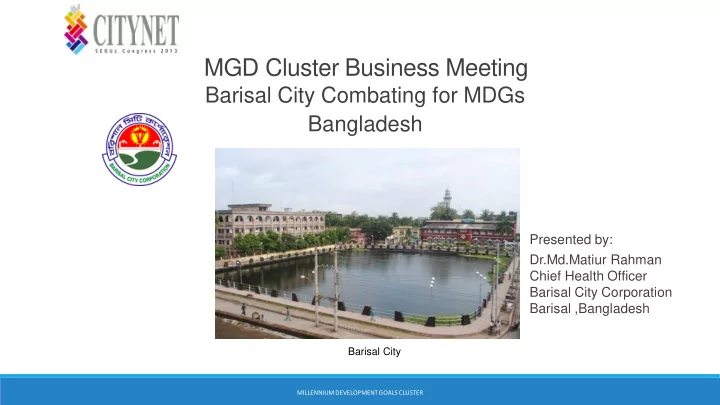
MGD Cluster Business Meeting Barisal City Combating for MDGs Bangladesh Presented by: Dr.Md.Matiur Rahman Chief Health Officer Barisal City Corporation Barisal ,Bangladesh Barisal City MILLENNIUM DEVELOPMENT GOALS CLUSTER Barisal City

slide-1
SLIDE 1

MILLENNIUM DEVELOPMENT GOALS CLUSTER

MGD Cluster Business Meeting

Barisal City Combating for MDGs Bangladesh

Presented by: Dr.Md.Matiur Rahman Chief Health Officer Barisal City Corporation Barisal ,Bangladesh

Barisal City

slide-2
SLIDE 2
  • 1. City Profile.
  • Name of city : Barisal
  • Area (Sq. Km) : 58 Sq. Km
  • Total population : 0.4 Million
  • Urban population growth rate : 6%
  • Population density : 1015/ Sq km (average)
  • Population living in slums : 80,000
  • MMR : 194
  • Under 5 mortality rate : 44
  • Life expectancy : 70 yrs
  • 2. Introduction of Topic.
  • The deadline for achieving MDGs is 2015 - only 2 years ahead.
  • Barisal city corporation is contributing to national progress of MDGs.
  • Barisal city corporation is implementing Urban Primary Health Care Project, Urban Partnership for Poverty Reduction Project

Urban Public and Environmental Health Sector Development Project for achieving MDGs.

  • In addition Barisal city corporation implementing many activities with the Central Government for MDGs.
  • Urban Primary Health Care Project is absolutely working for health MDGs

Polio campaign inauguration

Barisal City – Combating for MDGs

MILLENNIUM DEVELOPMENT GOALS CLUSTER

slide-3
SLIDE 3
  • 3. Urban Primary Health Care Project:

Project period: 2006- 2011 1st phage and 2012-2016 2nd phage. Funded by: ADB, DFID, SIDA, UNFPA and ORBIS. Objective of the project: To improve health status of the urban poor ,especially women and children. Component of the project : 1.Provision of primary health care and behavior change communication and marketing .

  • 2. Urban primary health care infrastructure and environmental health.
  • 3. Building capacity and policy support for urban primary health care.

4 .Project implementation and operational research. Service of the project: Immunization, Vitamin supplementation, Family panning , Antenatal ,obstetrical and postnatal care, Symptomatic case management of pneumonia and diarrhoea in children, Case identification and management for tuberculosis, Reproductive tract infection, HIV/AIDS counseling and testing, These services are directly contributing to achieving health MDGs. Implementation of project: Implemented by public private partnership (PPP) approach.

City Health Center City Maternity Hospital

MILLENNIUM DEVELOPMENT GOALS CLUSTER

slide-4
SLIDE 4
  • 4. Successful outcomes and progress of the project.

Outcomes:

  • Established Primary Health Care facilities in urban area.
  • Established quality primary health care services for urban population

with a particular focus on women and children.

  • Enhanced of Urban Local Body's capacity to ensure the delivery of PHC

services according to their mandate.

  • Ensured free health care services for urban poor.

Progress: Major service provided : (2006-2012)

  • Antenatal care : 64186
  • Normal delivery : 3636
  • Caesarian section : 3518
  • Postnatal care : 14707
  • Menstrual regulation : 6121
  • Other services : 90350
  • Total services : 997862

MDG Base year 1990 Current status 2011 MDG target 2015 MDG 4 144 44 48.0 MDG 5 574 194 143 MDG 6

  • 100

100 Especial health camp after cyclone Sidor MDGs achievement:

MILLENNIUM DEVELOPMENT GOALS CLUSTER

slide-5
SLIDE 5
  • 5. Lessons Learnt

From 1st phase of the project.

  • a. Governance:

Institutional arrangement s Established institutional arrangements for PHC services, but it is not enough to cope with the growing needs and future challenges in urban health. Management capacity City corporation effectively managing project activities, but some times partnership conflict slower the team speed. Health care financing Bureaucracy some times delayed fund release.

  • b. Access and delivery of services.

Pro-poor targeting Red card is a good tool for pro- poor identification Performance based contracting PBC has been shown effective in delivering PHC services to the urban poor. Health infrastructure Health care facilities need upgrading and strengthening Community participation Community participation is good and encouraging Health promotion Project branding drawn the attention of population to their services. Monitoring & evaluation Web-based data entry and reporting is successful for monitoring.

Satellite health camp

MILLENNIUM DEVELOPMENT GOALS CLUSTER

slide-6
SLIDE 6

6 .Challenges of the Project.

  • Increasing the utilization of PHC services by the poor, especially women and children.
  • Strengthening institutional arrangements of city corporation for sustainable services delivery.
  • Improve family planning service, adolescent health care, violence against women, nutritional activity.
  • Ensue effective coordination with other stakeholders for providing better services to the urban poor (slums and floating people).
  • Availability of resource to meet the future demand.

Detoxification camp inauguration TT campaign for industrial labour

MILLENNIUM DEVELOPMENT GOALS CLUSTER

slide-7
SLIDE 7
  • 7. Final Thought of the Project.
  • In Bangladesh , rapid unplanned urbanization making slums .
  • About 30 % of urban population is very poor ,living mostly in slums and squatters areas.
  • Urban poor are most vulnerable to communicable diseases.
  • Childhood illness like fever ,diarrhoea, acute respiratory infection are more prevalent among urban poor.
  • The main objective of Urban Primary Health Care Project is to improve health status of the urban poor, especially women and

children and this is directly related with health MDGs.

  • This objective and Urban Local Body's mandate is going to fulfill through the urban primary health care project.
  • urban primary health care project provides 30% of all services free to the poor and rest are with low cost.
  • It is operated by PPP approach and easily reached to urban poor for health service providing.

Patient in city maternity hospital Vitamin campaign in hard to reach area

MILLENNIUM DEVELOPMENT GOALS CLUSTER

slide-8
SLIDE 8
  • 8. Conclusion
  • Urban primary health care project is a successful project of Local Government of Bangladesh.
  • It is a new dimension for local government in health service providing.
  • It strengthened city health department and makes significant changes in the health seeking behavior of urban poor.
  • Out reach workers are the main players to awareness raising for health care in the community through household visits.
  • Red card holders receive 100% free services and red card is a unique initiative to reach the poor.
  • Non red card holders receive treatment and medicines at least cost .
  • Urban primary health care project is contributing to achieve health MDGs in Bangladesh .

Advocacy for vitamin campaign

Workshop to improving health care service

MILLENNIUM DEVELOPMENT GOALS CLUSTER