Presentation to the Standing Committee on Legislative Affairs Re: - - PDF document

presentation to the standing committee on legislative
SMART_READER_LITE
LIVE PREVIEW

Presentation to the Standing Committee on Legislative Affairs Re: - - PDF document

Presentation to the Standing Committee on Legislative Affairs Re: Bill 24 the Red Tape Reduction and Government Efficiency Act Mike Stainton, presenting on behalf of Dr. Alexis Kanu, Executive Director, Lake Winnipeg Foundation Introduction At


slide-1
SLIDE 1

October 2017 lakewinnipegfoundation.org 1

Presentation to the Standing Committee on Legislative Affairs Re: Bill 24 – the Red Tape Reduction and Government Efficiency Act

Mike Stainton, presenting on behalf of Dr. Alexis Kanu, Executive Director, Lake Winnipeg Foundation

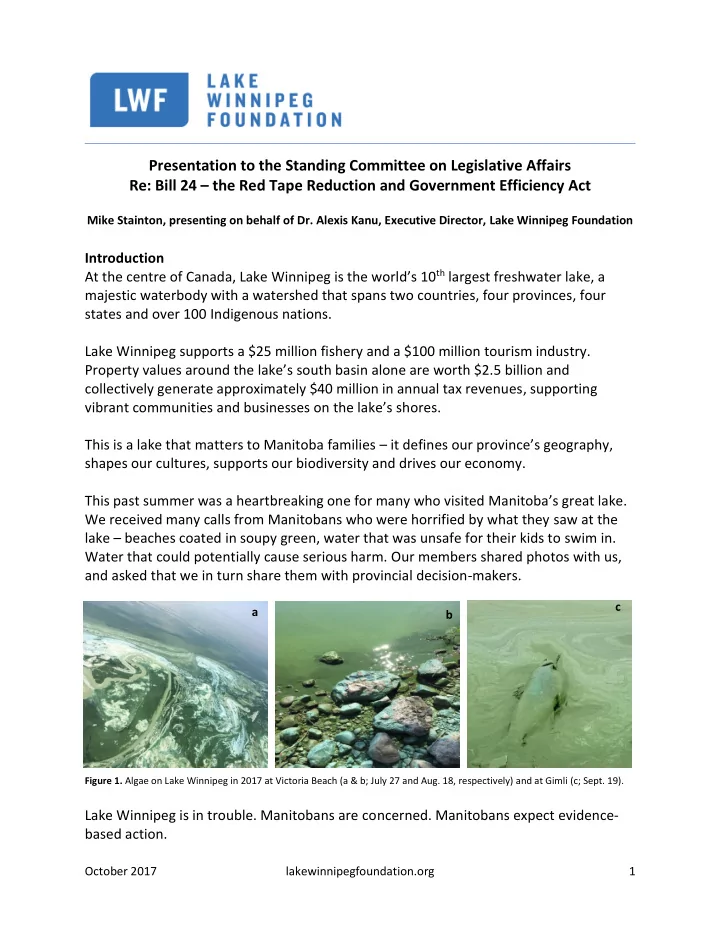
Introduction At the centre of Canada, Lake Winnipeg is the world’s 10th largest freshwater lake, a majestic waterbody with a watershed that spans two countries, four provinces, four states and over 100 Indigenous nations. Lake Winnipeg supports a $25 million fishery and a $100 million tourism industry. Property values around the lake’s south basin alone are worth $2.5 billion and collectively generate approximately $40 million in annual tax revenues, supporting vibrant communities and businesses on the lake’s shores. This is a lake that matters to Manitoba families – it defines our province’s geography, shapes our cultures, supports our biodiversity and drives our economy. This past summer was a heartbreaking one for many who visited Manitoba’s great lake. We received many calls from Manitobans who were horrified by what they saw at the lake – beaches coated in soupy green, water that was unsafe for their kids to swim in. Water that could potentially cause serious harm. Our members shared photos with us, and asked that we in turn share them with provincial decision-makers.

Figure 1. Algae on Lake Winnipeg in 2017 at Victoria Beach (a & b; July 27 and Aug. 18, respectively) and at Gimli (c; Sept. 19).

Lake Winnipeg is in trouble. Manitobans are concerned. Manitobans expect evidence- based action.

a b c

slide-2
SLIDE 2

October 2017 lakewinnipegfoundation.org 2

The Lake Winnipeg Foundation (LWF) is a membership-based organization advocating for change and co-ordinating action to improve the health of Lake Winnipeg. Combining the expertise of our Science Advisory Council and the commitment of our members, LWF is nationally recognized for our unique capacity to link science and action. Our goal is to ensure policy and practices informed by evidence are implemented and enforced. The Lake Winnipeg Foundation acknowledges the economic importance of the hog industry in Manitoba. We recognize the value of recycling manure nutrients to support crop growth. LWF recognizes that the hog industry shouldn’t be singled out – regulations related to the spreading of manure as agricultural fertilizer should apply to all of Manitoba’s livestock industries. Effective manure management ensures manure nutrients stay on agricultural fields where they support crop growth. Effective manure management is critical to prevent pollution and protect Manitoba’s water quality. The Lake Winnipeg Foundation is concerned that data are lacking to determine if current manure management practices are indeed effective. Without data, industry, government regulators and concerned citizens cannot accurately quantify the current impact of Manitoba’s hog industry on water quality, nor determine how the industry may be expanded without increasing phosphorus loading to Manitoba’s rivers, lakes and streams. Despite this lack of evidence, Bill 24 proposes to repeal sections of the Environment Act that govern the phosphorus-producing activities of Manitoba’s hog industry. Environment Act section 40.2: Prohibition – winter spreading Currently, Manitoba’s Environment Act prohibits the spreading of any livestock manure

  • n agricultural fields between November 10 and April 10. This is a widely recognized and

well-established best management practice, supported by broad scientific consensus. Arguably, the ban on winter spreading is the most important pollution-prevention measure undertaken for Lake Winnipeg in the past two decades. When manure is spread on saturated, frozen or snow-covered ground, the phosphorus it contains cannot be incorporated into the soil. On the surface of the soil, this phosphorus is not available to support plant growth, and is highly susceptible to runoff during winter storms or spring melt.

slide-3
SLIDE 3

October 2017 lakewinnipegfoundation.org 3

The ban on winter spreading is supported by both the research community and agricultural sectors in Manitoba. This prohibition applies to all livestock industries, not just hogs. Similar bans have been enacted in other jurisdictions – recently and notably in Ohio, where legislators enacted a winter ban with an eye to ongoing eutrophication challenges in Lake Erie. The Lake Winnipeg Foundation urges that Bill 24 be amended so as not to repeal Section 40.2 of Manitoba’s Environment Act. The ban on winter spreading of all manure should be maintained in legislation – the highest form of protection for Manitoba’s water. Environment Act section 40.1: Prohibition – confined livestock areas and manure storage facilities for pigs Section 40.1 of the Environment Act currently prohibits the construction or expansion of hog barns and manure storage facilities without environmentally sound manure treatment, including or equivalent to anaerobic digestion of manure. Anaerobic digestion does not remove phosphorus from manure. Rather, it separates the manure into solid and liquid components, and concentrates the phosphorus in the solid fraction of the manure. This helps to manage manure volumes, reducing the costs of transporting manure to spread fields at greater distances from the barns. Anaerobic digestion should not be the factor limiting the growth of Manitoba’s hog

  • industry. Industry expansion should be limited by the availability of suitable land for

manure spreading at a rate equivalent to the rate of crop uptake. The moment we start spreading more manure than crops can use, it’s no longer a useful fertilizer. It’s simply a waste product that we’re trying to get rid of – and it’s a risk to our water supply. The problem is this: we don’t currently have robust and credible water quality data to identify the extent or location of suitable land for increased manure spreading. The necessary water monitoring programs were never developed. Without knowing how much suitable land base exists, we don’t know the extent to which Manitoba’s hog industry can expand without increasing phosphorus runoff. To determine how much suitable land exists for manure spreading, robust data is required for a number of interacting factors, including:

  • Current soil phosphorus levels;
slide-4
SLIDE 4

October 2017 lakewinnipegfoundation.org 4

  • Crop phosphorus uptake rates;
  • The cost of manure transport;
  • Current and projected barn locations and hog densities; and
  • The risk of phosphorus runoff under different soil, vegetation, slope, connectivity

and manure application rates and conditions. Currently, hog production in Manitoba is very concentrated. Manitoba census division number 2, directly south-east of Winnipeg, supports 35% of the province’s hog

  • perations on less than 1% of its land base (Figure 2). Because high costs prohibit the

long-distance transport of manure, manure spreading from these operations is also very

  • concentrated. High hog density and high concentration of manure spreading is likely to

increase the risk of phosphorus runoff into provincial waterways.

Figure 2. Hog operations with manure management plans in 2017, located in Manitoba census division 2 (rural municipalities of Hanover, Franklin, De Salaberry, La Broquerie, Ste Anne, Tache and Ritchot).

Citizen science data is being collected in this region – among others – by the Lake Winnipeg Community-Based Monitoring Network. Data collection and analysis is

  • verseen by LWF’s nationally recognized Science Advisory Council. Leveraging decades
  • f analytical water chemistry expertise, we’re ensuring community-based monitoring

data is credible, robust and compatible with existing government data. Phosphorus losses from watersheds south-east of Winnipeg in census division 2 (Figure 3) are concerning, as they are considerably higher than anything previously reported for the same region in the State of Lake Winnipeg report (Figure 4). Community-based monitoring suggests these watersheds are phosphorus hotspots, contributing disproportionately high phosphorus loading to local waterways.

slide-5
SLIDE 5

October 2017 lakewinnipegfoundation.org 5

Figure 3. Phosphorus export coefficients (kg/ha/yr) in three sub-watersheds in the Red River Basin, measured by the Lake Winnipeg Community-Based Monitoring network in 2016 and 2017. Figure 4. Annual mean phosphorus export coefficients (kg/ha/yr) for five sub-watersheds in the Red River basin, from the State

  • f Lake Winnipeg: 1999-2007 report (2011, Manitoba Sustainable Development and Environment and Climate Change Canada)

It is important to note that correlation does not equal causation. We don’t know if the high phosphorus loading in these regions is directly linked to high hog density. Density

  • f other livestock – cows, chickens – is also high in this region, and urban areas are

developing rapidly.

Pembina: 0.27 La Salle: 0.33 Seine: 0.33 Rat: 0.24 Roseau: 0.13

slide-6
SLIDE 6

October 2017 lakewinnipegfoundation.org 6

But community-based monitoring indicates that we do need to know more before we are able to make responsible, evidence-based decisions about the hog industry – or to any other phosphorus-producing activities in these identified phosphorus hotspots. LWF advises that any proposal to expand Manitoba’s hog industry must first provide robust data to answer these outstanding questions. Industry, regulators and the public need data that clearly demonstrates the extent and location of suitable land for manure application in compliance with best management practices, and at rates that do not exceed crop uptake rates. Section 40.1 and the Schedule to Manitoba’s Environment Act should not be amended or repealed until these data are available. Enabling industry expansion Where do we go from here? How can we evaluate the feasibility and sustainability of hog industry expansion in Manitoba? Ten years ago, the CEC identified the need for a thorough review of hog industry regulation to evaluate the effectiveness of manure management practices. Such a review depended "on the availability of a wide range of water quality data.” In 2007, the commission noted that “water monitoring efforts needed to acquire these data should commence immediately.” That has not yet happened. But it has to start today. Collecting robust water quality data about Manitoba’s hog industry is not a hindrance or a hurdle to overcome. In fact, Manitoba’s provincial government has promised voters that it is committed to making decisions based on data. Here is an important

  • pportunity to fulfill that promise, and to support shared provincial goals.

Robust data will benefit industry, by identifying where and how sustainable expansion is possible. Robust data will benefit citizens, increasing public trust in the safeguards in place for Manitoba’s water. Robust data will benefit our precious lake, enabling us to make smart decisions to improve water quality and to ensure that a day spent at the beach isn’t a potential health risk for our kids and our grandkids.