Presentation to the New Mexico Legislative Finance Committee: General - - PDF document

presentation to the new mexico legislative finance
SMART_READER_LITE
LIVE PREVIEW

Presentation to the New Mexico Legislative Finance Committee: General - - PDF document

Presentation to the New Mexico Legislative Finance Committee: General Fund Consensus Revenue Estimate August 24, 2016 Demesia Padilla, CPA, Cabinet Secretary & Elisa Walker Moran, Chief Economist Economists: Hector Dorbecker, James


slide-1
SLIDE 1

TRD Memo to the LFC: General Fund Consensus Revenue Forecast —Released 08/24/2016 Page 1

Presentation to the New Mexico Legislative Finance Committee: General Fund Consensus Revenue Estimate — August 24, 2016 Demesia Padilla, CPA, Cabinet Secretary & Elisa Walker‐Moran, Chief Economist Economists: Hector Dorbecker, James Kaminsky, & Efrain Ibarra Executive Summary of Consensus Revenue Forecast

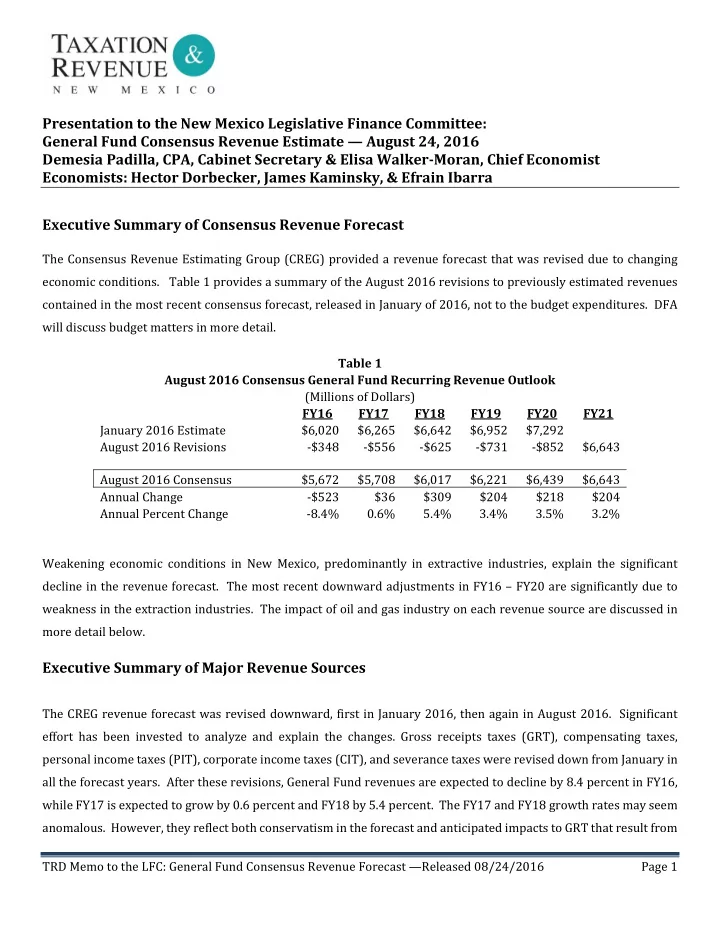
The Consensus Revenue Estimating Group (CREG) provided a revenue forecast that was revised due to changing economic conditions. Table 1 provides a summary of the August 2016 revisions to previously estimated revenues contained in the most recent consensus forecast, released in January of 2016, not to the budget expenditures. DFA will discuss budget matters in more detail. Table 1 August 2016 Consensus General Fund Recurring Revenue Outlook (Millions of Dollars) FY16 FY17 FY18 FY19 FY20 FY21 January 2016 Estimate $6,020 $6,265 $6,642 $6,952 $7,292 August 2016 Revisions ‐$348 ‐$556 ‐$625 ‐$731 ‐$852 $6,643 August 2016 Consensus $5,672 $5,708 $6,017 $6,221 $6,439 $6,643 Annual Change ‐$523 $36 $309 $204 $218 $204 Annual Percent Change ‐8.4% 0.6% 5.4% 3.4% 3.5% 3.2% Weakening economic conditions in New Mexico, predominantly in extractive industries, explain the significant decline in the revenue forecast. The most recent downward adjustments in FY16 – FY20 are significantly due to weakness in the extraction industries. The impact of oil and gas industry on each revenue source are discussed in more detail below.

Executive Summary of Major Revenue Sources

The CREG revenue forecast was revised downward, first in January 2016, then again in August 2016. Significant effort has been invested to analyze and explain the changes. Gross receipts taxes (GRT), compensating taxes, personal income taxes (PIT), corporate income taxes (CIT), and severance taxes were revised down from January in all the forecast years. After these revisions, General Fund revenues are expected to decline by 8.4 percent in FY16, while FY17 is expected to grow by 0.6 percent and FY18 by 5.4 percent. The FY17 and FY18 growth rates may seem

  • anomalous. However, they reflect both conservatism in the forecast and anticipated impacts to GRT that result from
slide-2
SLIDE 2

TRD Memo to the LFC: General Fund Consensus Revenue Forecast —Released 08/24/2016 Page 2 multi‐year medical‐related deductions and credits that are expected to impact FY 17. These will be explained further

  • below. Table 2 summarizes the estimated revenues of the major sectors. Table 3 identifies the revisions by the

major sectors. For more detail, see Appendix 1. Table 2 August 2016 Consensus General Fund Recurring Revenue Outlook (Millions of Dollars) FY16 FY17 FY18 FY19 FY20 FY21 Gross receipts tax $1,957 $1,944 $2,090 $2,168 $2,241 $2,310 Selective sales taxes $527 $543 $586 $608 $626 $644 Personal income tax $1,318 $1,339 $1,365 $1,404 $1,444 $1,494 Corporate income tax $120 $100 $88 $82 $94 $94 Energy‐related revenues $720 $755 $792 $812 $835 $857 Investment/Interest earnings $770 $762 $817 $859 $902 $941 Other revenues $260 $265 $280 $289 $296 $302 Total Recurring Revenue $5,672 $5,708 $6,017 $6,221 $6,439 $6,643 Annual Percent Change ‐8.4% 0.6% 5.4% 3.4% 3.5% 3.2% Table 3 August 2016 Revisions (Change from Prior Estimate) (Millions of Dollars) FY16 FY17 FY18 FY19 FY20 Gross receipts tax ($133) ($272) ($255) ($292) ($352) Selective sales taxes $7 ($6) $2 $9 $17 Personal income tax ($83) ($116) ($157) ($202) ($239) Corporate income tax ($103) ($120) ($117) ($81) ($74) Energy‐related revenues ($25) $11 ($22) ($65) ($88) Investment/Interest earnings $8 ($23) ($56) ($82) ($102) Other revenues ($20) ($30) ($20) ($18) ($15) CREG is not anticipating an economic recession during FY17. The CREG believes an unforeseen recessionary period would have a greater negative impact than currently anticipated. The CREG forecasts a weak outlook because extraction industry head‐winds are putting downward pressure on GRT, PIT, CIT, and severance taxes; a continued slow recovery after the Great Recession is putting downward pressure on consumer spending, resulting in lower GRT; and the potential for increased transfer payments from the federal government is putting downward pressure on PIT. Though not included in this forecast there is upward pressure and potential revenue gains that could result from oil production, as the rig count increased from 13 in March 2016 to 30 rigs in August 2016. While rig count has increased nationally, it increased most significantly in the Permian Basin. Additionally, as of August 23 the futures prices of $47.60 was above the CREG FY17 price of $45.

slide-3
SLIDE 3

TRD Memo to the LFC: General Fund Consensus Revenue Forecast —Released 08/24/2016 Page 3

Detailed Discussion, Tax Program Revenues

Gross Receipts Taxes (GRT) GRT was revised downward in August 2016 by $133 million in FY16, by $272 million in FY17, and by $255 million in FY18. Table 4, below, illustrates the CREG GRT forecast. Table 4 August 2016 CREG GRT Summary (Millions of Dollars) Column1 FY15 FY16 FY17 FY18 August 2015 Forecast $2,129 $2,234 $2,332 $2,425 January 2016 Estimate $2,095 $2,090 $2,216 $2,345 August 2016 Revisions ($133) ($272) ($255) August 2016 Consensus $2,095 $1,957 $1,945 $2,090 Annual Change, Dollars ($138) ($13) $145 Annual Change, Percent ‐6.6% ‐0.6% 7.5% Figure 1 below shows Matched Taxable Gross Receipts (MTGR)1 declined by $3.6 billion or 6.7% while GRT revenue booked to the General Fund declined by $130 million or 6.6% between FY15 and FY16.

Figure 1: MTGR and General Fund GRT

1 Amount of computed taxable gross receipts based on amount of tax paid during the month and matched to returns.

$47,620 $48,290 $47,881 $43,831 $46,599 $48,969 $50,158 $51,095 $54,497 $50,872 $1,840 $1,858 $1,832 $1,634 $1,822 $1,928 $1,918 $1,992 $2,095 $1,957 $0 $1,000 $2,000 $3,000 $4,000 $5,000 $6,000 $7,000 $8,000 $9,000 $10,000 $0 $10,000 $20,000 $30,000 $40,000 $50,000 $60,000 FY07 FY08 FY09 FY10 FY11 FY12 FY13 FY14 FY15 FY16 Prelim.

Millions Millions

Matched Taxable Gross Receipts and General Fund Gross Receipts Tax

Matched TGR (left Axis) GF GRT (Right Axis)

slide-4
SLIDE 4

TRD Memo to the LFC: General Fund Consensus Revenue Forecast —Released 08/24/2016 Page 4 Preliminary actual GRT revenue in FY16 is about $133 million or 6.6% below FY15. The CREG believes the main reason behind the decline is the state’s heavy reliance on the oil & gas industry. Table 5 below leads CREG economists to believe that most of the weakness in GRT is caused by a combination of factors that include higher than anticipated declines in GRT revenue generated through the extractive industry statewide and higher than anticipated declines in economic activity in Lea, Eddy, and San Juan counties. These counties saw a reduction of GRT revenue collections of $230.5 million (‐25.2%) between FY15 and FY16. Table 5 GRT Paid (Millions of Dollars) FY15 FY16 Change $ Change Lea County $378.1 $230.0 ‐39.2% ($148.1) Eddy County $283.2 $213.2 ‐24.7% ($70.0) San Juan County $253.9 $241.5 ‐4.9% ($12.4) Subtotal $915.1 $684.6 ‐25.2% ($230.5) Rest of State w/o Eddy, Lea, SJ $2,577.9 $2,695.0 3.7% $104.7 Total $3,493.0 $3,379.6 ‐3.4% ($125.8) While Lea, Eddy, and San Juan Counties had revenue decreases in FY16, the rest of the state saw an increase of $104.7 million (3.7%) in GRT revenue collections but it was not enough to offset the losses in the oil & gas producing counties. The decline is also a reflection of recent downward revisions of regional macroeconomic indicators such as New Mexico personal spending in food and medical, private wage and salaries, and employment in the construction and mining sectors. The share of total MTGR revenue collections by Lea, Eddy, and San Juan Counties has varied over time. Figure 2 shows the total MTGR share declined from 25% to 18% or by about 7.6% between May 2014 and May 2016. This decrease was primarily because of the dramatic decrease in the extractive industries’ economic activity because of the decline in oil prices and natural gas prices.

slide-5
SLIDE 5

TRD Memo to the LFC: General Fund Consensus Revenue Forecast —Released 08/24/2016 Page 5

Figure 2: Percent of MTGR in Lea, Eddy & San Juan Counties

The portion of GRT paid has decreased dramatically between FY15 and FY16. Figure 3 below shows the amount of GRT Paid by businesses in Lea, Eddy, and San Juan Counties decreased by about 25% or $230 million while GRT Paid by businesses in the remaining counties (excluding Lea, Eddy, and San Juan Counties) increased by 3.7% or $104.7 million.

Figure 3: Total GRT Paid by Businesses in Certain Counties

18% 21% 21% 18% 17% 21% 23% 23% 25% 23% 18%

0% 5% 10% 15% 20% 25% 30% May '06May '07May '08May '09May '10May '11May '12May '13May '14May '15May '16

Percent of Total Matched TGR in May in Lea, Eddy & San Juan Counties

Eddy Lea San Juan Eddy‐Lea‐ San Juan Combined $631 $519 $628 $734 $774 $823 $915 $685 $2,675 $2,522 $2,651 $2,686 $2,672 $2,684 $2,832 $2,936 $2,300 $2,400 $2,500 $2,600 $2,700 $2,800 $2,900 $3,000 $0 $100 $200 $300 $400 $500 $600 $700 $800 $900 $1,000 FY09 FY10 FY11 FY12 FY13 FY14 FY15 FY16

Total GRT Paid by Counties (Millions of Dollars)

Lea County Eddy County San Juan County Eddy‐Lea‐SJ Combined (Left Axis) Rest of State w/o Eddy‐Lea‐SJ (Right Axis)

slide-6
SLIDE 6

TRD Memo to the LFC: General Fund Consensus Revenue Forecast —Released 08/24/2016 Page 6 A secondary reason for the decline in FY16 is attributed to one‐time amendments by taxpayers to claim credits and deductions for multiple years they previously had not claimed. If not for these amendments, the GRT growth rate in FY16 would have been ‐3.3% in FY16 and ‐4.0% in FY17. These factors are discussed in more detail on pages 9‐10. Figure 4, below, shows monthly MTGR exhibit a cyclical pattern over the 12‐month period that comprise FY16. The last six fiscal years show December as traditionally the highest month while January‐February show the lowest levels over the cycle.

Figure 4: Monthly MTGR by Fiscal Year $0 $1 $2 $3 $4 $5 $6 Jul Aug Sep Oct Nov Dec Jan Feb Mar Apr May Jun

Billions

Monthly Matched Taxable Gross Receipts by Fiscal Year

FY09 FY10 FY11 FY12 FY13 FY14 FY15 FY16

slide-7
SLIDE 7

TRD Memo to the LFC: General Fund Consensus Revenue Forecast —Released 08/24/2016 Page 7 Figure 5 below shows the proportions of MTGR by industry sectors in FY16. Retail Trade represents the largest portion of the total with 24%, followed by Construction at 13.3%, Professional, Scientific, and Technical Services at 12.6%, Accommodation & Food Services at 8.8%, and Other Services at 8.2%.

Figure 5: MTGR by Industry Sector

Figure 6 and Figure 7 below show in combination the MTGR for key sectors between FY09 and FY16 and the increase or decrease amounts year‐over‐year, respectively. Although Retail Trade saw a decrease of $483 million in FY16 from FY15, their MTGR trend is positive for FY17 and beyond. The Construction sector continues to recover from the great recession as it added $94 million in FY16 from FY15 levels. The Professional, Scientific & Technical Services sector grew by $574 million of MTGR in FY16 over the previous year but it is unclear if there would be head winds in FY17. The Mining & Extraction sector saw dramatic losses in FY16 of about $1.5 billion of MTGR in FY16. Analysis from IHS Global Insight through UNM Business Bureau of Economic Research indicates the Mining & Extraction industry has hit rock bottom based on the recovery of crude prices.

slide-8
SLIDE 8

TRD Memo to the LFC: General Fund Consensus Revenue Forecast —Released 08/24/2016 Page 8

Figure 6: YR/YR TGR by Selected Industry Sectors Figure 7: Change in TGR by Selected Industry Sectors

$(278) ($1,361) ($59) ($610) ($66) $419 ($209) $135 $743 $221 $277 ($100) $185 $490 $372 $186 $288 ($220) $184 $172

($95) $16 $89 $189 $120

$522 $612 $1,198 ($41) $36 $(483) $94 $574 ($1,491) ($552) $549 ($660) $1,902 ($536) $302

$(2,000) $(1,500) $(1,000) $(500) $‐ $500 $1,000 $1,500 $2,000 $2,500

Year‐Over‐Year Change of Taxable Gross Receipts, Selected Sectors FY2009 ‐ FY2016

FY09‐FY10 FY10‐FY11 FY11‐FY12 FY12‐FY13 FY13‐FY14 FY14‐FY15 FY15‐FY16 8 Year Diff. $10,575 $6,798 $3,910 $2,397 $969 $10,298 $5,437 $3,851 $1,787 $903 $10,717 $5,227 $3,986 $2,530 $1,123 $10,994 $5,127 $4,171 $3,020 $1,495 $11,180 $5,415 $3,951 $3,204 $1,667 $11,085 $5,431 $4,040 $3,393 $1,787 $11,607 $6,044 $5,238 $3,352 $1,823 $11,124 $6,137 $5,812 $1,861 $1,271 $‐ $2,000 $4,000 $6,000 $8,000 $10,000 $12,000 $14,000 Retail Trade Construction

  • Prof. Sci & Tech Svcs. Mining & Extraction

Manufacturing

Millions

Taxable Gross Receipts, Selected Sectors FY2009 ‐ FY2016

FY2009 FY2010 FY2011 FY2012 FY2013 FY2014 FY2015 FY2016

slide-9
SLIDE 9

TRD Memo to the LFC: General Fund Consensus Revenue Forecast —Released 08/24/2016 Page 9 Effect of CRS Tax Credits on GRT Revenue Top YTD FY16 CRS credits claimed through May are $99 million, $18 million higher than total claims in FY15. Table 6 CRS Tax Credits Taken Against GRT, Comp. or Withholding (thousands of dollars) Program FY15 FY16 Change $ DOH Hospital GRT $5,514 $32,204 $26,690 Rural Jobs $109 $1,700 $1,591 Advanced Energy $585 $1,411 $826 Unpaid Doctors $668 $929 $261 Alternative Energy $0 $24 $24 Affordable Housing $653 $141 ($512) Investment $2,578 $1,907 ($672) Technology Jobs $4,822 $2,830 ($1,992) High Wage Jobs (refund) $57,206 $54,812 ($2,394) High Wage Jobs (credit) $8,631 $3,422 ($5,208) Total $80,767.1 $99,381.6 $18,614.5 Department of Health Licensed Hospitals Credit: The Department of Health licensed hospitals credit accounts for $32 million in FY16, up from $5.5 million in FY15. Traditionally, the majority of this credit is claimed in the second half of the fiscal year, as was the case in FY16. The credit was utilized more in FY16 by both existing and new

  • taxpayers. $11 million in FY16 came through 9 taxpayers claiming the credit for the first time. $28.9 million is

from amendments to the prior 3 years. Starting in FY17 we anticipate a higher credit level of $13.6 million. The remaining CRS tax credits remain stable compared to prior years. See table 6 for detail on credit utilization of top 10 CRS tax credits. High Wage Jobs Tax Credit (HWJTC): TRD economists have assumed the law changes that went into effect in June 2013 would result in a reduction in HWJTC claims once the backlog of claims and protests cleared TRD’s Legal Services Bureau and the courts. Based on the best available data and analysis to date, TRD economists estimate the amounts of HWJTC claims to “normalize” starting in FY17 as they get closer to the annual base of $20 million (new applications) with an estimated total claimed or paid amount of $36 million. Table 7 below reflects the amount of HWJTC (claimed or paid) in FY15 and FY16 in comparison to TRD economists’ expectations that were conveyed to the CREG in January 2016. It also contains TRD economists’ current expectation for HWJTC claims in FY17 and FY18.

slide-10
SLIDE 10

TRD Memo to the LFC: General Fund Consensus Revenue Forecast —Released 08/24/2016 Page 10 Table 7 High Wage Jobs Tax Credit Claims (Millions of Dollars) FY TRD Forecast Actual 2015 $67 $65.8 2016 $70 $58.2 2017 $36 N/A 2018 $28 N/A Special Note on the Decision and Order No. 16‐16 In May 2016, the Administrative Hearing Office (AHO) held that hospitals are eligible to claim the medical services deduction under 7‐9‐93, NMSA 1978 contrary to a TRD regulation, which prohibits licensed hospitals, hospices, nursing homes, outpatient or intermediate care facilities under the Public Health Act from claiming the deduction. The AHO reasoned that the deduction under 7‐9‐93 applies based on the nature of the payor, not the nature of the providing facility, as long as the services are within the providing facilities’ scope of practice. The AHO ruled that the department did not have authority to limit the applicability of the deduction by regulation. So far, based on the taxpayers that have submitted amended returns to claim this deduction (33 months) has created an estimated reduction of $39 million GRT revenue to the general fund. Thus far, this does not significantly impact the net distributions to the locals governments. This reduction in GRT is offset by an increase in the hold‐ harmless distribution because of the increase in the health care services deduction by qualifying hospitals. Compensating Taxes (Comp) The increasing volatility of this revenue source over the past several years continues to make it difficult to forecast. Comp revenue fluctuations have increased in frequency and magnitude as there has not been a back‐to‐back growth year since FY09. Figure 6 below shows preliminary FY16 Comp revenue collections of approximately $49 million or about 32% decrease from FY15. Several sectors saw double‐digit percentage change decline in FY16 from the prior year. Specifically, Real Estate (‐62%), Public Administration (‐64%), Agriculture (‐36%), Retail Trade (‐27%), Construction (‐57%), Utilities (‐24%), and Professional, Technical and Scientific Services (‐17%) saw declines.

slide-11
SLIDE 11

TRD Memo to the LFC: General Fund Consensus Revenue Forecast —Released 08/24/2016 Page 11 The Mining & Extractive industry (MEI) has made significant investments in the state over the past few years, contributing to increases in Comp Tax in FY15, a record year. However, the contribution to Comp revenue from MEI activity has fluctuated over the years with no apparent relationship to revenue collections. Figure 7 below shows the share of Comp that comes from MEI has increased from 20% in FY15 to 26% in FY16 while crude prices have taken a dive during this period. TRD economists believe Comp reacts differently than to price fluctuations than GRT, as most of the machinery brought by MEI companies into the state has not seen any change in the last 12

  • quarters. Though the CREG does not assume this in the production forecast, TRD believes that as the rig count

continues to recover, producers may begin to ramp‐up production in the future, and this revenue source is expected to grow by 6% in FY17 and by 7% in FY18.

Figure 8: Compensating Tax Revenue and Annual Growth Rates

‐12% 31% 17% 19% 5% 8% ‐27% 35% ‐10% ‐18% 54% ‐8% ‐32% $34 $44 $52 $61 $65 $70 $51 $69 $62 $51 $78 $72 $49

‐50% ‐40% ‐30% ‐20% ‐10% 0% 10% 20% 30% 40% 50% 60% FY04 FY05 FY06 FY07 FY08 FY09 FY10 FY11 FY12 FY13 FY14 FY15 FY16 Prelim. $0 $10 $20 $30 $40 $50 $60 $70 $80 $90

Millions FY2016 General Fund Compensating Tax Revenue and Annual Growth Rates

Growth Rate (Right Axis) Comp Tax (Left Axis) Trend

slide-12
SLIDE 12

TRD Memo to the LFC: General Fund Consensus Revenue Forecast —Released 08/24/2016 Page 12

Figure 9: Compensating Tax Revenue and Pct. Share of Extractive Industry

Personal Income Taxes Personal Income Taxes (PIT) grew 6.8% during FY15, but they are expected to decline by approximately 2% in

  • FY16. Table 8, below, illustrates the CREG PIT forecast.

Table 8 August 2016 CREG PIT Summary (Millions of Dollars) Column1 FY15 FY16 FY17 FY18 August 2015 Forecast $1,340 $1,379 $1,440 $1,506 January 2016 Estimate $1,401 $1,455 $1,522 August 2016 Revisions ($83) ($116) ($157) August 2016 Consensus $1,340 $1,318 $1,339 $1,365 Annual Change, Dollars ($22) $21 $26 Annual Change, Percent ‐ 1.67% 1.62% 1.94%

24% 23% 20% 26%

$83.7 $97.2 $135.4 $114.8 $63.6 $74.0 $106.0 $83.2 $20.2 $23.2 $29.5 $31.6 0% 5% 10% 15% 20% 25% 30% $0 $20 $40 $60 $80 $100 $120 $140 $160 FY13 FY14 FY15 FY16

Millions of Dollars

Compensating Tax Revenue and Pct. Share of Extractive Indus.

SHARE of Mining & OGAS Extraction from Total Comp (Right Axis) Total Comp Comp Excl. Mining & OGAS Extraction Comp Mining & OGAS Extraction ONLY

slide-13
SLIDE 13

TRD Memo to the LFC: General Fund Consensus Revenue Forecast —Released 08/24/2016 Page 13 PIT is lower due to significant high wage job losses in the extraction industries. Collections from all PIT sources were down during the fourth quarter of FY16. Sources include Income Tax Withholding, Oil & Gas Remitter Withholding, and PTW Withholding. Additionally, taxpayer refunds during the fourth quarter were higher than during FY15. The combination of these effects pushed total PIT revenues down for FY16. PIT revenue projections are broadly affected by personal income growth. While this economic indicator is generally positive and bullish, transfer payments are an integral component of this growth rate. Transfer payments include items such as retirement/pensions, social security benefits, and Medicaid. It continues to be an area of focus for the TRD economists. Another area affecting PIT revenues currently being studied by TRD economists is the effect of Pass‐Through Entities (PTE). TRD economists continue to investigate how increased use of PTE structures by businesses affects both PIT and CIT revenues. TRD economists also continue to study the volume of income that is actually business income, increases or decreases in apportioned and allocated income, tax credits, net operating losses (NOL), and NOL carry forwards. During FY16 TRD economists endeavored to quantify the effect of a weak extraction industry on PIT revenues. The IRS recently published a study discussing the challenges with PTE and identifying income distribution for tax

  • purposes. The problems identified at the federal level mirror challenges experienced by New Mexico. While we

know there is an effect, and while we suspect that the effect has a negative impact on PIT revenues, TRD economists have not completed sufficient analysis to offer a comprehensive and definitive explanation. It is a continued area of focus and research. Corporate Income Taxes New Mexico’s CIT performance is not out of sync with other major oil and natural gas producing states. 12 states have disclosed that on average their CIT collections have declined by 16 percent. Three of these were major oil and natural gas producing states who have disclosed to the FTA that on average their CIT collections have declined by 48 percent. New Mexico’s decline is in the middle of the oil and gas states. See appendix 3. FY16 CIT collections and FY17 CIT revenues were revised downward. The downward revisions reflect concerns with weaker extraction industry performance, and lower corporate profit expectations. Figure 10, below, illustrates the historical volatility of CIT collections.

slide-14
SLIDE 14

TRD Memo to the LFC: General Fund Consensus Revenue Forecast —Released 08/24/2016 Page 14

Figure 10: Corporate Income Tax Collections

FY16 CIT collections were significantly lower than FY15. TRD economists investigated several explanations for the

  • declines. Table 9, below, illustrates the CREG CIT forecast.

Table 9 August 2016 CREG CIT Summary (Millions of Dollars) CREG CIT Summary FY15 FY16 FY17 FY18 August 2015 Forecast $255 $225 $235 $195 January 2016 Estimate $255 $223 $220 $205 August 2016 Revisions ($103) ($120) ($117) August 2016 Consensus $255 $120 $100 $88 Annual Change, Dollars ($135) ($20) ($12) Annual Change, Percent ‐ 2.94% ‐ 6.67% ‐ 12.00% TRD economists examined and continued to examine several areas to understand the decline in CIT collections: 1) the effect of a weak extraction industry; 2) the effect of HB641 (2013); 3) lower corporate profit expectations; and 4) the effects of NOLs, overpayment of estimated taxes and business credits. A weak extraction industry, particularly weakness within oil & gas sector firms, put significant downward pressure

  • n CIT collections. During TY13 & TY14 over 300 firms reported NM taxable income exceeding $500 million in
  • aggregate. Revenue collections exceeded $37 million each tax year. However, during TY15 (YTD) only 54

extraction industry firms have reported NM taxable income; the tax base has shrunk to an amount just exceeding $5 million, resulting in YTD CIT collections from this sector of just over $300 thousand. By extrapolation, the estimated impact of the decline in extraction industry incomes is approximately $5 million in lost revenue, year to

$180 $104 $478 $187 $349 $255 $0 $100 $200 $300 $400 $500 $600 FY90 FY91 FY92 FY93 FY94 FY95 FY96 FY97 FY98 FY99 FY00 FY01 FY02 FY03 FY04 FY05 FY06 FY07 FY08 FY09 FY10 FY11 FY12 FY13 FY14 FY15 FY16 Millions

Corporate Income Taxes

CIT

slide-15
SLIDE 15

TRD Memo to the LFC: General Fund Consensus Revenue Forecast —Released 08/24/2016 Page 15

  • date. If these assumptions hold true as all extraction firms file final settlements, the revenue loss will be

approximately $38 million. The effect of HB641 was examined by TRD economists, both as a requirement of the law as well as an explanatory variable for the FY16 decline in revenues. TRD economists analyzed preliminary TY14 and TY15 tax returns to estimate the impact of HB61 compared to the analysis that was conducted in August 2015. Analysis performed on the limited number of taxpayers that have reported to date confirmed that the previous analysis was correct. The analysis examined the effects of both the rate change as well as the special apportionment election for

  • manufacturers. The effects of HB641 were included in the original revenue estimating models, and they caused

neither an increase nor a decrease beyond the effects originally forecast. Broadly, according to the US Commerce Department, a comprehensive measure of companies’ profits across the US dropped 1.1% during the second quarter, and year over year, fell 4.7%. This represents the biggest annual decline since the second quarter of 2009. The Congressional Budget Office expects CIT receipts to decline relative to gross domestic product (GDP), primarily because profits will decline relative to the size of the economy. These broader indicators and estimates place downward pressure on the CIT forecast, and it was adjusted to reflect these effects. Liquor Excise Taxes Liquor Excise taxes remain steady and we do not anticipate any major decline or increase in the near future. It is important to note that there is a shift in consumer behavior as the consumption of beer is declining while the consumption of micro beer which is taxed at a lower rate is increasing. At the same time consumption of spirits and wine is on the rise. There were some changes introduced during 2014 legislative session affecting Liquor Tax distribution to DWI Grant Fund HB‐16. This law amended Section 7‐1‐6.40, NMSA 1978, to increase the distribution of liquor excise tax revenue to the Local DWI Grant Fund to 46 percent for FY16 through FY18, which reduces General Fund distribution by an average of $2 million for the respective fiscal years. The second change to the distribution was the introduction of the Lottery Tuition Scholarship Fund Solvency SB‐347 which amends the Tax Administration Act to provide for a distribution, from FY16 and FY17, of thirty‐nine percent to the Lottery Tuition Fund; the overall effect leads to a reduction in distribution to the General Fund by about $19 million for the time the amendments are in effect. Motor Vehicle Excise Tax Motor Vehicle Excise Tax (MVX) revenues have remained steady throughout the year, and indicate that actual revenues will match the January 2016 Consensus Forecast. TRD projects that MVX revenue for FY16 will add up to $149.8 million, only $1.2 million below the CREG forecast of $151 million. The forecasts in FY17 and FY18 have also been adjusted downward.

slide-16
SLIDE 16

TRD Memo to the LFC: General Fund Consensus Revenue Forecast —Released 08/24/2016 Page 16 Insurance Premiums Tax The insurance premiums tax revenue in FY16 will exceed the January forecast by $20 million. The forecasts in FY17 and FY18 have been adjusted upward by $11 million and $18 million due to higher enrollment in the program. Federal Mineral Leasing Royalties (FML) FML in FY16 are $10 million below the January CREG forecast. The forecasts in FY17 and FY18 have been adjusted downward by $9 million and $12 million. The lower revenues as compared to the January CREG forecast are a reflection of low oil prices. High oil prices serve as an incentive for exploration, and thus increase the demand for land leases and royalties paid to New Mexico. Severance Taxes The weaker severance tax forecast largely relates to weaker oil and natural gas volumes than previously forecast even though oil and natural prices have been revised up. This provides a sustainable base‐level of production through the forecast period.

Figure 11: Oil Prices and Volume

FY04 FY05 FY06 FY07 FY08 FY09 FY10 FY11 FY12 FY13 FY14 FY15 FY16 FY17 FY18 FY19 FY20 FY21 Volume 67 63 60 60 60 62 63 69 80 96 114 141 146 140 140 140 140 140 Price $31. $45. $60. $59. $93. $64. $71. $84. $90. $85. $95. $60. $37. $45. $48. $50. $53. $56. $0.00 $10.00 $20.00 $30.00 $40.00 $50.00 $60.00 $70.00 $80.00 $90.00 $100.00 20 40 60 80 100 120 140 160 Millions of barrels

Oil Prices and Volume, FY2004 ‐ FY2021

slide-17
SLIDE 17

TRD Memo to the LFC: General Fund Consensus Revenue Forecast —Released 08/24/2016 Page 17 Natural Resource Extractive Sectors Oil exploration and production continue to show considerable strength. New Mexico oil prices have exceeded

  • expectations. New Mexico crude oil price is estimated at $37.75 in FY16, $0.75 higher than the January 2016
  • forecast. The forecasters now expect New Mexico oil prices to average $45 in FY17 and $48 in FY18, showing a $7

increase for FY17 and a $3 increase for FY18 from the January 2016 forecast. Crude oil production in New Mexico has been estimated to decrease 4.1% in FY16, reaching 140 million barrels. The CREG expects production to stay flat over the next few years. Natural gas prices in New Mexico are estimated at $2.40 in FY16, $0.15 below the January 2016 forecast. The CREG now expects New Mexico gas prices to average $3.00 in FY17 and $3.30 in FY18, showing a $0.10 increase in FY17 and $0.10 increase in FY18 from the January 2016 forecast. Part of the increase is due to higher natural gas prices and the liquid price as oil prices begin to increase. For the first time in a decade, New Mexico natural gas production increased 0.89% in FY14 but declined in FY15 by 0.2%. The CREG is expecting total production to continue to decline to 1,160 billion cubic feet in FY16 and 1,120 billion cubic feet in FY17. Figure 12 shows the history and forecasted natural gas prices and volumes.

slide-18
SLIDE 18

TRD Memo to the LFC: General Fund Consensus Revenue Forecast —Released 08/24/2016 Page 18

Figure 12: Natural Gas Prices and Volume

FY04 FY05 FY06 FY07 FY08 FY09 FY10 FY11 FY12 FY13 FY14 FY15 FY16 FY17 FY18 FY19 FY20 FY21 Volume 1545 1547 1520 1513 1431 1380 1295 1250 1228 1178 1188 1185 1160 1120 1080 1040 1000 965 Price $4.76$5.84$7.53$6.57$8.39$5.65$5.17$5.51$5.02$4.38$5.14$3.78$2.40$3.00$3.30$3.40$3.50$3.50 $0.00 $1.00 $2.00 $3.00 $4.00 $5.00 $6.00 $7.00 $8.00 $9.00 200 400 600 800 1000 1200 1400 1600 1800 Gas volume millions of mcf

Natural Gas Prices and Volume, FY2004 ‐ FY2021

slide-19
SLIDE 19

TRD Memo to the LFC: General Fund Consensus Revenue Forecast —Released 08/24/2016 Page 19 Figure 13 serves to illustrate the types of wells active in New Mexico over the last three years. The vast majority active are horizontal wells, which are believed to be more productive due to advancements in technology. The number of active wells has decreased, especially since oil prices began to decline in the summer of 2014. The decline in the number of active wells has not had a proportional effect on oil or natural gas production; natural gas production has remained stable, while oil production increased between FY15 and FY16. The effects of fewer active rigs may be offset by increases in technology used to extract the fuels primarily in horizontal wells. Though not included in this forecast there is upward pressure and potential revenue gains that could result from oil production, as the rig count increased from 13 in March 2016 to 30 in August 2016. While rig count has increased nationally, it increased most significantly in the Permian Basin.

Figure 13: Yearly Average Number of Drilling Rigs by Trajectory Type 8 7 4 4 56 72 47 20 20 16 8 2 10 20 30 40 50 60 70 80 2013 2014 2015 2016 Average Number of Rigs

Yearly Average Number of Rigs by Trajectory Type

Directional Horizontal Vertical

slide-20
SLIDE 20

TRD Memo to the LFC: General Fund Consensus Revenue Forecast —Released 08/24/2016 Page 20 Additional Risks to the Forecast In FY15 and FY16 TRD increased its audit efforts. These efforts resulted in additional revenues being collected in most of the major tax programs including GRT, compensating tax, and PIT. TRD expects to continue these efforts in FY17. The federal discretionary budget authority is increased by $80 million over 2 years, evenly split between defense and nondefense spending. This additional spending will boost spending in New Mexico, including spending associated with the national laboratories, federal government and roads. Source of Revenues The figure below shows that the majority of General Fund revenue in FY16 comes from general sales or the gross receipts tax at 35 percent (same in FY15, 34% in FY14), while the second largest revenue source is from personal and corporate income taxes at 25% (26% in FY15, 24% in FY14), followed by energy‐related revenues at 13% (16% in FY15, 20% in FY14).

General Sales 35% Selective Sales 9% Income Taxes 25% Energy Related 13% Investment earnings 14% Other revenues 4%

Source of Revenues FY16

slide-21
SLIDE 21

General Fund Consensus Revenue Estimate August 2016 Appendix 1

Pre‐ liminary Actual A u g 2 Jan 2016 Est. Aug 2016 Est. Change from Prior % Change from FY15 $ Change from FY15 A u g 2 Jan 2016 Est. Aug 2016 Est. Change from Prior % Change from FY16 $ Change from FY16 A u g 2 Jan 2016 Est. Aug 2016 Est. Change from Prior % Change from FY17 $ Change from FY17 Gross Receipts Tax 2,095.2 2,090.0 1,957.2 (132.8) ‐6.6% (138.0) 2,216.0 1,944.5 (271.5) ‐0.6% (12.7) 2,345.0 2,089.7 (255.3) 7.5% 145.2 Compensating Tax 71.8 54.4 46.7 (7.7) ‐35.0% (25.1) 64.1 49.5 (14.6) 6.0% 2.8 65.1 53.0 (12.1) 7.0% 3.5 TOTAL GENERAL SALES 2,167.0 2,144.4 2,003.9 (140.5) ‐7.5% (163.1) 2,280.1 1,994.0 (286.1) ‐0.5% (9.9) 2,410.1 2,142.7 (267.4) 7.5% 148.7 Tobacco Taxes 82.3 82.4 75.6 (6.8) ‐8.2% (6.7) 81.4 75.0 (6.4) ‐0.8% (0.6) 80.4 74.5 (5.9) ‐0.7% (0.5) Liquor Excise 26.3 6.6 6.7 0.1 ‐74.5% (19.6) 6.9 6.9 ‐ 3.0% 0.2 26.1 26.1 ‐ 278.3% 19.2 Insurance Taxes 149.9 188.0 208.0 20.0 38.8% 58.1 219.1 230.0 10.9 10.6% 22.0 231.8 250.0 18.2 8.7% 20.0 Fire Protection Fund Reversion 15.2 13.7 15.1 1.4 ‐0.4% (0.1) 12.4 13.1 0.7 ‐13.2% (2.0) 11.2 11.8 0.6 ‐9.9% (1.3) Motor Vehicle Excise 138.7 151.0 149.8 (1.2) 8.0% 11.1 152.0 148.5 (3.5) ‐0.9% (1.3) 157.0 153.6 (3.4) 3.4% 5.1 Gaming Excise 70.4 70.1 63.0 (7.1) ‐10.5% (7.4) 70.1 62.0 (8.1) ‐1.6% (1.0) 70.3 62.6 (7.7) 1.0% 0.6 Leased Vehicle Surcharge 5.2 5.2 5.5 0.3 5.0% 0.3 5.2 5.4 0.2 ‐1.8% (0.1) 5.2 5.4 0.2 0.0% ‐ Other 0.5 3.2 3.6 0.4 642.9% 3.1 2.1 2.1 ‐ ‐42.5% (1.5) 2.1 2.1 ‐ 0.0% ‐ TOTAL SELECTIVE SALES 488.5 520.2 527.3 7.1 8.0% 38.8 549.2 543.0 (6.2) 3.0% 15.7 584.1 586.1 2.0 7.9% 43.1 Personal Income Tax 1,339.7 1,401.0 1,317.6 (83.4) ‐1.7% (22.1) 1,455.0 1,339.0 (116.0) 1.6% 21.4 1,522.0 1,365.0 (157.0) 1.9% 26.0 Corporate Income Tax 254.5 223.0 120.0 (103.0) ‐52.8% (134.5) 220.0 100.0 (120.0) ‐16.7% (20.0) 205.0 88.0 (117.0) ‐12.0% (12.0) TOTAL INCOME TAXES 1,594.2 1,624.0 1,437.6 (186.4) ‐9.8% (156.6) 1,675.0 1,439.0 (236.0) 0.1% 1.4 1,727.0 1,453.0 (274.0) 1.0% 14.0 Oil and Gas School Tax 375.4 248.5 233.1 (15.4) ‐37.9% (142.3) 268.0 289.5 21.5 24.2% 56.4 309.6 302.0 (7.6) 4.3% 12.5 Oil Conservation Tax 20.1 13.3 11.3 (2.0) ‐43.8% (8.8) 14.2 13.8 (0.4) 22.1% 2.5 16.4 14.9 (1.5) 8.0% 1.1 Resources Excise Tax 13.3 13.0 11.2 (1.8) ‐16.1% (2.1) 13.0 13.0 ‐ 16.1% 1.8 13.0 13.0 ‐ 0.0% ‐ Natural Gas Processors Tax 18.6 19.7 20.4 0.7 9.7% 1.8 12.8 10.0 (2.8) ‐51.0% (10.4) 10.7 10.1 (0.6) 1.0% 0.1 TOTAL SEVERANCE TAXES 427.5 294.5 276.0 (18.5) ‐35.4% (151.5) 308.0 326.3 18.3 18.2% 50.3 349.7 340.0 (9.7) 4.2% 13.7 LICENSE FEES 55.9 54.5 54.8 0.3 ‐1.9% (1.1) 55.5 55.5 ‐ 1.3% 0.7 56.6 56.6 ‐ 2.0% 1.1 LGPF Interest 502.8 553.2 555.1 1.9 10.4% 52.3 538.3 538.2 (0.1) ‐3.0% (16.9) 601.9 583.8 (18.1) 8.5% 45.6 STO Interest 17.0 15.0 21.6 6.6 27.0% 4.6 46.8 23.3 (23.5) 7.9% 1.7 54.3 22.7 (31.6) ‐2.6% (0.6) STPF Interest 182.7 193.5 193.5 ‐ 5.9% 10.8 200.4 200.6 0.2 3.7% 7.1 216.5 210.6 (5.9) 5.0% 10.0 TOTAL INTEREST 702.5 761.7 770.2 8.5 9.6% 67.7 785.5 762.1 (23.4) ‐1.1% (8.1) 872.7 817.1 (55.6) 7.2% 55.0 Federal Mineral Leasing 542.2 400.0 390.0 (10.0) ‐28.1% (152.2) 385.0 376.0 (9.0) ‐3.6% (14.0) 410.0 398.0 (12.0) 5.9% 22.0 State Land Office 42.2 50.0 53.8 3.8 27.4% 11.6 51.2 52.7 1.5 ‐2.0% (1.1) 53.7 53.7 ‐ 1.9% 1.0 TOTAL RENTS & ROYALTIES 584.4 450.0 443.8 (6.2) ‐24.1% (140.6) 436.2 428.7 (7.5) ‐3.4% (15.1) 463.7 451.7 (12.0) 5.4% 23.0 TRIBAL REVENUE SHARING 67.2 64.3 62.2 (2.1) ‐7.4% (5.0) 65.8 61.9 (3.9) ‐0.5% (0.3) 67.8 61.2 (6.6) ‐1.0% (0.6) MISCELLANEOUS RECEIPTS 56.2 56.5 51.3 (5.2) ‐8.7% (4.9) 59.4 58.0 (1.4) 13.1% 6.7 60.3 59.0 (1.4) 1.7% 1.0 REVERSIONS 51.5 50.0 45.0 (5.0) ‐12.6% (6.5) 50.0 40.0 (10.0) ‐11.1% (5.0) 50.0 50.0 ‐ 25.0% 10.0 TOTAL RECURRING 6,194.7 6,020.1 5,672.1 (348.1) ‐8.4% (522.6) 6,264.6 5,708.4 (556.2) 0.6% 36.3 6,642.0 6,017.4 (624.6) 5.4% 308.9 TOTAL NON‐RECURRING 41.2 5.5 18.5 13.0 na (22.7) ‐ 62.0 62.0 na 43.5 ‐ ‐ ‐ na (62.0) GRAND TOTAL 6,235.9 6,025.6 5,690.6 (335.1) ‐8.7% (545.3) 6,264.6 5,770.4 (494.2) 1.4% 79.8 6,642.0 6,017.4 (624.6) 4.3% 246.9 Note: Columns in blue show difference between January 2016 Consensus Revenue Estimate and August 2016 Consensus Revenue Estimate Note: Columns in red show year‐over‐year growth expected in current August 2016 Consensus Revenue Estimate FY15 FY16 FY17 FY18

slide-22
SLIDE 22

General Fund Consensus Revenue Estimate August 2016 Appendix 1

Gross Receipts Tax Compensating Tax TOTAL GENERAL SALES Tobacco Taxes Liquor Excise Insurance Taxes Fire Protection Fund Reversion Motor Vehicle Excise Gaming Excise Leased Vehicle Surcharge Other TOTAL SELECTIVE SALES Personal Income Tax Corporate Income Tax TOTAL INCOME TAXES Oil and Gas School Tax Oil Conservation Tax Resources Excise Tax Natural Gas Processors Tax TOTAL SEVERANCE TAXES LICENSE FEES LGPF Interest STO Interest STPF Interest TOTAL INTEREST Federal Mineral Leasing State Land Office TOTAL RENTS & ROYALTIES TRIBAL REVENUE SHARING MISCELLANEOUS RECEIPTS REVERSIONS TOTAL RECURRING TOTAL NON‐RECURRING GRAND TOTAL A u g 2 Jan 2016 Est. Aug 2016 Est. Change from Prior % Change from FY18 $ Change from FY18 A u g 2 Jan 2016 Est. Aug 2016 Est. Change from Prior % Change from FY19 $ Change from FY19 A u g 2 A u gAug 2016 Est. % Change from FY20 $ Change from FY20 2,460.0 2,167.9 (292.1) 3.7% 78.2 2,593.0 2,241.5 (351.5) 3.4% 73.6 2,310.4 3.1% 68.9 66.6 57.2 (9.4) 8.0% 4.2 66.2 62.4 (3.8) 9.0% 5.1 68.6 10.0% 6.2 2,526.6 2,225.1 (301.5) 3.8% 82.4 2,659.2 2,303.8 (355.4) 3.5% 78.7 2,379.0 3.3% 75.1 79.4 74.0 (5.4) ‐0.7% (0.5) 78.4 73.5 (4.9) ‐0.7% (0.5) 73.0 ‐0.7% (0.5) 28.9 28.9 ‐ 10.7% 2.8 27.7 27.7 ‐ ‐4.2% (1.2) 27.7 0.0% ‐ 243.3 266.0 22.7 6.4% 16.0 255.6 283.0 27.4 6.4% 17.0 300.0 6.0% 17.0 10.0 10.5 0.5 ‐11.0% (1.3) 8.5 8.9 0.4 ‐15.2% (1.6) 7.3 ‐18.0% (1.6) 161.0 157.7 (3.3) 2.7% 4.1 164.0 162.0 (2.0) 2.7% 4.3 164.0 1.2% 2.0 69.1 63.2 (5.9) 1.0% 0.6 68.0 63.9 (4.1) 1.1% 0.7 64.5 0.9% 0.6 5.2 5.4 0.2 0.0% ‐ 5.2 5.4 0.2 0.0% ‐ 5.4 0.0% ‐ 2.1 2.1 ‐ 0.0% ‐ 2.1 2.1 ‐ 0.0% ‐ 2.1 0.0% ‐ 599.0 607.8 8.8 3.7% 21.7 609.5 626.5 17.0 3.1% 18.7 644.0 2.8% 17.5 1,606.0 1,404.0 (202.0) 2.9% 39.0 1,683.0 1,444.0 (239.0) 2.8% 40.0 1,494.0 3.5% 50.0 163.0 82.0 (81.0) ‐6.8% (6.0) 168.0 94.0 (74.0) 14.6% 12.0 94.0 0.0% ‐ 1,769.0 1,486.0 (283.0) 2.3% 33.0 1,851.0 1,538.0 (313.0) 3.5% 52.0 1,588.0 3.3% 50.0 335.9 298.7 (37.2) ‐1.1% (3.3) 355.4 307.8 (47.6) 3.0% 9.1 317.4 3.1% 9.6 17.8 15.7 (2.1) 5.4% 0.8 18.8 16.2 (2.6) 3.2% 0.5 16.8 3.7% 0.6 13.0 13.0 ‐ 0.0% ‐ 13.0 13.0 ‐ 0.0% ‐ 13.0 0.0% ‐ 10.5 9.7 (0.8) ‐4.0% (0.4) 10.3 9.4 (0.9) ‐3.1% (0.3) 9.4 0.0% ‐ 377.2 337.1 (40.1) ‐0.9% (2.9) 397.5 346.4 (51.1) 2.8% 9.3 356.6 2.9% 10.2 57.9 57.9 ‐ 2.3% 1.3 59.3 59.3 ‐ 2.4% 1.4 59.3 0.0% ‐ 651.9 613.2 (38.7) 5.0% 29.4 693.9 636.3 (57.6) 3.8% 23.1 657.5 3.3% 21.2 60.9 28.4 (32.5) 25.1% 5.7 74.3 41.4 (32.9) 45.8% 13.0 46.7 12.8% 5.3 227.5 217.0 (10.5) 3.0% 6.4 235.9 224.6 (11.3) 3.5% 7.6 236.8 5.4% 12.2 940.3 858.6 (81.7) 5.1% 41.5 1,004.1 902.3 (101.8) 5.1% 43.7 941.0 4.3% 38.7 445.0 420.0 (25.0) 5.5% 22.0 470.0 433.0 (37.0) 3.1% 13.0 445.0 2.8% 12.0 55.2 55.2 ‐ 2.8% 1.5 55.7 55.7 ‐ 0.9% 0.5 55.7 0.0% ‐ 500.2 475.2 (25.0) 5.2% 23.5 525.7 488.7 (37.0) 2.8% 13.5 500.7 2.5% 12.0 71.0 63.6 (7.4) 3.9% 2.4 73.1 63.5 (9.6) ‐0.2% (0.1) 63.6 0.2% 0.1 61.3 59.9 (1.4) 1.6% 0.9 62.3 61.0 (1.4) 1.7% 1.0 61.0 0.0% ‐ 50.0 50.0 ‐ 0.0% ‐ 50.0 50.0 ‐ 0.0% ‐ 50.0 0.0% ‐ 6,952.4 6,221.2 (731.2) 3.4% 203.8 7,291.7 6,439.5 (852.2) 3.5% 218.3 6,643.1 3.2% 203.6 ‐ ‐ ‐ na ‐ ‐ ‐ ‐ na ‐ ‐ na ‐ 6,952.4 6,221.2 (731.2) 4.7% 203.8 7,291.7 6,439.5 (852.2) 3.5% 218.3 6,643.1 3.2% 203.6 Note: Columns in blue show difference between January 2016 Consensus Revenue Estimate and August 2016 Consensus Revenue Estimate Note: Columns in red show year‐over‐year growth expected in current August 2016 Consensus Revenue Estimate FY20 FY21 FY19

slide-23
SLIDE 23

FY21 Actuals Jan16 Forecast Aug 16 Forecast Jan16 Forecast Aug 16 Forecast Jan16 Forecast Aug 16 Forecast Jan16 Forecast Aug 16 Forecast Jan16 Forecast Aug 16 Forecast Aug16 Forecast National Economic Indicators GI US Real GDP Growth (annual avg. ,% YOY)* 2.7 2.3 2.0 3.1 2.2 2.7 2.5 2.6 2.3 2.6 2.4 2.3 Moody's US Real GDP Growth (annual avg. ,% YOY)* 2.7 2.4 1.7 3.0 2.4 2.7 2.8 2.3 2.3 1.9 1.7 1.6 GI US Inflation Rate (CPI‐U, annual avg., % YOY)** 0.3 0.8 0.7 2.9 1.8 2.5 2.4 2.3 2.4 2.4 2.5 2.6 Moody's US Inflation Rate (CPI‐U, annual avg., % YOY)** 0.7 0.9 0.7 2.4 1.7 3.0 2.6 2.9 2.9 2.6 2.7 2.4 GI Federal Funds Rate (%) 0.11 0.39 0.30 1.41 0.60 2.41 1.30 3.20 2.20 3.30 2.90 3.00 Moody's Federal Funds Rate (%) 0.11 0.33 0.30 1.25 0.60 3.10 1.30 3.80 3.00 3.64 3.50 3.60 New Mexico Labor Market and Income Data BBER NM Non‐Agricultural Employment Growth 1.2 0.6 0.2 1.1 0.9 1.4 1.3 1.5 1.3 1.3 1.3 1.1 Moody's NM Non‐Agricultural Employment Growth 1.4 0.9 0.4 2.2 1.7 1.8 1.9 1.6 1.5 0.9 0.9 0.3 BBER NM Nominal Personal Income Growth (%)*** 5.5 3.2 3.6 4.0 2.9 5.1 3.8 5.2 4.8 5.1 5.0 5.0 Moody's NM Nominal Personal Income Growth (%)*** 5.1 2.7 3.6 2.9 2.0 3.8 2.7 4.1 4.4 3.6 4.4 3.3 BBER NM Total Wages & Salaries Growth (%) 3.8 2.6 1.8 3.7 2.9 4.3 4.1 4.7 4.2 4.6 4.1 4.2 Moody's NM Total Wages & Salaries Growth (%) 3.8 2.3 1.8 3.4 2.9 3.8 4.2 4.6 4.8 3.9 3.9 2.8 BBER NM Private Wages & Salaries Growth (%) 4.3 2.9 2.1 4.2 3.5 5.0 5.0 5.2 4.8 5.1 4.7 4.7 BBER NM Real Gross State Product (% YOY) 2.1 1.8 ‐1.1 2.5 1.4 2.6 2.3 2.6 2.4 2.4 2.3 2.6 Moody's NM Real Gross State Product (% YOY) 1.7 1.6 ‐0.6 2.5 1.5 2.0 2.3 2.0 1.9 1.9 1.6 1.7 CREG NM Oil Price ($/barrel) $60.67 $37.00 $37.75 $38.00 $45.00 $45.00 $48.00 $59.00 $50.00 $60.00 $53.00 $56.00 CREG NM Taxable Oil Volumes (million barrels) 141.4 150.0 146.0 155.0 140.0 158.0 140.0 160.0 140.0 161.0 140.0 140.0 NM Taxable Oil Volumes (%YOY growth) 24.7% 6.1% 3.3% 3.3% ‐4.1% 1.9% 0.0% 1.3% 0.0% 0.6% 0.0% 0.0% CREG NM Gas Price ($ per thousand cubic feet)**** $3.78 $2.55 $2.40 $2.90 $3.00 $3.20 $3.30 $3.45 $3.40 $3.50 $3.50 $3.50 CREG NM Taxable Gas Volumes (billion cubic feet) 1,185 1,200 1,160 1,170 1,120 1,140 1,080 1,120 1,040 1,100 1,000 965 NM Taxable Gas Volumes (%YOY growth) ‐0.2% 1.3% ‐2.1% ‐2.5% ‐3.4% ‐2.6% ‐3.6% ‐1.8% ‐3.7% ‐1.8% ‐3.8% ‐3.5% LFC, TRD Notes * Real GDP is BEA chained 2009 dollars, billions, annual rate ** CPI is all urban, BLS 1982‐84=1.00 base ***Nominal Personal Income growth rates are for the calendar year in which each fiscal year begins Sources: BBER ‐ July 2016 FOR‐UNM baseline. Global Insight ‐ July 2016 baseline. DFA Notes * Real GDP is BEA chained 2005 dollars, billions, annual rate ** CPI is all urban, BLS 1982‐84=1.00 base. ***Nominal Personal Income growth rates are for the calendar year in which each fiscal year begins *****The gas prices are estimated using a formula of NYMEX, EIA, and Moodys (June) future prices as well as a liquid premium based on oil price forecast Sources: July 2016 Moody's economy.com baseline

U.S. and New Mexico Economic Indicators Appendix 2

FY20 FY19 FY18 FY17 FY16 FY15

slide-24
SLIDE 24

Appendix 3 State CIT Collections Alaska ‐70.00% New Mexico ‐50.00% Delaware ‐46.80% North Dakota ‐30.00% West Virginia ‐22.80% Maine ‐17.70% Michigan ‐15.60% Kansas ‐15.00% Iowa ‐14.00% New Jersey ‐11.50% Nebraska ‐11.00% Utah ‐9.10% Arkansas ‐7.10% California ‐5.70% Wisconsin ‐2.90% Georgia 1.40% Florida 1.60% District of Columbia 7.40% Ohio No CIT, GRT down ‐.035 Average non‐O&G ‐16% Average O&G ‐48% Source: Federal Tax Administrators

Results of the FTA Listserv Survey