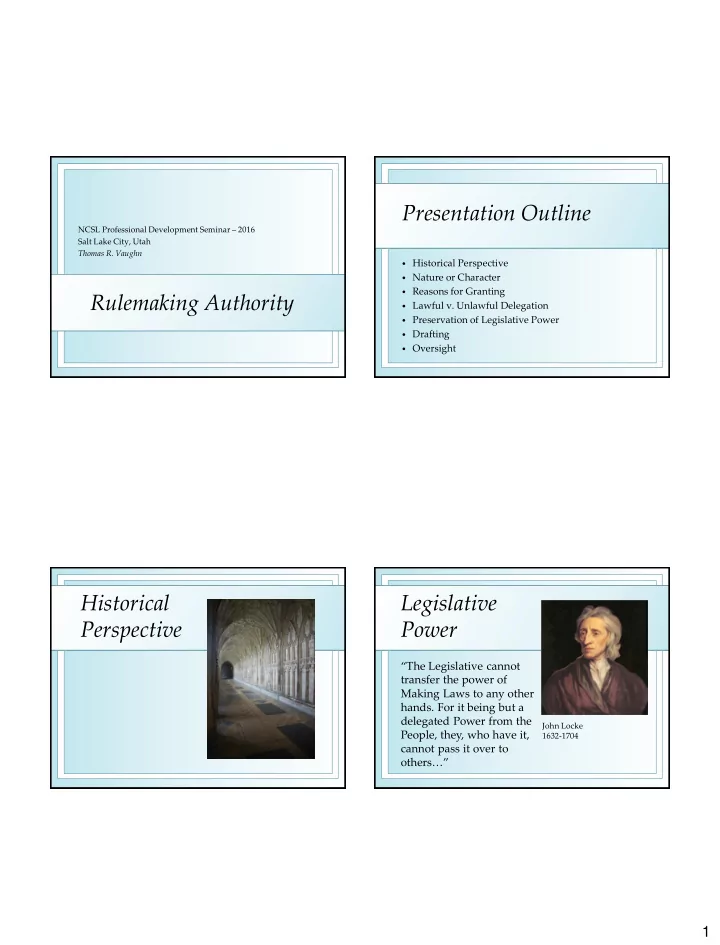
Presentation Outline NCSL Professional Development Seminar 2016 - - PDF document

presentation outline
SMART_READER_LITE
LIVE PREVIEW

Presentation Outline NCSL Professional Development Seminar 2016 - - PDF document

Presentation Outline NCSL Professional Development Seminar 2016 Salt Lake City, Utah Thomas R. Vaughn Historical Perspective Nature or Character Reasons for Granting Rulemaking Authority Lawful v. Unlawful Delegation


slide-1
SLIDE 1

1

Rulemaking Authority

NCSL Professional Development Seminar – 2016 Salt Lake City, Utah Thomas R. Vaughn

Presentation Outline

  • Historical Perspective
  • Nature or Character
  • Reasons for Granting
  • Lawful v. Unlawful Delegation
  • Preservation of Legislative Power
  • Drafting
  • Oversight

Historical Perspective Legislative Power

John Locke 1632-1704

“The Legislative cannot transfer the power of Making Laws to any other

  • hands. For it being but a

delegated Power from the People, they, who have it, cannot pass it over to

  • thers…”
slide-2
SLIDE 2

2

Charles-Louis de Secondat,

Baron de La Brède et de Montesquieu 1689-1755

Known for his articulation of the theory of “separation of powers.”

Separation of Powers

James Madison 1751-1836

“The accumulation of all powers, legislative, executive, and judiciary, in the same hands . . . may justly be pronounced the very definition of tyranny.”

Separation of Powers

“If we look into the constitutions of the several States, we find that . . . there is not a single instance in which the several departments of power have been kept absolutely separate and distinct.”

The Federalist Papers

James Madison 1751-1836

Nature of Rulemaking Authority

slide-3
SLIDE 3

3

“That the legislative power of Congress cannot be delegated is,

  • f course, clear.”

Federal Non-delegation Doctrine

United States v. Shreveport Grain & Elevator Co., 287 U.S. 77, 85, 53 S. Ct. 42, 44, 77 L. Ed. 175 (1932).

“But Congress may . . . devolve upon administrative officers the ‘power to fill up the details' by prescribing administrative rules and regulations.”

United States v. Shreveport Grain & Elevator Co., 287 U.S. 77, 85, 53 S. Ct. 42, 44, 77 L. Ed. 175 (1932).

“. . . the longstanding and much maligned doctrinal fiction that pretends that rulemaking is executive rather than legislative in nature . . .”

Legislative or Executive Power?

Kathryn A. Watts

Nature of Rulemaking Authority in States

slide-4
SLIDE 4

4

“In Michigan, the delegation doctrine provides that the Legislature may delegate power that is legislative in nature . . .”

Blank v. Dep't of Corr., 462 Mich. 103, 165, 611 N.W.2d 530, 560 (2000).

“Delegations of legislative authority include delegations

  • f rulemaking authority . . .”

Oshtemo Charter Twp. v. Kalamazoo Cty. Rd. Comm'n, 302 Mich. App. 574, 591, 841 N.W.2d 135, 145 (2013)

“The power to adopt rules and regulations is administrative in nature, not legislative . . .”

Woods v. Midwest Conveyor Co., 231 Kan. 763, 771, 648 P.2d 234, 242 (1982), superceded by statute on other grounds.

“The nondelegation doctrine . . . prohibits the General Assembly from delegating its legislative power to some other agency or person.”

People v. Lowrie, 761 P.2d 778, 781 (Colo. 1988) 530, 560 (2000).

slide-5
SLIDE 5

5

“This is not to say that the General Assembly may not delegate rulemaking authority to an administrative agency.”

People v. Lowrie, 761 P.2d 778, 781 (Colo. 1988)

Why Delegate Rulemaking Authority?

Congress “may establish primary standards, devolving upon others the duty to carry out the declared legislative policy; that is, as Chief Justice Marshall expressed it, ‘to fill up the details.’”

Pragmatism

Panama Ref. Co. v. Ryan, 293 U.S. 388, 426, 55 S. Ct. 241, 251, 79 L. Ed. 446 (1935)

It is “impracticable for the General Assembly to fix rigid standards to guide agency action . . . without destroying the flexibility necessary to effectuate obvious legislative goals in dealing with complex economic and social problems.”

Flexibility

People v. Lowrie, 761 P.2d 778, 781 (Colo. 1988).

slide-6
SLIDE 6

6

“It would have been impossible, in a single legislative session, to set forth all the requirements of such a complex activity as fiscal management.”

Complexity

Yelle v. Bishop, 55 Wash. 2d 286, 302-03, 347 P.2d 1081, 1091 (1959).

“The Legislature delegates rulemaking authority to state agencies because they usually have expertise in a particular area for which they are charged with

  • versight.”

Expertise

Whiley v. Scott, 79 So. 3d 702, 711 (Fla. 2011).

“As the problems of modern economic life grow more and more complex, legislatures, both state and Federal, find themselves lacking both in time and technique necessary to permit them to prescribe all of the detailed rules essential for dealing with the often highly technical subjects

  • f modern legislation.”

Time

3 A.L.R.2d 188

Lawful v. Unlawful Delegation

slide-7
SLIDE 7

7

  • Separation of Powers
  • Due Process

Unlawful Delegation: Two Types

The principle of separation of powers is violated when a branch

  • f government attempts to

exercise a core power or essential function of another branch.

Unlawful Delegation:

Separation of Powers

“Core functions or powers of the various branches of government are clearly nondelegable under the Utah Constitution.”

Core Functions

Salt Lake City v. Ohms, 881 P.2d 844, 848 (Utah 1994).

“a department . . . may not exercise powers not so constitutionally granted, which from their essential nature, do not fall within its division of governmental functions, unless such powers are properly incidental to the performance by it of its

  • wn appropriate functions.”

Essential Nature

Hawaii Insurers Council v. Lingle, 120 Haw. 51, 70, 201 P.3d 564, 583 (2008).

slide-8
SLIDE 8

8

What are core legislative functions?

“Hence it is a cardinal principle of representative government, that the legislature cannot delegate the power to make laws to any other body or authority.”

Legislating

Appeal of Locke, 72 Pa. 491, 494 (1873).

“The legislature cannot delegate its power to make a law; but it can make a law to delegate a power to determine some fact or state of things upon which the law makes, or intends to make, its own action depend.” Appeal of Locke, 72 Pa. 491, 498 (1873).

State Legislature 123 Abdication Street

1001

Pay to the Order

  • f

[Insert whatever you want here!!!]__________________ State Agency_______________________

State te Legis isla latu ture

slide-9
SLIDE 9

9

Crimes and Penalties Crimes and Penalties

“[T]he courts may not denounce and punish as crimes acts and omissions not made punishable by statute, for it is a legislative power to declare acts as crimes and to prescribe proper penalties.”

Crimes and Penalties

State v. Gallion, 572 P.2d 683, 688 (Utah 1977).

Crimes and Penalties

slide-10
SLIDE 10

10

“Where the statute provides a punishment for violating the regulations or orders of a commission, the power to create a crime is not delegated to the commission.”

Crimes and Penalties

People v. Soule, 238 Mich. 130, 139, 213 N.W. 195, 197 (1927).

“The core functions of

the legislative branch include . . . making appropriations.”

Carmel Valley Fire Prot. Dist. v. State, 25 Cal. 4th 287, 299, 20 P.3d 533, 539 (2001)

Appropriating Funds

“[T]he essentials of the ‘legislative function’ are the determination of legislative policy and its formulation and promulgation as a defined and binding rule of conduct.”

Cochran v. Black, 240 Ark. 393, 397, 400 S.W.2d 280, 283 (1966).

Establishing Policy

Policy “The power to tax is a legislative power, and cannot be delegated to an administrative body.”

Multnomah Cty. v. Luihn, 180 Or. 528, 540, 178 P.2d 159, 165 (1947).

Taxation

slide-11
SLIDE 11

11

No Blank Checks!

State Legislature 123 Abdication Street

1001

Pay to the Order of

[Insert whatever you want here!!!]__________________ State Agency_______________________

State te Legis isla latu ture

The rules

  • n rulemaking
  • Strict

Standards

  • Strict
  • Moderate

Standards

slide-12
SLIDE 12

12

  • Strict
  • Moderate
  • Permissive

Standards Strict

“Clear or specific standards” “intelligible principles” “rules of action or framework”

Strict

  • Arizona
  • Montana
  • New York
  • South Carolina
  • Texas
  • Utah

Moderate

Standards v. required expertise Practical under the circumstances

slide-13
SLIDE 13

13

Moderate

  • Alabama
  • Colorado
  • Hawaii
  • Idaho
  • Minnesota
  • New Jersey

Permissive

“Suitable standards” “Adequate safeguards”

Permissive

  • California
  • Iowa
  • Maryland
  • Oregon
  • Washington
  • Wisconsin

“PRIIA grants Amtrak, a self-interested entity, power to regulate its competitors.”

Unlawful Delegation:

Due Process

Ass'n of Am. Railroads v. U.S. Dep't of Transp., 821 F.3d 19, 34 (D.C. Cir. 2016).

slide-14
SLIDE 14

14

  • Is it a lawful delegation?
  • Have you provided adequate guidelines

for your jurisdiction?

  • Have you protected the constitutional

power of your client?

Drafting

The department shall . . . in accordance with Title 63G, Chapter 3, Utah Administrative Rulemaking Act, make rules establishing: (A) a project funding application process; (B) project funding requirements; (C) project approval criteria; and (D) standards for evaluating the effectiveness of funded projects in reducing salinity in the Colorado River.

Utah Code 4-2-8.5

The department is authorized and directed . . . to make and enforce such rules as may in its judgment and discretion be necessary to carry out the purposes of this chapter.

Utah Code 4-3-2

. . . the State Building Board may make rules establishing circumstances under which bids may be modified when all bids for a construction project exceed available funds as certified by the director.

Utah Code 63A-5-103

slide-15
SLIDE 15

15

[T]he department shall have the power to adopt, amend, or rescind rules necessary to carry out the provisions of this title.

Utah Code 26-1-5

Legislative Oversight Congress: Legislative Veto

1932 Legislative Appropriation Act 1983 295 congressional veto provisions in 196 different statutes

slide-16
SLIDE 16

16 Challenge to legislative veto provision in the Immigration and Nationality Act

I.N.S. v. Chadha

“We see therefore that the Framers were acutely conscious that the bicameral requirement and the Presentment Clauses would serve essential constitutional functions.”

I.N.S. v. Chadha, 462 U.S. 919, 951, 103 S. Ct. 2764, 2784, 77 L. Ed. 2d 317 (1983).

“[W]hen the Framers intended to authorize either House of Congress to act alone and outside of its prescribed bicameral legislative role, they narrowly and precisely defined the procedure for such action.”

I.N.S. v. Chadha, 462 U.S. 919, 955, 103 S. Ct. 2764, 2786, 77 L. Ed. 2d 317 (1983).

“To accomplish what has been attempted by one House of Congress in this case requires action in conformity with the express procedures of the Constitution's prescription for legislative action: passage by a majority of both Houses and presentment to the President.”

I.N.S. v. Chadha, 462 U.S. 919, 958, 103 S. Ct. 2764, 2787, 77 L. Ed. 2d 317 (1983).

slide-17
SLIDE 17

17

Legislative Oversight by States

States where legislative veto provisions have been struck down

  • Alaska
  • Kansas
  • Missouri
  • New Jersey
  • Pennsylvania
  • South Carolina
  • West Virginia
  • Connecticut
  • Idaho
  • Illinois
  • Iowa
  • Louisiana
  • New Jersey
  • Nevada
  • North Dakota
  • South Carolina

States with legislative veto provisions that have not been struck down

  • Kansas
  • Missouri
  • New Hampshire
  • Oregon
  • Kentucky
  • West Virginia

States where other legislative oversight methods have been struck down

slide-18
SLIDE 18

18

  • Alaska
  • Iowa
  • Louisiana
  • Michigan
  • Nevada
  • Pennsylvania
  • South Dakota
  • Wisconsin

States that allow temporary suspension of rules

  • Florida
  • Iowa
  • Minnesota
  • Montana
  • Nebraska
  • Nevada
  • New Hampshire
  • North Carolina
  • North Dakota
  • Vermont

States with legislative objection and burden shifting

  • Kentucky
  • Louisiana
  • Maryland

States with legislative objection triggering gubernatorial review

  • Utah
  • West Virginia

State with less common approaches

slide-19
SLIDE 19

19

  • Nature of legislative authority
  • Reasons for delegating rulemaking authority
  • Pragmatism
  • Flexibility
  • Complexity
  • Expertise
  • Time

Conclusion

  • Unlawful Delegation
  • Separation of powers
  • Due process violation

Conclusion

  • Separation of powers
  • Core Functions
  • Legislating
  • Crimes and penalties
  • Appropriating funds
  • Establishing Policy
  • Taxation

Conclusion

  • Standards
  • Strict
  • Moderate
  • Permissive

Conclusion

slide-20
SLIDE 20

20

  • Drafting
  • Lawful v. unlawful delegation
  • Providing sufficient guidelines
  • Protecting legislature’s constitutional

power

Conclusion

  • Legislative oversight
  • Constitutional issues
  • Variety of methods

Conclusion

Thomas R. Vaughn

Office of Legislative Research & General Counsel W210 House Building Utah State Capitol Complex Salt Lake City, Utah 84114 tomvaughn@le.utah.gov 801-538-1032

Thank you!

Attributions

1.

History cover page: Image courtesy of artur84 at FreeDigitalPhotos.net

2.

Slide “Legislative Power” NCSL, Delegation of legislative Power, quoting Second Treatise of Civil Government, John Locke, 1690.

3.

Two Slides “Separation of Powers,” James Madison, The Federalist Papers, No. 47, New York Packet. Friday, February 1, 1788.

4.

“. . . the longstanding and much maligned doctrinal fiction that pretends that rulemaking is executive rather than legislative in nature . . .” Georgetown Law Journal, Vol 103:1003, p. 1060, Kathryn A. Watts, Rulemaking as Legislating, 2015

5.

Nature of rulemaking authority: Mathmatics image courtesy of Pixabay

6.

Nature of Rulemaking Authority in States: Delicate Arch image and leaf image courtesy of Pixabay

7.

Reasons: Why delegate Legislative Authority: Image courtesy of Thomas R. Vaughn

8.

Lawful v. Unlawful Delegation: Image courtesy of Stuart Miles at FreeDigitalPhotos.net

9.

What are core Legislative Functions? Image courtesy of foto76 at FreeDigitalPhotos.net

slide-21
SLIDE 21

21

Attributions

  • 10. Strict: Image courtesy of stockimages at FreeDigitalPhotos.net
  • 11. Moderate: courtesy of Thomas R. Vaughn
  • 12. Permissive: Image courtesy of Thomas R. Vaughn
  • 13. Crimes and Penalties: Handcuffs Image courtesy of nixxphotography at FreeDigitalPhotos.net
  • 14. Crimes and Penalties: Medicine Image courtesy of holohololand at FreeDigitalPhotos.net
  • 15. Appropriations: Stacked Money Image courtesy of sheelamohan at FreeDigitalPhotos.net
  • 16. Taxation: Coins Image courtesy of jk1991 at FreeDigitalPhotos.net
  • 17. Time: Stopwatch Image courtesy of digitalart at FreeDigitalPhotos.net
  • 18. Drafting images courtesy of Pixabay
  • 19. Legislative Oversight: Image, New Zealand, Courtesy of Pixabay
  • 20. Congress, Legislative Veto: US Capitol image courtesy of Pixabay
  • 21. Legislative Oversight by States: Images courtesy of Pixabay
  • 22. Unlawful Delegation, Due Process: Train image courtesy of Pixabay

Attributions

  • 23. Garvey Schubert Barer Professor of Law, University of Washington School of Law, 2015, Kathryn A. Watts,

Rulemaking as Legislating.

  • 24. Justia (http://law.justia.com/constitution/us/article-1/03-delegation-of-legislative-power.html), Delegation and

Individual Liberties, Delegation of Legislative Power, The History of the Doctrine of Nondelegability (last viewed

  • n 9/27/16).
  • 25. Institutional Design and the Lingering Legacy of Antifederalist Separation of Powers Ideals in the States,

Vanderbilt Law Review, Vanderbilt University School of Law, Jim Rossi, 52 Vand. L. Rev. 1167, October 1999.

  • 26. Sutherland Statutory Construction, Chapter 4, The Delegation of Powers.
  • 27. Jerry L. Anderson and Christopher Poynor, A Constitutional and Empirical Analysis of Iowa’s Administrative

Rules Review Committee Procedure, 61 Drake L. Rev. 1 (2012).

  • 28. NCSL, Separation of Powers – Delegation of Legislative Power
  • 29. NCSL, Separation of Powers – Legislative Oversight
  • 30. NCSL, Conditions for Legislative Review of Administrative Rules, November 2010, Updated July 2016 .
  • 31. Stephen Wermiel, SCOTUS for law students: Non-delegation Doctrine Returns After Long Hiatus, December

4, 2014.