Presentation for the Health and Human Services Interim Committee - - PDF document

presentation for the health and human services
SMART_READER_LITE
LIVE PREVIEW

Presentation for the Health and Human Services Interim Committee - - PDF document

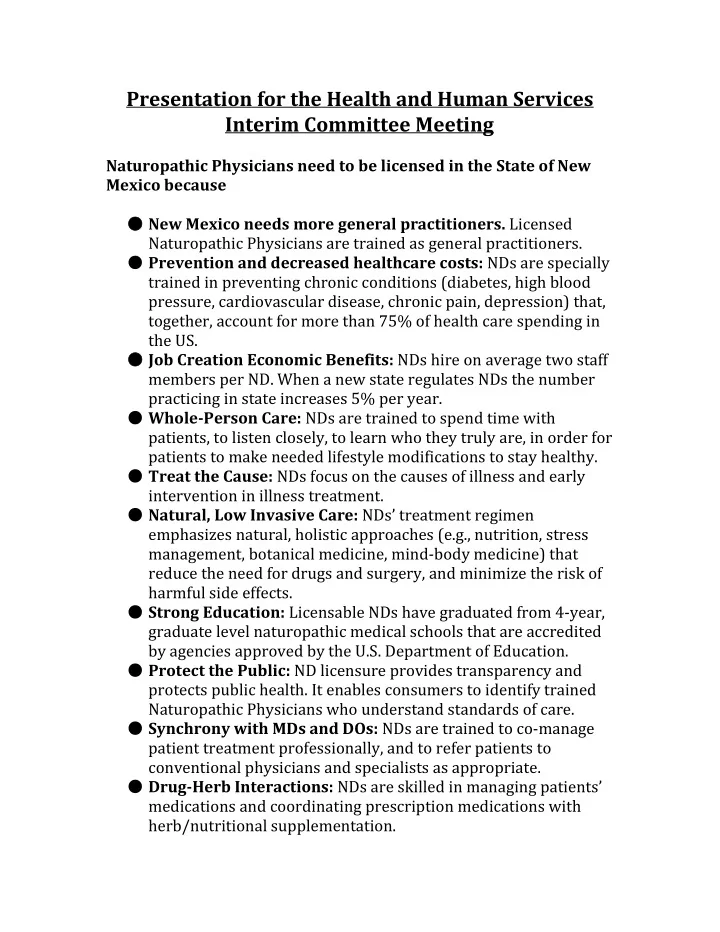
Presentation for the Health and Human Services Interim Committee Meeting Naturopathic Physicians need to be licensed in the State of New Mexico because New Mexico needs more general practitioners. Licensed Naturopathic Physicians are


slide-1
SLIDE 1

Presentation for the Health and Human Services Interim Committee Meeting

Naturopathic Physicians need to be licensed in the State of New Mexico because

  • New Mexico needs more general practitioners. ​Licensed

Naturopathic Physicians are trained as general practitioners.

  • Prevention and decreased healthcare costs:​ NDs are specially

trained in preventing chronic conditions (diabetes, high blood pressure, cardiovascular disease, chronic pain, depression) that, together, account for more than 75% of health care spending in the US.

  • Job Creation Economic Benefits: ​NDs hire on average two staff

members per ND. When a new state regulates NDs the number practicing in state increases 5% per year.

  • Whole­Person Care:​ NDs are trained to spend time with

patients, to listen closely, to learn who they truly are, in order for patients to make needed lifestyle modifications to stay healthy.

  • Treat the Cause:​ NDs focus on the causes of illness and early

intervention in illness treatment.

  • Natural, Low Invasive Care:​ NDs’ treatment regimen

emphasizes natural, holistic approaches (e.g., nutrition, stress management, botanical medicine, mind­body medicine) that reduce the need for drugs and surgery, and minimize the risk of harmful side effects.

  • Strong Education:​ Licensable NDs have graduated from 4­year,

graduate level naturopathic medical schools that are accredited by agencies approved by the U.S. Department of Education.

  • Protect the Public:​ ND licensure provides transparency and

protects public health. It enables consumers to identify trained Naturopathic Physicians who understand standards of care.

  • Synchrony with MDs and DOs:​ NDs are trained to co­manage

patient treatment professionally, and to refer patients to conventional physicians and specialists as appropriate.

  • Drug­Herb Interactions:​ NDs are skilled in managing patients’

medications and coordinating prescription medications with herb/nutritional supplementation.

slide-2
SLIDE 2
  • Patient Self­Responsibility:​ By learning about how their minds

and bodies work holistically, patients are encouraged to take a more active role in maintaining wellness. What is a Naturopathic Physician?

  • Naturopathic physicians combine the wisdom of nature with the

rigors of modern science. Steeped in traditional healing methods, principles and practices, naturopathic medicine focuses on holistic, proactive prevention and comprehensive diagnosis and

  • treatment. By using protocols that minimize the risk of harm,

naturopathic physicians help facilitate the body’s inherent ability to restore and maintain optimal health. It is the naturopathic physician’s role to identify and remove barriers to good health by helping to create a healing internal and external environment.

  • Naturopathic physicians work in private practices, hospitals,

clinics and community health centers. NDs practice throughout the United States and Canada. Qualified naturopathic physicians undergo rigorous training before they become licensed health­care practitioners.

  • NDs treat all medical conditions and can provide both individual

and family health care. Among the most common ailments they treat are allergies, chronic pain, digestive issues, hormonal imbalances, obesity, respiratory conditions, heart disease, fertility problems, menopause, adrenal fatigue, cancer, fibromyalgia and chronic fatigue syndrome. NDs can perform minor surgeries, such as removing cysts or stitching up superficial wounds. However, they do not practice major

  • surgery. NDs are trained to utilize prescription drugs, although

the emphasis of naturopathic medicine is the use of natural healing agents. What is the education of a Naturopathic Physician?

  • Seven accredited naturopathic medical schools operate in North
  • America. All programs are accredited by regional accrediting

agencies as well as by a programmatic accrediting agency (the Council for Naturopathic Medical Education) recognized by the US Department of Education.

slide-3
SLIDE 3
  • The Doctor of Naturopathic Medicine (ND) degree is a doctoral

level, four­year academic and clinical program. Candidates for naturopathic medical school have a Bachelor’s degree with prerequisites in biology, chemistry, physics and psychology.

  • The program is residential and includes a minimum of 4100

clock hours, 1200 of which must be clinical training in direct patient care under the supervision of licensed NDs and other health professionals. Didactic clinical sciences courses complement direct patient care clinical shifts.

  • The first two years of the ND program are composed of basic

biomedical science courses such as anatomy (including cadaver dissection), biochemistry, physiology, pathology, immunology,

  • etc. Clinical diagnosis courses such as interviewing, physical

examination, laboratory and other diagnostic testing, and medical record documentation are also incorporated into the first two years of the program. The third and fourth years are a combination of clinical education and training in the various aspects of clinical medicine such as cardiology, rheumatology, gastroenterology, reproductive medicine, etc.

  • Outpatient evaluation and management of commonly seen

conditions and prevention and health promotion strategies are taught in the classroom, and students work in primary care

  • utpatient clinics directly with patients.
  • Naturopathic clinical principles and philosophy are taught

throughout the program and naturopathic treatments (including diet, nutrition, botanical medicine, behavioral medicine, prevention and more) are taught alongside conventional approaches to health and disease.

  • Training in consultation, co­management and referral with other

health professionals is a standard part of the curriculum.

  • Naturopathic Physicians from DOE accredited institutions pass

the Naturopathic Physicians Licensing Examination (NPLEX), have the ability to get a National Provider Identification number (NPI#) and in some states, hold a Drug Enforcement Administration (DEA) license.

  • Continuing Medical Education (CME) is required for all licensed
  • NDs. The number of hours required varies by state or

jurisdiction, but generally ranges from 20 to 50 hours of CME annually.

slide-4
SLIDE 4

Where are Naturopathic Physicians currently licensed? United States:

  • Alaska
  • Arizona
  • California
  • Colorado
  • Connecticut
  • Hawaii
  • Kansas
  • Maine
  • Maryland
  • Minnesota
  • Montana
  • New Hampshire
  • Puerto Rico
  • North Dakota
  • Oregon
  • Puerto Rico
  • Utah
  • Vermont
  • Virgin Islands
  • Washington DC
  • Washington state

Canada:

  • Alberta
  • British Columbia
  • Manitoba
  • Ontario
  • Saskatchewan

Naturopathic medicine excels at prevention and low­cost management of chronic and stress­related illnesses:

  • Diabetes
  • Heart disease
  • Obesity
  • Arthritis
  • Depression
slide-5
SLIDE 5
  • Over 75% of all health care spending is on chronic illness
  • In the US, we focus on high­tech treatment of disease; much less
  • emphasis on lifestyle counseling and wellness promotion
  • We spend more than any country for health care – yet we rank

37th in health quality among developed nations.