
SLIDE 1
Preoday and Chilango Retail EXPO Presentation
Want to discover more? preoday.com
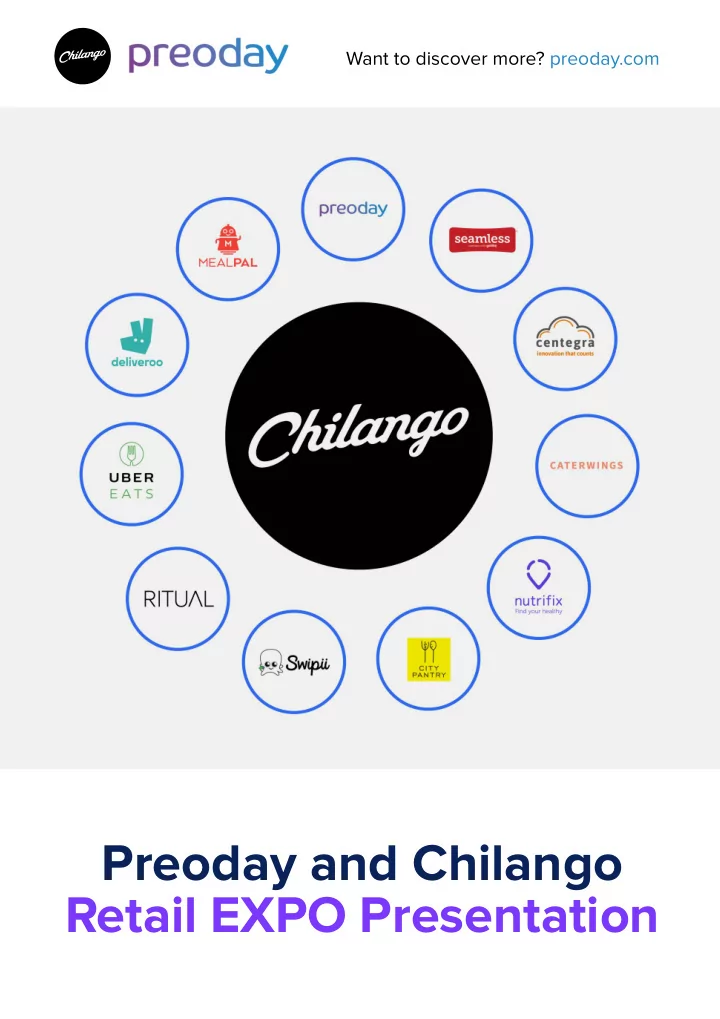
Preoday and Chilango Retail EXPO Presentation Embracing technology - - PDF document
Want to discover more? preoday.com Preoday and Chilango Retail EXPO Presentation Embracing technology to increase sales How to make the most of all the digital channels available As part of this years Retail EXPO show, our CEO
Want to discover more? preoday.com
Nick Hucker, Preoday: Dan Houghton, Chilango:
Dan, can you give us an indication of how much of your business you’d say is “digital”? Right now, I’d say three of the eleven restaurants are digital, if you take them by
digital channels, but if you just go, right, how much business is online, it’s basically three restaurants’ worth. So just under 30 percent
it was zero two and a half years ago. We do a very high volume in the City. We will serve six hundred people in two hours and also have a good delivery trade, with some residential.
As part of this year’s Retail EXPO show, our CEO Nick and Dan Houghton from Mexican fast food brand Chilango, discussed the merits and challenges of working with a variety of technology
Want to discover more? preoday.com
Nick Hucker, Preoday:
Thanks Dan, that’s really helpful. I’d say as a provider to these sorts of businesses, one of the interesting things is actually meeting a hospitality business where both the founders are hugely passionate about technology and therefore as a provider to those individuals it means you really have to be to the point because they understand exactly what you do for a living and they also know exactly what they want from technology, which sometimes is not the case. But what we also find is that Dan has a very interesting set of partners. And I think this is a reflection of the marketplace that we find
for anyone in terms of business. You have a wide range of partners: delivery, ordering, white label, POS integrations, etc. What I wanted to ask Dan first is: why have so many partners?
Want to discover more? preoday.com
Want to discover more? preoday.com
Dan Hougton, Chilango:
So that’s how we’ve ended up with a range of
have our own click & collect that Nick and his team power at Preoday and we have a loyalty system which is with a start-up called Swipii, who basically help us on the collection of consumer data. And then Nutrifjx, a nutrition- led marketplace. As a consumer you can subscribe to them and choose restaurants that suit your nutritional needs. We’ve got an integration with them through to Preoday. A lot of partners creates a ton of work for
printers and all those kind of things not really glued together from a technology point of view, but you know if something can be bringing in, say, £500 a week to the restaurant consistently and it doesn’t screw up operationally, we’ll do it. We’ve just got to try and be with them as they grow up to make the most of it. Essentially, I think is very shortsighted and destructive to rely
everybody’s needs, it’s just not like that. As mentioned, I’ve got the technology background - I used to be a developer as well, so I can see the full spectrum of what a good technology partner looks like from being part
partners? Well I mean, starting with delivery and the third- party marketplaces, I just think number one that you just don’t want to pick a winner. Obviously, it moves way too quickly. Some of them like Deliveroo would love you to be exclusive, but I just think you’re picking a winner by putting all your eggs in one basket and that’s a very dangerous thing to do. Who’s to say you get it right? And then secondly, consumers don’t yet swap between channels. So, if you’re
your audience. There’ll be some overlap, but I think if you just pick one, you’re going to be eliminating some of the guests who you serve in the restaurant. If we’re just on one channel we can’t serve some of them. That’s a little bit short sighted in my view.
Want to discover more? preoday.com
Nick Hucker, Preoday: Nick Hucker, Preoday: Nick Hucker, Preoday:
So that leads me on to the question - What sort of criteria did you apply in selecting those partners? With this data gathered through all these various sources and from these various elements, how much of that do you then use to drive what you put on the menu and how much the consumer spends within a Chilango store? How much of that data are you actually using? With the rise of “dark kitchens”, how do you view them taking your data and then potentially taking customers away from you? Yeah, I think they would do that regardless
if they’re doing their own thing, there is still space for us, so I don’t think it’s completely
take intellectual property and so on, but I think that if you’ve got a good brand and a good
Dan Hougton, Chilango: Dan Hougton, Chilango:
Some of the key things to look for with technologies like white label tech where you’re actually acquiring technology is how much money the companies have raised relative to their direct competitors; or how long have they been around. So, if someone’s been around for fjve years, they’ll probably be around for fjve more. Or if they raised $50 million, they’ll be around for a while. So that’s on the technology side,
You also want data and a sense of a contract. I just think we’ve got to be open minded.
Dan Houghton, Chilango:
So, in terms of operational data, we do a lot. All the difgerent providers give you operational
how long is the team taking to accept an order? How quick are you preparing the food? How long should you make the courier wait? That’s information we get from all partners. We put the [operational] data from Deliveroo directly into
the other platforms. We still have those [other platforms by email] every week. You can see that this is very correlated [with Deliveroo’s data]. In terms of marketing and actually understanding the consumer and really having that digital relationship, we’ve got some way to go. We’ve just hired a marketing director as we just recognised that here we’ve gone from having no sales on digital and everything face to face, to nearly 30 percent digital sales in 2 1/2 years. We’re in danger of becoming disintermediated and losing the relationship with the customer. Plus, digital relationships are really efgective, so we’d be crazy not to use them.
Want to discover more? preoday.com
Nick Hucker, Preoday: Dan Hougton, Chilango: “You don’t have to just use third parties, you can use white-label, but you have to get behind it and really push it. But I think it’s worth it because you start to get a better feel for what the relationship is.” Dan Houghton, Chilango
One thing I would suggest to people is that the [aggregators] are prepared to share data. They won’t give you the individual customers,
them directly, but, for example, i’ve asked them to give me postcodes, i.e. Everyone we have delivered to who has a certain postcode
you know whether there’s a work address or a residential address. You can also ask Uber Eats and Deliveroo for listing information. That means when you appear in the listing panel and you know how long people have been on that page, how many are going to my page, do they click through, did they fulfjl etc. It’s not quite as good as having Google analytics, but it’s a good start. So we’re just at the beginning of the journey, but I’m very excited because where we got to on
marketing, means that now we’ve added that to our team hopefully we’ll do even better. What sort of tips would you give to some of the operators in terms of putting it all together from a technology integration point of view? We have an EPOS company that is prepared to do integrations. So, we have an API where we pull out all the data from that, which goes into our data warehouse daily. We have a direct integration with Deliveroo, straight into our EPOS and straight into our data warehouse. Critically, you want an EPOS provider that is able to integrate with a range of other providers and you want them to be doing that for all their clients, not just you. The EPOS is integral to making the integrations work. The primary source of truth for us is the EPOS database, which has everything we need [on sales and stock].
Want to discover more? preoday.com
Nick Hucker, Preoday: Dan Houghton, Chilango: Dan Houghton, Chilango: If you would like to find out more about implementing digital ordering, here is some further reading:
What advice do you have for operators who are finding all of this very confusing? I think you’ve got to embrace the fact that this is a consumer-led change. You know I’ve heard so many people at conferences, especially
they see it is damaging either hospitality or in a sense, destroying their margin. Lastly, I would say you don’t have to just use third parties, you can use white-label, but you have to get behind it and really push it. You’re going to get behind it and really work on pushing back because consumers are being bombarded by opportunities to order from a third party every day and just to get them to use yours and to sign up requires efgort. But I think it’s worth it because you start to get a better feel for what the relationship is. We fjnd fulfjlling these orders actually easier because the way we fulfjl normally as you know is that the guest comes in and queues and then makes the order, which has to be prepared as fast as possible. That’s actually diffjcult to fulfjl at
and someone collect can be easier. We also price higher on delivery. Overall, the fmex labour on walk-in is 15% for us, but on delivery it’s 10%. Aggregators say that it’s pure incremental sales on delivery and some operators say that aggregators cannibalise your earnings. I’ve done studies on our data, and concluded that delivery is about a third cannibalising from other channels, two-thirds incremental growth. You have to be careful. You probably take a little bit
London Tech Week 2018 – The Integrations and Innovations Needed for Ordering Success How to be a smooth operator Case study – 288 Bar & Wok
Nick Hucker, Preoday:
How are you using technology to help with the challenge of labour in terms of order fulfilment?