Preconception Health It Takes a Village: Giving Our Babies the Best - - PowerPoint PPT Presentation

preconception health
SMART_READER_LITE
LIVE PREVIEW

Preconception Health It Takes a Village: Giving Our Babies the Best - - PowerPoint PPT Presentation

Preconception Health It Takes a Village: Giving Our Babies the Best Chance What is Preconception Health? It focuses on women and men taking steps now to protect the health of a baby they might have sometime in the future. 1 What is


slide-1
SLIDE 1

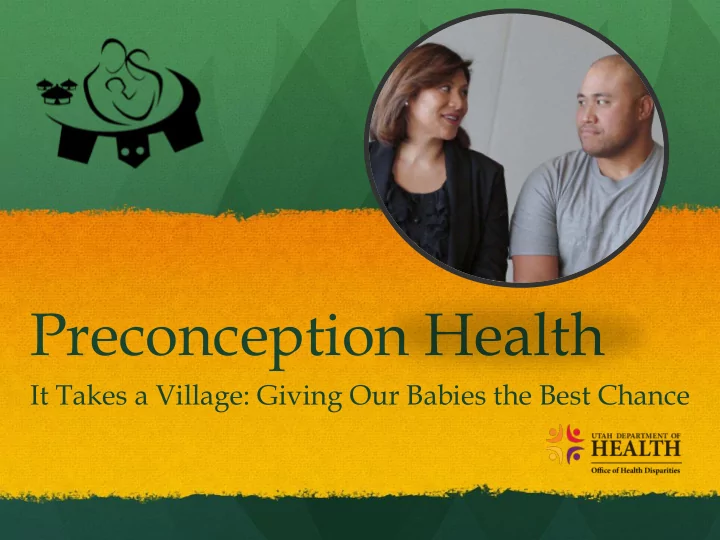
Preconception Health

It Takes a Village: Giving Our Babies the Best Chance
slide-2
SLIDE 2

What is Preconception Health?

  • It focuses on women and men

taking steps now to protect the health of a baby they might have sometime in the future.

1

slide-3
SLIDE 3

What is Preconception Health?

  • It emphasizes a woman being

healthy BEFORE she becomes pregnant.

1

  • It promotes the health of women

and girls of reproductive age.

1

slide-4
SLIDE 4

Why is Preconception Health Important?

  • Prenatal care starts too late to prevent

many of the poor pregnancy outcomes.

2

  • Women who have higher levels of health

before pregnancy have healthier

  • utcomes.

3

  • Unhealthy behaviors and certain

exposures during the first few weeks of pregnancy can negatively affect the baby’s development and pregnancy

  • utcomes.

3

slide-5
SLIDE 5
slide-6
SLIDE 6

Why is Preconception Health Important?

  • Each mother-to-be has a personal

relationship with her fonua or fanua or land and environment.

  • Starting well before pregnancy, even as a

young woman, the mother-to-be can have positive exchanges with her fonua

  • r fanua or land and environment.
slide-7
SLIDE 7

Why is Preconception Health Important?

  • Fathers have an important role in caring

for the fonua or fanua, meaning both the land and the placenta.

4

  • Fathers, the family, and the community

care for the health of all women, mothers-to-be, and the environment.

slide-8
SLIDE 8

Why is Preconception Health Important?

  • Caring for the fonua or fanua will reciprocate

that care so mothers and their bodies are prepared to have the healthiest pregnancy possible for when that time comes.

  • When that time does come, mothers are

prepared to create their baby’s placenta or fonua or fanua and become its nourishing environment or fonua or fanua, from which the baby will receive the nourishment needed to sustain life.

slide-9
SLIDE 9

How can I be as healthy as possible BEFORE pregnancy?

5

  • Schedule a preconception health visit
  • Visit your doctor at least three months

before you become pregnant.

  • This gives you the chance to talk about

your plan to get pregnant.

slide-10
SLIDE 10

How can I be as healthy as possible BEFORE pregnancy?

5

  • Know your health history and your

family health history

  • Be able to give the doctor as much

information as possible

  • Past pregnancies, preterm births,

miscarriages, etc.

  • Medical conditions and current medications
  • Mental health history
  • Home and workplace environment
slide-11
SLIDE 11

How can I be as healthy as possible BEFORE pregnancy?

5

  • Get to your healthy weight
  • Pacific Islanders have the highest maternal
  • besity rate in Utah (52.0%).

6

  • “Being overweight or obese can make it harder to

get pregnant and increase your risk of experiencing problems.”

5

slide-12
SLIDE 12

References

1. Centers for Disease Control and Prevention (CDC). (2015). Reproductive Health. Retrieved February 19, 2016, from http://www.cdc.gov/reproductivehealth/womensrh/ 2. Tyden, T. (2016). Why is preconception health and care important? Upsala Journal of Medical Sciences, 121(4), 207. doi: 10.1080/03009734.2016.1211776 3. Baby Your Baby (2018). Preconception Health. Salt Lake City, UT: Utah Department of Health. 4. Ka'ili, T. O., personal communication, February 15, 2018. 5. Maternal and Infant Health Program. Utah Department of Health. Retrieved April 26, 2017. https://mihp.utah.gov/before-pregnancy/i-am-planning-to-become-pregnant-in-the-next-year 6. Office of Health Disparities (2015). Health Status by Race and Ethnicity 2015. Salt Lake City, UT: Utah Department of Health.