Practice Makes Progress: the multiple logics of continuing - - PowerPoint PPT Presentation

practice makes progress the multiple logics of continuing
SMART_READER_LITE
LIVE PREVIEW

Practice Makes Progress: the multiple logics of continuing - - PowerPoint PPT Presentation

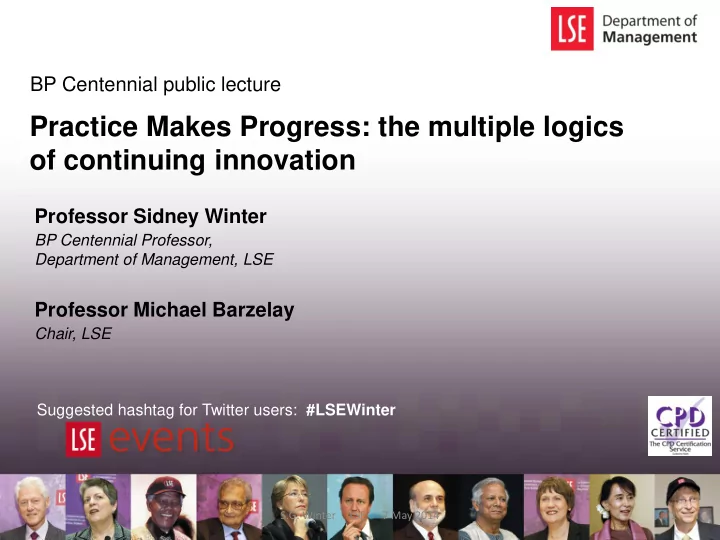
BP Centennial public lecture Practice Makes Progress: the multiple logics of continuing innovation Professor Sidney Winter BP Centennial Professor, Department of Management, LSE Professor Michael Barzelay Chair, LSE Suggested hashtag for


slide-1
SLIDE 1

Practice Makes Progress: the multiple logics

  • f continuing innovation

Professor Sidney Winter

BP Centennial Professor, Department of Management, LSE Suggested hashtag for Twitter users: #LSEWinter

BP Centennial public lecture Professor Michael Barzelay

Chair, LSE

1 S.G. Winter LSE 7 May 2014

slide-2
SLIDE 2

KNOWLEDGE FOR INNOVATION

Overview: This lecture includes

One key contrast: “ideas” versus “logics” Three examples of “logics” of innovation Brief comments on related discussions in economics, management and policy Concluding remarks

2 S.G. Winter LSE 7 May 2014

slide-3
SLIDE 3

KNOWLEDGE FOR INNOVATION

  • I. Drivers of Innovation:

Ideas, inventions and logics

3 S.G. Winter LSE 7 May 2014

slide-4
SLIDE 4

KNOWLEDGE FOR INNOVATION

4 S.G. Winter LSE 7 May 2014

slide-5
SLIDE 5

KNOWLEDGE FOR INNOVATION

They say you can’t patent an idea: Test that one in your search engine!

How to Patent an Idea: 10 Steps (with Pictures) - wikiHow www.wikihow.com › ... ›

5 S.G. Winter LSE 7 May 2014

slide-6
SLIDE 6

KNOWLEDGE FOR INNOVATION

Joseph A. Schumpeter, 1883-1950

Schumpeter made a sharp, then-novel conceptual distinction between invention ( which of course was long familiar and celebrated in its own right) and innovation. In Schumpeter’s early work (TED), development is the result of innovations by entrepreneurs, disrupting the equilibrium “circular flow.” He seems to have had large-scale innovations mainly in mind.

  • I. The Theory of Economic

Development, 1911 [1934]

  • II. Capitalism, Socialism and

Democracy, 3rd ed, 1950

6 S.G. Winter LSE 7 May 2014

slide-7
SLIDE 7

KNOWLEDGE FOR INNOVATION

Inventions (or “ideas”?) vs. Innovation per JAS

  • “As long as they are not carried into practice, inventions are

economically irrelevant. And to carry any improvement into effect is a task entirely different from the invention of it and a task, moreover, requiring entirely different kinds of aptitudes.”

  • There is no real shortage of “… new possibilities. They are

always present, abundantly accumulated by all sorts of people” (TED, p. 88)

  • the entrepreneurial function “does not consist essentially in

either inventing anything or otherwise creating the conditions which the enterprise exploits. It consists in getting things done.” (CSD, p. 132).

7 S.G. Winter LSE 7 May 2014

slide-8
SLIDE 8

KNOWLEDGE FOR INNOVATION

This “idea” idea underemphasizes several things

  • The importance of persistence and hard work.

"Genius is one percent inspiration and ninety-nine per cent

  • perspiration. Accordingly, a 'genius' is often merely a talented

person who has done all of his or her homework.” --- Thomas A. Edison (in various versions & places)

  • The extended, cumulative and highly social nature of progress

in particular fields (e.g., understanding of electricity).

  • The role of many contextual and organizational factors (e.g.,

cooperation and competition, networks, challenges).

  • THE SUBSTANTIAL BODIES OF KNOWLEDGE THAT POINT

OUT PLAUSIBLE PATHS TO PROGESS (but do not describe the detailed implementation)

8 S.G. Winter LSE 7 May 2014

slide-9
SLIDE 9

KNOWLEDGE FOR INNOVATION

Diverse terminology in a multi-disciplinary literature

  • What are here called “logics” are close cousins of familiar

concepts that have been introduced and studied under other names, including “natural trajectories,” “technological paradigms,” “technological trajectories.” More general terms, such as “heuristics” and “principles” are also appropriately invoked.

  • Contributions to conceptual understanding and detailed case

studies have been advanced by scholars from many fields, including economics, sociology, economic history, business history, technological history, and management.

9 S.G. Winter LSE 7 May 2014

slide-10
SLIDE 10

KNOWLEDGE FOR INNOVATION

  • II. Three Illustrative “Logics”

Increasing the size of equipment units

Decreasing the size of design features (miniaturization) Spatial replication (more of about the same, only elsewhere)

10 S.G. Winter LSE 7 May 2014

slide-11
SLIDE 11

KNOWLEDGE FOR INNOVATION

The “multiple logics”

  • Are diverse as well as numerous.
  • Often have a “fractcal structure” (narrow rules/heuristics are

nested in broader ones).

  • Some have a solid foundation basis in “STEM” knowledge,
  • thers not so much.
  • Many are, at this point, long- familiar paths to innovation.
  • None offer a guarantee of innovative success, much less a

specific success achievable within given time and budget constraints.

  • ALL HAVE SHAPED THE WORLD WE LIVE IN, AND ARE

RESHAPING IT RIGHT NOW.

11 S.G. Winter LSE 7 May 2014

slide-12
SLIDE 12

KNOWLEDGE FOR INNOVATION

Miraculous Logics?

  • None of these high-level logics describes an actual way to

achieve anything in particular – they are not recipes, or algorithms, or points in production sets.

  • If they were, perhaps there would be no need for “practice.”
  • In each case, innovative success with a “logic” depends on

solving a host of problems that are associated with the actual physical materials, people and locations involved. Repeated engagement with these relaxes the constraints over time.

  • Is the high-level logic a significant factor compared to the

innumerable low-level problem solutions?

12 S.G. Winter LSE 7 May 2014

slide-13
SLIDE 13

KNOWLEDGE FOR INNOVATION

Example 1: Scaling up equipment: From geometry to cost

  • Increasing the linear scale of a 3-D object, while maintaining

its geometric configuration, increases the surface area according to the square of the linear dimension and the volume according to the cube.

  • If the object is a unit of productive equipment of some sort,

the question is how the different dimensions relate to cost and to output.

  • A quite common case is that capacity is closely related to

volume while cost is closely related to surface area. In the ideal case, capacity cost per unit then varies as the two-thirds power of capacity.

13 S.G. Winter LSE 7 May 2014

slide-14
SLIDE 14

KNOWLEDGE FOR INNOVATION

From the DC 3 to the A 380

Length ratio = 3.7. (note: 3.7 squared = 13.7) Passengers ratio: about 20 to 30, depending on configuration Years between first flights: 70

14 S.G. Winter LSE 7 May 2014

slide-15
SLIDE 15

KNOWLEDGE FOR INNOVATION

Example 2: Miniaturization in semiconductors: Gordon Moore’s (top-level) Innovation Logic

“By making things smaller, everything gets better

  • simultaneously. There is little need for trade-offs. The speed of
  • ur products goes up, the power consumption goes down,

system reliability, as we put more of the system on a chip, improves by leaps and bounds, but especially the cost of doing things electronically drops as a result of the technology.”

  • - Gordon Moore, “Lithography and the Future of

Moore’s Law,” 1995 SPIE speech, final page (Intel)

15 S.G. Winter LSE 7 May 2014

slide-16
SLIDE 16

KNOWLEDGE FOR INNOVATION

From description to prediction to strategy

  • Gordon Moore observed, in 1965, that the number of transistors on

a chip had been doubling annually for a few years (starting from the planar transistor in 1959).

  • He predicted that this pace would continue for at least ten years,

and estimated that in the future the doubling time would be two years.

  • “Intel, which has maintained this pace for decades, uses this

golden rule as both a guiding principle and a springboard for technological advancement, driving the expansion of functions on a chip at a lower cost per function and lower power per transistor by introducing and using new materials and transistor structures.”

  • - Intel’s website today

16 S.G. Winter LSE 7 May 2014

slide-17
SLIDE 17

KNOWLEDGE FOR INNOVATION

Challenges along the way

Wafer size, purity of the silicon Yield issues, especially as chip areas and component numbers increased. Manufacturing environment: Clean room technology. Multiple challenges of photolithography technique: Shrinking feature size, declining wave lengths of the light. Generations of Innovation in lithography equipment

17 S.G. Winter LSE 7 May 2014

slide-18
SLIDE 18

KNOWLEDGE FOR INNOVATION

Example 3: Replication

  • Replicator organizations are firms whose growth strategy is

based on the idea of creating, in an expanding set of new locations, new units that function according to the same routines that are followed in other locations by the existing units.

  • Such firms are particularly common (and highly visible) in

retail settings, such as fast food, restaurants, hotels, banks, brokers, coffee shops, office supplies, home improvements, book stores, low-priced furniture, and clothing shops.

18 S.G. Winter LSE 7 May 2014

slide-19
SLIDE 19

KNOWLEDGE FOR INNOVATION

Challenges for replicators

  • Replication would pose little challenge to replicators, and

perhaps little to managers involved, if physical space were homogeneous.

  • In fact it is heterogeneous for physical reasons (e.g.,

weather) as well as for economic, cultural and institutional

  • nes.
  • Site selection, knowledge transfer, and attention to the

possibilities and hazards of adaptation are key challenges, largely for managers at HQ.

19 S.G. Winter LSE 7 May 2014

slide-20
SLIDE 20

KNOWLEDGE FOR INNOVATION

  • III. Related discussions

Economics

(production theory, evolution) Strategic Management (sustainable advantage, dynamic capability) Policy (the “innovation system”)

20 S.G. Winter LSE 7 May 2014

slide-21
SLIDE 21

KNOWLEDGE FOR INNOVATION

“Towards an evolutionary theory of production”

  • Economists remain quite attached to the theoretical idea that

economic actors generally get the right answers to their decision problems. Actors know what could be done and decide what should be done.

  • In the processes of technological change, the comparison of

the alternatives is deeply intertwined with the discovery of the alternatives, which is a sequential “path-dependent” process.

  • It is quite possible model such processes in ways that

respect the micro-level realities. It is very hard to do that and respect the “right answers” commitment as well.

21 S.G. Winter LSE 7 May 2014

slide-22
SLIDE 22

KNOWLEDGE FOR INNOVATION

Schumpeter on the routinization of innovation

“Progress itself may be mechanized as well as the management

  • f a stationary economy, and this mechanization of progress

may affect entrepreneurship and capitalist development nearly as much as the cessation of economic progress would.” (CSD, 3rd ed. (1950) p. 131). “… it is much easier now than it has been in the past to do things that lie outside familiar routine – innovation itself is being reduced to routine. Technological progress is increasingly becoming the business of teams of trained specialists who turn out what is required and make it work in predictable ways…. (p. 132)

22 S.G. Winter LSE 7 May 2014

slide-23
SLIDE 23

KNOWLEDGE FOR INNOVATION

Teece, et al., on “dynamic capability”

  • D. Teece, G. Pisano and A. Shuen, “Dynamic Capabilities and

Strategic Management” Strategic Management Journal 18 (1997), 509-533.

  • Per these authors, “dynamic capability” confers upon a firm

the ability to cope with change – where successful “coping” involves in particular the maintenance of high profitability.

  • Can the ability to cope with change be improved through

practice?

23 S.G. Winter LSE 7 May 2014

slide-24
SLIDE 24

KNOWLEDGE FOR INNOVATION

The U.S. Innovation System: The Magic in the (Accidental) Mix

  • The “ideas” path to progress and the “logics” path have

been strongly complementary in the U.S. in recent decades.

  • Nobody designed the system to function this way; the

“logics” part was put in place for other reasons – to wage expensive “battles against cancer and Communism.” (Keith Pavitt’s characterization of U.S. “industrial policy.”)

  • In principle, a better system could be designed. But in

practice?

24 S.G. Winter LSE 7 May 2014

slide-25
SLIDE 25

KNOWLEDGE FOR INNOVATION

  • IV. Concluding comments

25 S.G. Winter LSE 7 May 2014

slide-26
SLIDE 26

Practice Makes Progress: the multiple logics

  • f continuing innovation

Professor Sidney Winter

BP Centennial Professor, Department of Management, LSE Suggested hashtag for Twitter users: #LSEWinter

BP Centennial public lecture Professor Michael Barzelay

Chair, LSE

26 S.G. Winter LSE 7 May 2014