
SLIDE 1
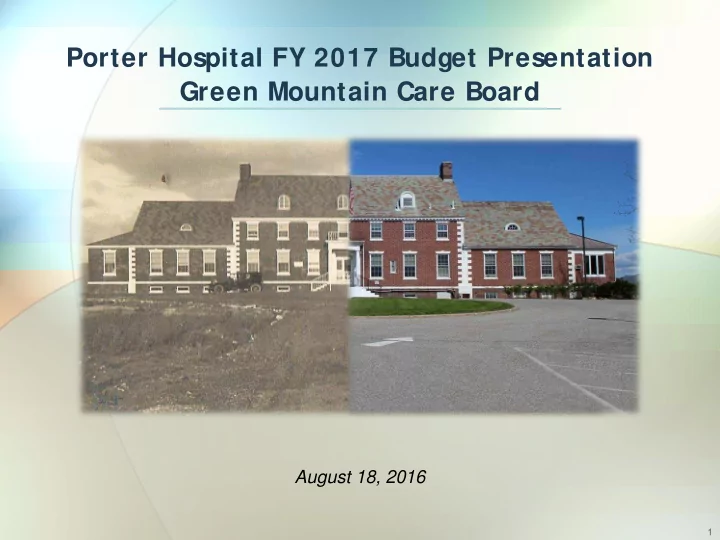
Porter Hospital FY 2017 Budget Presentation Green Mountain Care Board
August 18, 2016
1
Porter Hospital FY 2017 Budget Presentation Green Mountain Care - - PowerPoint PPT Presentation
Porter Hospital FY 2017 Budget Presentation Green Mountain Care Board August 18, 2016 1 Index Introduction FY 2017 Budget & S upport Quality & Integration CHNA Update Organizational Chart GMCB Answers
1
2
3
4
($ in thousands)
FY 2016 Budget FY 2017 Budget
Total Expenses 77,255 $ 77,327 $ Depreciation and Amortization (3,390) $ (3,289) $ Net "Cash" Expenses 73,865 $ 74,038 $ Days in Year 366 365 Total Expense Per Day 201.8 $ 202.8 $ Cash & Investments (Revised Forecast as of 9-30-16) 16,933 $ 16,933 $ Days Cash on Hand 83.9 83.5 Net Change in Days Cash on Hand (0.4) Margin Target Development: Required to Maintain DCOH 86 $ 5 Days Growth DCOH 1,014 $ Debt Payments 717 $ Pension Funding 465 $ Capital Spending 4,006 $ Subtotal 6,288 $ Less Depreciation & Amortization (3,289) $ Margin Target 2,999 $ FY 2017 Total Margin Budget Request 3,802 $ Target Variance 803 $
5
FY 2016 Revised Forecast FY 2017 Budget ($ in thousands) Net Patient Service Revenue $73,831 $76,095 Other Operating Revenue $2,872 $1,987 340b Revenue $2,966 $2,694 Other Non-Operating Revenue $233 $354 Total Revenue $79,902 $81,129 Total Expenses ($76,448) ($77,327) Total Margin $3,454 $3,802 Add Back Required Accruals ($500) $139 Depreciation and Amortization $2,903 $3,289 Total Net "Sources" of Cash $5,856 $7,230 Debt Payments ($780) ($717) Pension Funding ($437) ($465) Equity Transfer To Affiliate ($2,250) ($2,350) Capital Spending ($2,300) ($4,006) Total Net "Uses" of Cash ($5,767) ($7,538) Net Cash Flow $89 ($308) Beginning Days Cash on Hand 84.4 84.8 Ending Days Cash on Hand 84.8 83.3 Net Change Days Cash on Hand 0.4 (1.5) Total Expense Per Day ($201) ($203)
6
FY 2014 Actual FY 2015 Actual FY 2016 Budget FY 2016 Forecast FY 2017 Budget Budget to Budget % ∆ REVENUE Total Gross Patient Revenues 133,682,767 142,245,626 155,893,897 155,541,273 161,257,384 Total Contractual Allowance and Discounts (65,651,131) (68,340,342) (77,384,575) (79,850,592) (83,208,233) Provision for Bad Debts (2,006,852) (3,256,656) (3,429,666) (2,740,325) (2,460,639) Disproportionate Share Revenue 691,760 847,101 501,426 506,408 506,408 Net Patient Service Revenue 66,716,544 71,495,729 75,581,083 73,456,765 76,094,920 0.7% Meaningful Use 751,268 681,617 270,352 459,620 125,001 Total Other Revenue 2,080,942 1,991,031 1,689,570 1,864,684 1,861,662 Other Operating Revenue 2,832,210 2,672,648 1,959,922 2,324,304 1,986,663 TOTAL NET OPERATING REVENUE 69,548,754 74,168,377 77,541,005 75,781,069 78,081,583 0.7% EXPENSES Management Contracts 2,247,457 2,710,040 2,232,155 5,149,222 3,898,379 Salaries and Wages Expense 32,200,341 33,942,747 36,576,151 34,631,246 35,025,754 Benefits 8,949,602 8,942,445 9,785,502 9,319,921 9,400,483 Supplies & Expenses 11,533,200 12,190,267 12,243,723 12,519,445 12,558,459 Purchased Services 7,951,025 9,688,046 8,697,407 9,313,022 8,599,722 VT Medicaid Tax 3,910,935 4,046,887 4,016,414 4,180,236 4,180,236 Depreciation and Amortization 4,501,518 3,174,885 3,390,087 3,223,896 3,288,613 Interest 409,809 322,120 313,280 391,004 375,258 TOTAL OPERATING EXPENSES 71,703,887 75,017,437 77,254,719 78,727,992 77,326,904 0.1% OPERATING MARGIN (2,155,133) (849,060) 286,286 (2,946,923) 754,679 340B Revenue 3,222,965 3,269,714 2,952,914 2,913,656 2,693,560 Other Non-Operating Revenue 718,556 340,404 402,425 305,395 353,714 TOTAL NON-OPERATING REVENUE 3,941,521 3,610,118 3,355,339 3,219,051 3,047,274
TOTAL MARGIN 1,786,388 $ 2,761,058 $ 3,641,625 $ 272,128 $ 3,801,953 $ Total Margin % 2.6% 3.7% 4.7% 0.4% 4.9% 7
FY 2017 Healthcare Reform Initiatives:
decision to participate in this “ non-risk” program.
%∆ FY 2016 Budget 75,581,085 FY 2017 Budget 76,094,920 0.7% 513,835 Budget to Budget Change
($ in Millions) Charge Increase 1.1 Payor Mix
(0.6) Commercial Ask 1.2 Utilization (2.4) Bad Debt 1.0 Charity Care 0.3 DSH
0.5 $
8
9
A 1% increase ≈ $1.1M of GPSR and $0.2M of NPS R.
GPSR NPSR Medicare 2,354
921
2,078 817 Self-Pay/Other 372 320 Budget to Budget Change 5,725 1,137 Percent Increase vs. FY 2016 Budget 3.68% 1.51% Payor Impact
10
2015 Actual FY 2016 Budget FY 2016 Forecast FY 2017 Budget ADMISSIONS: MEDICAL SURGICAL 1165 1,236 1,133 1,164 OBSTETRICS 371 357 340 379 TOTAL ACUTE HOSPITAL ADMISSIONS 1,536 1,593 1,472 1,543 NEWBORN NURSERY 376 369 362 379 SWING BED 55 66 55 34 TOTAL ADMISSIONS 1,967 2,028 1,888 1,955 AVERAGE LENGTH OF STAY 3.1 3.4 3.3 3.2 PATIENT DAYS: MEDICAL SURGICAL 4020 4,595 4,124 4,089 OBSTETRICS 870 825 776 884 TOTAL ACUTE HOSPITAL PATIENT DAYS 4,890 5,420 4,900 4,973 NEWBORN NURSERY 800 795 733 810 SWING BED 667 581 557 409 TOTAL PATIENT DAYS 6,357 6,796 6,190 6,192 AVERAGE DAILY CENSUS 17.42 18.62 16.91 16.96
11
2015 Actual FY 2016 Budget FY 2016 Forecast FY 2017 Budget EMERGENCY ROOM VISITS 15,374 14,673 15,036 15,196 OP SURGERY PROCEDURES 3,279 3,228 3,350 3,370 PORTER PRACTICE MANAGEMENT VISITS 99,287 107,220 106,875 102,614
12
−
Reorganization of PMG
−
Holistic Management of All PMC Entities
−
Compliant with AMS / MGMA Productivity Benchmarks
−
Full Year of S elf -Insured Health Care Benefit
−
Includes Inflation Factor of 2%
−
Pharmacy
−
Temporary labor
urg and OR.
BUDGET FY16 BUDGET FY17 VARIANCE BUD 16 - BUD 17
Porter Hospital 478.1 453.2 (24.9) PMC (Via Management Contract) 15.9 29.2 13.3 Total Porter Hospital & PMC 494.0 482.4 (11.6)
13
14
15
16
ubstance Abuse/ Opiate Addiction S ervices
17
HELEN PORTER HEALTH CARE AND REHABILITATION CENTER PORTER REAL ESTATE HOLDINGS, LLC PORTER MEDICAL CENTER AUXILIARY PORTER HOSPITAL, INC PORTER MEDICAL CENTER, INC.
18
1) Since the reevaluation of your primary care network, provide an update of the size and scope of your primary care network presented in the hospital budget. What changes have occurred? Physicians have dropped by 2 but mid-levels are increasing by 13. Explain this
Our FY 2016 budget for primary care FTEs (Total of MD and Mid-Levels) were 28.8 and our FY 2017 budget includes 23.7 FTEs. We experienced a closure of one of our sites of service (Porter Internal Medicine). We still maintain a very high primary care provider per 1,000 resident ratio as compared to Vermont and national
such that their annual patient visits and panel sizes are reasonable as compared to surrounding markets. In the FY 2016 budget submission, there are 15 Mid-Levels who were not reported as Mid-Levels. These Mid- Levels were reported as non-MD FTEs and should have been reported under the Mid-Level category.
19
2) The hospital’s net patient revenues (NPR) are increasing 0.7% over 2016 budget. This easily meets the target as the hospital has revised its budget base to reflect the changes outlined in their narrative. a) Explain your NPR changes at the budget hearing using the payer schedule provided in the staff’s
GMCB is interested in understanding the changes occurring from budget to budget by payer. The overall budget to budget change in NPR is $0.5M. This change breaks down as follows:
b) A $600,000 loss in NPR is identified as budgeted losses due to anticipated changes to reimbursement for Medicare and Medicaid. Provide an update on the status of these assumptions. The Medicaid NPR rate variance of ($0.3M) is the anticipated result of future PPS changes unknown to us at the time of budget submission and based on previous years’ experience. The Medicare NPR rate variance of ($0.3M) is the anticipated reserve expense as per our calculation of critical access hospital reimbursement via the Medicare cost report.
20
3) The hospital is requesting a 3.7% overall rate increase. Hospital inpatient (4.3%), outpatient (4.6%), and physician services (0%) are all priced differently. Describe the strategy for pricing services differently. The difference in inpatient and outpatient percentage of charge increase is due to the distribution of pharmacy and chargeable medical / surgical supplies between in and outpatient. Porter does not apply a standard charge increase to these items, whereas their pricing is based on cost, and applied based on tiers of cost. The standard charge applied to all other procedures is actually 5.3%, but averages out to 4.3% Inpatient, 4.6% inpatient, and an overall average of 3.7%. No increase is applied to physician services whereas all of Porter’s insurance payments are based on fee schedules, and not percentage of charge. The only patients who would participate in a price increase for physician services would be those with no insurance whatsoever (a/k/a Self Pay). 4) The hospital has identified the NPR dollars related to the rate increase at $1,137,777. These dollars will be earned from payers by raising prices by the effective rate increase. In addition, the hospital identifies NPR dollars they anticipate as part of their negotiations with insurers of $1,150,595. This is called their “commercial ask”. Explain the differences from the hospital’s perspective. As all hospitals try to address the cost shift, continually created by the fact that the Medicaid system reimburses at a rate significantly below true cost and has no annual update this coming year, we have made our best effort to negotiate fair and reasonable increases with our commercial insurance contracts (a/k/a, “commercial ask”). Porter then determined how much of a charge increase might be reasonable to request considering the desire to achieve an acceptable margin, balanced with continued concerns for charge transparency and consumer decisions.
21
5) Describe the purpose for transferring FTEs to the parent organization and rehiring them under Management
administrative and per unit costs? Discuss how this is related to the labor benchmarking work that is intended to find greater efficiency and reduce overall FTE needs. The transfer of FTEs to the Parent Company (“Porter Medical Center”, a/k/a “PMC”) is budget neutral, in that it did not result in any corporate-wide FTE growth. Our labor benchmarking system considers not only hospital specific paid hours, but also the allocated hours as well as consideration for any temporary labor hours (including nurse travelers), therefore regardless of the corporate location or use of temporary labor, all labor hours are considered for the purpose of measuring against labor management targets. The purpose of the move was to create a more holistic and consistent environment across all business units of PMC. We believe that this has had a positive effect on intercompany communications and employee engagement. 6) Explain the changes being seen in utilization. Acute admissions are expected to increase over projected 2016 while physician visits are expected to decline. Explain the assumptions used to develop these estimates. Describe the infusion program and the data and assumptions that were examined to support launching this new service. The projection for FY 2016 includes the impact of our first quarter experience, which reflected a significant decrease in acute admissions for both Medical Surgical and Swing Bed. We do not anticipate this experience to recur in FY 2017; therefore, acute admissions were budgeted at a more comparative level to previous year’s trends. Physician visits have declined primarily due to the aforementioned closure of Porter Internal Medicine. Infusion services had previously been provided on a limited and urgent basis by the nursing staff of our inpatient
North and South for these services. Recognizing that there was a market opportunity, Porter identified and repurposed space within our existing building capable of providing this service in a far more patient friendly environment.
22
7) The hospital moved to a self-insured health care insurance product to save costs. What are the trade-offs for making such a change? What is the risk for the hospital? The potential risk would be that Porter might incur an atypical increase in claims vs. the most recent five year
approximately $400,000 is included in the FY 2017 budget in order to build reserves to an appropriate level. 8) Bad debt and free care are budgeted to drop over 20% from 2016 budget levels. The hospital explains that bad debt and free care is lower (less cost) because Financial Advocates at Porter have helped more patients obtain insurance coverage. Quantify the changes the hospital is seeing with bad debt/free care services. Describe any changes being seen for the number of patients or cases. When budgeting for bad debt and sliding scale, a recent actual trend rate is applied to gross charges as the basis for the FY 2017 budget calculation. The budget to budget decrease for bad debt was based on a decrease in the accounts receivable aging of self- pay balances during FY 2015. This improvement in the aging was not a consideration for the FY 2016 budget. If we exclude the anomaly year of FY 2015, and use FY 2014 and FY 2016 revised forecast as a basis, the FY 2017 budget is reasonably comparative. Self-Pay balances have materially decreased over the last three years, thusly affecting our sliding scale discount and resulting in a decrease of the trend rate.
23
9) Describe the hospital’s efforts with local mental health and other providers to strengthen community health
The Middlebury health service area’s community health action team (CHAT) includes more than 25 local agency members including the Counseling Service of Addison County (CSAC), Addison County Home Health and Hospice (ACHHH), the Turning Point Center of Addison County, Blueprint for Health, and Addison Respite Care Home (ARCH), as well as the newly-formed case management department at Porter Medical Center, help form the foundation of integration and collaboration that is strengthening Porter’s coordination of care and overall
and improvements in preventive care metrics. Leaders from several of these organizations, including the executive directors of both CSAC and ACHHH, now sit on the Porter Medical Center Board. Limitations we continue to experience are particularly identified in categories of mental health services and addiction medicine. 10) Are the FY 16 projections for net revenues, expenditures, and surplus as reported still valid? If not, describe any material changes. The FY 2016 Projection was based on a continuation of the historical trend in the physician practices at Porter, which did not consider the improvement strategy that followed soon thereafter. Through the combination of turnover and specific operational initiatives, the physician practices have experienced discernible improvement in recent months. 11) What are the hospital’s current plans for CONs identified in 2018 and 2020?
We included place holders of $3.5M for an EMR and $20M for an MOB for future consideration. These key purchases are under further consideration as we explore affiliation options.
24
NUCLEAR MEDICINE CAMERA 400,000 ULTRASOUND UNIT (2) 350,000 FULLY DIGITIAL X-RAY EQUIPMENT 129,500 DEFIBRILLATORS 110,000 MINI C ARM 100,000 PMA BUILDING RENOVATION 350,000 PARKING LOT REPAIR/RESURFACE 125,000 AFM PRACTICE RENOVATION 100,000 TOTAL IT REPLACEMENTS & UPDATES 500,000 Clinical Replacements Include: Infrastructure Improvements Include: Information Technology:
25
26