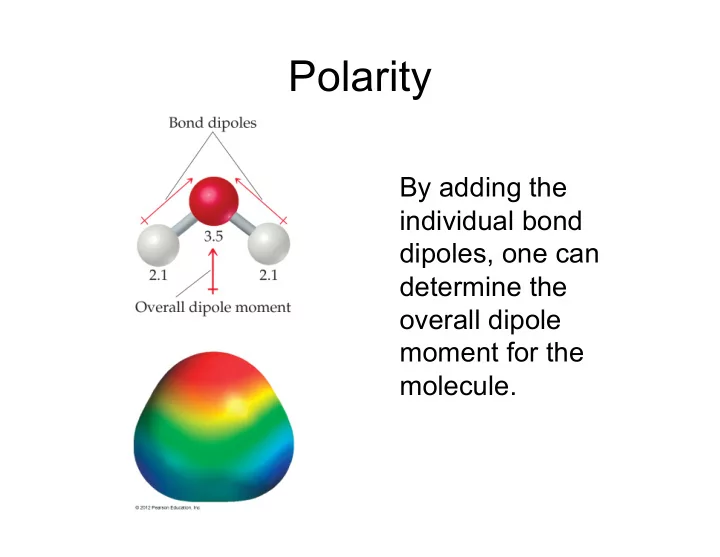
SLIDE 1 Polarity
By adding the individual bond dipoles, one can determine the
moment for the molecule.
SLIDE 2
Polarity
SLIDE 3
Polarity
SLIDE 4 Electron Domains
electron pairs as electron domains.
- In a double or triple bond,
all electrons shared between those two atoms are on the same side of the central atom; therefore, they count as
- ne electron domain.
- The central atom in
this molecule, A, has four electron domains.
SLIDE 5
Valence-Shell Electron-Pair Repulsion Theory (VSEPR)
The best arrangement of a given number of electron domains is the one that minimizes the repulsions among them.
SLIDE 6
Molecular Geometries
SLIDE 7
Molecular Geometries
Within each electron domain, then, there might be more than one molecular geometry.
SLIDE 8
SLIDE 9 Linear Electron Domain
- In the linear domain, there is only one
molecular geometry: linear.
- NOTE: If there are only two atoms in the
molecule, the molecule will be linear no matter what the electron domain is.
SLIDE 10 Trigonal Planar Electron Domain
- There are two molecular geometries:
– Trigonal planar, if all the electron domains are bonding, – Bent, if one of the domains is a nonbonding pair.
SLIDE 11 Tetrahedral Electron Domain
- There are three molecular geometries:
– Tetrahedral, if all are bonding pairs, – Trigonal pyramidal, if one is a nonbonding pair, – Bent, if there are two nonbonding pairs.
SLIDE 12 Trigonal Bipyramidal Electron Domain
distinct molecular geometries in this domain:
– Trigonal bipyramidal – Seesaw – T-shaped – Linear
SLIDE 13
Trigonal Bipyramidal Electron Domain
Lower-energy conformations result from having nonbonding electron pairs in equatorial, rather than axial, positions in this geometry.
SLIDE 14 Octahedral Electron Domain
equivalent in the
- ctahedral domain.
- There are three
molecular geometries:
– Octahedral – Square pyramidal – Square planar
SLIDE 15 Nonbonding Pairs and Bond Angle
- Nonbonding pairs are physically
larger than bonding pairs.
- Therefore, their repulsions are
greater; this tends to decrease bond angles in a molecule.
SLIDE 16 Multiple Bonds and Bond Angles
bonds place greater electron density on
central atom than do single bonds.
affect bond angles.
SLIDE 17
Larger Molecules
In larger molecules, it makes more sense to talk about the geometry about a particular atom rather than the geometry of the molecule as a whole.
SLIDE 18 Overlap and Bonding
bonds forming through the sharing
adjacent atoms.
this can only occur when orbitals on the two atoms overlap.
SLIDE 19 Overlap and Bonding
the electrons and nuclei closer together while simultaneously decreasing electron– electron repulsion.
- However, if atoms get too
close, the internuclear repulsion greatly raises the energy.
SLIDE 20 Hybrid Orbitals
- These two degenerate orbitals would align
themselves 180° from each other.
- This is consistent with the observed geometry of
beryllium compounds: linear.
SLIDE 21
Hybrid Orbitals
With carbon, we get four degenerate sp3 orbitals.
SLIDE 22
Electron-Domain Geometries
Table 9.1 contains the electron-domain geometries for two through six electron domains around a central atom.
SLIDE 23
Bonds
SLIDE 24
SLIDE 25 Multiple Bonds
- In a molecule like formaldehyde (shown at
left), an sp2 orbital on carbon overlaps in s fashion with the corresponding orbital on the
- xygen.
- The unhybridized p orbitals overlap in p
fashion.
SLIDE 26
Multiple Bonds
In triple bonds, as in acetylene, two sp orbitals form a s bond between the carbons, and two pairs of p orbitals overlap in p fashion to form the two p bonds.
SLIDE 27
Delocalized Electrons: Resonance
SLIDE 28
Delocalized Electrons: Resonance
SLIDE 29
Resonance
The organic molecule benzene has six s bonds and a p orbital on each carbon atom.
SLIDE 30 Resonance
- In reality the p electrons in benzene are not
localized, but delocalized.
- The even distribution of the p electrons in benzene
makes the molecule unusually stable.
SLIDE 31
Molecular-Orbital (MO) Theory
SLIDE 32
MO Theory
SLIDE 33 MO Theory
and p orbitals, there are two types of interactions:
– The s and the p orbitals that face each other
– The other two sets of p
fashion.
SLIDE 34
MO Theory
SLIDE 35 MO Theory
- The smaller p-block elements in the second
period have a sizable interaction between the s and p orbitals.
- This flips the order of the s and p molecular
- rbitals in these elements.
SLIDE 36
Second-Row MO Diagrams