Plagiarism and Scientific Misconduct Problematic/questionable - - PowerPoint PPT Presentation

plagiarism and scientific misconduct
SMART_READER_LITE
LIVE PREVIEW

Plagiarism and Scientific Misconduct Problematic/questionable - - PowerPoint PPT Presentation

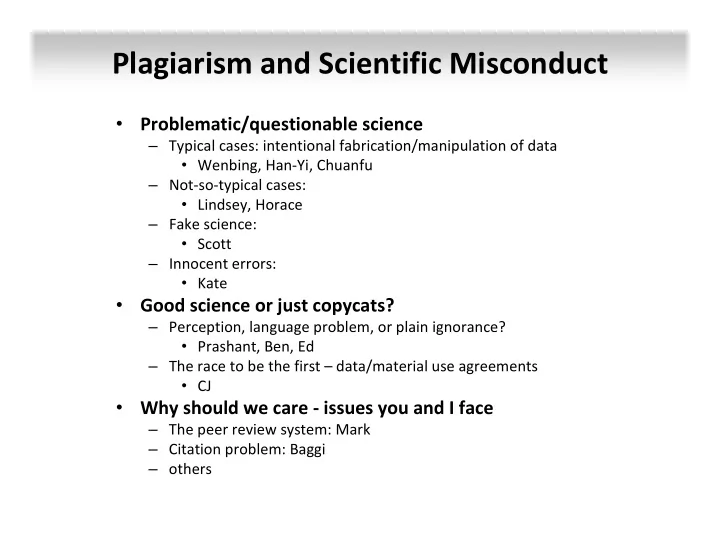
Plagiarism and Scientific Misconduct Problematic/questionable science Typical cases: intentional fabrication/manipulation of data Wenbing, Han Yi, Chuanfu Not so typical cases: Lindsey, Horace Fake science:


slide-1
SLIDE 1

Plagiarism and Scientific Misconduct

  • Problematic/questionable science

– Typical cases: intentional fabrication/manipulation of data

  • Wenbing, Han‐Yi, Chuanfu

– Not‐so‐typical cases:

  • Lindsey, Horace

– Fake science:

  • Scott

– Innocent errors:

  • Kate
  • Good science or just copycats?

– Perception, language problem, or plain ignorance?

  • Prashant, Ben, Ed

– The race to be the first – data/material use agreements

  • CJ
  • Why should we care ‐ issues you and I face

– The peer review system: Mark – Citation problem: Baggi – others

slide-2
SLIDE 2

Wenbing’s pick: Retraction of Deb et al., Science 311 (5763) 992-996. Science 27 July 2007:

  • Vol. 317. no. 5837, p. 450

DOI: 10.1126/science.317.5837.450b Retraction We wish to retract our Report "CDX2 gene expression and trophectoderm lineage specification in mouse embryos" (1). Allegations of research misconduct were received by the University of Missouri-Columbia (MU) Provost, and an investigation found that the first author (K.D.) engaged in research misconduct by intentionally falsifying and fabricating digital images in the preparation of Figs. 4I; 4N; 4S; 2G; 3, J to L; S2, V to X; and S6, I to K accompanying the Science article. In addition, the original raw image files for the majority of the figures in the paper have not been located (the exceptions being the confocal scanning images in Figs. S1, S3, S4, S5, and S6), raising the possibility that the data they represent may also be suspect. We have decided to withdraw the article in its entirety in view of the fact that the paper was founded at least in part on falsified or fabricated images.

  • K. Deb, M. Sivaguru, H. Y. Yong, R. M. Roberts, Science 311, 992 (2006).
slide-3
SLIDE 3

digital images fabricated

slide-4
SLIDE 4

~ from thescientist.com

Han-Yi’s pick

slide-5
SLIDE 5

What happened?

  • Judith Thomas & Juan Contreras (UAB) ~ immunosuppression
  • Immunotoxin FN18‐CRM9 &15‐deoxyspergualin (15‐DSG)
  • $23 million from NIH
  • Remove one kidney → transplant

→ remove second kidney after 1 month

  • inflated the apparent effectiveness of the drugs
  • Reported in 2006 by Thomas
  • 16 publication retracted

haryana‐online.com

slide-6
SLIDE 6

May be true, but definitely not right

slide-7
SLIDE 7

Chuanfu’s pick: The story of florigen

Julius von Sachs (1832-1897); German botanist

Photoperiodism: plants response to the relative length of day and night

Garner and Allard, 1920 Knott, 1934

day length is perceived by the leaves, whereas flower formation takes place in the shoot apical meristem signal can also be transmitted from a flowering partner (donor) via a graft union to a nonflowering partner (receptor).

Chailakhyan, 1936

introduced the term ‘‘florigen’’: specific substances with a regulatory function

Zeevaart, 1958, 1982

universal in plants

Chemical extractions a specific ratio of known hormones and metabolites

SDP-LDP LDP-SLDP LSDP-LDP LSDP-SLDP

slide-8
SLIDE 8

Tao Huang Ove Nilsson

slide-9
SLIDE 9

Hsp heat shock-inducible promoter FT FLOWERING LOCUS T GUS

slide-10
SLIDE 10
slide-11
SLIDE 11

Science 23 December 2005:

  • Vol. 310. no. 5756, pp. 1880 ‐ 1885

DOI: 10.1126/science.310.5756.1880a BREAKTHROUGH OF THE YEAR:

  • T. Huang et al., "The mRNA of the Arabidopsis Gene FT Moves from Leaf to Shoot Apex and Induces Flowering," Science 309, 1694

(2005)

  • M. Abe et al., "FD, a bZIP Protein Mediating Signals from the Floral Pathway Integrator FT at the Shoot Apex," Science 309, 1052 (2005)

P.A. Wigge et al., "Integration of Spatial and Temporal Information During Floral Induction in Arabidopsis," Science 309, 1056 (2005)

  • A. Maizel et al., "The Floral Regulator LEAFY Evolves by Substitutions in the DNA Binding Domain," Science 308, 260 (2005)
  • M. Ashikari et al., "Cytokinin Oxidase Regulates Rice Grain Production," Science 309, 741 (2005)
  • M. Ueguchi‐Tanaka et al., "GIBBERELLIN INSENSITIVE DWARF1 Encodes a Soluble Receptor for Gibberellin," Nature 437, 693 (2005)
  • N. Dharmasiri et al., "The F‐Box Protein TIR1 is an Auxin Receptor," Nature 435, 441 (2005)
  • S. Kepinski and O. Leyser, "The Arabidopsis F‐Box Protein TIR1 is an Auxin Receptor," Nature 435, 446 (2005)

S.J. Lolle et al., "Genome‐Wide Non‐Mendelian Inheritance of Extra‐Genomic Information in Arabidopsis," Nature 434, 505 (2005)

slide-12
SLIDE 12
slide-13
SLIDE 13

Florigen has a long history of disappointing people. We’re getting there, but the race is intense, and we need to keep cool heads. ‐Willliam Lucas, UC Davis plant biology professor

slide-14
SLIDE 14

Then, how do we deal with data point (outlier) removal?

  • 1. Something wrong with an equipment. All data generated from

that equipment should be discarded, not some of them.

  • 2. Not uniform condition: close to light, fan, door, cooler etc.;

watering, soil, insect, pathogen infection.

  • 3. Plants develop differently, even sowed the seeds or

transferred cuttings to soil at the same time.

  • 4. Before attempting to remove any abnormal data points for

unclear reason, repeat the experiment will help make the decision.

slide-15
SLIDE 15

Charlatanry in forensic speech science: A problem to be taken seriously

  • A. Eriksson and F. Lacerda

International Journal of Speech, Language and the Law (2007)

Lindsey’s pick

slide-16
SLIDE 16

Giving Your Competitors a Bad Name

  • Review article by two experts studying the sounds of

speech was peer‐reviewed and published

  • Argued a lack of scientific basis for determining

emotional stress by analyzing the sound of one’s voice, which was basis for a product developed by Nemesysco Ltd.

  • Targeted Mr. Liberman personally
  • Nemesysco Ltd. Threatened to sue for defamation if

article wasn’t retracted

slide-17
SLIDE 17

Happy Ending?

  • Paper is still in print
  • Journal has agreed to print a rebuttal letter
  • The technology is still being used – by the UK

government

slide-18
SLIDE 18

Horace’s pick

slide-19
SLIDE 19
slide-20
SLIDE 20

The short, prolific career of an ambitious young physicist. Jan Hendrik Schön

Scott’s pick: Fabricating Science

slide-21
SLIDE 21

MsbA EmrE

Kate’s pick

slide-22
SLIDE 22

Science 2001 Sept Science 2005 May Science 2005 Dec Science 2006 Dec

slide-23
SLIDE 23

J Mol Biol. 2003 Jul Retracted on 2007 Jun

slide-24
SLIDE 24

PNAS 2004 March Retracted on 2007 Feb

slide-25
SLIDE 25
slide-26
SLIDE 26

Phases = a program package for the processing and analyzing diffraction data from macromolecules.

“An in-house data reduction program introduced a change in sign for anomalous differences. This program, which was not part of a conventional data processing package, converted the anomalous pairs (I+ and I-) to (F- and F+), thereby introducing a sign change.” Flipping fiasco. The structures of MsbA (purple) and Sav1866 (green) overlap little (left) until MsbA is inverted (right).

slide-27
SLIDE 27
  • 29. The package PHASES was used for all phase calculations with

multiple isomorphous and all anomalous scattering data. The correct hand of the structure was established by observing the hand of the a‐helices in the sharpened 4.5 electron density map and also confirmed when docking a fragment of the hisP to the NBD density. Eightfold non‐crystallographic symmetry averaging, solvent fattening/fipping, phase extension, and amplitude sharpening were accomplished using locally written software (G. Chang, unpublished data) and yielded electron density maps that were

  • f excellent quality for model building.

“ Iterative eightfold noncrystallographic symmetry averaging, solvent flattening/flipping, phase extension, and amplitude sharpening using in-house programs yielded electron density maps of excellent quality for tracing a polypeptide chain (Fig. 3) (29).” 2006 September, Roger Dawson and Kasper Locher published their paper in Nature, presenting a new, highly-resolved structure of a homologous transporter, which illustrated an inherent flaw in Chang et al's research.

slide-28
SLIDE 28

La Jolla, CA

slide-29
SLIDE 29

Summary

1. Structure of MsbA from E. coli: A Homolog of the Multidrug Resistance ATP Binding Cassette (ABC) Transporters. Science 2001 – 2006 Chang et al. 2. Structure of MsbA from Vibrio cholera: a multidrug resistance ABC transporter homolog in a closed conformation. JMB 2003 – 2007 Chang. 3. Structure of the multidrug resistance efflux transporter EmrE from Escherichia coli. PNAS 2004 – 2007 Ma et al. 4. Structure of the ABC Transporter MsbA in Complex with ADP∙Vanadate and Lipopolysaccharide. Science 2005 – 2006 Reyes et al. 5. X‐ray Structure of the EmrE Multidrug Transporter in Complex with a

  • Substrate. Science 2005 ‐2006 Pornillos et al.
  • The five retracted papers have been cited 729 times since their

publication.

slide-30
SLIDE 30

Plagiarism: copied text

Biology

  • In vitro development of human germ line cells from embryonic stem cells
  • Eventually develops into haploid motile, sperm‐like cells

When Where and How?

  • Published online (8th July, 2009) in Stem Cells and development without

proof reading and copy editing!

  • No problems with the science or conclusion of the paper
  • On 21st July, 2009 paper was retracted
  • Jae Ho Lee (Post‐doc) was removed from the authorship
  • Newcastle University is standing behind this group

Prashant’s pick

slide-31
SLIDE 31

Two copied paragraphs

Original text from 2007 review Online version published in July, 2009

slide-32
SLIDE 32

Ohio University Engineering College Plagued with Plagiarism

“...some papers included words or even pages that had been copied from other research work or published books.” VOA (Tom), “says in one case more then 50 pages had been copies (sic), and another 14 pages, including typos.” NPR

Ben’s pick

slide-33
SLIDE 33

Plagiarism in Grad students’ theses

  • 2005 former student, Tom Matrka investigating

dishonesty among colleagues, after dispute with advisor

  • ver thesis proposal
  • reviewed by 2 university officials
  • “rampant and flagrant plagiarism” (40 theses)
  • most problems in literature review section
  • some material appeared again and again
  • many were students of Jay S. Gunasekera and Bhavin V.

Mehta

slide-34
SLIDE 34

Example

slide-35
SLIDE 35

The Defense...

  • Most of the offending students came from other

countries – limited english skills? – limited knowledge of rules of writing

  • Gunasekera had previously taught in Australia and Sri

Lanka, and was not familiar with US standards of citations – but problem goes back 20+ years!

slide-36
SLIDE 36

Consequences

  • Theses required to be rewritten or revoked
  • former students defend theses again and re‐enroll
  • Ph.D students suspended until master’s theses re‐written
  • a University committee recommended firing Gunasekera

and another prof, Mehta

  • Mehta left Ohio U
  • Gunasekera stepped down from dept chair and lost

“distinguished prof” title

  • Gunasekera is suing Ohio U for defamation
slide-37
SLIDE 37

Ongoing fallout

  • as of 1/14/2010 – federal judge ordered that the

university hold a public hearing where Gunasekera can attempt to clear his name

  • problems not limited to mech eng dept
  • Chair of Ac Honesty Hearing Committee approved a

Ph.D. dissertation that contains plagiarism

slide-38
SLIDE 38

Scientific Misconduct: Chinese Researchers Debate Rash

  • f Plagiarism Cases

Li Xiguang, Xiong Lei Science 18 October 1996: Vol. 274. no. 5286, pp. 337 – 0 DOI: 10.1126/science.274.5286.337

Plagiarism - "use or close imitation of the language and thoughts of another author and the representation of them as one's own original work."

1995 Random House Compact Unabridged Dictionary

Accidental or Deliberate? Does it matter?

Ed’s pick

slide-39
SLIDE 39

Li Fubin Papers

  • Published two papers identical to earlier papers
  • Made up an additional 23 papers!
  • Plagiarism!
slide-40
SLIDE 40

Pan Aihua Paper

  • Others point out Pan Aihua paper is 1/3 identical

to another paper.

  • Admits: “significant degree of identity in the

wording”

  • Not plagiarism (?): "because we have all the
  • riginal data."
slide-41
SLIDE 41

Published online August 31, 2009 Retracted online September 6, 2009

CJ’s pick

slide-42
SLIDE 42
  • NIH database of genotype and phenotype (dbGaP)
  • SAGE (Study of Addiction: Genetics and Environment)
  • Policy: data embargo for 9‐12 months
  • This SAGE data embargo ended Sep. 23, 2009
  • Chen et al. paper published online Aug. 31, 2009
  • Submitted in March 2009
  • Caught by the data generator!
  • Zhang signed the data‐sharing agreement (unbeknown to his co‐authors).
  • Paper never made it to the printer.
  • BUT the retraction did (Oct 6, 2009)!
  • PNAS may modify the author checklist.
  • Zhang may be further sanctioned by NIH.
slide-43
SLIDE 43

Even Retracted Papers Endure

KATHERINE UNGER AND JENNIFER COUZIN

www.sciencemag.org SCIENCE VOL 312 7 APRIL 2006

Baggi’s pick

slide-44
SLIDE 44

Retracted papers continue being cited

  • Many retracted papers continue to be cited

– after retraction citations sharply decrease but difficult to "prevent" it from happening – some citations are "negative" – negative post-retraction citations are rare

  • Friedhelm Herrmann (German cancer researcher):

– 17 of his 19 retracted papers cited since retraction – some after 10 years – two were cited > 60 times

  • Jan Hendrik Schon (German physicist):

– 2 of his retracted Nature papers have been cited – 17 times after vs. 153 times before retraction

slide-45
SLIDE 45

Know before you cite

  • Research is not credible if fraudulent paper is cited:

– Paul Friedman (former dean at UCSD): "If people cite fraudulent articles, then either their research is going to be thrown off or something will be wasted"

  • Scientists often unaware that they are citing a

retracted paper:

– Lon Kaufman (cell biologist at University of Illinois, Chicago) was unaware that his 1999 Plant Journal article cited a Nature paper retracted in 1998 – Michael Croft (immunologist at La Jolla Institute) had no idea that his 2003 article in Nature Reviews Immunology cited a PNAS paper co-authored by Herrmann retracted in 1997

slide-46
SLIDE 46

How to prevent retracted papers from enduring

  • Online retraction notices not efficient:

– Biochemist Hans Vogel learned that his 2005 Biochemistry article cited a paper retracted from Cell 4 months earlier – Vogel's paper was submitted before retraction was issued: "I would have probably cited it again."

  • Possible solutions:

– Journals should purge the literature of retracted data – when a retraction is issued journals should alert those who previously cited the work

  • Journal editors say they don't have resources to do so:

– A journals’ director: “Checking every citation in submitted paper is impossible; reviewers and publishers do not look up every reference.”

  • Reviewers closely familiar with a given field ought to

recognize “a suspicious name" in a citation

  • Publicity may be one of the best tools to keep track of

retracted papers

slide-47
SLIDE 47

http://www.dilbert.com/fast/2006-11-11/

slide-48
SLIDE 48

Authors, journal editors respond to possible cases of plagiarism identified by UT Southwestern Medical Center

  • eTBLAST – analyzes random abstracts from Medline
  • 70,000 highly similar citations
  • Small sample → 207 article pairs with signs of plagiarism
  • 162 questionnaires sent to authors and editors

− 83 submissions reviewed, 46 retracted (55.4%)

  • ~50% of duplications have not been reviewed
  • Before questionnaires:
  • Original authors

− 93% did not know of duplications

  • Duplicate authors (only 60 replies)

− ~25% deny wrongdoing − ~17% unaware of being an author

  • 174 responding journal editors
  • 11 never had to handle potential plagiarism
  • 12 not going to pursue plagiarism complaint

Mark’s pick

slide-49
SLIDE 49
slide-50
SLIDE 50
slide-51
SLIDE 51

That’s why we have these ‘new’ polices:

  • Web‐based supplemental data submission required.
  • “data not shown” not allowed by high‐profile journals.
  • Author contribution statement required.
slide-52
SLIDE 52

What do all these mean

to researchers and/or mentors ?

  • Misconduct:

– Data record, lab notebook etc – Lab/peer discussion – Check your own data (human/computer errors etc)

  • Plagiarism:

– Not OK to copy other’s sentences (not even in Methods!). – Not OK for “self‐plagiarism” either. – Not OK to use 2nd‐hand references (read what you cite). – Not to “believe” everything you read: Just because it was published doesn’t mean the data or the interpretation is “correct”.

  • The peer‐review system…
slide-53
SLIDE 53

Is this a case of self‐plagiarism ???