PhUSE C PhUSE, Conference 2010 f 2010 Berlin, 17-20 October 2010 - - PowerPoint PPT Presentation

phuse c phuse conference 2010 f 2010
SMART_READER_LITE
LIVE PREVIEW

PhUSE C PhUSE, Conference 2010 f 2010 Berlin, 17-20 October 2010 - - PowerPoint PPT Presentation

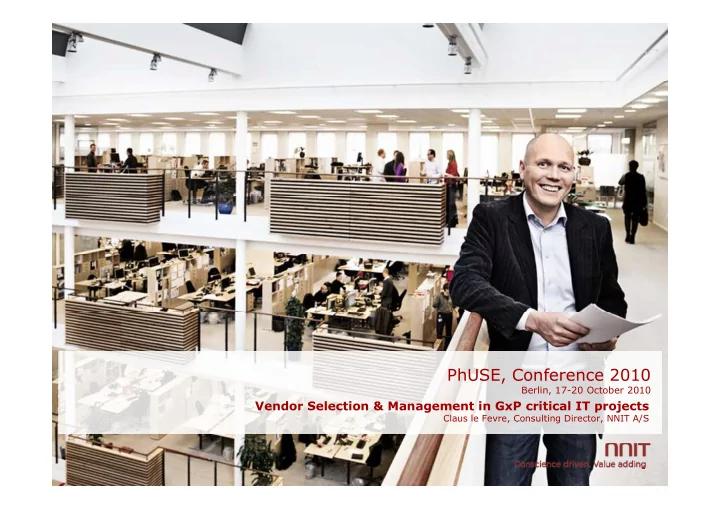
PhUSE C PhUSE, Conference 2010 f 2010 Berlin, 17-20 October 2010 Vendor Selection & Management in GxP critical IT projects Claus le Fevre, Consulting Director, NNIT A/S Slide 1 Author: xxxx Approved by: xxxx Version xx INTERNAL


slide-1
SLIDE 1

PhUSE C f 2010 PhUSE, Conference 2010

Berlin, 17-20 October 2010

Vendor Selection & Management in GxP critical IT projects

Claus le Fevre, Consulting Director, NNIT A/S

Author: xxxx • Approved by: xxxx • Version xx INTERNAL USE ONLY Slide 1

slide-2
SLIDE 2

Agenda Agenda

Introduction

1

Approach to vendor selection

2

C l i

4

Risk based validation

3

Conclusion

4

Slide 2

slide-3
SLIDE 3

The Right Quality Level…

Yes

Common Sense

No Yes

Common Sense

No

Bureaucracy Quality

Yes

Bureaucracy Quality

Standards &

Chaos Creative Chaos

Methods

No

Slide 3

slide-4
SLIDE 4

Agenda Agenda

Introduction

1

Approach to vendor selection

2

C l i

4

Risk based validation

3

Conclusion

4

Slide 4

slide-5
SLIDE 5

Computer validation model Computer validation model

El b ti /

gement

Inception Elaboration/ Construction Transition

n

  • rt

V endor manag Validation pla Validation rep V User requirements specification . Performance qualification V V . . . Installation qualification System specification - Functional part Detailed specification Coding Operational qualification Unit test Code review System specification - technical part

Time

g

Slide 5

slide-6
SLIDE 6

Computer validation model Computer validation model

El b ti /

gement

Inception Elaboration/ Construction Transition

n

  • rt

V endor manag Validation pla Validation rep V User requirements specification . Performance qualification V V . . . Installation qualification

Time

Slide 6

slide-7
SLIDE 7

Selection of vendor

  • Identification of potential vendors
  • Business application
  • Prior experience
  • Indication of capabilities

Potential vendors

  • Vendors chosen for proof-of-concept
  • Functionality of application
  • Capabilities and competencies
  • Knowledge of business processes
  • Technical competencies

Proof-of-concept

  • Validation Management
  • Test Management

h l i f d

Selection

  • The selection of vendor
  • The formal vendor audit

Slide 7

slide-8
SLIDE 8

Proof-of-concept workshop – an example

  • Demonstration and discussion of general validation approach
  • content of and interfaces between processes (workflows) used for validation activities

(for example Computer system validation SOP, Test Management SOP and handling of non-conformities SOP)

  • Demonstration and discussion of validation deliverables
  • content & walkthrough of package
  • the full portfolio of documents (e g plans protocols reports test cases & CILs)

the full portfolio of documents (e.g. plans, protocols, reports, test cases & CILs)

  • Presentation and discussion of general development approach
  • content of processes for development of user requirements, functional and technical

p p q , design requirements

  • how are design reviews and code reviews performed and documented

P t ti d di i f l t ti iti

  • Presentation and discussion of release management activities
  • content of processes (workflows) used for releasing of upgrades and patches

Slide 8

slide-9
SLIDE 9

Proof-of-concept workshop – an example

  • Demonstration of tool for automatic OQ test generation and

test execution test execution

  • structure and functionality of the tool
  • validation of the tool and relevant documentation
  • Presentation of activities to prepare and execute the

automated OQ test cases

  • how are the OQ test cases (TCs) built and what guidelines are used
  • what kind of reviewing and approval activities are performed of the OQ TCs
  • Known challenges of using the tool in projects?
  • Known challenges of using the tool in projects?

Slide 9

slide-10
SLIDE 10

Value of the proof-of-concept?

  • Significant knowledge of vendor strengths and weaknesses
  • What are the risks
  • What are the risks
  • To what extent can we reuse vendor validation deliverables
  • Input to which quality assuring activities to implement
  • Vendor better able to understand our requirements
  • How do we approach validation

Whi h i t d h di lid ti d li bl

  • Which requirements do we have regarding validation deliverables
  • Increased openness between the parties
  • Strengthened personal business relationship
  • Input for special focus areas in the formal audit

Slide 10

slide-11
SLIDE 11

How to select the vendor How to select the vendor

Slide 11

slide-12
SLIDE 12

The formal vendor audit The formal vendor audit

  • Use knowledge from proof-of-concept activities

Use knowledge from proof of concept activities

  • Focus on evidence of efficient QMS
  • Select carefully what to scrutinize

Select carefully what to scrutinize

  • Focus on critical SW development and maintenance aspects
  • Project management & software development practices

j g p p

  • Release & configuration management
  • Can you still minimize your validation when upgrading to next releases
  • Accept terminology other than IQ, OQ, PQ
  • As long as content complies with requirements
  • Use vendor documentation by referencing it in your own

validation documents

Slide 12

  • Get behind the surface – talk to employees
slide-13
SLIDE 13

Agenda Agenda

Introduction

1

Approach to vendor selection

2

C l i

4

Risk based validation

3

Conclusion

4

Slide 13

slide-14
SLIDE 14

Risk based validation Risk based validation

Ri k b d h

  • Risk based approach
  • Risk based approach starts identifying risks associated

with selected vendor

  • Risk based approach includes identifying impact on

pp y g p aspects of regulatory concern

  • Base risk analysis on GAMP 5 categories
  • Different levels of risk analysis dependent on GAMP

Different levels of risk analysis dependent on GAMP category

  • Different levels of GxP criticality in same system
  • Different levels of risk analysis during the

Different levels of risk analysis during the project phases

  • Initial phase: Identify GxP modules and function
  • Design phase: Identify GxP critical record and control
  • Test phase: Identify different levels of testing

Slide 14

slide-15
SLIDE 15

QA activities for vendor deliverables (GAMP cat. 5) l – an example

  • Vendor deliverables
  • Vendor deliverables
  • Software modules
  • IQ, OQ, PQ test cases
  • Traceability matrix (to FRS)
  • Design walk-through-meeting

l lk h h h d d d h

  • Formal walk-through meeting where vendor presents design and test approach
  • Conclusion whether design can start
  • Defect walk-through meeting
  • Defect walk through meeting
  • Review of vendor deliverables
  • Evaluation of fulfilment of acceptance criteria
  • Input for formal design review
  • Reuse of test cases in validation

Slide 15

slide-16
SLIDE 16

Agenda Agenda

Introduction

1

Approach to vendor selection

2

C l i

4

Risk based validation

3

Conclusion

4

Slide 16

slide-17
SLIDE 17

Conclusion Conclusion

  • Evaluate the vendor capability
  • Screening
  • Establish knowledge of vendor strength and weaknesses
  • Face-to-face interaction
  • Structured selection of the vendor
  • Formal audit
  • Focus especially on areas for special scrutiny
  • Risk based approach
  • Which parts will the vendor be involved in?
  • Which QA activities will we implement to be able to benefit from vendor capabilities?

Slide 17

slide-18
SLIDE 18

Thank you! Thank you!

Slide 18

slide-19
SLIDE 19

Contact data Contact data

Consulting Director Life Sciences Consulting

Claus le Fevre

Life Sciences Consulting NNIT A/S Buddingevej 197 DK-2860 Søborg +45 3075 3003 (mobile) +45 3075 3003 (mobile) cfev@nnit.com www.nnit.com

Slide 19